The green benches of the House of Commons were packed, the atmosphere taut and febrile. Labour MPs, many visibly uneasy, filed through the division lobbies as the government fought to contain a deepening political crisis.
On Tuesday evening, in a vote that could define the trajectory of the Prime Minister’s leadership, MPs rejected a motion to refer him to the Privileges Committee by 335 votes to 233.
The result followed an intense operation from Downing Street to rally wavering support.
A majority of Labour MPs ultimately voted against the motion, shielding the Prime Minister from further parliamentary scrutiny over claims he misled the Commons on the vetting of Lord Mandelson.
Sir Keir has consistently rejected the allegations, insisting that due process was followed in the appointment of Lord Mandelson as the UK’s ambassador to the United States – a tenure that ended abruptly after just seven months.
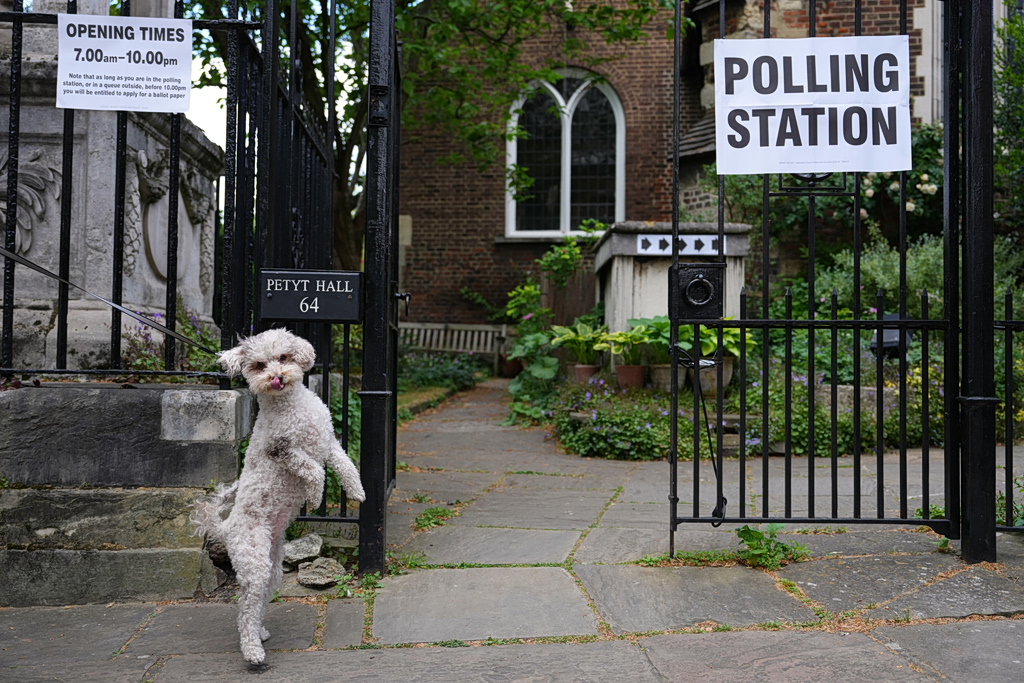
A dog jumps outside a polling station in London, Thursday, May 7, 2026 as it waits for the owner during the UK 2026 local elections.(AP Photo/Kirsty Wigglesworth)
Conflicting Testimonies at the Heart of the Scandal
A few hours earlier, the Commons had witnessed more than four hours of pointed questioning.
Two central figures in the Mandelson affair delivered sharply contrasting accounts.
Sir Philip Barton, then the most senior civil servant at the Foreign Office, described a process that was far from routine. He told MPs it was not “normal”, had been conducted under “pressure”, and that Downing Street had been “dismissive” of essential vetting procedures.
In stark contrast, Morgan McSweeney, the Prime Minister’s former chief of staff, defended the integrity of the process. He insisted the selection had been robust, that no undue pressure had been exerted on civil servants, and claimed Mandelson secured the role by concealing links to Jeffrey Epstein.
Security Concerns Add to Political Strain
The political turbulence unfolds against a backdrop of mounting national security concerns. Jonathan Hall KC, the government’s independent reviewer of terrorism legislation, warned that attacks targeting Jewish communities represent “the biggest national security emergency” in nearly a decade.
His remarks followed a stabbing incident involving two Jewish men in Golders Green, north London, which police have classified as terrorism-related.
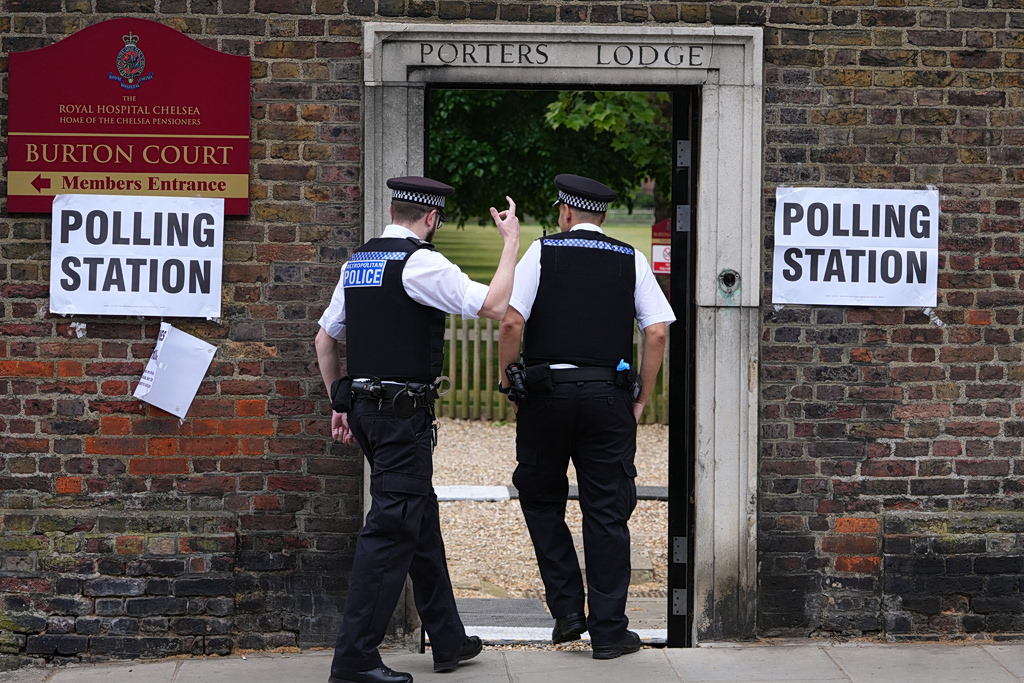
Police officers enter a polling station in London, Thursday, May 7, 2026 during the UK 2026 local elections.(AP Photo/Kirsty Wigglesworth)
Elections That Could Reshape British Politics
Attention is now turning to the ballot box. On Tuesday 7 May, millions of voters across the United Kingdom will participate in the largest set of elections since the 2024 general election.
Contests will span local councils and mayoralties in England, alongside parliamentary elections in Scotland and Wales. Early projections suggest a dramatic political shift.
Lord Robert Hayward has forecast losses of approximately 1,850 council seats for Labour – more than 75% of those it currently defends.
The Conservatives are also expected to suffer, with potential losses of around 600 seats. Reform UK and the Green Party are poised to make significant gains.
MPs speaking to TO VIMA described such outcomes as “bad news” for a Prime Minister already grappling with scandal and persistently low approval ratings.
“A Familiar Story for Greek Readers”
Speaking to TO VIMA, Professor of Political Science, University of Manchester, Robert Ford draws a striking parallel between Britain’s current political moment and Greece’s recent past:
“This will be the biggest shift in the balance of power between the parties in a British local election since the modern system of British local government or English local government was introduced in the 1960s. So, what we’re going to see, which will be quite familiar I suspect to Greek readers, is a sort of simultaneous collapse of both of the traditional governing parties that have dominated politics here for decades and the rise of radical parties on both the left and the right at the same time. So, it’s going to be a pretty remarkable set of results, I suspect.”
Ford explicitly situates Britain within a broader European pattern of political fragmentation: “Again, I think a familiar story for readers in the Mediterranean context, because it’s very much what you lived through about ten years ago.”
He warns that the Prime Minister’s position may become increasingly precarious: “It’s very difficult to preside over the worst local election results in modern history at a time when you’re the most unpopular Prime Minister in modern history and expect to emerge from that without facing some sort of serious jeopardy.”
On the government’s central challenge, Ford is unequivocal: “It promised to deliver major sweeping change but it also promised that people wouldn’t have to pay more money in taxes for that major sweeping change… you can either have major sweeping change or you can have low taxes… it is impossible to deliver on both of those promises.”
Regarding the Mandelson affair, he suggests its electoral impact may be limited: “I don’t really think it has a major impact… Keir Starmer was already extremely unpopular with voters before that scandal came in.”
Instead, he points to deeper voter discontent driving support for insurgent parties: “Frustration with what people feel is a failed status quo… steadily mounting numbers of voters are becoming frustrated and indeed just completely disaffected with the traditional status quo. And they want something different.”
A British version of mid-term elections
Professor Tony Travers from LSE Department of Government described the upcoming vote as part of a broader democratic pattern seen across advanced democracies: “These are, in effect, a sort of British version of mid-term elections, not unique to Britain. We’ve seen them in France recently, we’ll see them in the United States in November.” He said the elections amount to a wider political judgement beyond local government: “So, all countries with some local government or sub-national government peers have these elections.
“But this particular set in Britain, which consists of national parliament elections in Scotland and Wales, and then local municipality elections in many parts of particularly urban England, amounts to a sort of referendum on not just the UK government in Westminster, the Labour government, but also to some extent on the future of its leader, Sir Keir Starmer, the Prime Minister.”
Travers argues Britain is undergoing a structural political shift away from its traditional two-party system: “So, in addition to the Conservatives and Labour, we’ve now got the Greens to the left of Labour, Reform to the right of the Conservatives, the Liberal Democrats, of course, it’s a centre party in the middle. They’ve been there some time. They’re much smaller than the other two.”
He added that nationalist parties further complicate the picture: “And then, of course, in Scotland and Wales, there are nationalist parties, the Scottish National Party and Plaid Cymru.”
On the fragmentation of the vote, he said: “What we’re going to see, according to the polls, is a result where five, or in Wales and Scotland, six parties get more than 10% of the vote, which begins to look like election results in the Netherlands or Sweden or most European countries.”
Asked about the implications for the Prime Minister, Travers said the scale of losses would be decisive: “I think anything above 1,800 out of 2,500 would be, every extra one gets worse and worse and worse. I think if Labour only lost 1,500, 1,600 seats, that would be seen as okay, oddly, whereas losing more than 1,800 looks very bad”. He concluded that political consequences would depend heavily on the final result: “Everything is judged against expectations. And then the question is, if they are bad, will one of Keir Starmer’s colleagues decide enough is enough and then suggest a leadership challenge?”.
Fragmentation and Electoral Volatility
Dr Eoghan Kelly, Doctor and Post Doctoral Researcher in British Politics at Queen Mary University of London highlights the structural dynamics behind the anticipated upheaval: “the local elections coming up are being held across much of England. The general expectation here is that this is going to be quite a bad year for Labour and also possibly for the Conservatives.”
He notes diverging regional trends: “many cities, inner cities going towards the Greens, rural areas and sort of the post-industrial north going a bit more towards Reform.”
Kelly emphasises the distortive effects of the electoral system: “it’s very possible that people are going to win two-thirds majorities in councils with under a third of the vote.”
On Labour’s strategic missteps: “Not only have they not won them back, but they have also alienated a huge chunk of their own electoral base.”
He also links the Mandelson controversy to broader dissatisfaction: “it’s part of the same thing that’s driving away left-wing voters from Labour.”
The scale of potential losses is stark: “they’re looking at a position where they could lose 1,500 councillors… something like two-thirds of the ones that they have current.”
While leadership change is uncertain, pressure is expected to intensify: “it might be enough to force them to change direction and pivot maybe to the left. But we’ll see.”
A Political System in Transition
Tom Lubbock, Pollster and Co-founder of JL Partners, frames the elections as a defining moment: “This is the biggest set of elections in the UK since the General Election of 2024 and the results will answer a series of key questions in British politics.”
He points to the emergence of a fragmented, multi-party landscape: “in London we will see the move to true five party politics with the likelihood that five different parties control at least one council.”
Across the UK, longstanding political patterns appear to be breaking down: “In Wales a century of political history is going to be rewritten leaving Labour in third place at best.”
Lubbock identifies a fundamental weakness at the heart of Labour’s difficulties: “The main challenge is the lack of a well-known story to be able to tell about the direction they are taking the country.”
He adds: “they are deeply unpopular… and unable to wrest back control of a news cycle dominated by actions of the US and scandal at home.”
An Uncertain Road Ahead
As Westminster grapples with scandal, security concerns, and electoral behaviour changes, Britain appears to be entering a period of profound political realignment.
The parallels with Greece’s recent past – economic strain, voter disillusionment, and the rise of alternative political forces – are increasingly difficult to ignore.
The results on 7 May may not only determine control of councils, but also the future of the Prime Minister’s leadership – and the shape of British politics for years to come.