
 Μake us preferred on Google
 Talks between the European Parliament, EU member states, and the European Commission wrapped up on Wednesday evening without reaching any agreement on implementing the EU-US trade deal — opening a fresh cycle of uncertainty in transatlantic relations and bringing Donald Trump’s tariff threat of 25% tariffs on European cars back to the forefront.
The failure to reach a compromise is now piling pressure on Brussels. Washington’s position is that the European Union has been dragging its feet on commitments made last year at the Turnberry resort in Scotland, a golf property owned by the American president.
Six Hours of Talks, No Breakthrough
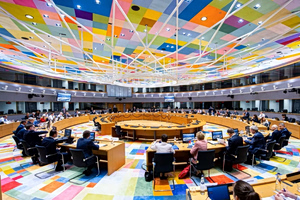
The negotiations lasted approximately six hours, with EU Trade Commissioner Maros Sefcovic urging both sides to reach an agreement that would put transatlantic trade relations on stable footing.
Despite the pressure, the talks ended without any breakthrough. MEP Karin Karlsbro of the Renew Europe political group described the discussions as “good and constructive,” while stressing that what is needed is a deal that is “Trump-proof” before any final ratification can take place.
With the talks having come up empty, the pressure is now shifting to the American side. US Ambassador to the EU Andrew Puzder warned that the 25% tariff threat on European cars could be imposed “very soon” if immediate progress is not made.
The Turnberry Deal and the EU’s Commitments
The so-called Turnberry Agreement was reached last July, during a meeting held at Donald Trump’s golf resort in Scotland. Under the terms of that political framework, the European Union committed to eliminating tariffs on American industrial goods, while the United States agreed to cap most of its tariffs at 15%.
However, the EU has yet to move forward with the legislation required to put the agreement into effect, a delay that has been a source of frustration at the White House and has increased pressure on the European Commission.
The Commission’s Director-General for Trade, Sabine Weyand, had struck an optimistic tone before the talks, saying that all the conditions were in place for Europe to demonstrate it remains a “reliable partner,” while also preserving the tools needed to respond to any potential American moves.
The European Parliament Pushes Back
Despite the Commission’s willingness, and that of several member states, to move the deal forward, significant resistance has been building inside the European Parliament.
Many MEPs argue that Trump’s recent threats against Greenland, combined with Washington’s overall posture toward Europe, make unconditional ratification of the agreement deeply problematic.
The political climate has also shifted following the U.S. Supreme Court’s decision in February to strike down the initial tariffs Trump had imposed, a ruling that emboldened voices in Europe calling for a renegotiation of the deal’s terms.
Bernd Lange, chair of the European Parliament’s International Trade Committee, has been leading the charge for tougher guarantees. Among the demands from MEPs: a clause that would freeze the agreement if the United States threatens EU territorial integrity, and a termination clause that would kick in before Trump’s term ends.
The Threat to Europe’s Auto Industry
The biggest concern remains the immediate tariff threat of 25% tariff on European car manufacturers, one of Europe’s most significant export sectors. Such a move could deal a particularly severe blow to Germany’s automotive industry, as well as to the broader European manufacturing supply chain.
Ambassador Puzder sent a blunt message to Brussels, saying that “if a deal is not a real deal, then the United States will walk away from it”, widely interpreted as a warning that Washington is ready to abandon the entire framework agreed upon in 2025.
A New Round of Talks Set for May 19
Both sides are expected to attempt another round of negotiations on May 19, although that date has not yet been officially confirmed.
The goal remains to finalize an agreement by July, when the temporary tariff suspension announced by the Trump administration is set to expire. American officials, however, are growing increasingly impatient, viewing the EU’s slow pace as a deliberate stall.
The coming weeks are expected to be critical, both for the future of transatlantic trade relations and for the stability of European industry, at a time when the global economy remains fragile and geopolitical tensions continue to intensify.