To many people both within Greece and abroad, Father Dionysios Tambakis comes across as an oddity, embodying an unexpected contradiction. He is an Orthodox priest, clothed in the traditional black cassock, who composes atmospheric music driven by electric guitars and inspired by the ancient melodies of Byzantine chant and at times ancient Greek scales and tonality.
Some of his pieces feature the voices of traditional Byzantine cantors, both male and female.
Within a span of months, his recordings—which initially were available only on his own, obscure YouTube channel—now are streamed on Spotify. A limited, vinyl edition of his album, entitled “Paradise Metal”, was released, and his songs have attracted listeners from various parts of the world.
International media attention
In no time, he has drawn the attention of major international media—including recent articles in the New York Times and the famed music magazine Pitchfork—that have sought to fathom how heavy metal and Orthodox Christianity could possibly coexist.
Yet, speaking with him, one quickly discovers that he sees no contradiction at all. His story is not about challenging tradition but about discovering how every authentic gift—even the electric guitar—can become another way of searching for God.
The first thing Father Dionysios wants you to understand is that he has never considered himself extraordinary.
He does not speak like a musician whose work has attracted an international following, nor like a priest who has unexpectedly become a cultural curiosity.
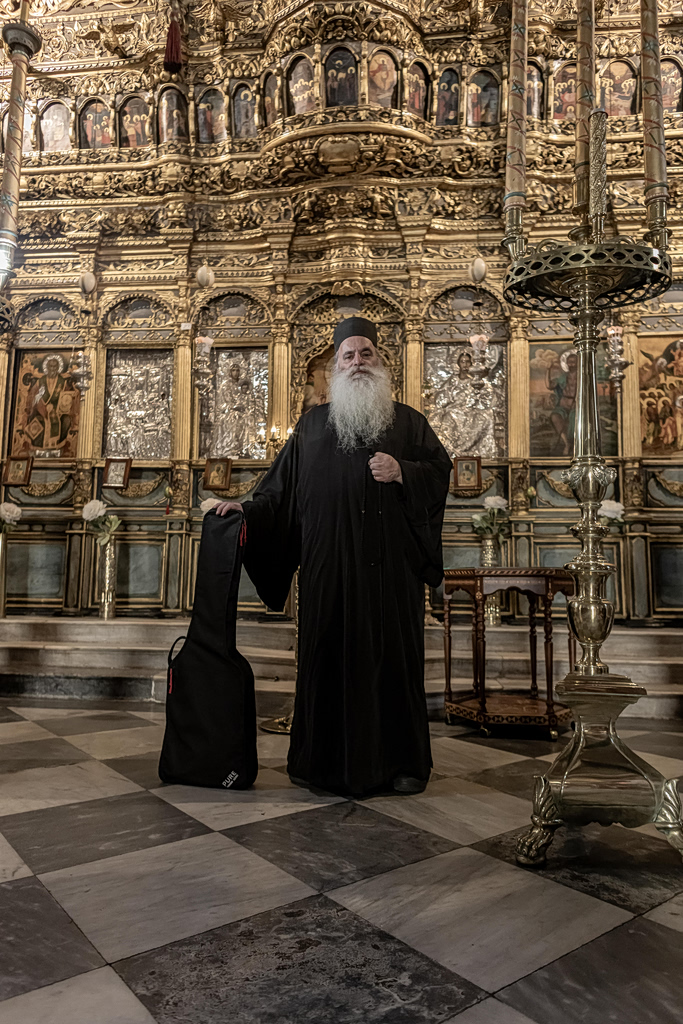
Father Dionysios with his guitar, standing in front of the altar of his Nafplio Parish of the Birth of the Virgin Mary. PHOTO BY PANAGIOTIS MOSCHANDREOU
A family man: A restless spirit behind a conservative appearance
Judging by his outward appearance, you would at first think Dionysios belongs to the most conservative, outdated brand of Orthodox clergyman. He has a full, long and unkempt beard—something like an Old Testament patriarch—and his white hair is tied at the back of his head in a bun, resembling more an Orthodox priest from the 60s and 70s than a contemporary Greek clergyman. He wears a monk’s cap rather than the more formal, rigid stovepipe kalimafhi.
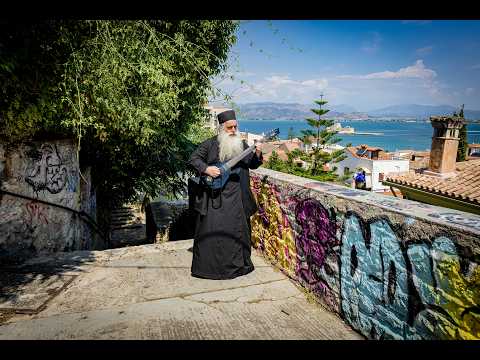
The 53-year-old father of three—between the ages of 20 and 30—is the parish priest at the Church of the Birth of the Virgin Mary, in the picturesque and historic seaside town of Nafplio, in the Peloponnese. Until now, he has made his music in his own home, but there are plans for studio recordings. His youngest son works for Hellenic Telecoms in the monastic colony of Mount Athos. His eldest, a daughter, is a psychologist.
Music as a form of prayer, a universal language
His modesty is authentic, not feigned. There is no sense of self-importance in his conversation. Instead, he returns repeatedly to the same themes—humility, gratitude, and the conviction that whatever good has emerged from his music belongs not to him, but to God.
It is perhaps this absence of conceit that makes his story so compelling.
For most observers, Father Dionysios seems almost impossible to categorize. An Orthodox priest recording contemplative heavy metal inspired by Byzantine chant appears to bridge worlds usually regarded as incompatible. Yet, he rejects the notion that he is combining opposites. For him, music has always been a universal language through which the human soul reaches toward heaven.
“Music,” he says, “is a form of prayer.”
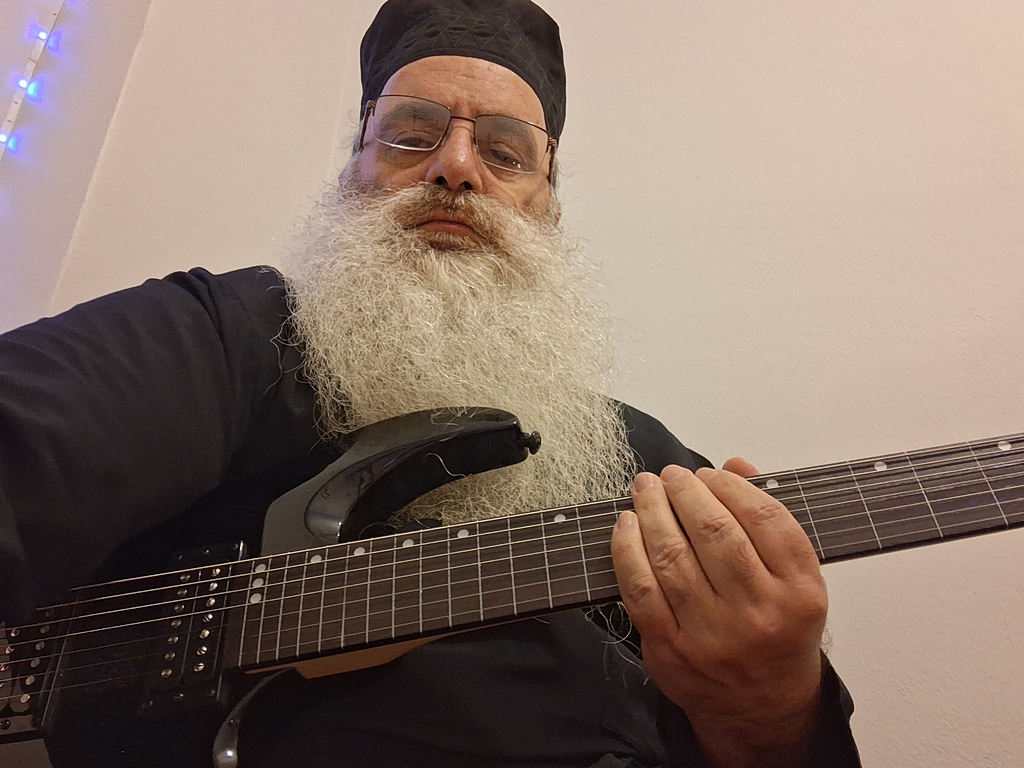
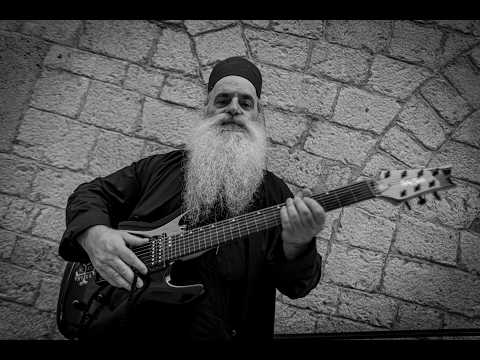
Close-up portrait of Father Dionysios. PHOTO BY PANAGIOTIS MOSCHANDREOU
Growing up in humble circumstances
“I do not come from any distinguished, illustrious, or prominent background,” he says with characteristic simplicity when asked about his upbringing.
His childhood was spent in old Kokkinia, among families shaped by poverty and the lingering memory of displacement. Many were first- and second-generation refugees from Asia Minor, who fled Turkey in the population exchange that followed the Asia Minor Catastrophe. His own family belonged to the third generation, but material wealth was still scarce. But he remembers something infinitely more valuable: the authenticity of the people there.
“They were poor but genuine people,” he recalls. “They had no reason to pretend to be anything other than who they were.”
The gift of simplicity: a poor and dignified background
His parents embodied those virtues. Neither had studied beyond primary school. His father’s family came from Smyrna, his mother from Crete, but what defined them most was not geography or education but character.
“I cannot remember them ever gossiping about anyone or deliberately harming another person.” He underlines that neither of them ever found themselves involved in legal disputes or public quarrels.
They accepted hardship with quiet dignity, concerned only with living honestly rather than comparing themselves with others. Only later did he realize how unusual that upbringing had been.
When he became priest of the historic Church of Panagitsa (Virgin Mary) in Nafplio, he found himself defending church property and navigating disputes that exposed him to jealousy, litigation, and division.
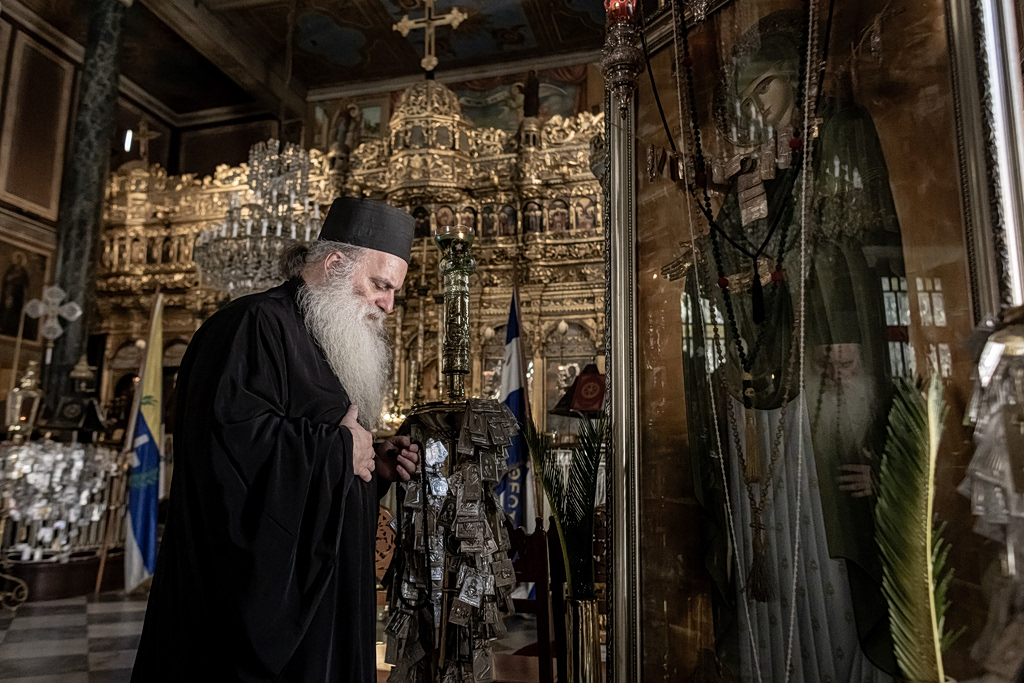
Father Dionysios praying before the icon of the Virgin Mary, at the church where he serves. PHOTO BY PANAGIOTIS MOSCHANDREOU
“It was something of a cultural shock,” he admits. “I encountered the litigiousness, division, and envy that can exist even among otherwise educated and cultivated people.”
The experience deepened rather than diminished his appreciation for the simple virtues that had shaped his childhood.
A childhood calling
His decision to become a priest was neither sudden nor dramatic. There was no conversion, no extraordinary vision, no moment of crisis.
Instead, the calling emerged naturally through the example of the priests at his home parish of Saint Nicholas in Nikaia, near Piraeus.
“They truly loved Christ,” he says. More importantly, they inspired others to love Him as well. Rather than merely teaching doctrine, they demonstrated a life centered on worship, compassion, and service. They awakened in young people a love for the altar and for helping others. Their example proved decisive.
‘Teacher, I want to become a priest’
One memory still makes him laugh.
During his first year of secondary school, his teacher asked every pupil to write an essay describing what they hoped to become as adults.
“I wrote, ‘A priest.'”
The response completely bewildered his teacher, who happened to hold strongly atheistic views. “My answer threw her into confusion,” he recalls with a smile.
He later studied at the Higher Ecclesiastical Academy of Athens in Kifissia, years he remembers as filled with hope, friendships, and dreams for the future. Looking back, however, he credits neither academic study nor intellectual argument for his vocation. It began with the quiet witness of ordinary parish priests whose lives reflected the Gospel.
An unexpected international audience

The attention that eventually surrounded Father Dionysios arrived almost by accident.
For years he quietly maintained a YouTube channel, uploading original music inspired by Byzantine chant and dedicated especially to the Virgin Mary. These recordings were acts of personal devotion rather than public performance.
At the same time, another fascination was taking shape. He found himself increasingly interested in exploring the relationship between different musical traditions. Rather than viewing genres as competing identities, he saw them as different dialects within the same universal language.
A call from Thessaloniki
Then came an unexpected message. A producer from Thessaloniki, Nikos Chatzilaskaris, contacted him despite never having met him. Hesitantly, he suggested releasing some of Father Dionysios’ recordings in England.
From there, everything changed.
The music gradually reached listeners across Europe and beyond. Reviews appeared. Journalists began calling. Before long, respected international publications had taken notice of a Greek Orthodox priest creating music unlike anything they had encountered before.
“A surprising number of Greek and international media outlets have featured me,” he says, sounding almost embarrassed, “as though I were some great and celebrated musician.”
He remains deeply uncomfortable with celebrity. He says he often left his telephone switched off, preferring obscurity to publicity.
“In Greece, it is often better not to attract too much attention,” he says, with more than a touch of suspicion toward the Greek media.
Quoting Christ’s words that, “No prophet is accepted in his own land”, he explains that fame can easily become spiritually dangerous if it distracts from one’s mission. His response has been to navigate this unfamiliar territory with “prudence, humility, and prayer.”
Music as prayer: a soul searching for God
To understand Father Dionysios’ music, one must first understand what music means to him. It is not simply performance. Nor is it mere entertainment.
“For me,” he says, “music is a form of prayer.”
Alongside what he calls “the primordial cry that rises from the depths of the human soul,” he places an instrument few would expect an Orthodox priest to celebrate: the electric guitar.
“Strange as it may sound,” he says, “the guitar—especially the fretless guitar—can express the intensity, the longing, and the cry of a soul thirsting for God.”
The very word metal, he notes, reminds him of the ancient Greek verb metallō—to seek, to search, to explore.
Whether understood linguistically or symbolically, the image captures his artistic vision perfectly.
Penetrating the heart with his guitar
“I use the electric guitar,” he says, “as a means of exploring the depths of my own heart, where the Kingdom of Heaven lies hidden.”

His own relationship with the instrument is surprisingly recent.
Only about a year before this interview, he bought an inexpensive electric guitar as an experiment. Yet the musical influences of his youth—hip-hop, breakdance, and the sounds of the 1980s—had never left him. Rather than abandoning those influences when he entered the priesthood, he wondered whether they might be brought into conversation with the ancient musical language of Byzantine worship.
The heavy metal component of his music – which he uniquely combines with Byzantine chant (he is quite a good cantor in some of his songs) and ancient Greek musical scales – is rooted in Doom Metal. Yet, presumably because the word doom does not at all jive with the salvational, teleological core of Orthodox Christianity – the Resurrection of Christ – he has “baptized” it “Paradise Metal”.
Blasting Dubai, Saudis and the Gulf potentates
While most of his songs are based on Orthodox hymnography, he has not shied away from scathing socio-political criticism and biting satire.
On this score, the song “Dubai Is Gone” is indeed explosive: “Dubai you’re finished, the party’s over. Finito, party animals.
“Rich Saudis, all petroleum magnates, the bombs are dropping like rain, the orgies are over and the public square has emptied, take your toy pail and go to another beach [a Greek phrase for get lost].
“Dubai, contemporary Babel, the Gomorra of the rich, for you, bankruptcy is golden, and it is drawing near.
“Mullahs and sheiks living in opulence, with a soul blackened by filth and bitterness, your life of gorging has dried up, your [oil] deposits from Hades were taken and scattered by a Persian ship…”
Birds of the forest sing with different voices at once
Too often, he argues, musicians retreat into opposing camps. Traditionalists dismiss contemporary sounds as inherently suspect, while progressives regard Byzantine music as hopelessly outdated. He believes both attitudes impoverish music itself. “They complement one another beautifully.”
“If the only birds allowed to sing in the forest were the ones whose songs we personally preferred, the forest would become a dull and lifeless place.”
Heavy metal was created by God
Perhaps no phrase better captures Father Dionysios’ outlook than his startling declaration that “heavy metal was created by God.”
He immediately explains what he means.
Heavy metal, he insists, is not a single ideology, but a broad musical tradition encompassing many different expressions. Some undoubtedly embrace darkness or anti-religious themes. Others do not.
“A knife,” he says, “can be used for good or for evil.”
What first attracted him to heavy metal was not rebellion for its own sake but the extraordinary expression and power of the electric guitar. Its commanding presence could communicate longing, struggle, hope, and transcendence with unusual intensity.
For many years, he says, people assumed heavy metal was inherently diabolical. He rejects that assumption entirely. “The devil cannot create anything truly worthwhile. Only God, the Creator, can do that.” The electric guitar itself, he argues, is a gift born from human creativity—a creativity ultimately grounded in God.
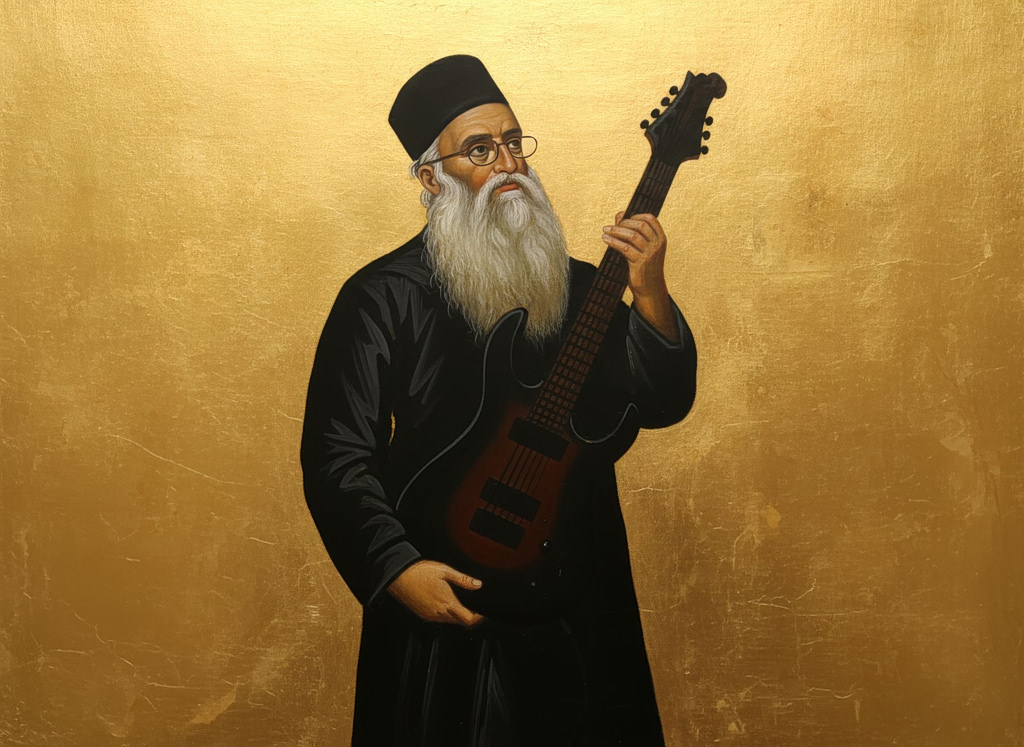
Portrait of Father Dionysios, painted with the technique of Byzantine iconography, from this archives.
“If the Evil One [the devil] chooses to appropriate one of God’s gifts for darkness,” he says, “while we refuse to use that same gift for good, that is deeply disappointing.”
His aim is therefore not to imitate secular heavy metal but to redeem its expressive possibilities.
Sui Generis: beyond labels
Listeners often describe Father Dionysios’ work as Doom Metal because of its slow tempos, resonant guitar tones, and contemplative atmosphere.
Doom Metal is a slow tempo genre of heavy metal. It has two sides to it: Religious content on the one hand and the sorrowful, melancholic, depressive heartache elements on the other.
Many doom bands – like Black Sabbath, Candlemass, and Cathedral deal with religion and some sorrowful things. These bands quite often wear Christian Crosses, whether they are actually religious or just for show.
Father Dionysios accepts the influence of Doom Metal on his music but he is careful to underline that the comparison hardly tells the whole story.
His music, he says, cannot really be confined within labels.
It draws instead upon the modal traditions of Ancient Greek and Byzantine music, creating something simultaneously ancient and new.
One piece is entitled “Hymn of Euripides” (from 480 BC) which he has set to music and reads, while the video shows the Trojan Horse moving..
If conventional doom metal often explores occult symbolism or haunted landscapes, his music seeks prayerful contemplation. The resemblance lies only in atmosphere.
“As a priest,” he says, “I draw my inspiration from the Divine Liturgy. The Liturgy transcends both time and place; it moves within eternity. I want my music to inhabit that same beautiful, timeless, and metaphysical atmosphere.”
A gentle mission
For all the attention his music has received, Father Dionysios repeatedly returns to his own single truth.
“For me, Christ is everything.” Yet, he notes, because Christ never forces Himself upon anyone, neither should Christians.
His music therefore avoids aggressive preaching or overt proselytism. Instead, he hopes simply to create beauty and allow God to work quietly within each listener.
“I try to maintain a holy gentleness and kindness,” he says, “without aggressive, propagandistic, or intrusive tones.”
His audience reflects that subtleness. It includes Orthodox Christians, Catholics, Protestants, Jews, Muslims, and atheists. He recalls, with obvious delight, receiving a congratulatory message from a rabbi.
“We love them all,” he says. “If, through the musical phrases we compose, their souls receive joy and hope, then that is enough. There is no greater happiness than helping another human being breathe a little more freely.”
Christ’s little donkey
One final question remains. How does Father Dionysios perceive and handle all the attention now focused upon him? To answer, he turns to the Gospel.
“When Christ entered Jerusalem, crowds spread garments and palm branches before Him. Yet another participant, however, shared in that joyful procession. The little donkey.”
“The little donkey,” Father Dionysios says, “shared in some of the glory and honor. Not because anyone admired the animal itself, but because it carried Christ.”
“I am happy and honored,” he continues, “to feel that I am Christ’s little donkey, upon whom hope, joy, and the Good News are proclaimed through the music we are striving to bring forth.”