 Μake us preferred on Google
As Israelis prepare to vote on October 27, the country faces an election that could bring Benjamin Netanyahu’s long tenure to an end without necessarily producing a clear governing majority. Three years after the October 7 attacks, amid the devastating war in Gaza and a shifting regional security landscape, the vote raises questions extending well beyond Israel’s political leadership: from the resilience of its democratic institutions and divisions within Israeli society to its strategic relationship with the United States.
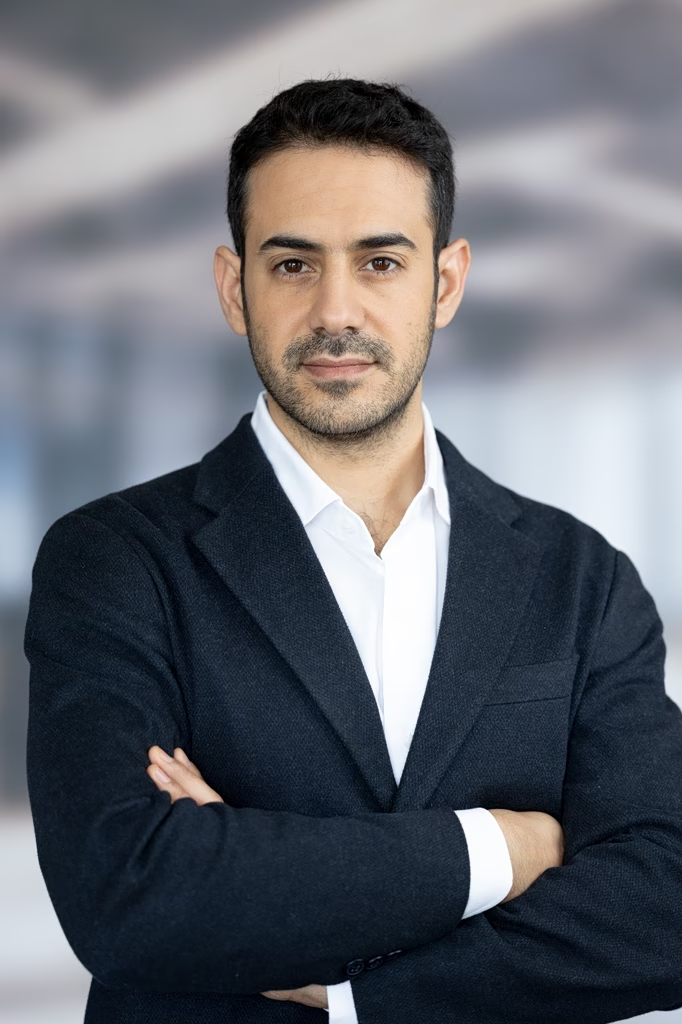
Gadi Ezra, who served as Director of Israel’s National Public Diplomacy Unit in the Prime Minister’s Office under Naftali Bennett and Yair Lapid, offers a perspective informed by his experience in government, international law and the military. A veteran of an elite IDF paratrooper unit, he served in Gaza during the 2008–09 conflict, an experience he wrote about in his first book, “11 Days in Gaza.” He then returned to combat reserve duty following the October 7 massacre in 2023. A strategist, global speaker, regular panelist on Israeli TV, columnist for Yedioth Ahronot, and contributor to international publications including TIME, Ezra ranked first on The Jerusalem Post’s 2026 list recognizing a new generation of Israeli leaders and thinkers. In an interview with To Vima International Edition, he examines the electoral arithmetic, the alliances that could determine Israel’s next government and a question that extends beyond the ballot box: whether a change in leadership would also mark a change in the country’s political direction.
1) Polls suggest that Tuesday’s election may produce neither a clear winner nor a workable majority. With Gadi Eisenkot challenging Netanyahu, Naftali Bennett and Yair Lapid running together, and Arab parties potentially holding the balance of power, could you walk us through the most plausible coalition scenarios?
Let me begin with a little background, because it explains everything that follows. Contrary to what many assume, Israelis don’t elect a government. They elect a parliament, called the “Knesset” in Hebrew. Once the results are in, the President of the State consults with every party that won seats, and each recommends a Member of Knesset to form the government. The member entrusted with the task has 28 days, which the President can extend by up to 14 more days, to present a government to the Knesset for a vote of confidence.
The Knesset has 120 seats, so every coalition wants 61: an absolute majority that gives it control of the national agenda, legislation, and the initiatives the coalition cares about. But 61 is the ideal, not the legal threshold. A government can be sworn in by a simple majority of those voting – 57 against 52, say, with the rest abstaining. For example, the government formed in 2021 was approved by a vote of 60 to 59, with one abstention. Israel has also had minority governments, which governed with the outside support of parties that never formally joined the government.
Now to the question itself. According to the latest polls, neither side has a majority. The bloc of parties committed to backing Netanyahu for forming a government has fewer than 60 seats. The bloc that wants to replace him does pass 61 in the polls – but a majority in a poll is not a coalition. It lacks internal consensus and, so far, the willingness to sit together. Some of its parties have already said they will not form a government that relies on the votes of parties that want Netanyahu replaced but are not Zionist, such as the Arab parties. At the same time, Eisenkot has declared that he will not sit in the same government as Netanyahu, which, in theory at least, takes a unity government off the agenda. And then there are parties running on an explicit platform of uniting across the blocs, precisely to break this divide.
So, the possibilities are many. Forming a government in Israel blends political skill, game theory, ideology, and compromise. One thing is certain: the days ahead will be very tense.

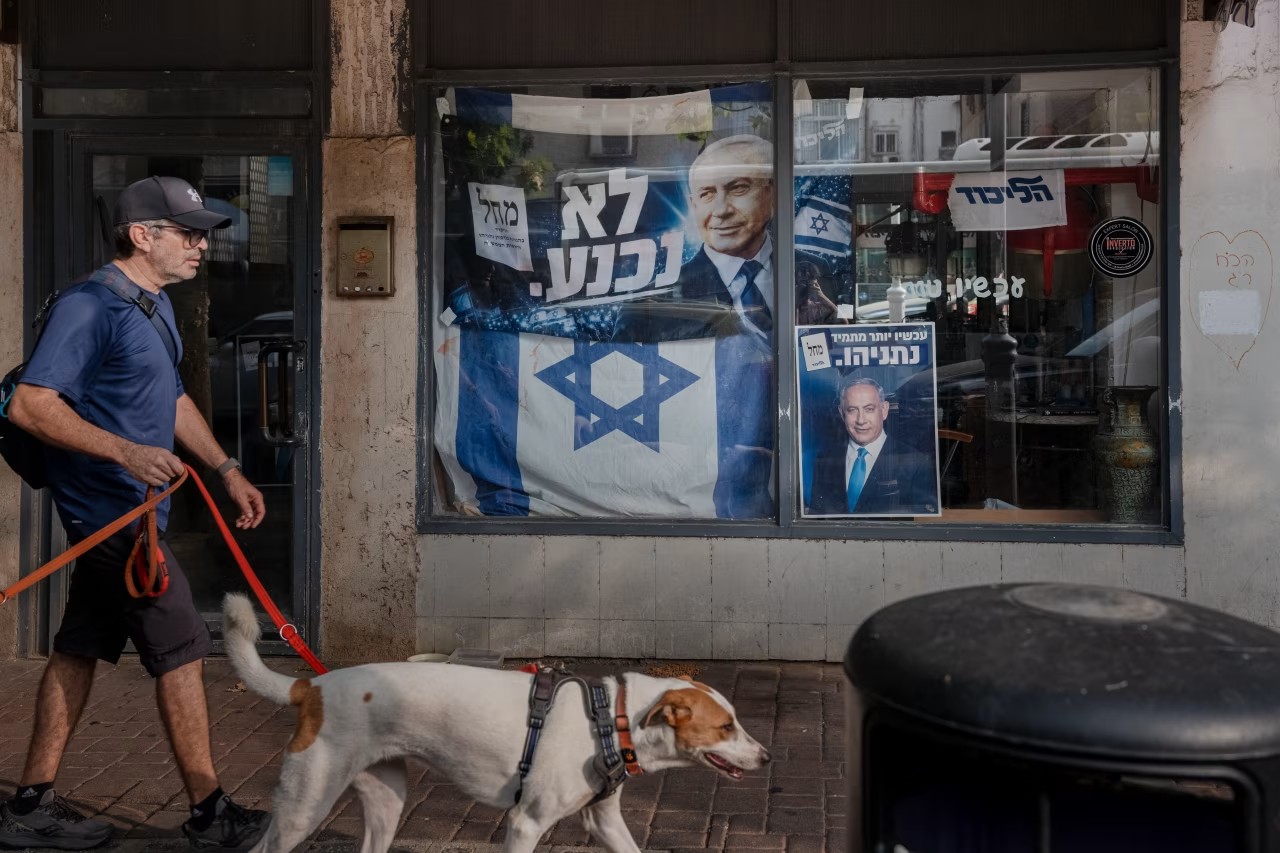
A supporter of Israeli Prime Minister Benjamin Netanyahu, leader of the Likud party, displays a flag depicting him at Mahane Yehuda market, ahead of Israel’s national election, in Jerusalem, October 22, 2026. REUTERS/Kevin Coombs
2) This is Israel’s first general election since the October 7 attacks, and the question of responsibility for the security failures of that day remains unresolved. Netanyahu’s opponents have called for an independent state commission of inquiry, while he has resisted the proposed process. Why has it become so politically divisive to investigate what went wrong on October 7?
The first thing to understand is that the failure of October 7 did not begin on October 7. Beyond that morning’s security failure, there was a conceptual one: the belief that Hamas could be contained. As a result, Israel permitted the transfer of hundreds of millions of dollars into Gaza, in the hope that the money would help rebuild it. Hamas, which ruled Gaza, used those resources to build the terror infrastructure, including an entire brainwashing and incitement system, that struck us that day. The failure belonged to the military and political echelons alike, and it stretches back many years.
Now, Israel’s principal legal instrument for examining questions of this magnitude is the state commission of inquiry. A government decision normally establishes such a commission, but the President of the Supreme Court appoints its members, and it has considerable powers: it can compel testimony and order the production of documents. Since the law creating them passed in 1968, governments of the left and the right alike have established twenty such commissions, and for most of that history they have been instruments of broad consensus. According to the most recent poll by Channel 12, Israel’s most-watched news channel, conducted in early October, 66% of Israelis support establishing such a commission, 21% oppose it, and 13% are undecided.
Broadly speaking, the commission’s opponents argue that the courts have become political, and that any commission appointed by the judiciary will therefore be biased. Its supporters reply that this is the State of Israel’s official instrument for exactly such moments, that no one had a problem with it until now, and that the charge of politicization is an attempt to evade the truth. In this sense, all opposition parties say that if they form a coalition, their first decision will be to establish such a committee.
What is important to understand is that for many Israelis, this is not only about establishing the truth and making sure it never happens again. There is a deeper layer here – of healing, and of closure with the greatest trauma in the history of the State of Israel. As long as we do not fully know what happened there, the wound stays open.

A woman holds a placard as Israelis from a “Flight for Change” flight from San Francisco arrive at Ben Gurion International Airport, in order to vote in Israel’s national election, in Lod, Israel, October 26, 2026. REUTERS/Amir Cohen
3) Your book, 11 Days in Gaza, recounts your experience as a young reservist during Israel’s 2008–09 military operation in Gaza. Fifteen years later, following October 7, you found yourself back in uniform, this time as a husband and father. How did returning to Gaza change your understanding of the conflict, and what did the soldier of 2023 understand that the young man of 2009 could not?
A great deal has changed, and a great deal has not.
At the national level, Israelis are more clear-eyed. We understood that there is no solution short of eliminating Hamas and de-radicalizing Gaza’s education system. One cannot live alongside an entity whose declared purpose is to destroy you. And we understood that when they say they want to annihilate us, they mean it and are prepared to carry out the most horrific acts imaginable. If you compare the size of populations between Israel and Greece, it’s like more than 1,200 Greeks were brutally murdered in one day, and more than 250 were kidnapped, among them women, children, and the elderly.
What has not changed is the high standard Israel holds itself to in combat. We are the target of a propaganda campaign designed to portray us as a state committing genocide. This accusation, however, is baseless, not only because the data show that no genocide is taking place in Gaza, but because our methods of warfare are the most precise in the Western world. I say this with confidence, not only as a reservist in an elite unit but as someone who holds three law degrees, with a specialization in international law. No army in the world contends with combat as complex as the IDF does, in dense urban areas, against an enemy that hides behind its own population, and none operates with greater precision. The reason, incidentally, is that unlike our enemies, we understand our goal is to return to civilian life, live prosperous lives, and build a country we can be proud of. In other words, like the Greeks, we love life. That is our secret, and the foundation of our entire high-tech industry. We cherish life, and we want to make it better – for ourselves, and for all our friends.
At the personal level, there is a difference between fighting at 22, with few commitments in life, and fighting at nearly 40, with a family and a full career. 11 Days in Gaza was written to show that war is not only heroism and danger. It is also sadness, boredom, and anxiety; a full spectrum of emotions and sensations that live in the spaces in between. The book was published in Israel two years ago and in the United States last month and is now being adapted into a movie. I very much hope it reaches Greek readers, who are very close to my heart.

4) Across Europe, citizens have recently taken to the streets over economic insecurity, declining public services and the war in Gaza. In Israel, protests have centred on the failures of October 7, political accountability and national security. Yet the debate over security also raises deeper questions about trust in state institutions and the obligations of citizenship, particularly as ultra-Orthodox exemptions from military service have become a major political fault line. Beyond the immediate question of who governs, what are the principal concerns and social issues shaping the vote of ordinary Israelis?
There is a cliché in Israel that every election is the most fateful in the country’s history. The trouble with clichés is that they contain a kernel of truth. This election is truly dramatic, and there is no shortage of issues troubling Israelis. If I had to generalize, I would point to three.
The first is the investigation of the October 7 massacre, which we have already discussed: the pursuit of truth and repair, and the dispute over the right way to pursue them.
The second is whether to continue or halt the judicial reforms that began under the outgoing government before October 7. Supporters argue that the judiciary and the government’s legal advisers do not allow Israeli governments to govern, and that these changes are essential if Israel is to meet the challenges of the coming years. Opponents argue that this is not a healthy reform but rather a trampling of the system – especially in a country with no constitution and no settled constitutional culture – and that it weakened Israeli society in the run-up to October 7.
The third is conscripting the ultra-Orthodox into the army. This may sound strange to a non-Israeli audience, but not all Jews in Israel believe in military service; some prefer to devote their lives to Torah study. The state has funded that way of life for many years. Since October 7, many parties have declared that it will end. The reasons are partly practical: the army needs the manpower to meet its ongoing missions, and partly a matter of principle: all citizens are equal, and no one should risk his life while another sits and studies. Incidentally, the same point applies to Israel’s Arab population, the overwhelming majority of which also does not serve. Israel offers alternatives for those who do not enlist, such as national or civilian service, and many argue that everyone should serve the state: if you cannot serve in uniform because of a particular sensitivity, you can serve in a hospital or elsewhere. In the end, this is a question of ethos, of a country’s DNA, and Israelis are asking themselves what kind of country we will be in the decades ahead: one where everyone serves the state, or one with exemptions.
Beneath these three political questions lies a fourth that Israelis share with Greeks and with every other electorate: the economy. Greeks tend to meet Israelis on holiday, in Rhodes, in Crete, in Athens, at our most relaxed and most generous, and from a distance Israel looks like a prosperous country, which, on paper, it is. But daily life here is expensive. In its 2025 survey of Israel, the OECD ranked us fourth among its 38 members for the cost of a comparable basket of goods and services. The average gross salary, according to our Central Bureau of Statistics, is a little over 14,500 shekels a month, roughly €4,000 at today’s exchange rate, but a high-tech sector pulls that average up, with an average salary of 34,000 shekels; most Israelis earn well below it. Add three years in which hundreds of thousands of reservists have spent months away from their jobs, their families and their small businesses, and you understand why household finances are on every voter’s mind.
Two structural facts make the economy inseparable from the questions above. The first is that high-tech is the locomotive of the entire economy: fewer than one in ten Israeli workers is employed in it, yet it produces about 58% of our exports; it accounted for half of our growth last year, and its employees pay roughly a third of all income tax on wages. The second is that only 53% of ultra-Orthodox men are employed – against 81% of ultra-Orthodox women, who have in effect become their community’s breadwinners – in a community that already makes up 14% of the population and is growing faster than any other. So, the debate over military service is also a debate over the economy, and the question an ordinary Israeli family asks on its way to the polls is simple: who serves, who works, and who pays. In Israel, those are not three debates but one.

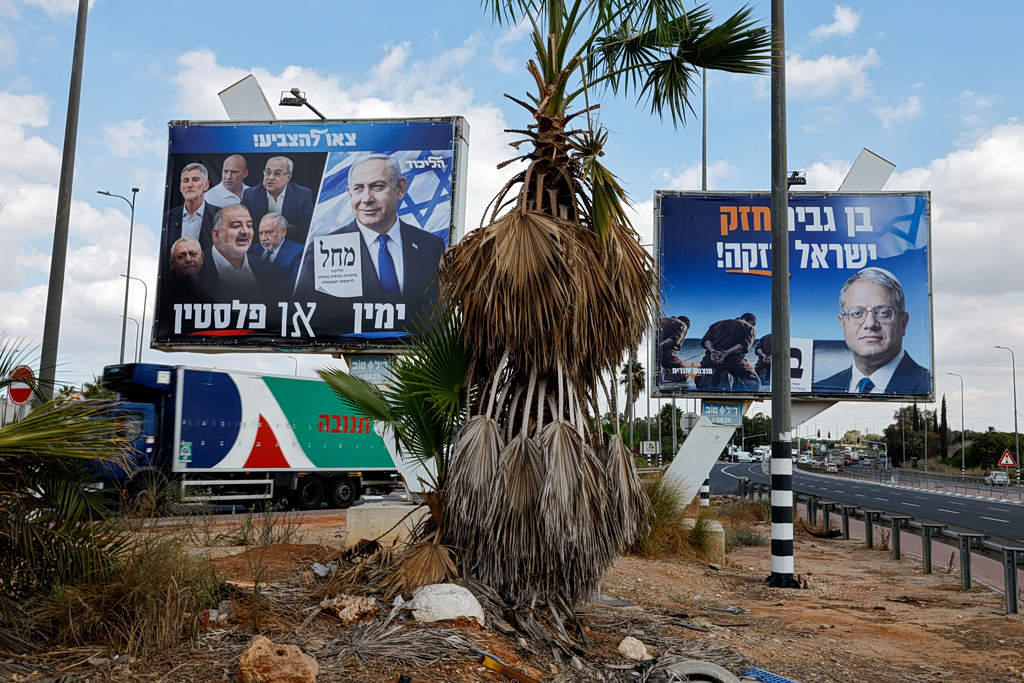
People walk past campaign posters featuring images of Israel’s far-right National Security Minister Itamar Ben-Gvir, ahead of the Israeli parliamentary election, in Bnei Brak, Israel, October 25, 2026. The poster reads ‘Ben Gvir is strong, Israel is strong”. REUTERS/Nir Elias
5) Before October 7, hundreds of thousands of Israelis took to the streets to protest Netanyahu’s plans to give politicians greater control over the appointment of judges and limit the Supreme Court’s ability to challenge government decisions. Critics warned that the reforms would weaken democracy, while supporters argued that elected politicians should have greater authority. How central is the dispute over judicial independence to the upcoming vote?
Israel has no constitution. Instead, the Knesset passed a series of “Basic Laws” throughout the years, meant to become its chapters one day, and in the 1990s the Supreme Court ruled it could strike down ordinary legislation that contradicted them. Israel also has a single-chamber parliament, no upper house, and no presidential veto, and the government, by definition, commands a majority in the Knesset. In practice, therefore, the Supreme Court is the only institution that can tell an Israeli government “no” – which is why whoever defines the powers of that court defines the limits of government in Israel.
In January 2023, Justice Minister Yariv Levin presented a package of changes, and three examples capture it. The first concerned how judges are chosen. Israeli judges are selected by a nine-member committee of justices, ministers, members of Knesset, and representatives of the Bar, in which no camp holds a majority; the plan would have given the governing coalition control. The second was an “override clause”: if the Court struck down a law, the Knesset could re-enact it by a simple majority of 61. The third was the abolition of the “reasonableness” standard, a doctrine that allows the Court to annul government decisions – a ministerial appointment, say – that it finds extremely unreasonable.
Supporters argued that no other democracy lets sitting judges hold an effective veto over the choice of their successors; that a court which strikes down laws without a constitution, and annuls decisions merely for being “unreasonable,” has taken powers no one ever granted it; and that the correction must come from the elected Knesset. Opponents argued that in a country with no constitution and no other check, a coalition that controls judicial appointments and can override rulings with 61 votes is a coalition without limits, and that the rights of every minority and every individual would then depend on the goodwill of a passing majority. Both sides claimed to be defending democracy: one its majoritarian meaning, the other its liberal one. What followed was the largest protest movement in Israel’s history – hundreds of thousands of Israelis in the streets, week after week, for the better part of a year. Only one element of the package was enacted, the abolition of the reasonableness standard, and the Supreme Court struck it down in January 2024. After October 7, the rest was frozen, but the dispute did not go away.
It is now back on the ballot: the next Knesset will decide whether to complete or repeal the overhaul and will fill four of the fifteen Supreme Court seats that currently stand empty. You asked for my view as a lawyer, and it is modest. Serious jurists on both sides agree that Israel’s constitutional arrangements need clarification; a system in which the balance of power rests on precedent and custom rather than written rules serves no one well. The real disagreement is less about whether than about how. Every democracy that has done this well has changed the rules of the game by broad agreement, not by whichever side happened to hold 61 seats that year. If 2023 taught us anything, it is that one team cannot reform the referee.
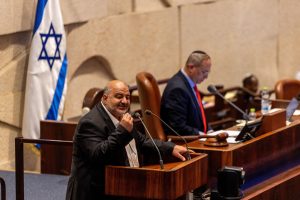
Mansour Abbas, leader of the Ra’am party, speaks at the plenum at the Knesset, Israel’s parliament, in Jerusalem, July 13, 2026. REUTERS/Ronen Zvulun
6) The opposition is reportedly preparing to challenge Knesset Speaker Amir Ohana’s position immediately after the election, potentially with the support of Arab lawmakers, even before a new government is formed. Why has control of the Speaker’s office become so strategically important?
This is a central issue, and many Israelis overlook it. Forming a government can take many weeks, as I already described. By contrast, replacing the Speaker of the Knesset will probably be the fastest move we see, provided a majority supports it.
The reason is that the Speaker is one of the most powerful figures in Israeli politics. He heads one of the three branches of government, alongside the executive and the judiciary, and that position gives him control of the Knesset’s agenda: which bills come to a vote, which issues fill the news cycle, which coalition initiatives move forward, and which opposition initiatives are held up. In purely constitutional terms, the Knesset is supposed to oversee the government, but in practice the opposite happens: because an Israeli government usually enjoys a built-in majority in the Knesset, the government steers the Knesset. The identity of the Speaker helps make that possible.
And there is a psychological dimension. A new Speaker tells Israelis that a new era has begun. So, if the opposition parties command a majority, it is reasonable to expect that replacing the Speaker will be among their very first moves – probably even before a government is formed.
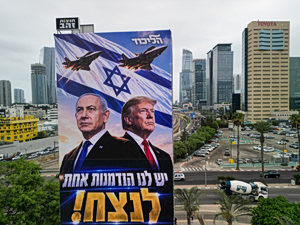
A drone view of an election campaign display for Israeli Prime Minister Benjamin Netanyahu’s Likud party, depicting Netanyahu and US President Donald Trump with the words in Hebrew “we have one opportunity to win!”, the day before Israel’s national election, in Tel Aviv, Israel, October 26, 2026. REUTERS/Amir Cohen
7) You have written extensively on how Israel is increasingly losing the support of younger Americans, even as relations between Netanyahu and Trump remain exceptionally close. What should a new Israeli government do to address this growing divide and redefine the relationship with Washington?
Let me begin with the premise, because everything else follows from it. Israel’s relationship with the United States is not one alliance among many; it is deeply strategic. America provides Israel with a diplomatic umbrella – above all, its veto at the UN Security Council, which it has used dozens of times on Israel’s behalf – and a security umbrella: roughly $3.8 billion a year in military assistance under the current ten-year agreement, joint defence programs, intelligence cooperation and, when it mattered most, American forces helping to defend our skies. Every Israeli government, of every political colour, has treated this relationship as one of the foundations on which the country’s security rests.
That is precisely why the trends beneath the surface worry me, and why the warmth between the Prime Minister and President Trump should not be mistaken for the relationship’s health. Three problems stand out.
The first is that Israel has become a partisan issue in America, which it never used to be. For decades, support for Israel was one of the few things Democrats and Republicans agreed on. Today, according to Gallup’s annual survey this February, 70% of Republicans sympathize more with the Israelis while 65% of Democrats sympathize more with the Palestinians – and for the first time since Gallup began asking the question, Americans as a whole lean, narrowly and within the margin of error, toward the Palestinians. Pew found in March that 60% of Americans hold an unfavourable view of Israel, up from 42% four years earlier. Israel cannot afford to belong to one party, because in America, sooner or later, the other party governs.
The second is generational, and here the figures are hard for an Israeli to read aloud. In a Harvard-Harris poll this July, American voters were asked whether they supported Israel or Hamas – an organization that murdered, raped, and kidnapped civilians on October 7, and that the United States itself has designated a terrorist organization for nearly thirty years. Among all voters, 73% chose Israel. Among voters aged 18 to 24, 60% chose Hamas. These are the voters, donors, officers, and members of Congress of 2040.
The third, and for me the most painful, is the distance opening between Israel and American Jews, the community that has stood behind Israel longer and more faithfully than any other. A survey released this year by the Jewish Federations of North America found that among Jewish Americans aged 18 to 34, only 57% feel an emotional attachment to Israel, compared with 88% of those over 75, and that nearly a third describe themselves as non-Zionist or anti-Zionist.
What should a new government do? Above all, treat this as a strategic problem rather than a communications problem. Israel needs a national plan, led from the Prime Minister’s Office and resourced like the security priority it is, for rebuilding its standing in America over the next decade: with both parties and not one; on campuses and in state legislatures; in churches and synagogues; and in the technology and business communities where Israel has its most natural partners and highly demonstrates its value. It needs to return to the bipartisan discipline that served it for seventy years, so that an Israeli prime minister is as welcome, and as careful, in a Democratic White House as in a Republican one. And it needs to remember another thing: in the age of the smartphone, how Israel fights and how its leaders speak are not separate from its national security; they are part of it.
The United States is not a bank from which Israel withdraws support. It is a relationship between two peoples, and relationships must be tended. Because this alliance is irreplaceable, it cannot be left to drift.