 Μake us preferred on Google
The rent was suspiciously low for such a spacious home in Athens. Athenodorus wanted to know why.
Its previous occupants had reportedly endured sleepless nights, disturbed by clanking chains and an elderly apparition. Eventually, the living moved out and the house was left vacant.
The ancient philosopher rented it anyway.
Writing in the early second century AD, the Roman author, lawyer and public official Pliny the Younger recorded Athenodorus’ tale in a letter to his friend Sura. His question was simple: did ghosts really exist, or were they creations of frightened minds?
Preserved in Book 7, Letter 27 of his collected Letters, Pliny relates what has come to be one of antiquity’s enduring haunted-house stories.
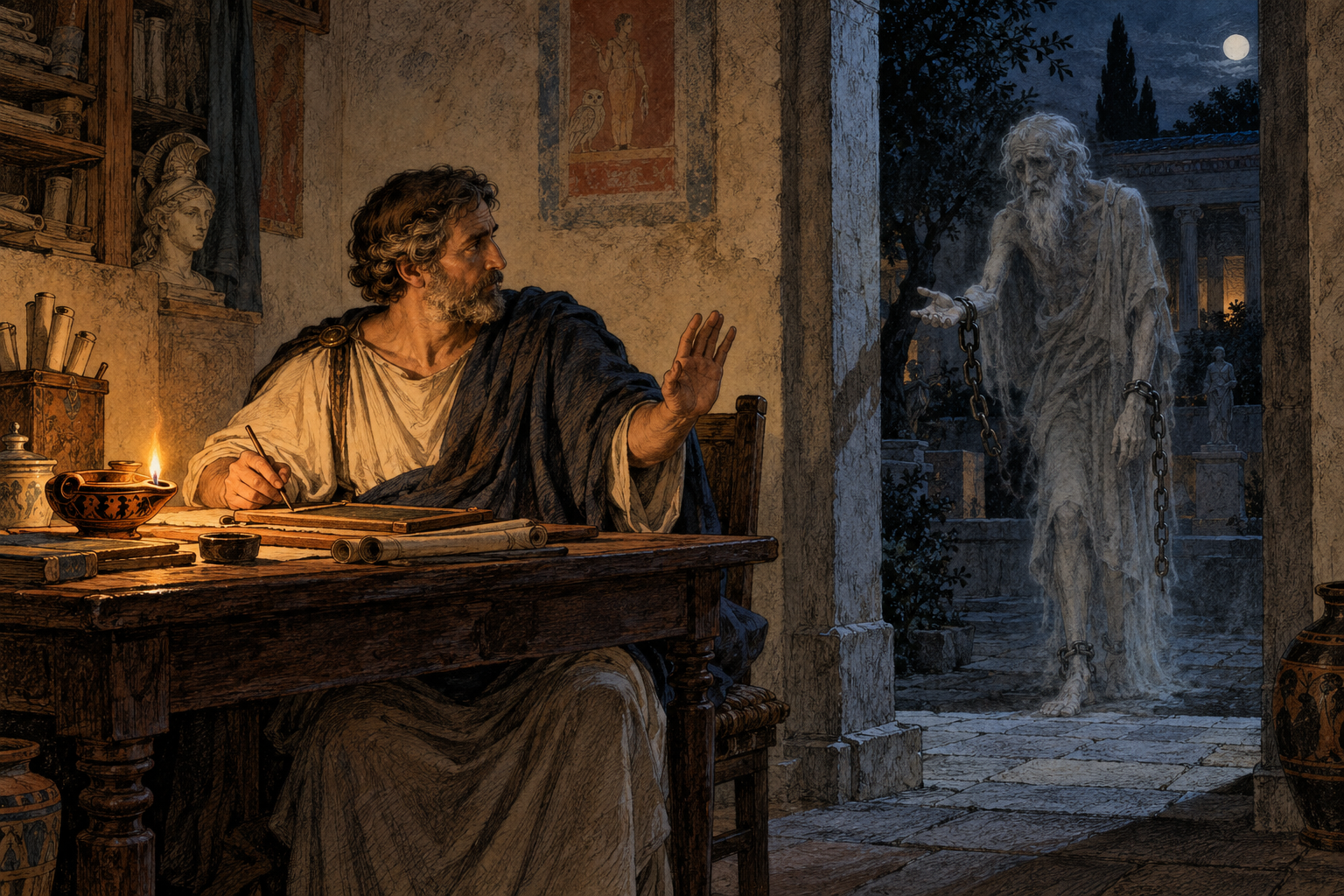
One night, Athenodorus settled down with writing materials and a lamp, keeping his attention on his work rather than allowing his imagination to wander. When the apparition appeared, he was not immediately inclined to follow.
“Athenodorus made a sign with his hand that it should wait a little, and bent again to his writing,” the English translation reads. But the ghost persisted, rattling its chains above his head. Eventually, the philosopher picked up his lamp and followed it.
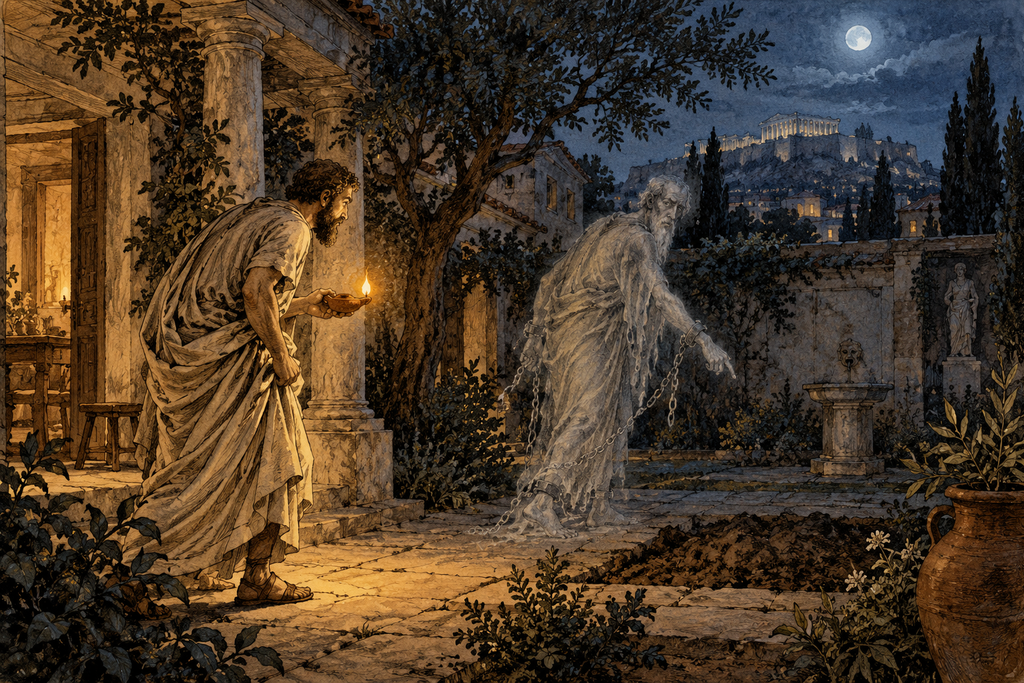
Athenodorus follows the ghost into the yard. Image generated by AI.
The figure led him into the courtyard, where it vanished. Athenodorus marked the spot with a handful of grass and leaves. The next day, excavation uncovered human bones entangled in chains. After the remains received a public burial, the haunting ceased.
The surviving text is real, but the encounter cannot be verified, nor can the house be located today.
Yet Pliny’s story offers an entrance into an Athens beyond the familiar routes between the Acropolis and the souvenir shops: a city mapped through whispered warnings, mysterious buildings and places where the past refuses to remain quiet.
What the Dead Asks of the Living
Ghosts were already an old idea when Pliny wrote.
Ancient Mesopotamian texts describe spirits that retained something of their human nature after death, including hunger and thirst, creating a need for attention and care from living relatives. Neglected offerings or improper burial could leave them restless and troublesome.
Ancient Greek literature also relates the obligation of the living to provide a certain level of care for the dead. In Book 11 of Homer’s Odyssey, Odysseus summons the dead while seeking guidance from the prophet Tiresias. The first spirit to approach is his companion Elpenor, whose body has been left unburied on Circe’s island.
His request is painfully human: return, perform his funeral rites and raise a mound with his oar planted above it, so that future travelers will remember him.
Other ancient traditions offer up familiar scenery: dark waters, waiting souls and Charon, the ferryman. The Styx is the best-known river of the underworld, although accounts also associate Charon with the Acheron. In Virgil’s Aeneid, the unburied wait on the bank, denied passage until their remains are laid to rest—or a hundred years have passed.
The details vary, but burial repeatedly matters. In Pliny’s Athens, too, the disturbance ends only when someone attends to the forgotten dead.
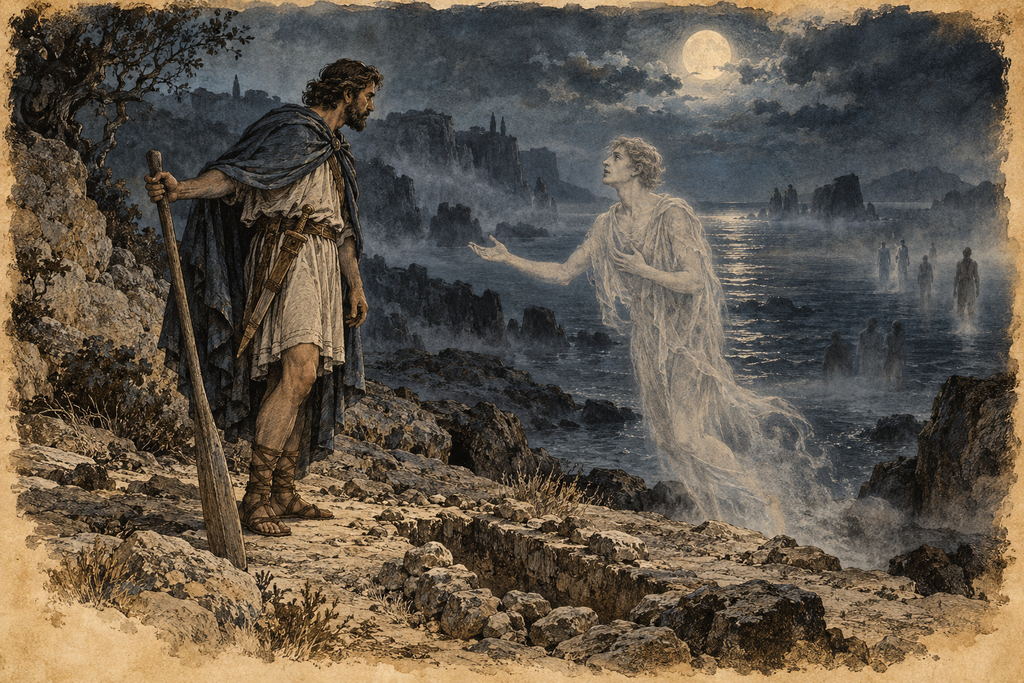
Odysseus encounters the shade of Elpenor, who asks his companion to return and give him a proper burial. Image generated by AI.
The Duchess in White
Centuries later, another bereavement would become part of the region’s ghost lore.
On Mount Penteli, northeast of central Athens and famous for the marble used to build the Parthenon, the legends gather around the Duchess of Plaisance, known in Greece as the Duchess of Plakentia.
Her daughter Eliza died during a journey to Beirut in the 1830s. The duchess had her body embalmed and returned with it to Athens, keeping the remains in her house on Pireos Street, which she intended to bury in a church she wanted to build on Mount Penteli.
In 1847, fire destroyed the house and the embalmed body. An account preserved in the diary of Christiane Lüth describes the duchess pleading for someone to rescue her daughter’s remains. But nobody dared enter the basement.
Later folklore transformed that loss into a haunting: a white-clad woman wandering near her Penteli residence, still searching for her daughter. The death and fire belong to historical record, while the restless apparition belongs to the legend.
Her Rododafni Castle has a more tangible biography. According to Penteli municipality, it remained uninhabited and ruined for more than a century after her death in 1854. Restoration began in 1959; the building subsequently served as a royal summer residence and later became a municipal cultural venue.
Another legend links the duchess to Davelis, a notorious nineteenth-century bandit whose real name was Christos Natsios. It imagines a romance and a secret passage connecting her castle to the nearby cave now known by his nickname.
Penteli municipality identifies the affair as a myth and reports that, despite seraching, they never found the legendary connecting tunnel.
A Cave of Mysteries
The supposed tunnel to the duchess’s castle is only one of the stories surrounding Davelis Cave. Other accounts describe voices coming from the darkness and electronic equipment behaving strangely—claims that remain unverified.
Other “mysteries” and unusual incidents have helped sustain its reputation. Penteli municipality records repeated construction and excavation work in the late twentieth century, including an attempt to resume work in August 1990 that stopped following press opposition.
Its account notes the cave’s association with rumors of mystical ceremonies. Meanwhile, other sources cite the inexplicable discovery of dead animals in the area.
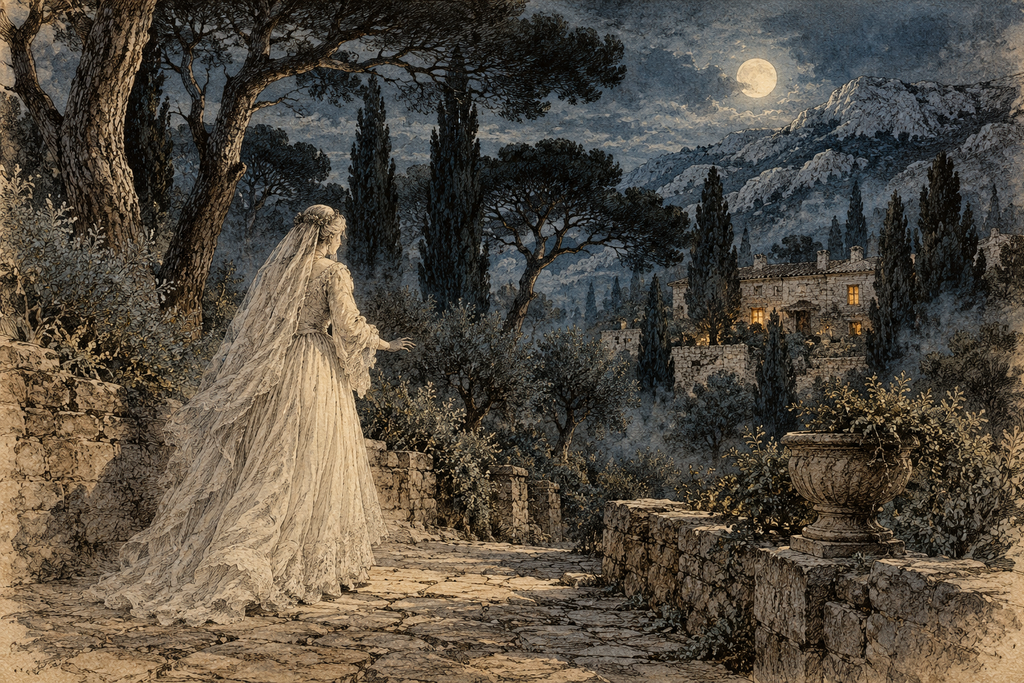
The veiled wanderer of Mount Penteli. Image generated by AI
The Mansion with Another Life
Further west, on Kifissias Avenue in Kifissia, the impressive Villa Kazouli carries its own unsettling reputation.
Accounts of haunted Athens describe oppressive rooms and unexplained presences within the mansion. Some versions connect them to alleged wartime atrocities; others introduce an older burial ground. These are claims within the circulating stories and require historical evidence beyond their repetition.
The villa’s restoration and subsequent use are documented. The Green Fund’s history records its rehabilitation in the 1990s, its reopening in 1999 and its later role as the fund’s headquarters.
The building has returned to ordinary working life. Its reputation has proved harder to renovate.
Strange Lights Beside the Cemetery
Back in Athens, Logginou Grove in Mets offers a smaller, more familiar setting. A low wall separates the neighborhood park from the monuments of the First Cemetery.
One night, according to a personal account published on the paranormal website called Paranormap, two friends went there looking for ghosts. Among the bushes, the writer says, they spotted a floating, spherical light. They moved behind the vegetation with a torch and camera to investigate.
The account offers no neat explanation. The writer considers whether the light might have been a natural phenomenon. Years later, however, an acquaintance allegedly described seeing a human-shaped apparition at precisely the same spot.
Logginou’s legends also circulate beyond those forums: Athens Voice has described the grove’s longstanding association with haunting stories.
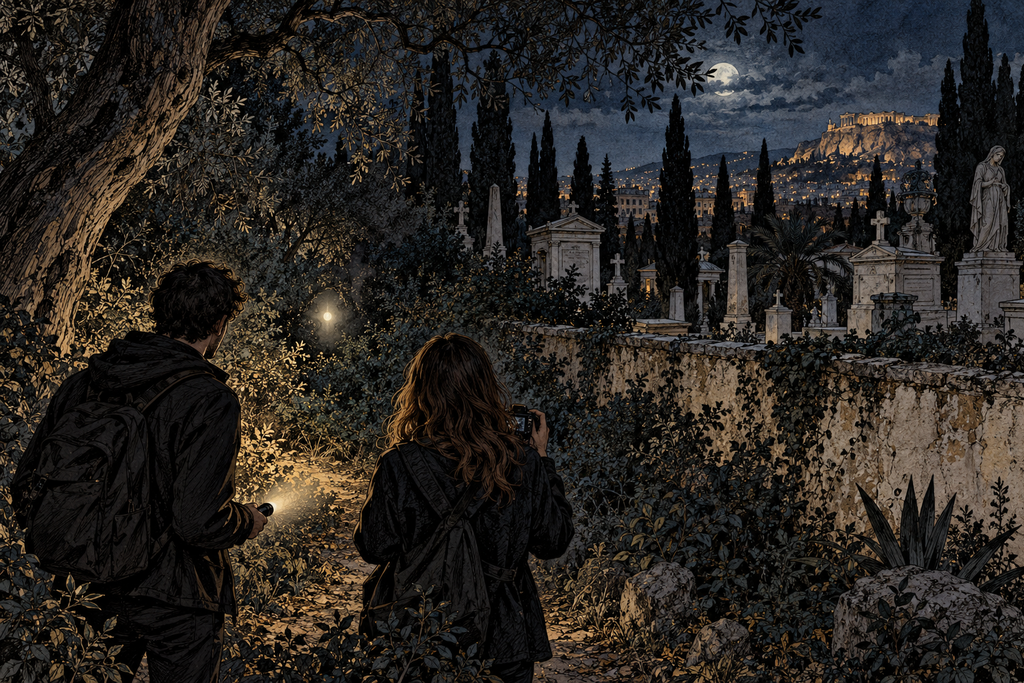
The light beyond the wall. Image generated by AI
A Question for the Living
Pliny ended his letter by asking Sura to consider the evidence and help settle his doubts. He wanted an answer, although he invited his friend to examine both sides.
Nearly two millennia later, the conversation continues in neighborhood recollections, local histories and paranormal forums. And Pliny’s question remains relavent: was something there, or did fear give it shape?
Whatever the answer, a familiar obligation, as well as a cautionary tale, runs from ancient Mesopotamian beliefs to many funeral traditions today: care for the dead, honor their passing and lay them properly to rest. Peace, these stories suggest, is not only for the dead, but for the living as well.