 Μake us preferred on Google
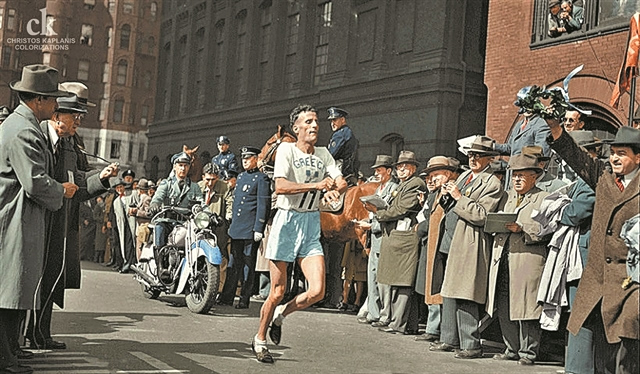
 BOSTON, April 20, 1946. Stylianos Kyriakides crosses the finish line of the Boston Marathon. He is so thin that the American newspapers struggled to describe him without sounding cruel. He had not raced seriously in five years. He wins anyway. And when the tape breaks across his chest, he raises his arms and shouts: For Greece.
On the evening of April 16, 2026, eighty years after Kyriakides’ victory, the 42nd Boston Marathon Wreath Ceremony took place at the Prudential Center, organized by the Consul General of Greece, the Alpha Omega Council, and the 26.2 Foundation. For the occasion, Dimitris Kyriakides, son of Stylianos Kyriakides traveled from Athens as part of a six-member delegation. Four olive wreaths, cut from the plains of Marathon and dipped in 24-karat gold were presented to the Boston Athletic Association. Four days later, they crowned the winners of the 130th Boston Marathon.
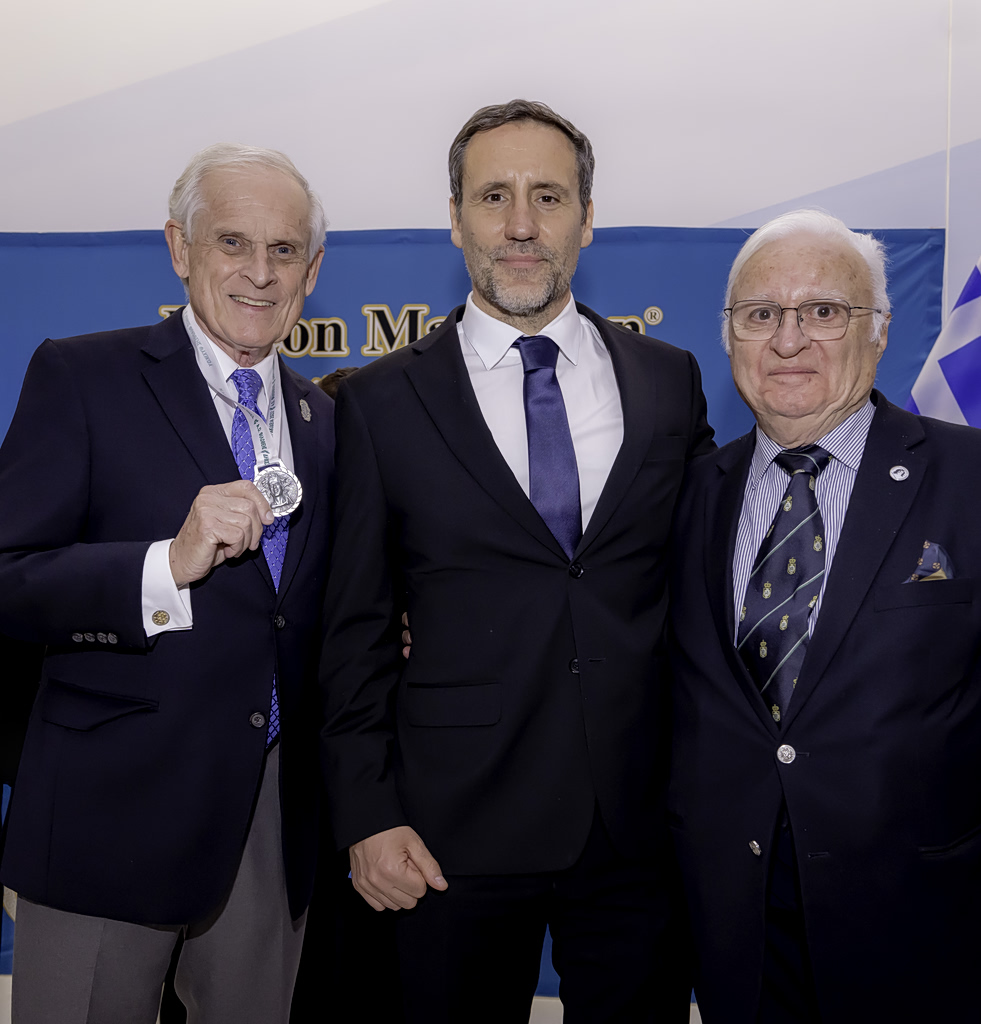
From left to right: Tim Kilduff (president and founder of the 26.2 Foundation), Symeon Tegos (Consul General of Greece in Boston), and Dimitri Kyriakides (son of Stylianos Kyriakides).
Photo credits: John Deputy
“He did not run the Boston Marathon to win,” Dimitris Kyriakides said. “He ran to convince the American people to help Greece.”
In April 1946, Greece was in ruins. The German occupation had ended less than two years earlier. A civil war was grinding on. Food was scarce, infrastructure destroyed, and a population exhausted by a decade of consecutive catastrophes had almost nothing left. Stylianos Kyriakides, one of the finest distance runners of his generation, had not raced seriously in five years. He trained for six months in Cyprus, where it was at least possible to run through the streets, and arrived in Boston.
He won anyway, setting the best time in the world at the time. When he crossed the finish line, American sponsors rushed toward him, professional contracts, money, and the promise of a career. They wanted to keep him. He turned them all down. “My father was the first charity runner in the world,” Kyriakides said. “He did not come to Boston to put money in his pocket. He came to help his country.”
President Truman invited him to the White House. He also called in Johnny Kelley, the American favorite who had finished behind Stylianos, and asked how this gaunt Greek had managed to beat him. “How can you beat a guy like that?” Kelley said. “He wasn’t running for himself. He was doing it for his country.”
Truman ordered the dispatch of 25,000 tons of food, medicine, clothing, and shelter, a relief effort that came to be known as the Kyriakides Package. The following year, Stylianos returned to Boston and ran again, finishing tenth, this time collecting funds and secondhand athletic equipment from American universities to send Greece’s Olympic team to the 1948 Olympic Games in London. Greece marched first into the stadium that summer, flag raised, because of a marathon runner who had refused, twice, to enrich himself.
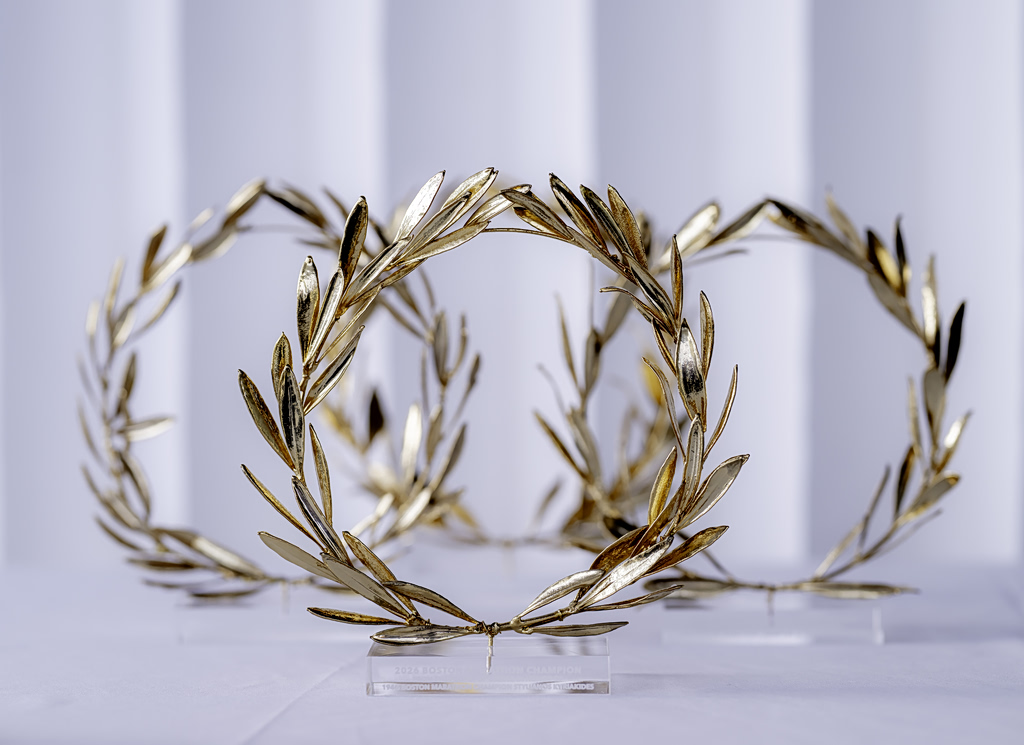
Gold wreaths. Photo credit: John Deputy
Dimitris Kyriakides found the full weight of that story not from his father, but from a box in the attic. Stylianos had kept a meticulous archive of documents, photographs, running equipment, and letters. He never mentioned any of it. “He never spoke about himself,” Kyriakides said. “The word he used was always ‘we.’ Never ‘I.’ As a team, he believed, we can accomplish many things.”
Since then, Kyriakides has spent his adult life as the keeper of that story. He has brought Greek athletes to Boston and helped erect four statues of Stylianos in Greece, Cyprus, and the United States. He has consulted on more than twenty documentaries about his father. “In every single one of them, I was involved,” he said, “because I was the one who built his archive.” One won an Emmy Award in 2004. “Stylianos Kyriakides is honored around the world,” Kyriakides said. “From Cyprus to China.” The first exhibition room of the Marathon Museum in Marathon, Greece, is also dedicated to him.
The wreath ceremony, which is a very important part of the Boston Marathon, has a history of its own. The tradition of crowning Marathon winners with Greek wreaths began in 1933, when George Demeter, a Greek-American civic leader, introduced the custom of laurel wreaths at the finish line. The tradition of presenting olive branch wreaths began in 1984, when Peter Agris of the Alpha Omega Council, in collaboration with Massachusetts Governor Michael Dukakis, Boston Mayor Ray Flynn, and Boston Marathon Director Tim Kilduff, introduced the custom to the Boston Marathon. It was in the 2000s that it began to evolve into the Boston Marathon Wreath Ceremony known today. The committee later decided that the wreaths would be dipped in 24-karat gold and presented each year to the Boston Marathon winners on behalf of the people of Greece. The base of each wreath carries an inscription dedicating it to the memory of Stylianos Kyriakides.
This year, the ceremony carried extra weight. It coincided with the 50th anniversary of the Alpha Omega Council and the 130th running of the Boston Marathon. Four members of the delegation ran the race itself. Kyriakides, who was himself a competitive 800-meter runner in his youth and helped his father organize the early editions of the Athens Marathon from 1955 onward, was there to honor his father’s legacy. “When I was young, we thought the marathon runners were crazy,” he said. “You’d see them in the road and say: these people are out of their minds.” He added. “But things have changed a lot.”
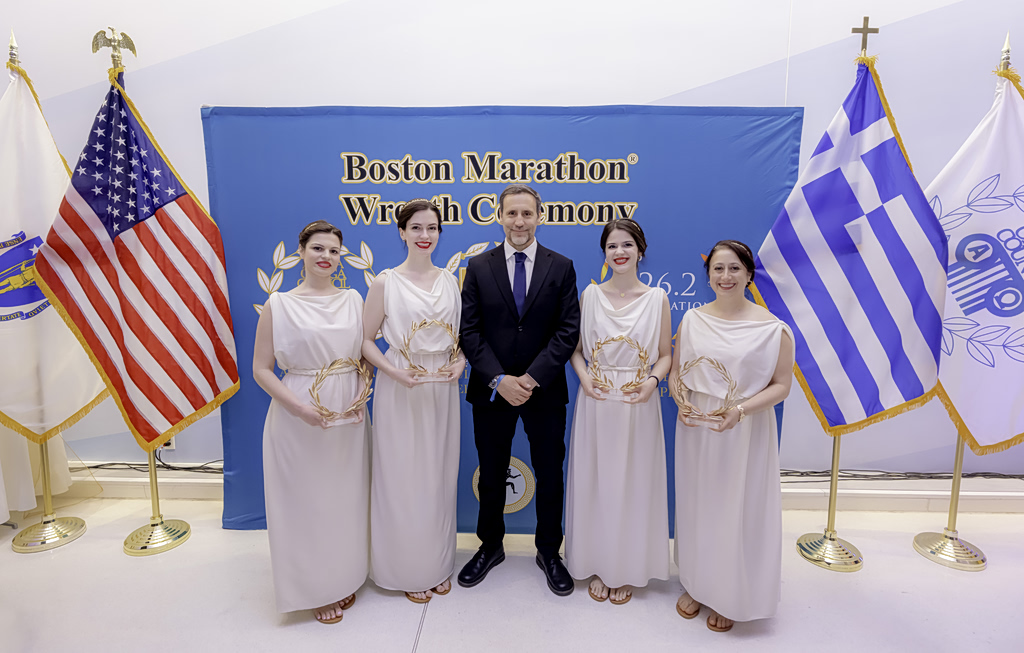
Boston Lykeion Ellinidon Maidens (from left to right: Ioanna Skourti, Stella Erickson, Dido Stoikou, Argo Kaminis) holding the gold-platted wreaths with Symeon Tegos.
Photo credits: John Deputy
The 1946 Boston Marathon had 116 runners. This year, more than 30,000 crossed the finish line. Kyriakides watched the sport transform over the decades. By the late 1980s and early 1990s, he said, participation was slowly climbing, a hundred runners, maybe two hundred. The real turning point came after 2004. “The marathon movement grew internationally,” he said, “and because of the Olympics in Athens, it grew in Greece too.” The Athens Classic Marathon now reaches its entry limit of 17,000.
If he were running a marathon today, Kyriakides said, he would shout what his father shouted when he came home to a Greece torn apart by civil war: Greeks! Unite! For the good of our country.
In 1946, Stylianos ran past sparse crowds in a city that barely knew his name. In 2026, his son stood at a ceremony in his honor, in a city that had never forgotten it.
The 130th Boston Marathon presented by Bank of America took place on April 20, 2026. The gold olive wreaths, cut from the plains of Marathon, Greece, crowned the four winners of the race from each category.