 Μake us preferred on Google
 In the early 1970s, the neatly kept interior of John’s coffee shop, on the corner of 66th Street and Broadway, welcomed a police officer each morning known worldwide for his incorruptible character. Al Pacino had immersed himself so deeply in the role of Serpico that he startled the Greek owner of John’s, Evangelos Bourlotos, with the intense look he gave him every time he ordered his coffee. Even today, Bourlotos recalls their frequent—and always fascinating—encounters, at a time when all of New York seemed to feature a little bit of Greece.
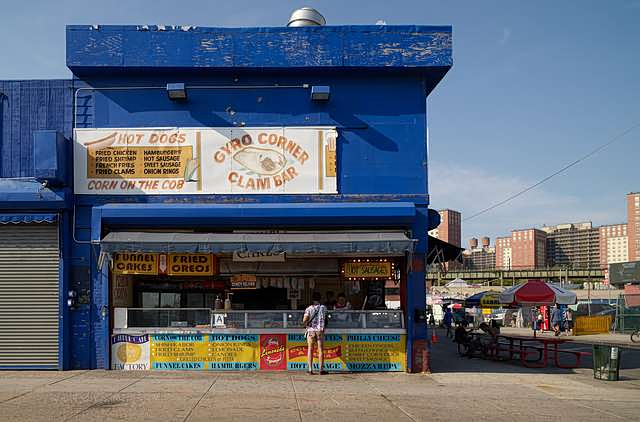
Restaurants, diners, grocery stores, bakeries; Greek-owned businesses were everywhere. Bringing a distinct warmth and personality to the Big Apple—as captured in the mid-1970s by photographer Kay Zakariasen on the streets of Manhattan and Queens. These images were recently shared by the New York Public Library in celebration of Greek Heritage Month.
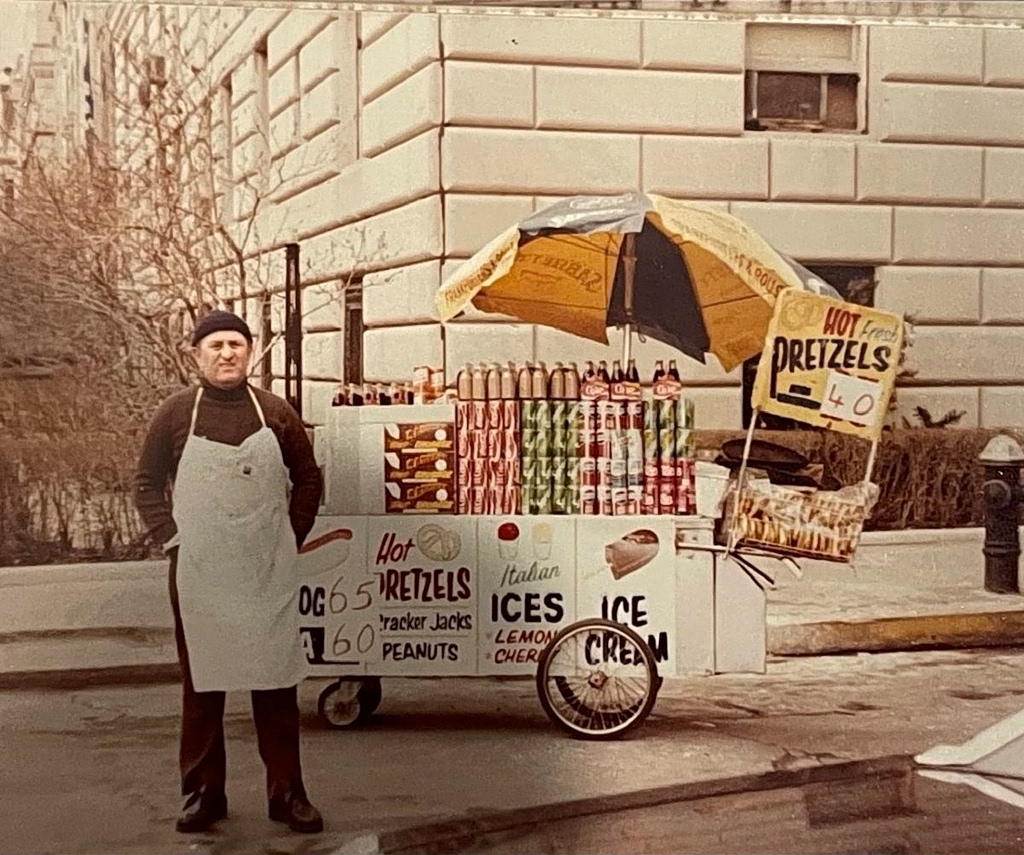
In one of them, a man in a dark blue ushanka and white apron is smiling beside his Sabrett hot dog cart, set against the façade of the Metropolitan Museum of Art on a sunny day in 1976. The man was Anastasios Velis—Fotis’s father and Francine’s grandfather.
“It is great seeing my father in front of the Metropolitan Museum selling hotdog. It brings back so many memories” Fotis Velis tells TO BHMA.
A unique archive of Greek presence
That street portrait is part of a collection donated in 2022 by Zakariasen to the New York Public Library: a remarkable archive of around 400 color slides, negatives, prints, interview transcripts and research material from a 1976 photographic essay on the Greek diaspora in New York. Alongside the images, the voices of the people themselves survive—transcribed interviews (not yet digitized) with owners and workers, including their names, places of origin in Greece and the businesses where they worked.
Zakariasen, who later became photo editor at the American Museum of Natural History’s Natural History magazine, had been drawn to immigrant communities in the U.S. since her student years. Her husband, David Hanson, says she was struck by how deeply Greeks had rooted themselves in the world of diners and small businesses. Indeed, a 1972 survey by the Greek American Neighborhood Action Committee found that 92% of restaurants across New York City and surrounding areas were either owned or run by Greek immigrants.
From Nafpaktos to the American journey
Every story was different—many of them extraordinary. Before standing behind his metal cart selling hot dogs year-round at the Metropolitan Museum and other busy spots, Anastasios Velis had tried to build a life in his hometown of Nafpaktos, western Greece. He worked on intercity buses, introduced the town’s first taxi—a 1956 Chevrolet Bel-Air—and later opened a kafeneio. None of it, however, provided the stability he needed to raise his family.
Fotis remembers his father’s life was structured entirely around work. When they arrived in New York in 1966 aboard the “Olympia”—the famed ocean liner that carried thousands of Greeks to America in the 1950s and ’60s—his father was already 35. He traveled with his wife Aglaia, their two children, and a $150 check. Neither his age nor his responsibilities supported him through the harsh reality of migration.
One episode from his journey borders on the unbelievable. While waiting at the U.S. embassy for his visa, with slim chances of success, a soldier overseeing the crowd singled him out and moved him to the front of the line. Velis did not understand why—until later, when he learned he had once driven the soldier’s mother to a hospital in Athens. Migration, it seems, is shaped not only by policy and necessity, but also by virtue and chance.
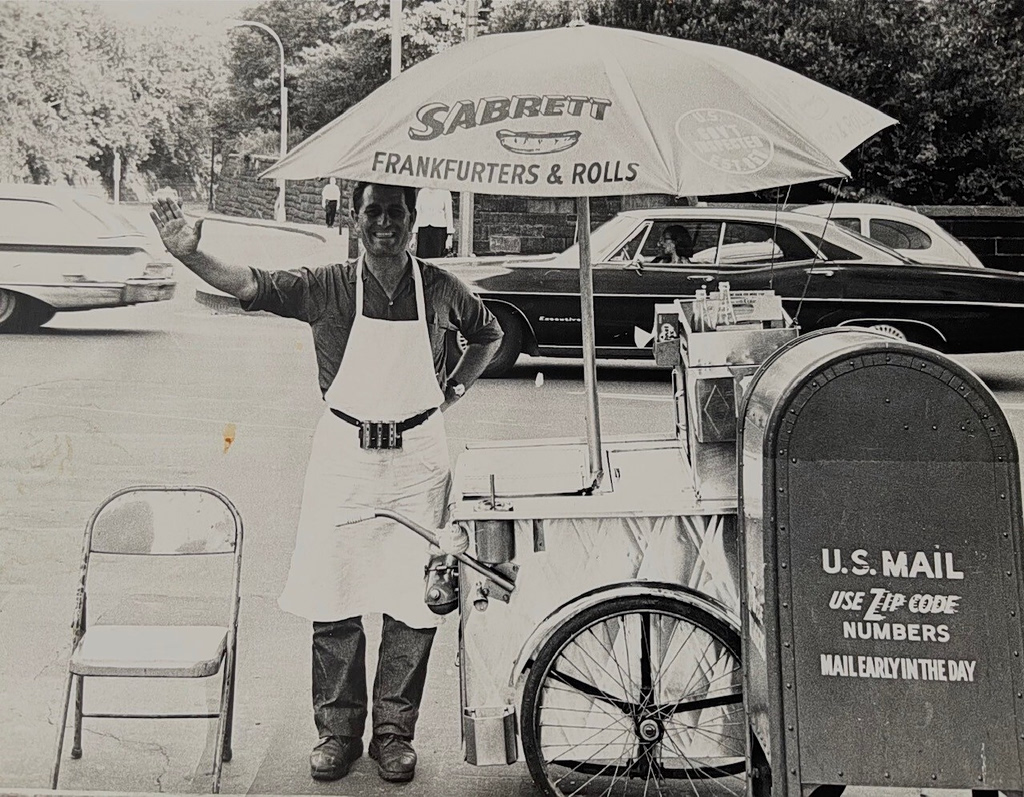
Anastasios Velis at his Sabbret hot dog stand, photo curtesy of the Velis family personal archive.
“From six in the morning to midnight”
Velis’s first job in New York was in a Greek restaurant. “He worked for six months, from six in the morning until midnight, six days a week,” his son recalls. Sunday was his only day off. He earned $60 a week—barely enough to cover rent.
His break came through a small advertisement in a Greek newspaper: “Be your own boss,” it read, next to an image of a hot dog stand. Velis took the leap. He built his own cart and gradually established a small business. The work load never lightened—it simply transformed. He was no longer someone else’s employee, but a street vendor with his own income, risk and responsibility. Eventually, he even employed others. For his family, that step marked the beginning of a more stable life, built on relentless effort.
“My grandfather left Greece, his home that he loved, to step into the unknown,” Francine says. “He carried courage and determination to build something for his family.” Today, she sees the result not only in his success, but in the opportunities he created for future generations. “My career as an attorney in New York and New Jersey was made possible by the foundation he created. His sacrifice and courage rippled through generations and changed the trajectory of our lives.”
Yet America never replaced Greece in his heart. “He missed Greece as soon as he stepped foot on the Olympia,” Francine says. Nafpaktos remained a place of beauty and calm—a contrast to the intensity of New York. After three decades of hard work, Velis returned home. This November, the smiling man in the ushanka will turn 97.
Serpico, Theodorakis and the diner world
Evangelos Bourlotos’s story offers another glimpse into Greek Manhattan—the bustling world of diners and coffee shops. He arrived from Piraeus at 15. “I was devastated,” he recalls. His family settled in Brooklyn, and he began school, determined to work hard despite knowing little English.
He soon found work at John’s coffee shop, located near the Lincoln Center, the Juilliard School and the city’s major cultural institutions. From there, he saw New York in a way few ever truly experience. “I saw Luciano Pavarotti, Placido Domingo and Jose Carreras live without paying for a ticket,” he says. He also remembers Mikis Theodorakis and the excitement his success sparked among Greek immigrants.
Later, Bourlotos and a friend bought John’s café, which operated 24/7. “We didn’t even know where the key was,” he says. The place became a crossroads for artists, journalists, workers and celebrities. During the filming of Serpico, Al Pacino would regularly stop by for coffee. Names like Anjelica Huston, John Huston and Carroll O’Connor passed through like fleeting shadows of a city in constant motion.
Yet beneath the glamour lay hardship. Bourlotos recalls the grueling work, exploitation and exhaustion. He even remembers a young Geraldo Rivera visiting the café to document poor working conditions. Rivera donned an apron and grilled burgers alongside him—but the fatigue remained.
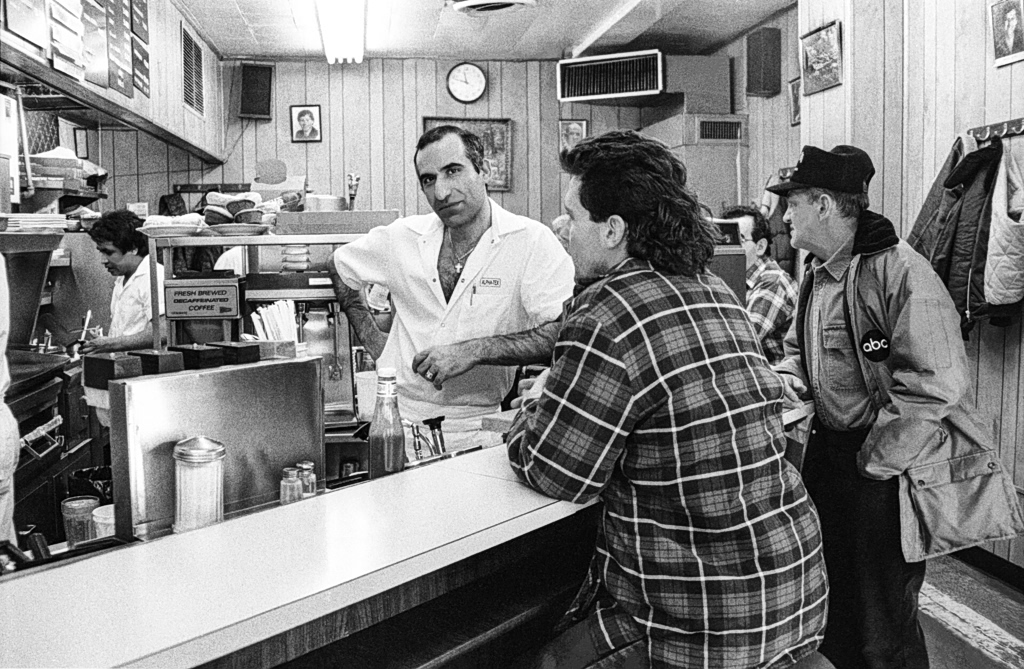
Interior of John’s coffee shop, photo curtesy of Bourlotos’ family personal archive. Photo by Joanna Tully.
Homesickness beneath the city lights
He also recalls the infamous blackout of July 1977. “People rushed into the café for safety. We sold everything we had within hours—serving eggs with donuts instead of bread.” Outside, the city burned with looting and fires, a stark reflection of the poverty and desperation during that time.
Through it all, his thoughts always went back to Greece. “A Greek who never left his land can never understand the feeling of longing for the place you were born” Bourlotos says. He reminisced on concerts by Greek singers where audiences got visibly emotional. “It’s very vivid in my memory the tears on the faces of the people in the theatre from the pain of missing their land.” These were people who had built new lives, but held on to their cultural roots; a part of which they could never fully regain.
Bourlotos returned to Greece permanently in 2016 and now lives in Volos with his American wife. “Life here wasn’t as smooth as I expected,” he admits, “but I managed to overcome the difficulties and at this point I can admit to myself that I made the right decision.”
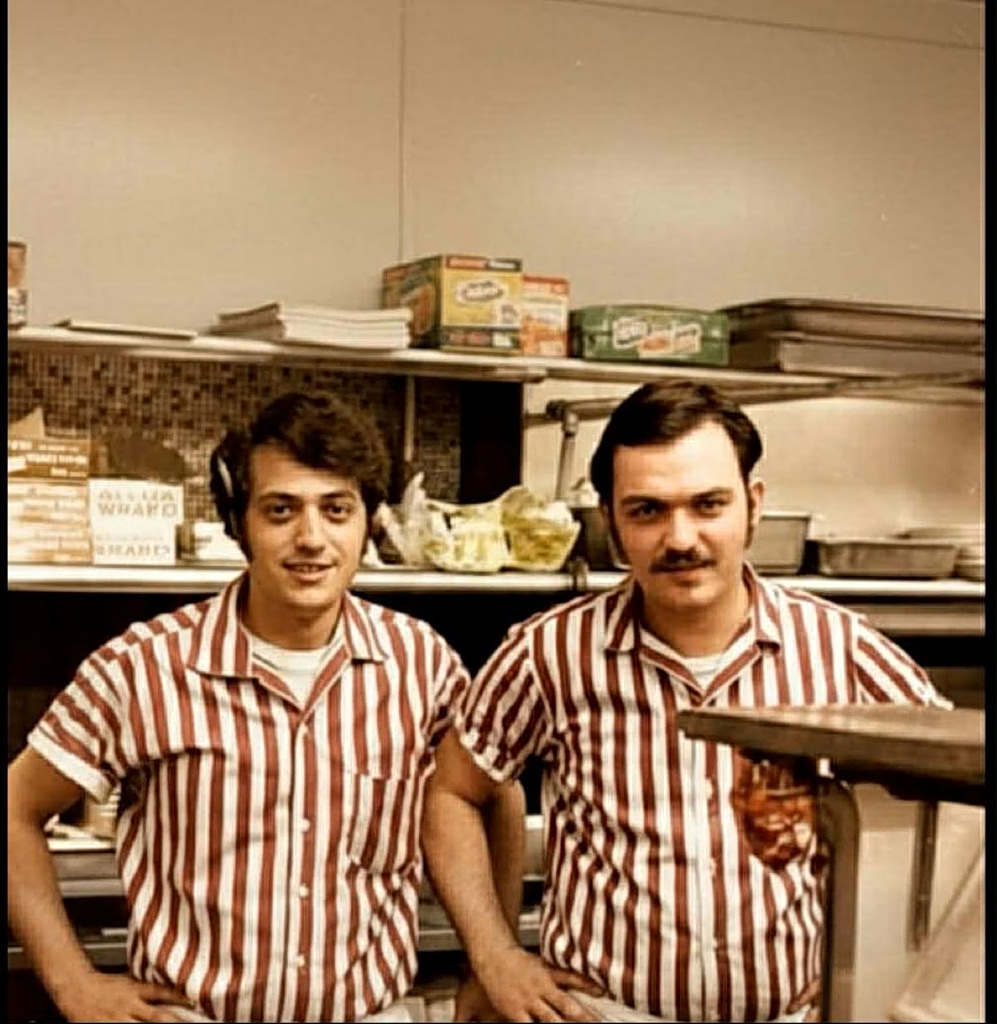
Shedding light on the overlooked
Today, Kay Zakariasen’s photo essay holds special value. It preserves a largely overlooked chapter of Greek immigrant life in 1970s New York, prompting reflection on the character of “ordinary people” who shaped one of the last great waves of Greek migration in the 20th century.
Their stories draw attention to what is often undervalued: dignity, hard work, responsibility and self-respect.
Interest in Zakariasen’s photographic essay is no longer limited to its archival significance. The NINETTO Gallery in Athens is preparing an exhibition dedicated to her work for the end of the year, along with a special publication that will draw on the interviews she conducted at that time. Nearly half a century later, Zakariasen’s stunning work invites a renewed inquiry into belonging, displacement, diasporic identity, and the shifting meaning of ‘home’.