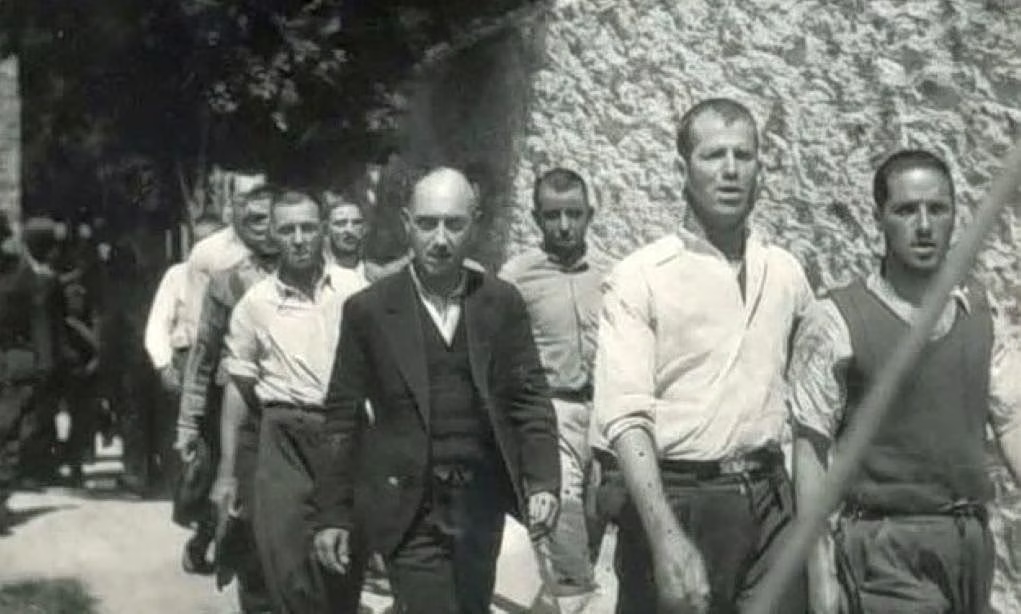
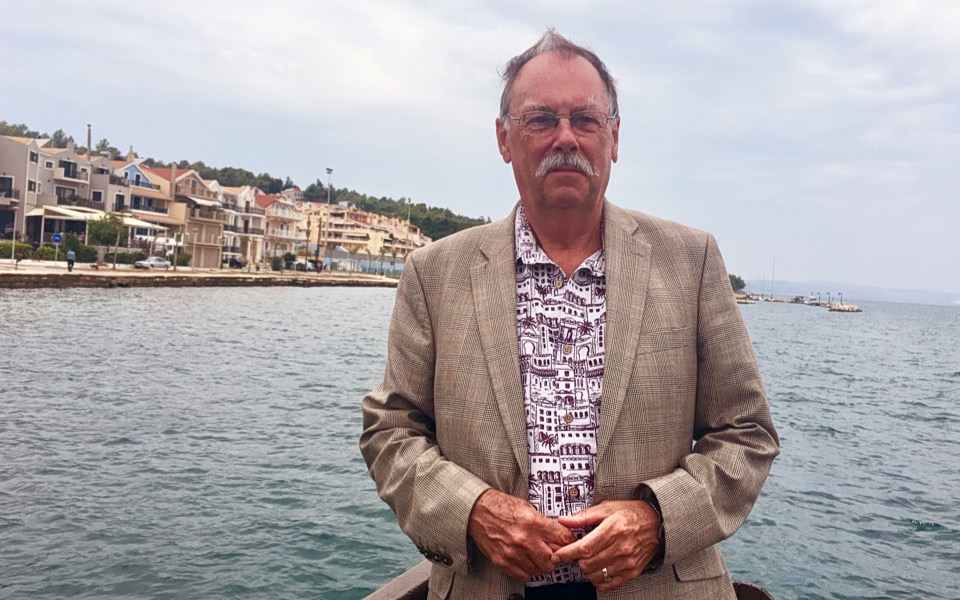
In this interview with TO BHMA International Edition award-winning historian Roderick Beaton begins with a stark warning: the political turbulence of today bears unsettling similarities to the 1930s. Rising populism, democratic backsliding, polarization, and growing pressure on the rule of law recall the fragile interwar years, when democracy in Europe was still young and vulnerable. Beaton does not claim that history repeats itself mechanically, nor that another world war is inevitable. But he stresses that patterns can re-emerge. Democracy, he argues, has never been Europe’s default condition; it has historically been the exception. What has endured more consistently is the principle of the rule of law—first articulated in ancient Greece as isonomia, equality before the law.
In recent years, we’ve seen democratic backsliding in several countries. From a historical perspective, are such cycles of instability a normal feature of democratic development?
What you need to be very clear about is that democracy, although it began in Europe, and of course it began right here in Greece, is not really a fundamental characteristic of European civilization. We may not like to admit it to ourselves, but the truth is that Europeans have lived under non-democratic systems for much longer than they have lived under democratic ones. So, I think the current upheavals and the current threats to democracy are, in a way, nothing new. They’re very disturbing. Because they’re highly reminiscent of similar disturbances that occurred when democracy was even more recent in Europe—namely, in the interwar period. And I fear there are many similarities between the period we’re living through now and the 1930s.
But taking the long view, it seems to me that the fundamental characteristic, the one element you can trace right through European history from the time of the ancient Greeks to today, is not democracy, but the rule of law.
And, as they did for many things, the ancient Greeks had a word for this. They called it ‘isonomia’, the idea that “all citizens are equal before the law” and laws are impartial and apply to everyone.
That’s something that I think is fundamental to the ancient Greek city-states. And while Roman civilization was founded with violence, it was maintained by law.
Do you think the rule of law, the rule of international law, the rule European countries adhere to, is at stake?
Well, yes, I think it is.
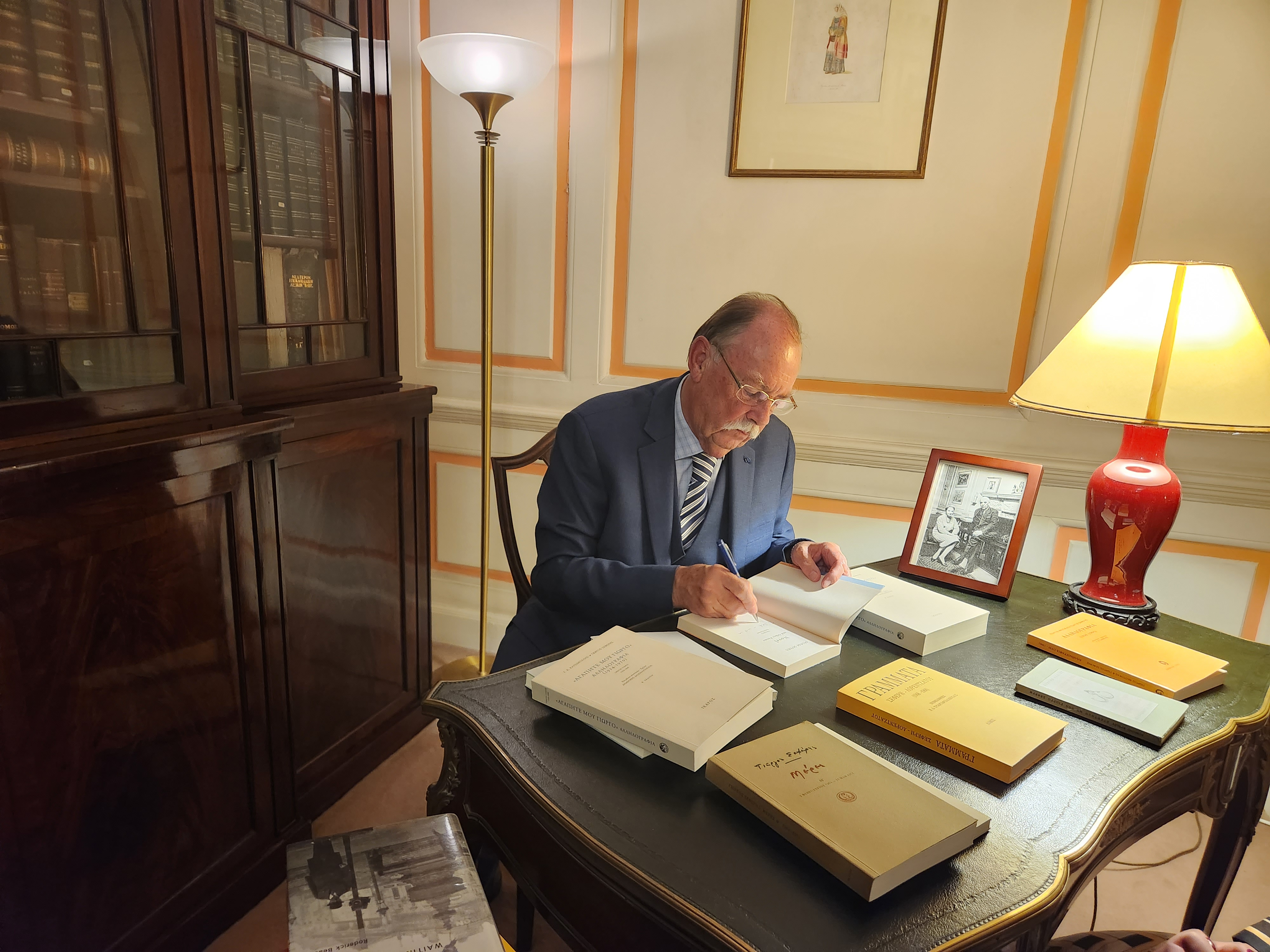
So, are we going to have another world war?
Well, there are two things here. First of all, I seriously wonder whether the rule of law still holds internally in the United States. And I think that’s a problem for them.
But the international rule of law is a much more recent phenomenon. And it’s much more fragile. We never really had, though the Romans had the “eus gentium”, the concept of the law of nations.
So, like the Americans today, the Romans decided what the laws were and handed them out to everybody else.
And various attempts have been made since the Romans, or even since the ancient Greeks, to regulate relations among states. I think the honest truth is that these have always been unstable and that the international rule of law, the international system we recognize and took for granted until recently, dates from 1945 and not really before. So, history really has very little to offer us when it comes to knowing how to avoid war.
Around the world today, we see populism, we see polarization. But are there lessons to be learned from Greece?
The Greeks tried populism and turned their backs on it. But it caused them terrible suffering before they did. Many of the internal divisions and tragedies of modern Greek history have turned upon a rather crude populist conception of the nation; I mean, let’s not forget that there was a very bitter civil war fought in Greece in the 1940s.
A lesson I learned from writing the history of Greece as a modern nation is that in the last 300 years, the Greek population, the Greek people at large, have experienced just about every calamity history can visit on a nation. But they came through it. And I hope they’ve learned from these often very bitter, very violent, experiences.
I think that if people were to read Greek history, they would see lots of pitfalls and lots of dangers; lots of things that Europe as a whole, or other nations, could very well avoid.
It sometimes feels as though societies are not learning everything there is to learn from history—or, perhaps, that they are not interpreting it carefully enough. Do you think history repeats itself, as we often say?
Do people learn from history? It was a Hungarian commentator, I think, who said that we Hungarians have sadly always chosen the wrong side in history.
But does history repeat itself?
No. But when you look at history over a long period, you can certainly detect patterns. And there is a kind of shape to events. I think that’s quite complicated, because there is actually a shape to events in themselves.
But I also believe it’s very important that what we call history is actually about telling the story. It’s organizing events that might seem quite random into a sequence, into a narrative. In a way, raw events by themselves, in my mind, are not really history. They’re just things that happen. So, History is the business of connecting. It’s the way we perceive, the way we understand the things that have happened in the past. I suppose that what I’m asking is whether the passion exists in the raw events or in the way we perceive those events? And I think it’s probably somewhere in between. But I do believe there are patterns. And when I said I could see many similarities between the last few years and the 1930s, that’s a very clear-cut example.
What I think the historian is never entitled to say is this: because it happened that way then, it will happen again in the future. We all desperately want to see into the future, or we think we can, but we don’t have that right. History stops in the present, at the present moment. But what we can sometimes do is reconstruct or reorganize those patterns in the light of where we are today.
We can’t predict what’s going to happen in the future, but we jolly well can decide what the best course of action is in the particular circumstances, given what we know about similar circumstances in the past.
So, if where we are now is like the 1930s, what do we do to avoid the moment where Hitler makes a deal with Stalin and they invade Poland together and divide it up between them. What could anybody have done differently?
Or, rather, what could we do? because you can’t rewrite history, either. What can we do now to avoid a similar situation? Once again, I don’t know the answer.

In that context do you perceive Russia as the biggest threat to Europe now? And can history play a role here?
You know, nations are not given; they’re created by people. And in the 2013-2014 election in Ukraine and the demonstrations that preceded them, there were people who had decided they wanted to be part of Europe, part of the European Union, and not part of Russia, which had been their old master.
And, astonishingly, this desire drew together people who might not otherwise have much in common… What I mean is, they didn’t really have a national history as such at all, and this desire created a nation out of… disparate elements. And, if I may say so, because I don’t want to offend my Greek friends, there are similarities here with the Greek Revolution. Because, as a solidified unit, the Greek nation was really created out of the years of the Greek Revolution.
It was really the struggle for independence, and the threat of complete annihilation, that forged a nation out of extreme necessity. Back in 1996, Samuel Huntington wrote in a famous book called The Clash of Civilizations, the likelihood of Ukraine breaking apart in a civil war like Yugoslavia was greater than that of Ukrainians ever fighting Russians. And given what was happening in the Balkans in the 1990s, you could see what he meant, because it could have happened in Ukraine, too. So it was actually the external threat of Russia that made the Ukrainian nation possible.
You referred earlier to the Greek Revolution. Let’s talk a bit more about the historical role and legacy of Kapodistrias.
He’s a remarkable figure, and unique in so many ways. He came from Corfu and was brought up under the Venetian Empire, where Italian was the common language of the upper classes. He went off to Russia, where he became the foreign minister to the Tsar. Later, he was in exile in Switzerland, and then he came here as… kyvernitis, which people translate as ‘president’, though ‘governor’ is better. And then he was assassinated. Though some say it was for personal reasons, he basically set out to impose order on a society in complete disorder after the revolution. His principles were fairly authoritarian, of course, because he’d learned his statecraft in Tsarist Russia. All of which makes him an atypical Greek. His mentality was formed, and later developed, in a way quite different from the majority of Greeks at the time. I think he was deeply patriotic. He cared about Greece, and he really wanted the best for the nation. But I get the feeling he never really understood the people he was governing. And they certainly didn’t understand him.
Do you think we have a responsibility to teach history truthfully to younger generations? And is it even possible to speak of an absolute truth with regard to historical events?
As I said, history is two things that overlap: it’s the raw events, but it’s also the narrative of those events. Because the events don’t really mean anything until you draw them together into a narrative. But as soon as the historian does that, they are also distorting them in some ways. Because every narrative is a series of choices as to what stays in and what is left out.
If you’re telling the story, it’s like you’re drawing a line across a map, and I don’t think there’s an ideal way of doing that. Take this example from my earliest experience of history in primary school, when I was seven or eight years old. Well, the history we were taught in Edinburgh wasn’t the history of the United Kingdom, it was the history of Scotland. And I was brought up on bloody battles and sieges in which the enemy were always English. It was only later, when I lived in England, that I learned the stories from my British children about the Battle of Bannockburn, and the Scots digging pits and putting stakes in them for the English cavalry to fall into.
The English captured the castle in Edinburgh. And one wintry night, a brave Scot climbed the sheer face of the cliff there in the rain, which was the one place everybody considered impossible to climb. But he did it, and he got into the castle and he opened the gates and the Scots rushed in and massacred all the English. So, you can’t help it, but also need to grow out of it, in a way.
You are a scholar and a professor who often engages with the media and speaks to journalists. How do you assess the role of historians in today’s public conversation? Do you believe they have a meaningful role to play?
Oh, yes, far more than ever before.
I mean, to take a concrete and shocking example once again, when Putin starts to write history, something is really seriously wrong. Because you don’t want history written by the people who also have their finger on the nuclear button.
We need historians. And it’s not even to set the record straight, because as I was saying, there isn’t necessarily a definitive record. No, we need historians to Keep telling and retelling the story—the facts—in the light of where we stand at a particular moment.
How do social media platforms shape the role of historians and public discourse today? And how is the rise of artificial intelligence influencing that landscape?
I find both those things pretty terrifying, to be honest. And, you know, I’ve never used social media. Still, before we had social media, we had the press. That goes back to the 18th century, and allowed various people to say things they hadn’t been allowed to say before that. Which whipped up passions and led to various potentially disastrous situations.
And if you think back to the world of the ancient Greek city-states and their politics, ta tis poleos, as they say, the affairs of the city-state. Well, it was only men in that world, and it was about men talking among themselves, and I’m sure they were shouting at the tops of their voices, just like you hear people doing here today. So, it’s quite possible that the ancient agora here in Athens was a bit like a social media forum. A sort of ancient Twitter sphere.
Looking at European history, when and why have people chosen to start revolutions? What kinds of social, political or economic grievances tend to push societies to that point?
I have one simple answer for our times, and that is the financial crisis of 2008.
And, again, that’s one of the parallels I draw with the 1930s, when the 1929 crash led to the Great Depression. And I’m sure that, without that economic collapse, there need not have been a second World War.
I’m afraid that the sort of populist phenomena we were talking about earlier lead to conflict by their very nature. Because, quite apart from politics and ideologies, people have seen their standard of living getting worse. Here in Greece, it got a lot worse for a time, of course.
And I think there’s another aspect to this, which may be unique to our modern world. Since World War II, everybody has been used to things getting better all the time. People take it for granted that they will enjoy better conditions, earn more money, have better houses than their parents did, and so on. And that held true for several generations, and especially for my own. But younger generations are not seeing that.
And because their expectations remain too high, they get bitter. They turn to social media. They turn to extremely populist politicians.
There was Franco in Spain, there was Mussolini in Italy, there was Hitler in Germany. And, you know, what were they? Well, people may not necessarily have wanted them especially, but they had no great hope anywhere else.
They allowed them to come to power. And once they came to power, the people couldn’t stop them.
How much does history depend on individual personalities? Could the presence of leaders like Adenauer or Churchill fundamentally alter today’s political landscape?
That’s a huge question. It’s what they call “the great man theory” of history.
I do think a lot of things that happen in history come down to the actions and the personality of particular individuals at particular times. And one of the extraordinary things in history, I think, is why the decisions or actions of one man—and it usually is a man—at a particular moment can be so incredibly consequential, with an impact they couldn’t possibly have foreseen. I mean, my favorite example of that is the first emperor of Byzantium, Constantine. After he won his battle, he decided he was going to embrace Christianity and give all the money to the churches and recall the council of the bishops in Nicaea. He was just one man among many who were fighting to become emperor, and he won. And he decided to throw in his lot with the minority Christians.
Why should that happen? If you look at it through religious history, you get one kind of answer. But if you take it from a secular point of view, it comes actually down to idiosyncrasies, I feel. History is full of moments like that.
Thank you so much, Professor.
Well, that’s all right. That’s my pleasure.
Beaton will participate in the Delphi Economic Forum XI, taking place from 22–26 April 2026. His timely reflections also resonate with his forthcoming book, Europe: A New History, scheduled for release on April 28, 2026, by Basic Books. The volume is a bold new history of Europe, tracing the continent’s story from ancient Greece to the Russian invasion of Ukraine—an expansive narrative that seeks to uncover the deeper patterns shaping Europe’s past and present.