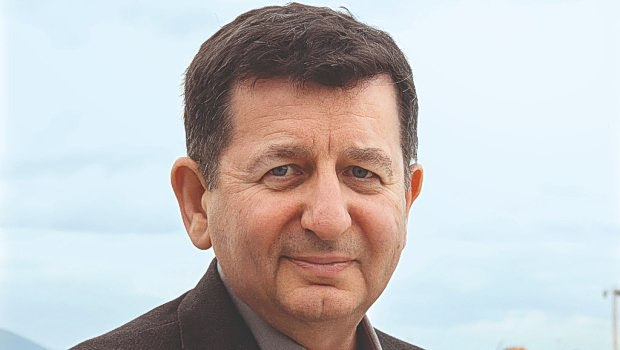
Nick Dallas was born in the village of Myrini, ten kilometers from the town of Karditsa, on the road to Larissa. In 1971, when he was just five years old, his family emigrated to Australia. Today, as a member of the Board of Directors of the Greek Community of Melbourne, with 25 years of experience in an international publishing house based in New York, he devotes his time to preserving Greek language and culture. At the same time, he is writing a doctoral thesis at the University of Macedonia in Thessaloniki on Greek political refugees in Tashkent – an almost unknown aspect of the Greek diaspora.
The path of immigration
“My story is no different from that of many immigrants,” says Dallas. “My father had made four applications – to Canada, Australia, Germany, and even to the merchant navy. My mother didn’t want us to leave, but she wanted us to be together. Better in Australia than my father being away at sea.” His home region is rural: “cotton, corn, and other crops” and he has few but vivid memories of his early years there. “I remember when we left, there was a meter of snow in our village.”
The family arrived in Melbourne with the same dream that all immigrants of the time had: to work for five years, save money, and return to Greece. “Five years turned into ten, ten into twenty, twenty into forty, and we’re still here,” he says with a smile. “Our parents went straight to the factories. Everyone worked as much as they could. But then you get caught up in things—the children go to high school, enter university, start families.” Within a few months of his arrival, little Nick spoke English well enough to become an interpreter for his parents. From an early age, he loved reading, especially history, geography, and mythology. This love eventually led him to a publishing house specializing in scientific and educational books, even though he had a PhD in organic chemistry. “It was a hobby job, because all my spare money was spent on books.”
The Greek Community of Melbourne
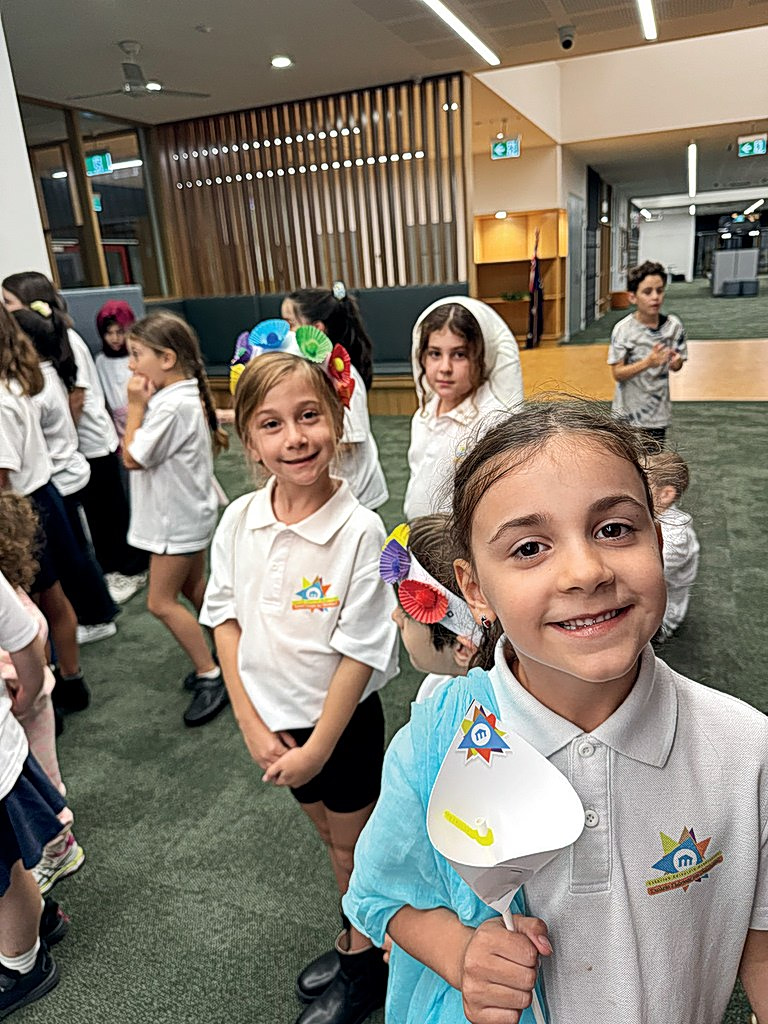
The Greek Community of Melbourne is one of the largest Greek organizations in the diaspora. For the past 14 years, Dallas has been a member of the Board of Directors, which consists of nineteen volunteers and places particular emphasis on culture and education. “We have over a thousand students in various Greek language programs, from preschoolers to adults. We even offer programs for children as young as 18 months. Language needs to start as early as possible—Greek is not easy.”
The fourteen-story community building is located in the city center—a strategic location that has proven to be crucial. “Melbourne is a very spread-out city; it takes two hours to cross it. The center is the most convenient location – all public transport passes through there.” The building houses offices, classrooms, an event space, and a rooftop café-restaurant. Several floors are rented out to private businesses, providing the community with an income. The community also maintains about ten schools and five churches in various parts of the city.
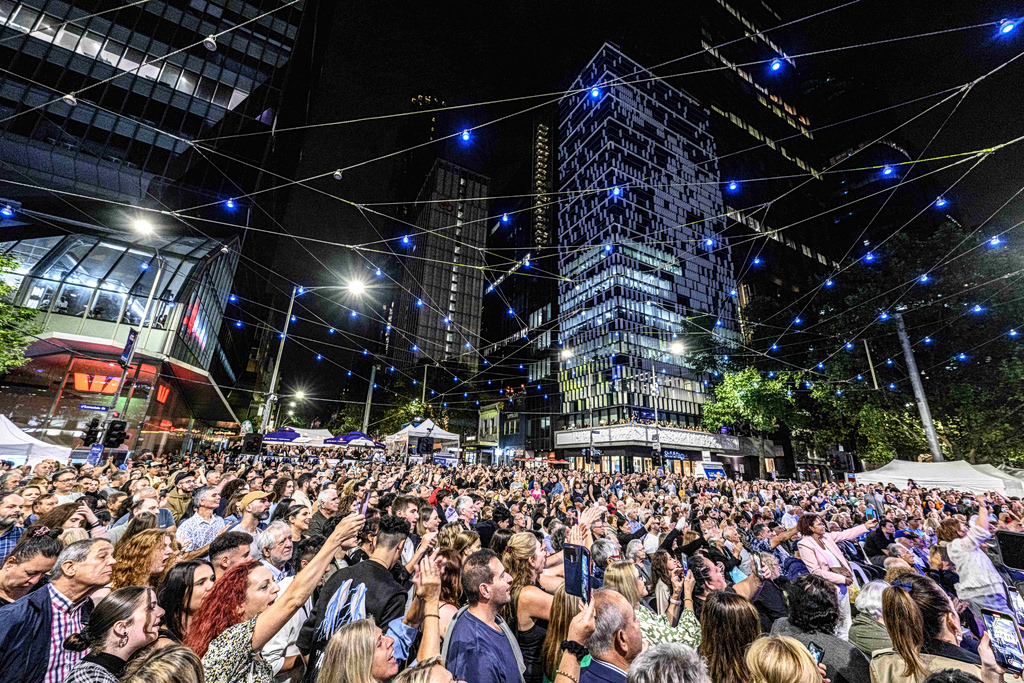
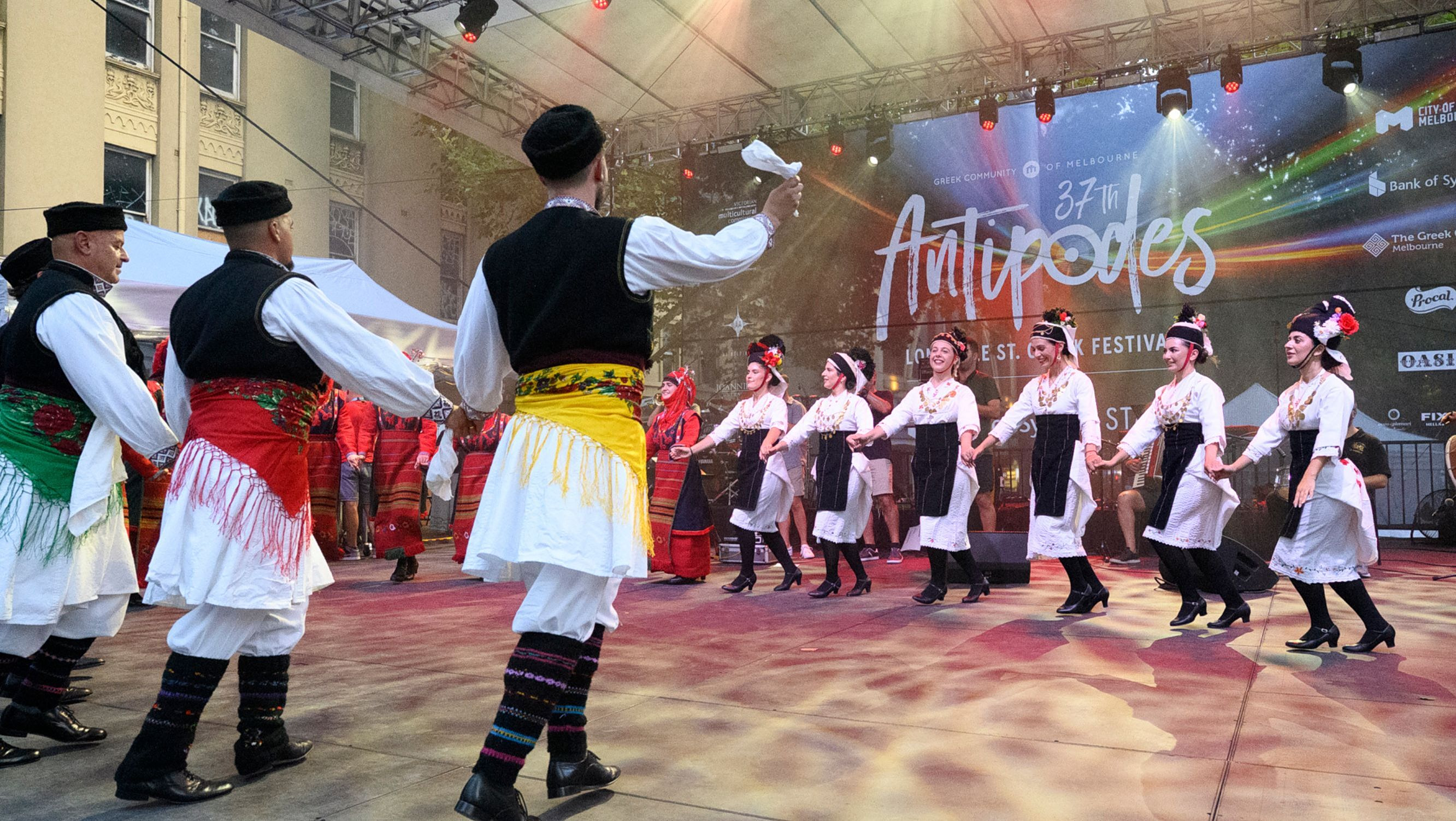
The community organizes two major festivals each year. The Antipodes Festival, which has been held for almost 40 years, attracts over 100,000 visitors in a single weekend. “We close the streets, we bring in artists from Greece—Dalaras has come, and Haris Alexiou, and Protopsalti. There are food stands—loukoumades, souvlaki—fraternities, schools, Greek products. Dance groups come from other states. Greeks and non-Greeks come by, get a taste of Greek culture.” The second festival organised is the Greek Film Festival every October, which brings in over 10,000 attendees.
What it means to be Greek in the diaspora
“The issue of identity is multidimensional,” Dallas observes. “You can be Greek without speaking the language, but if you want to explore your identity in depth, you can’t go any further without it. How deep do you want to go? At some point, you hit a wall.” The big challenge is the next generation: in twenty to thirty years, 80-90% will come from culturally mixed marriages. “Why would this child want to engage with their Greek identity, which will be one of many? That’s the big question.”
The answer lies in diversity: “There is no single solution. We have to offer choices—dance, theater, music, philosophy, cooking. Everyone has different buttons. We have to go beyond language.” He disagrees with the view that mixed marriages don’t help. “It depends more on the parent’s mindset. If the parent respects language learning and the advantages of bilingualism, they will send their child to Greek school.” It is interesting to note that in recent years there has been an increase in adult classes. “They come to Greece, have a good time, and say: I want to learn the language. Many feel that they missed an opportunity because they did not go to Greek school as children or rebelled against their parents. Now they regret it.”
The relationship with the Church
In Australia, unlike in America, where almost everything is done under the auspices of the Church, the Community maintains relative autonomy. “Historically, there have been problematic relations between the Community and the Church. Studying the history of the Australian diaspora, we see that in the 1950s and 1960s, 90% of the time they were in conflict over this issue. The local Greek communities had popular committees and were autonomous. Then the Archdiocese came along and the conflicts began – give us the titles of the churches” – “no, we built them.” Today there is reconciliation, but Greece is not a secular state – there is no separation of church and state – and this affects relations. Both organisations avoid conflict, knowing that they have many challenges in common.

The secularization of Australian society is evident. “In the last census, the largest category – about 39% of the total population – stated that they had no religion.” He sees the influence of the Church changing from generation to generation. “In my generation, those who attend regularly are few and far between. For many, it is simply a cultural identity—saints feasts days, Easter, Christmas, the Assumption. The boundaries between culture and religion are blurred.” He believes that diversity is essential: “If you don’t have diversity, if you don’t have choices, fewer people will engage with Greek identity.”
The new migration
The recent Greek economic crisis has brought 15,000-20,000 newly arrived Greeks to Australia. “Australia is a difficult destination – it’s far away, the distance scares people. It’s not like Germany or England, from where you can fly to Greece for the weekend,” he explains. Ninety percent of those who came already had some connection to the country, usually through Australian citizenship acquired by birth or through their parents in earlier decades. A smaller percentage were skilled professionals in fields where Australia has a shortage – civil engineers, IT specialists, even electricians. “They no longer need unskilled labor, as they did when our parents arrived. The demand profile has changed. If you are young, know English, and have one of these professions, you get points and are very likely to be accepted.” The community has created special campuses for the children of these families, who speak Greek as their first language.
Connecting the diaspora – Miltiadis Marinakis Chair
Dallas is concerned about the state of Greek studies at universities, but remains optimistic. “Twenty years ago, there were six universities in Melbourne offering Greek studies, now there is only one left and it is struggling. The problem is that the departments found it difficult to attract students of non-Greek origin.” However, there are also positive developments. At the University of Melbourne, with a budget of $2.5 million and a grant from the Australian government, a diaspora studies program with a Greek dimension was created under the historian Antonis Pirperoglou. “It offers courses related to Greek immigration and has a research program—without research, you don’t have the same prestige as a program.”
Of particular importance is the collaboration with George Anagnostou the Miltiadis Marinakis Professor for Modern Greek Language and Culture from Ohio State University. “When he came to Australia, I tried to connect him with people who are active in this field. I try to be a connecting link.” Through the Chair, Anagnostou offers courses on Greek culture, cinema, and literature—approaches that can attract non-Greek students as well. “The diaspora must talk to the diaspora. We have a lot to share with our compatriots in the United States, Canada, and elsewhere. We face the same problems—why reinvent the wheel every time?”
The Greeks of Tashkent
At the same time, Dallas is working on a doctoral thesis on the Greek political refugees who ended up in Tashkent after the Civil War. “There were about 100,000 Greeks who ended up as political refugees in the Peoples’ Democracies and the Soviet Union. In Tashkent, which was then the capital of Soviet Uzbekistan, they were mainly fighters of the Democratic Army, 90% of whom were of rural origin.” There he discovered archives with thousands of registration cards that no one had studied – “they were a bit abandoned, they survived by accident.”
“Imagine someone from a village in northern Greece who has never left his prefecture. Suddenly they find themselves in Grammos in the final battle, then pass through Albania, see the sea for the first time, board Soviet ships, and after two weeks arrive in the steppes of Central Asia—nothing like the forested northern Greece, a different culture, mainly Islamic. What was going through the minds of these young people?” He has been there three times in the last year and has bonded with the community. Today, 1,000-1,500 people of Greek origin live in Tashkent, mainly children and grandchildren of political refugees. More recently, a Greek embassy was opened and a seconded teacher was sent there.
The future
Dallas believes that Greece could do more for the diaspora. “The number of seconded teachers has fallen dramatically – there used to be thirty, now you can count them on the fingers of one hand. And their salary does not reflect the cost of living in Australia – if they can’t make ends meet, they won’t stay.” He considers the student camps in Greece, which were suspended during the crisis but are now being revived, to be important for the children of the diaspora. “That’s where you create the future ambassadors of Greece. Many children have never been there – Australia is far away and tickets are expensive. The children form strong bonds at these camps.” Adequate staffing of consular services and simplification of bureaucratic procedures for those living in the diaspora would also help significantly.
“The challenges never end,” he concludes, “but we have reached a good point. We are a mature community and can act as mentors to more recent immigrant communities coming from war zones such as Sudan or Somalia. We guide them, talk to them about our experiences, how our schools were built. That is Australia’s success—that so many different peoples, over 200 nationalities, have been able to build this country together. And we are proud of that.”