 Μake us preferred on Google
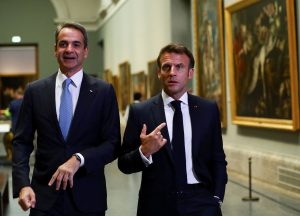
 The upcoming visit of French President Emmanuel Macron to Athens on April 24–25 is expected to take on a special character due to the international geopolitical context, as well as the renewal of the Greek–French strategic cooperation in defense and security. The French side is arriving with a large delegation, including the country’s biggest companies, and agreements are being prepared on submarines, nuclear energy, defense innovation, and infrastructure projects.
Delegation of 52 people
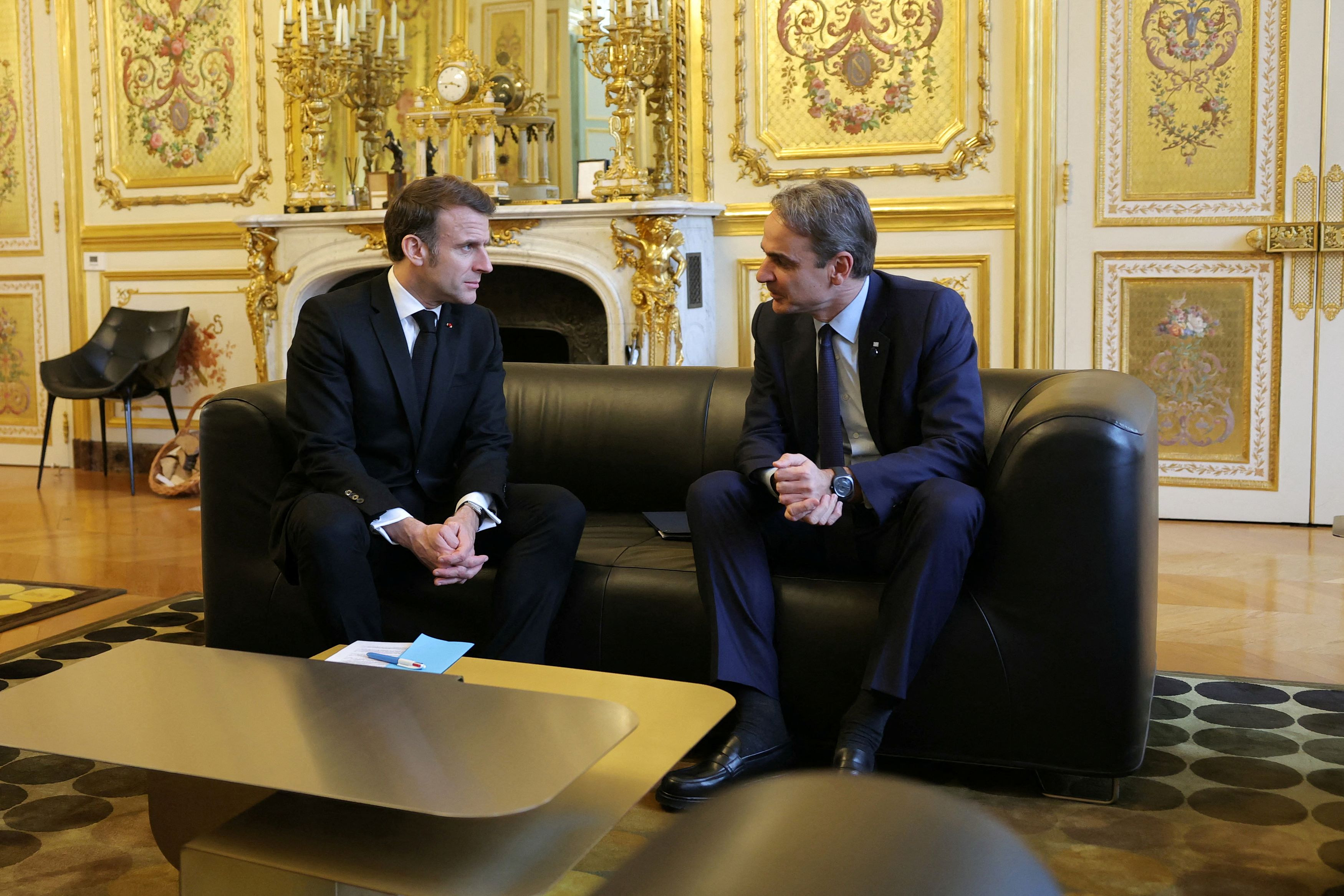
According to a French Élysée official familiar with the negotiations between the two sides, who spoke to To Vima on condition of anonymity, the new agreement will go far beyond the original one of 2021, when Emmanuel Macron and Kyriakos Mitsotakis signed the “Strategic Partnership Agreement for Cooperation in Defense and Security,” further strengthening ties between the two states.
At this point, it is worth noting that the French government delegation arriving on April 24–25 will be larger than before and will consist of 52 people. This is something new and signals an upgrade of Greece’s standing in its relationship with France, because, according to the protocol of the French presidency, the number of officials reflects the importance of the partner. According to information, President Macron will be accompanied by the Ministers of Foreign and European Affairs Jean-Noël Barrot, Defense Minister Catherine Vautrin, Culture Minister Catherine Pégard, and possibly two more ministers whose participation had yet to be formally confirmed.
The crisis that brought the two countries closer
Also arriving in Athens will be presidential diplomatic advisors for Europe, the Mediterranean, and Defense, representatives of the French Ministry of Armed Forces (for talks on defense cooperation, the Belharra frigates, Rafale aircraft, and defense innovation—together with representatives of the French Directorate General for Armament), as well as officials from the French Ministry of Foreign Affairs.
The event that brought the two countries closer was the Greek–Turkish crisis in the summer of 2020. That crisis alerted the Greek Prime Minister’s office to the need for strengthening the country’s defense shield, while also reminding France that its vital interests, especially in the Southeastern Mediterranean, should not be taken for granted. This crisis coincided with the now unavoidable need to modernize the equipment of the Greek Armed Forces across all three branches: the Air Force, Navy, and Army.
Within a short period, Greece acquired 24 Rafale fighter jets, while the three FDI (Belharra) frigates of the “Kimon” class became four, a sign of mutual trust between the leaderships of the two countries. None of this, of course, happened overnight; it was the result of negotiations conducted in a climate of goodwill. And the issues were closed in record time.
The three pillars of the visit
To Vima is able to report that the visit will revolve around three axes. The first has already been mentioned and concerns the renewal and strengthening of the 2021 agreement.
The second axis will be primarily defense-related. Occasionally, proposals have been discussed to provide Greek Mirage 2000-5 fighter jets to Ukraine in exchange for compensation, but this has not moved forward for obvious reasons: Greece cannot give away even one fighter jet unless it has another to replace it (e.g., Rafale). And such a replacement is not currently in sight.
On the contrary, according to people familiar with the defense needs of the Armed Forces, a program that is likely to be at the top of the list for the next round of defense procurements (a €5 billion program was approved just a few days ago) is submarines—a weapons system that requires 6 to 8 years to build.
A proposal is highly likely from the French side for the supply of submarines either of the Scorpène class or the Blacksword Barracuda class.
If this scenario materializes, it is almost certain that the remaining two or three submarines in the agreement will be of the same class, making the Greek Navy a force composed almost entirely of French-origin vessels.
The third axis will include, among other things, French assistance and cooperation with Greece in the field of nuclear energy for commercial purposes.
Already from Prime Minister Kyriakos Mitsotakis’ visit to Paris for the 2nd Nuclear Energy Summit on March 10 this year, a first indication of the Greek Prime Minister’s intentions was given: “Nuclear energy is changing rapidly. There are fast technological developments, enormous innovation. And we know that our demand for electricity will continue to increase. Regardless of how much we expand renewable energy sources, we will need long-term predictable baseload energy. No technology can compete with what nuclear energy offers us,” he stated at the time.
President Macron said at the same summit that nuclear energy allows France to lead technological developments, “as it provides the necessary energy for the operation of large data centers and the development of computing power required by the challenge of Artificial Intelligence.”
Other areas of cooperation
According to the same source, France intends to provide technical support for the giant PPC (DEI) data center in Western Macedonia, a project mentioned in an interview with To Vima by former US ambassador to Greece Geoffrey Pyatt on April 12, which aims to export energy to the Western Balkans.
Other areas of cooperation in this third axis include tourism, health, education, culture, civil protection, and innovation—especially in relation to military technology, which is a key objective of the Greek government. Another French source familiar with the issue recently spoke warmly about Greece in this sector, specifically mentioning ELKAK, the Hellenic Center for Defense Innovation.
For his part, ELKAK CEO Pantelis Tzortzakis notes: “For me, the Greek–French agreement also has a personal dimension. We created ELKAK largely by looking at the French model—we saw there how research can be connected with defense application and we said ‘this is what we want to do.’ The AID (Agence de l’Innovation de Défense) was there from the beginning, when we were still finding our path—they gave us expertise and trust. Now, with the renewal of the agreement, I feel it is time to move forward. To do things together, not just to buy and receive. The relationship has matured—and so have we.”
The French delegation list includes the country’s largest companies, such as Dassault (manufacturer of Rafale), Naval Group (Belharra), MBDA (missiles), Thales (Belharra etc.), EDF (Electricité de France), SoftBank (technology investments), Horiba (research equipment), Framatome (civil nuclear energy), ACC (low-carbon batteries), Pasqal (quantum technology), Safran, Vinci (construction), Suez, and Total (energy). Alongside them will also arrive French startups and tech companies such as Contentsquare, Look Up Space, Mistral AI, and Verkor.
For the Greek government, the Greek–French friendship is entering a new phase and acquiring the characteristics of a multi-level cooperation—not only in diplomacy and defense, but also in areas such as online child protection and other initiatives at the forefront of shaping the European framework.