In the dimly lit churches of his childhood, he sought out the figures that fascinated him most: mounted saints wielding flaming swords, strange trees, and the golden skies of Byzantine icons. Years later, these early experiences would return, transformed in the paintings of Alekos Fassianos, in a world inhabited by human figures that seem at once familiar and drawn from memory, myth and imagination.
A few days before the opening of the exhibition The Enigmatic World of Man, Monk Aetios welcomed us into the “Technis Fylaktirion” Contemporary Art Gallery at the Panachrantou Monastery on Andros. The exhibition had only just been installed. Amidst the paintings, artists books, prints and sculptures by Alekos Fassianos, the absence of the artist himself was palpable, even as his presence seemed to permeate every room.
This feeling is perhaps best expressed by collector Christos P. Moschandreou, a close friend of the painter and one of the people who played a decisive role in preserving and promoting his work:
Alekos Fassianos and I were connected through our common roots in Nafpaktia—his through his late mother and mine through my father—as well as through our profound and genuine love for Greek Art. Fortunately, my passion for collecting coincided with a successful professional career in Greek advertising and the financial means to pursue it. In 1995, during one of our meetings, I revealed to him my intention to establish an Art Gallery in Messolonghi, my birthplace, to house my collection. Fassianos contributed immensely to making that vision a reality. In 1996, at the Old Parliament in Athens, we presented a new edition of our National Anthem, which had first been published in Messolonghi in 1825, accompanied by two engravings by Alekos Fassianos. Our late mutual friend Apostolos Gavras persuaded me to become a collector of the limited and collectible editions produced in runs of 30 to 150 copies, featuring engravings, original artworks, woodcuts and linocuts by Fassianos. In 2016, we presented the 91 books from my collection containing works by Fassianos at the Municipal Gallery of Athens, in Agrinio, and in Corfu, the birthplace of his father. The absence of Alekos Fassianos is felt by everyone, but above all by Greek culture, which he loved deeply and to which his contribution was invaluable.
The retrospective exhibition, presented from June 27 to September 30, seeks to illuminate precisely this contribution. Through rare works from the Alekos Fassianos Estate, the Christos P. Moschandreou Collection and private collections, it traces the journey of an artist who shaped one of the most recognizable visual languages in postwar Greece.
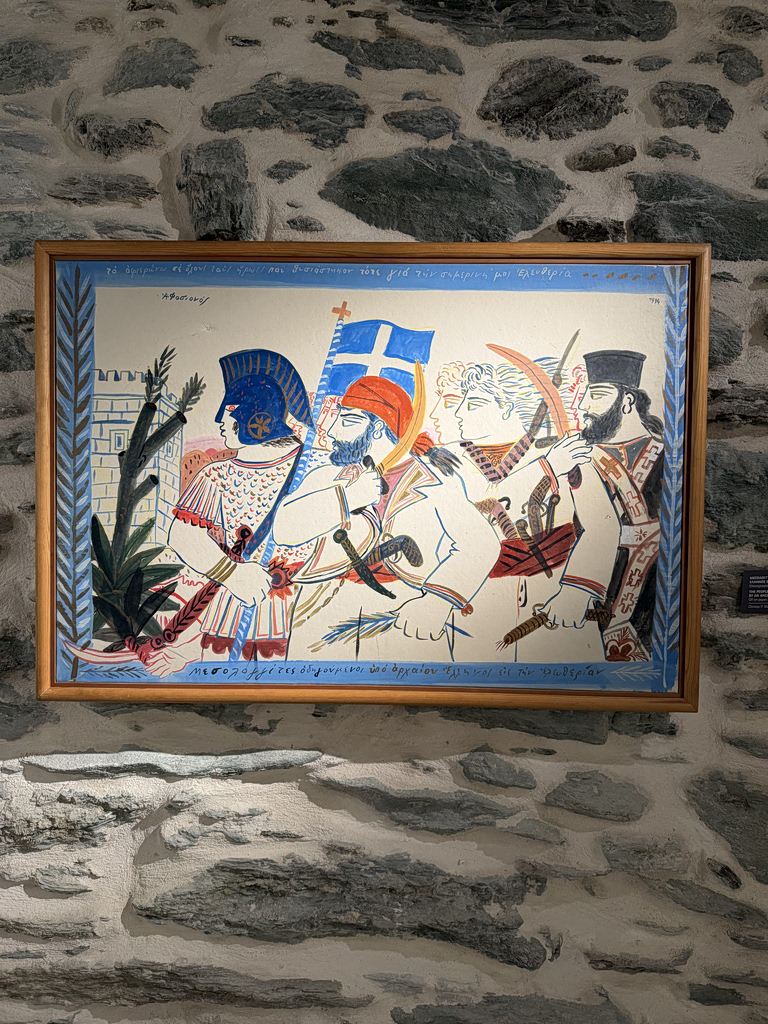
A painting from the collection of H. Moschandreou. PANOS KOUGIAS/TO BHMA INTL EDITION
“My grandfather was a priest. I was born in 1935, right next to the church where he served. We lived in a small house overlooking the sunsets near the Church of the Holy Apostles, beneath the Acropolis. From a very young age, largely because of my grandfather, I wandered through the dimly lit post-Byzantine churches, helping him at times by carrying the censer and at others by reading passages from the Epistle.
My mother was a philologist with a passion for the ancient Greek world. She would take me to museums, to the Acropolis, and wherever ancient artefacts could be found. My father was a musician, and so I learned to play the violin. I do not think that influenced me very much, because from early childhood all I wanted was to paint. Until the age of seventeen, I taught myself. On the one hand, I inhabited the magical world of church icons; on the other, the sculptural worship of the ancient Greeks.
More than the religious aspect itself, however, I was captivated by the icons—both Byzantine and folk. The mounted saints, with their halos and flame-emitting swords, slaying beasts, made a profound impression on me. So did the barren Byzantine mountains in the background, the strange trees and plants, and the golden skies. I tried to copy the icons. Yet I also wanted to create my own images, to express a world of my own, already shaped by everything I was seeing around me. The figures I paint today wield flaming swords like the Byzantine saints. Yet they are otherworldly creatures, born of my own imagination, emerging from those dark churches of my childhood.
I love masses of red or blue, but not in the abstract. I want colour and line to symbolize something. That is why the figures I paint are always dissolving, living among flowers. Perhaps they are dead.” As Alekos Fassianos noted, these worlds coexist throughout his work, and today they re-emerge at the Monastery of Panachrantou.
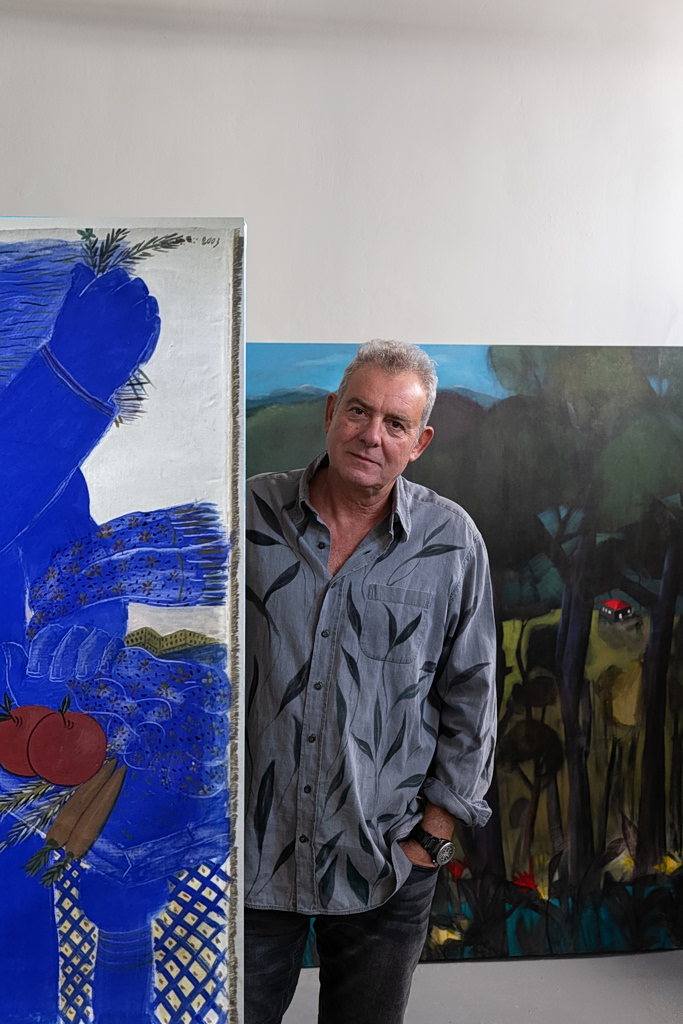
Christos Kehagioglou with a painting by Fassianos. PANOS KOUGIAS/TO BHMA INTL EDITION
On the occasion of the exhibition, we spoke with its curator, the painter Christos Kehagioglou, about the relationship between Fassianos’ work and the unique setting of Panachrantou Monastery, the spiritual origins of his art, and the “enigmatic world” of humanity that, in his view, lies at the heart of the artist’s creative vision.
The “Technis Fylaktirion” Contemporary Art Gallery is housed within a historic monastic complex imbued with spiritual significance. Tell us a few words about the permanent collection, and about how you envision the role of Panachrantou Monastery and this new cultural initiative within Greece’s contemporary artistic landscape.
The “Technis Fylaktirion” Contemporary Art Gallery was born from the desire to create, within the unique spaces of the Holy Monastery of Panachrantou, a place dedicated to art that highlights the spiritual dimension of contemporary artistic creation. It brings contemporary art and tradition to the same table, with spirituality serving as the common ground.
It is a creative interaction in which contemporary art acquires a different depth when anchored within such an environment, while tradition, by embracing the contemporary, reveals the meaningful role it can still play in today’s society.
The permanent collection includes works by important contemporary Greek artists and seeks to offer a concise overview of the various expressions of spirituality in modern and contemporary Greek art.
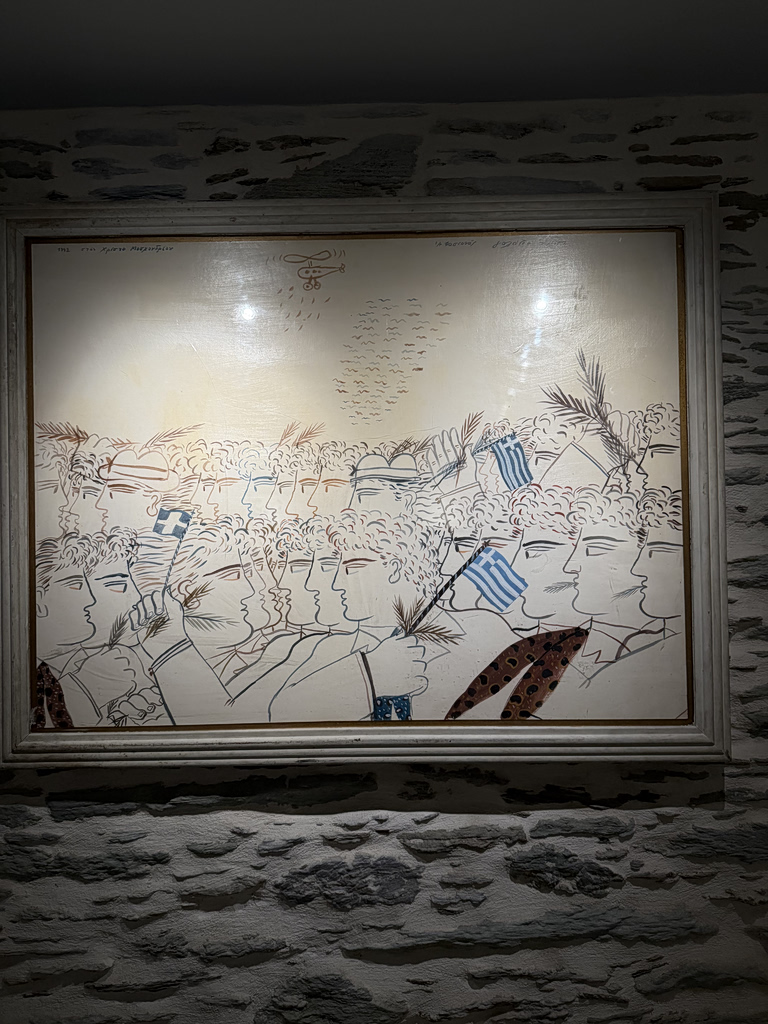
A painting from the collection of H. Moschandreou. PANOS KOUGIAS/TO BHMA INTL EDITION
Our vision for “Technis Fylaktirion” is that, over time, it will become a space of reference and dialogue and contribute to a more meaningful encounter between contemporary art, spirituality and our cultural heritage. The Church and contemporary art have often kept their distance from one another, even though at their core they share common concerns about the human condition. It is this deeper connection that we wish to bring to light.
Why did you choose Alekos Fassianos to inaugurate the gallery’s new cycle of temporary exhibitions? Which aspects of his work engage most meaningfully with the distinctive character of Panachrantou Monastery?
The choice of Alekos Fassianos was almost self-evident. He is undoubtedly one of the most important artists of the twentieth century. His work is instantly recognizable, deeply loved in Greece, profoundly human-centered, rich in spiritual dimensions, and highly expressive of modern Greece. He also maintained a deep connection with the Church through his grandfather, a cultivated and influential figure who left a lasting impression on him. “My grandfather was a priest,” he would often say with pride.
He was an artist who succeeded in creatively transforming antiquity, Byzantium, the folk tradition and contemporary experience into a wholly personal visual language. Without directly addressing religious subjects, he touches upon humanity’s presence in the world, our relationship with time, memory, love and decay, and our search for meaning. At the same time, the luminous, two-dimensional world of his paintings bears intriguing affinities with Byzantine art. Within the unique environment of the monastery, his figures acquire an additional dimension of contemplation, in a sense offering a different version of the Icon.
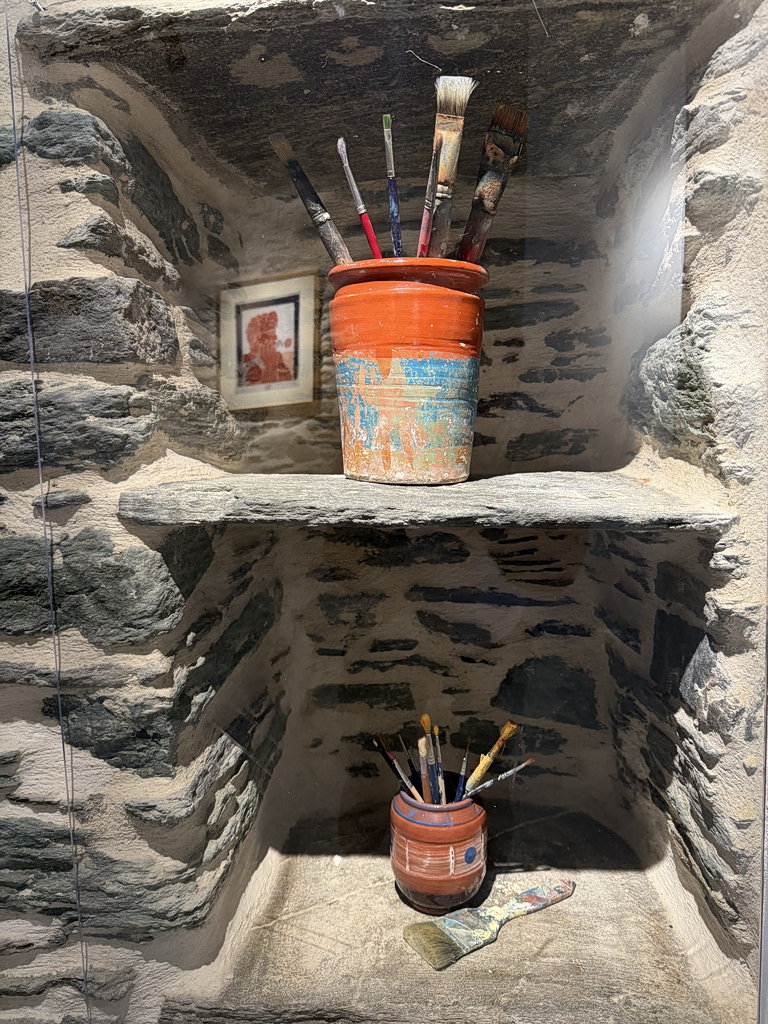
PANOS KOUGIAS/TO BHMA INTL EDITION
The exhibition is titled “The Enigmatic World of Man.” What do you hope visitors will take away with them, and which aspects of Fassianos’ artistic journey does the exhibition forefront?
The title “The Enigmatic World of Man” does not refer to a mystery awaiting resolution, but rather to that timeless dimension of human existence that art continually seeks to approach but never exhausts. This element runs through our ancient, Byzantine and folk traditions, and I believe it also lies at the core of Alekos Fassianos’ work. His figures seem to bring us very close to the essence of humanity without ever fully revealing it. In that sense, they remain enigmatic.
In curating the exhibition, I was not interested in a strictly chronological or thematic presentation. Paintings, prints, sculptures, art objects and handmade books coexist freely, creating a unified world that allows visitors to approach the artist’s evolution, but above all the atmosphere of his work.
As they wander through the stone spaces of the monastery, I would like visitors to feel that they are encountering something of the artist’s own presence—his thoughts, his sensitivity and his world.
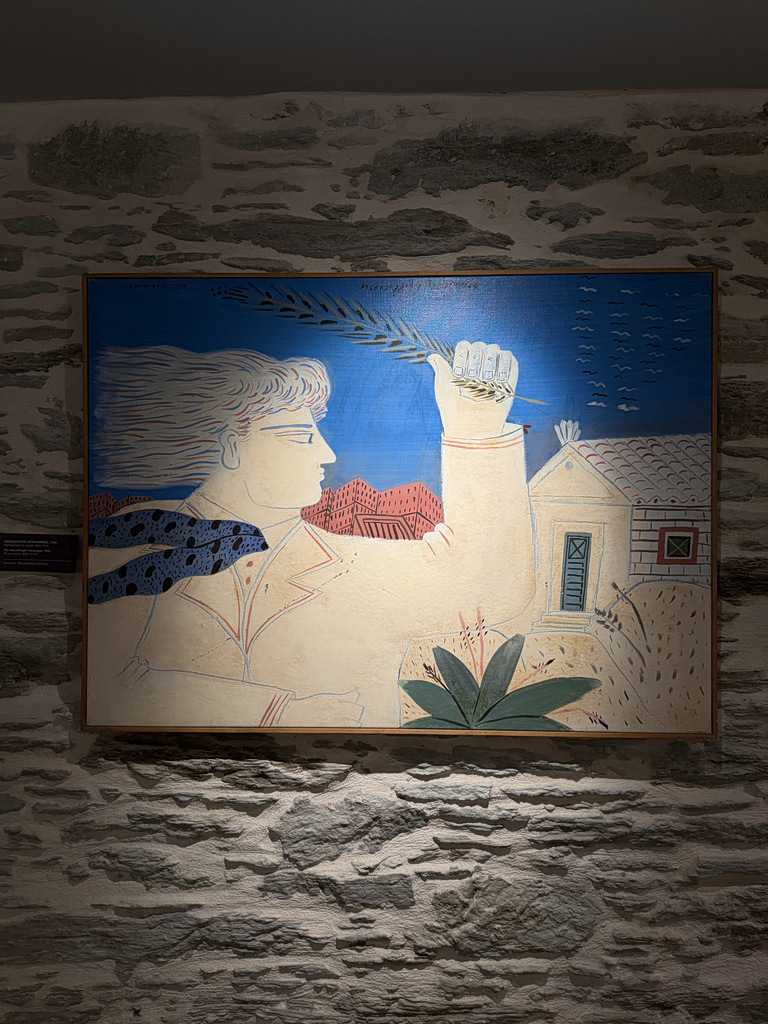
A painting from the collection of H. Moschandreou. PANOS KOUGIAS/TO BHMA INTL EDITION
Through rare works, many of which have seldom been exhibited or are being shown to the public for the first time, the exhibition highlights the way Fassianos transformed elements of Greek tradition, mythology, folk art and contemporary life into a unique visual universe.
I hope visitors will leave having gained a deeper understanding of his work, but also with the feeling that his figures continue to speak about questions that remain essential and relevant to all of us.
As a painter with your own artistic journey, how did you approach Fassianos through a curator’s lens? Were there aspects of his work that influenced you personally or led you to a new understanding of the relationship between art and human existence?
I knew Alekos Fassianos personally and always held him in great affection and esteem. His way of speaking was simple, intelligent and deeply poetic, filled with humor and remarkable insight. All these qualities can also be found in his painting.
As the curator of this exhibition, I wanted to reveal something of the presence of the man, not just the renowned artist. For that reason, I chose to stage an exhibition that emphasizes the atmosphere of his work rather than an academic reading of it.
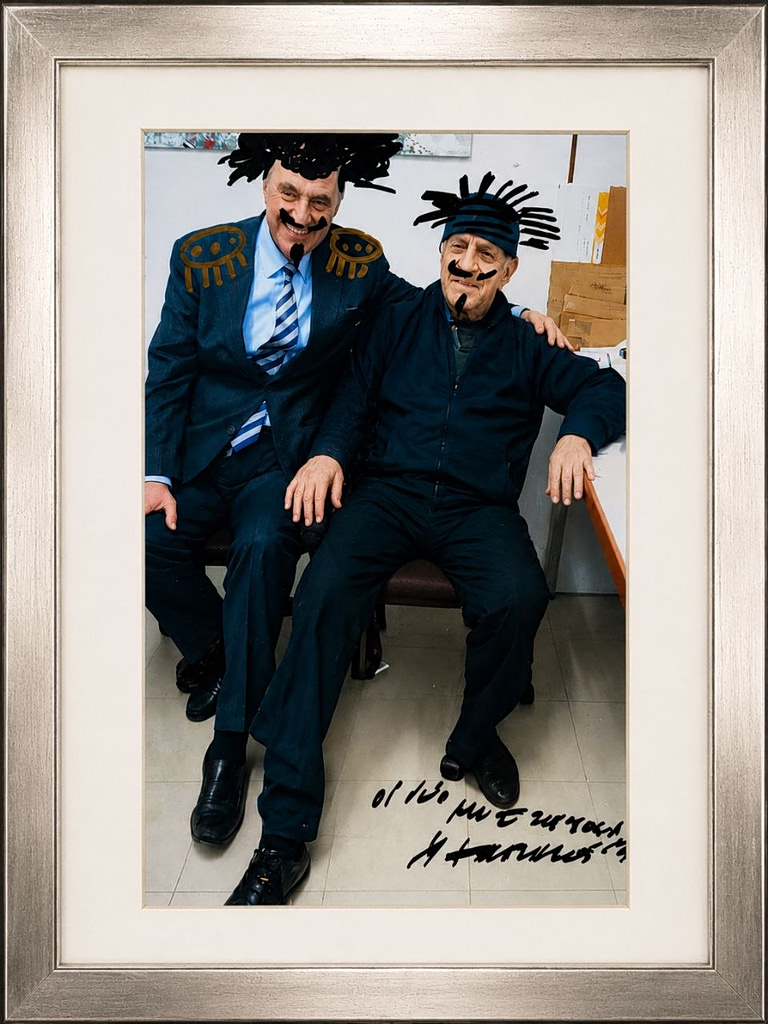
PANOS KOUGIAS/TO BHMA INTL EDITION
Preparing the exhibition gave me the opportunity to delve even deeper into his oeuvre. What continues to move me most is the consistency with which he remained devoted, over decades, to the fundamental questions of human existence: love, desire, memory, friendship, freedom, our relationship with time, and our relationship with nature.
The more one observes his figures, the more they acquire an archetypal dimension. They do not refer to specific individuals or situations, but to experiences that are universal and timeless. He himself famously said that they were “otherworldly creatures of my own imagination, born out of the dark churches.” I believe this phrase is uniquely illustrative of both the inner world of Fassianos’ work and how he related to the ecclesiastical environment.
Engaging with his work renewed in me a profound conviction: that art remains the most meaningful way of approaching the enigma that is humanity. Science helps us understand the world; art allows us to come closer to its mystery.