
 Μake us preferred on Google
 We may have reached the end of the first week of June, but it’s just the beginning of what will be an action-packed summer in Athens, Greece. Concert and festival season is in full swing, with the Athens Epidaurus Festival alone hosting over 90 cultural events this season. However, summer in the capital is not for the weak—or the unprepared.
Each year, the heatwaves across Europe are causing more and more discomfort. A recent news bulletin by the UN World Meteorological Organization, warned that the extreme weather phenomenon known as El Niño will be exacerbating what is an already overheated climate. This year’s heightened temperatures have already brought heat-related casualties to Spain, France and the United Kingdom. Athens is surely not far behind, with this month’s forecasts predicting hot days upwards of 32 degrees Celsius.
With enough sweaty years spent in the city and painful sunburns to boot, this survival guide contains a local’s wisdom for you to follow. That way, exploring the city will be fun without any sudden fainting spells, or unnecessary visits to the nearest ER.
If you have experience dealing with hot summers, take this article and pass it on to a friend who is planning their first Athenian vacation.
Photo by Elena Markopoulou
Shade ≠ protection
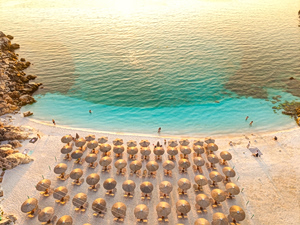
Avoiding the sun doesn’t guarantee you won’t get burned. What burns the skin isn’t the actual sunlight itself, but ultraviolet (UV) rays which are invisible to the naked eye. In a research article published through the Skin Cancer Foundation titled “If You Can See Sunlight, Seek The Shade”, it is repeatedly noted that not all shade is equally protective. A beach umbrella makes you feel covered enough, but you remain exposed to 80% of all UV rays.
Take note of the daily UV index in your Weather app of choice. It’s more valuable than you may realize.
Reapplying sunscreen is not optional
This may be common knowledge to some, but it bears repeating. We have moved on from “sloppy” tubes of sunscreen that get tedious to apply, so there is no excuse to skipping this step. High-SPF sunscreens are now available in face mist and stick form, so pick whichever suits you best.
It is recommended by Johns Hopkins Medicine that you reapply your sunscreen every 2 hours, and immediately after swimming and/or excessively sweating. The lowest SPF protection you should be using is at least 30, but Greek locals tend to go for factor 50. Sunshine and heat are particularly aggressive, on a busy day that extra strength can help balance one or two missed re-applications.
At the end of the day, nobody likes dealing with itchy, flaking skin on their vacation. So make sunscreen a daily priority!
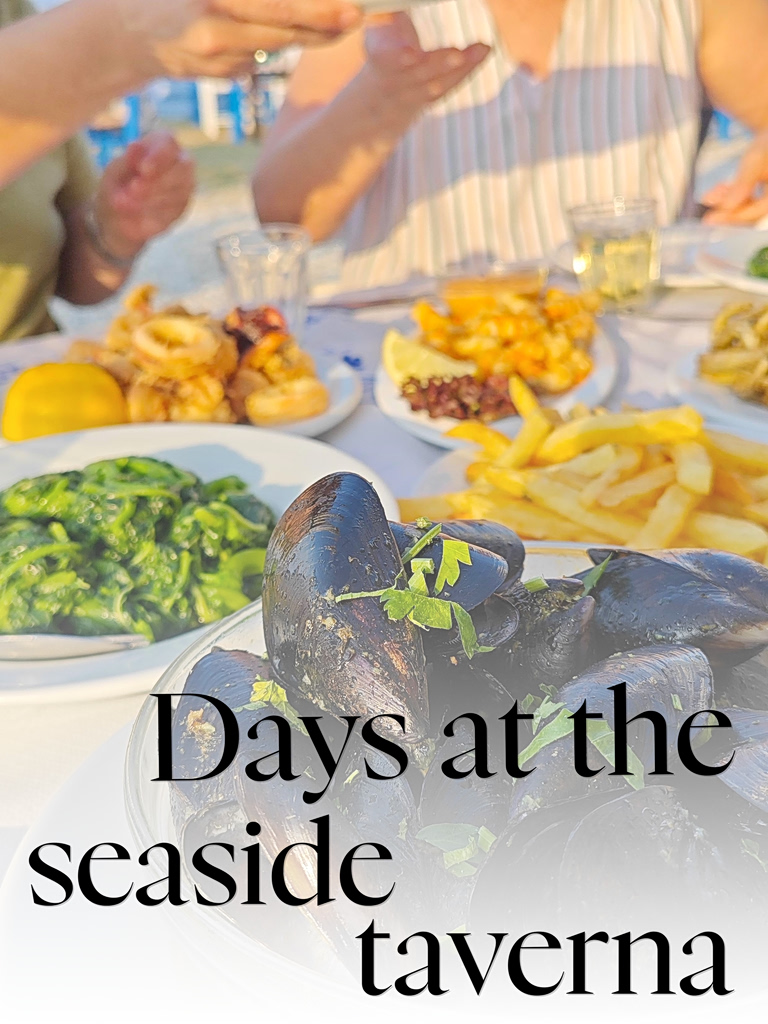
Photo by Elena Markopoulou
Mediterranean cuisine and peak fruit/vegetable season
An authentic Greek gyros is irresistible even on the hottest summer day. No one is telling you not to indulge—but it would be wiser to keep the heavier dishes for dinner.
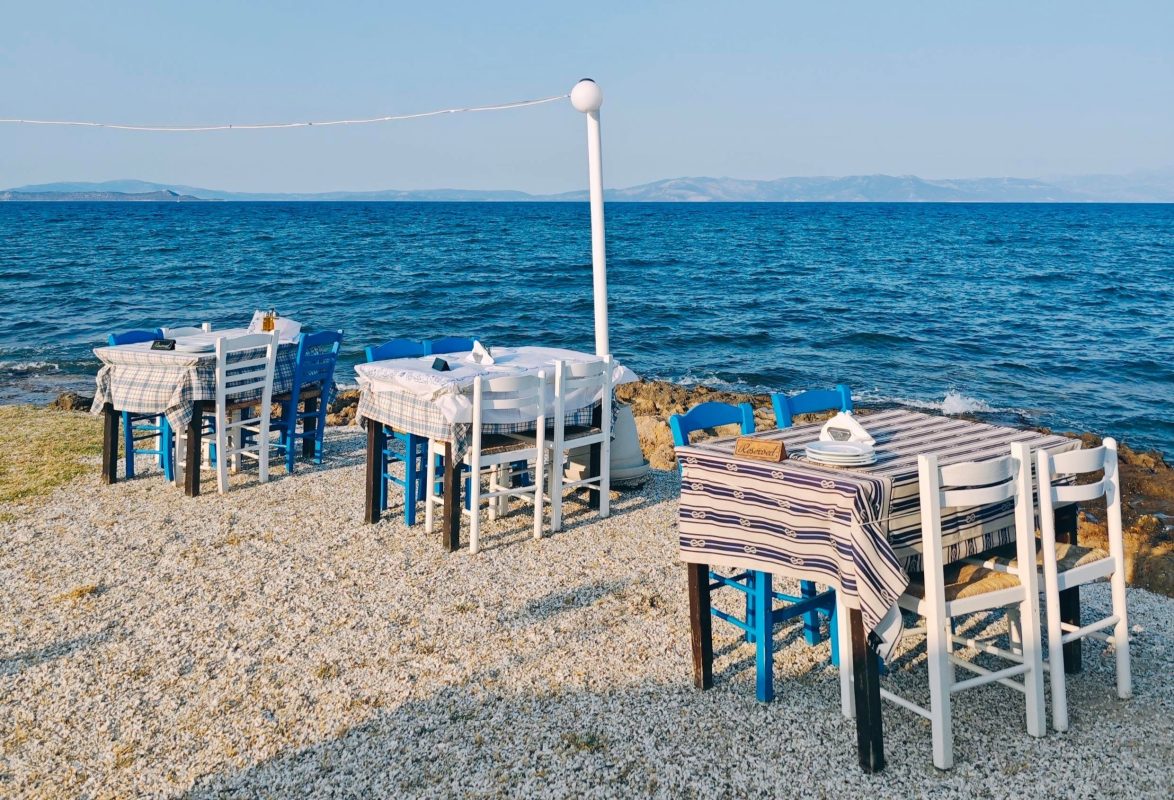
Take advantage of the fresh produce and Mediterranean dishes during the day to stay full without weighing yourself down. Tried and true taverna staples Athenians most look forward to come summer are taramosalata (Greek roe fish dip), fried calamari and steamed mussels. Fresh figs are a Greek summer snack staple, as well as cantaloupe and watermelon.
Spending your time… swimmingly!
Health authorities worldwide strenuously discourage tanning, but it’s a summertime tradition embedded into vacationing.
When we’re at the beach we often rely on tanning oils to help bring that sun-kissed skin home. However, you should know: not all body types tan. If you have noticed that, unlike others, you peel but don’t get that glowing caramel shade, it’s genetic. All bodies contain melanin (the pigment that darkens the skin when exposed to sunlight), but in different quantities and quality. Do not fall for the tanning oil advertisements promising you the perfect tan.
If you’re trying tanning oils regardless, use an SPF factor 30 sunscreen prior and don’t go cooking yourself under the scorching heat for longer than 2 hours at a time. Instead of a lovely tan, you may end up looking more crustacean than desired.

Photo by Nansy Samaka
Open-toed footwear VS sneakers
Regardless of how hot it may or may not be outside, you will be traipsing around a city. Taking any form of public transport in open-toed shoes can be done successfully… as long as it’s not literal flip flops. You don’t want to find yourself gluing your shoe back together or wrapping up your foot with the first thing in your bag.
Sneakers are always preferable when a long commute (or an extra long walk) is anticipated. If that’s not at all your style, opt for a stronger-soled companion like the trusted Birkenstock. For anyone choosing to wear heeled sandals, the sidewalks in Athens are not particularly heel-friendly. Beware of cracks in the road, sudden dips and slippery cobblestone.
All-time summer trend: chic headwear
Whether you prefer straw hats, baseball caps, cotton bandanas or silk scarves, pick some headgear to wear along with your sunglasses.
Much like all shade is not equally protective, same goes for hats and head coverings. Health authorities advise you pick a wide-brimmed hat that covers your face, ears and neck. Bucket hats tend to be the ideal candidate, but straw hats can also do the trick.
Understandably, you may not want to wear a prominent hat. Most Athenians who are not hat-wearers alternatively wear bandanas or scarves. Even if you don’t go for the safest option, any head covering in the summer is better than none.
Linen and natural fabrics preferred
Speaking of fashionable choices, clothing also plays a huge role in combating the heat. Basic color theory dictates that darker colors absorb more light, thus get warmer faster. Assuming this will not stop you from committing to a dark-hued summer wardrobe, your next “saving grace” lies within your closet’s composition labels.
Beware of anything 100% polyester, elastene and synthetic fibers. Not only do they get very hot, they absorb all bad odors faster and are tough to keep clean. Opt for natural fibers that breathe: silk, cotton, viscose and any variable blends.
Photo by Elena Markopoulou
Afternoon strolling tips
Resisting the temptation to go outside when the sun is at its hottest, so as to make the most of your trip, is hard. Museums, shops, outdoor exhibitions, festivals, there’s so much to do in the city and only so many days to do it.
The warmest hours vary slightly by day, so keep an eye on your Weather app of choice for accurate data. Generally, from around 1p.m. to 4p.m. is when Athens starts sizzling—but that can start earlier and end later if we’re experiencing heatwaves. If your need to see the sights trumps all, do not leave home without a large bottle of water and all the sun protection aforementioned.
You may notice as you walk around the busy downtown streets that everyone is holding takeaway cups with skinny black straws. Hot days are ideal to try the quintessential Athenian beverage: an ice-cold freddo espresso. The magical caffeine booster that when created correctly, can withstand even the hottest of days!
Don’t be a dead giveaway tourist
Athenians, similar to New Yorkers, have certain pet peeves which also translate into great self-defense for any newcomers. “Emily In Mykonos (Paris)” may have some extravagant brand sponsorships and couture wardrobe… but that’s Mykonos. Someone kind will tell you that locals won’t judge you for living your Greek vacation dream—someone honest may disagree. Athenians dress with intention and sneaky thieves in mind, which makes spotting the tourists among a crowd that much easier.
It is the densely packed, central areas that you should avoid if you’re planning on wearing your finest summer outfits. TripAdvisor put Greece 9th in its list of Top 10 Places to Beware of Pickpockets, noting one should “keep their bags close to the vest while your eyes admire the rest”. Since most ancient sites are outdoors, you never know who may slip by you.
Kolonaki, which is downtown Athens’ most expensive neighborhood, would be the safest place to wear your high-end resort pieces. Even so, to any true Athenian, the overly polished look is a dead giveaway of a tourist. Similar to the lobster-red skin, cargo shorts and flip flops movie trope!
Finally, don’t ignore government warnings
If you’re going to take anything away from this guide, let it be the following: take the severe weather alert issued by the Ministry for Climate Crisis and Civil Protection seriously. Heatwaves in Athens and any concrete-filled city are no joke, which is why every household is properly equipped: fans, air conditioners, cold water etc. An alert urging you stay indoors means the cityscape is reaching boiling temperatures.
Braving the heat is not worth it, even if it costs you precious hours from your booked and busy day. Unlike a casual sunburn, a heatstroke can have pretty immediate, potentially deadly consequences. Symptoms include confusion, lack of coordination, fever, and skin that is cool to the touch despite high body temperature. Heatstroke can also cause severe breathing difficulties, further escalating to seizures and losing consciousness. No amount of historical adventuring or time pressure is worth risking ones health and even life over.
Which is why when the streets are suspiciously empty, stay in a cool space until sundown. Enjoy a choriatiki (Greek salad), some tsipouro and take it easy for a while—arguably the most Athenian quality one could embody!