 Μake us preferred on Google
 On this day, May 5th 1955, precisely 71 years ago, the Allied military occupation of the Federal Republic of Germany (FRG), otherwise known as West Germany, was lifted. It had been in effect since the defeat of the Nazis on May 8th of 1945, nearly a decade prior. This moment marked not just the end of occupation, but West Germany’s full integration into the Western Cold War alliance.
West Germany itself had only been formed 6 years prior, on May 23rd, 1949. It emerged as a separate democratic state from the gradual breakdown of the four-power Allied cooperation, the solidifying of Cold War divisions, and the Western powers’ determination to stabilize and rebuild the western occupation zones economically and politically.
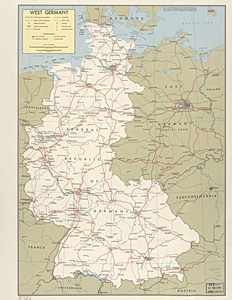
A 1969 map of West Germany, showing the division between the Federal Republic of Germany and the East German Soviet Zone. Library of Congress
The Limits of Sovereignty
Pressing unresolved issues such as what to do with the divided Berlin, or the eventual long-term issue of reunification meant that the allies were not unilaterally withdrawing from the German question as a whole. In fact, the allies kept control over West Berlin, and foreign troops were to stay on German soil. West Germany was now sovereign in principle, but not fully independent in practice.
Firmly embedded in the US-led Western orbit, West Germany became both the centerpiece of the Allied propaganda campaign showcasing the virtues of liberal capitalism, and a critical strategic partner in the NATO European military order.
A Decision of Momentous Gravity
Konrad Adenauer, the first Chancellor of West Germany, also made the conscious decision to prioritise integration with NATO and the Western socio-political economic model, over the prospect of immediate reunification with Eastern Germany. He anchored West Germany firmly within the Western Bloc, sacrificing the aspiration of German unity for the foreseeable future, to gain security, legitimacy and prosperity within the Western alliance.
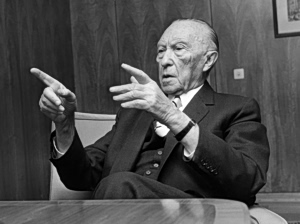
Former German Chancellor Konrad Adenauer gestures in December 1965. (AP Photo/Heinrich Sanden jr.)
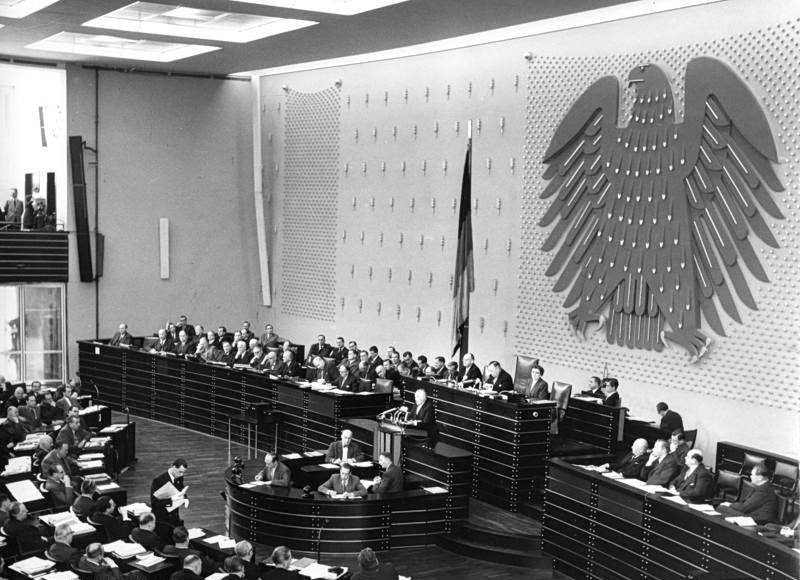
In February 1955 Adenauer addressed the Bundestag (German parliament), stating: “Today marks the end of the era of occupation for the Federal Republic of Germany… we are a free and independent state.”
The German political scene was not united in this assessment. Opposition party leader Erich Ollenhauer of the SPD (Social Democratic Party) stated: “Germany remains split. We can only talk of German sovereignty when Germany is reunified in freedom.”
Both men were, in their own way, correct. West Germany’s sovereignty was not just taken for granted but was strategically negotiated and traded for alignment with the West. Nominal freedom had been achieved, but at the cost of the country’s division.
Why 1955?
A decade following WWII’s conclusion, the world order had changed dramatically from the three-power (US, USSR, Britain) coalition. China had emerged as a communist country in 1949, and the USSR had acquired nuclear weapons the same year. Rising Cold War tensions meant that the Western Allies needed West Germany as a military partner against the real or perceived threats of the communist world. The Berlin Blockade (1948 – 1949) and the Korean War (1950 – 1953) had made that need impossible to ignore.
But needing Germany and being able to rearm Germany were two different problems. The first attempt at a solution, the European Defence Community was a proposal for a supranational European army that would absorb West German troops under multilateral control. This initiative collapsed in August 1954 when the French rejected it, calling upon their living memory of two German invasions to veto the prospect of a militarily augmented Germany.
The West required an immediate alternative.
That alternative was the Paris Agreements of October 1954. Rather than folding West Germany into a new supranational army, the Agreements took a more direct route by bundling the formal end of the Allied occupation with full NATO membership in a single package.
To make this work and allow Germany to rearm and contribute to the alliance, it required the markings of legitimacy. The most unambiguous symbol of legitimacy has always been the possession of full sovereignty. With sovereignty fully restored, Germany could officially rearm.
It was now authorised to build a conventional military force of up to 500,000 troops, though explicitly prohibited from developing nuclear, biological, or chemical weapons.
The Soviet response was immediate. Nine days after West Germany was granted sovereignty and entered NATO, the USSR established the Warsaw Pact on May 14th, 1955. The military line of the Cold War had been drawn in permanent ink.
Looking Through the Historical Lens
What Adenauer agreed to in 1955 did not just define West Germany’s place in the Cold War, it set the terms of division for an entire generation.
The two Germanies became fundamentally different in their visions of the country, each one being pulled in by the geopolitical and ideological orbits of the two competing superpowers of the Cold War. The gravitational pull of the West and East was economic, political and ideological all at once, creating divisions that were made concrete in August 1961 when the Berlin Wall was erected.
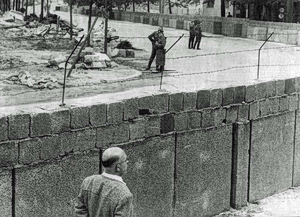
A West Berlin civilian stands alongside the newly erected Berlin Wall as East German border guards patrol the other side, August 1961. (Wikimedia Commons)
For 35 years, an entire generation, East and West Germany remained divided, until reunification in 1990, an event that preceded the collapse of the Soviet Union itself by just over a year.