 Μake us preferred on Google
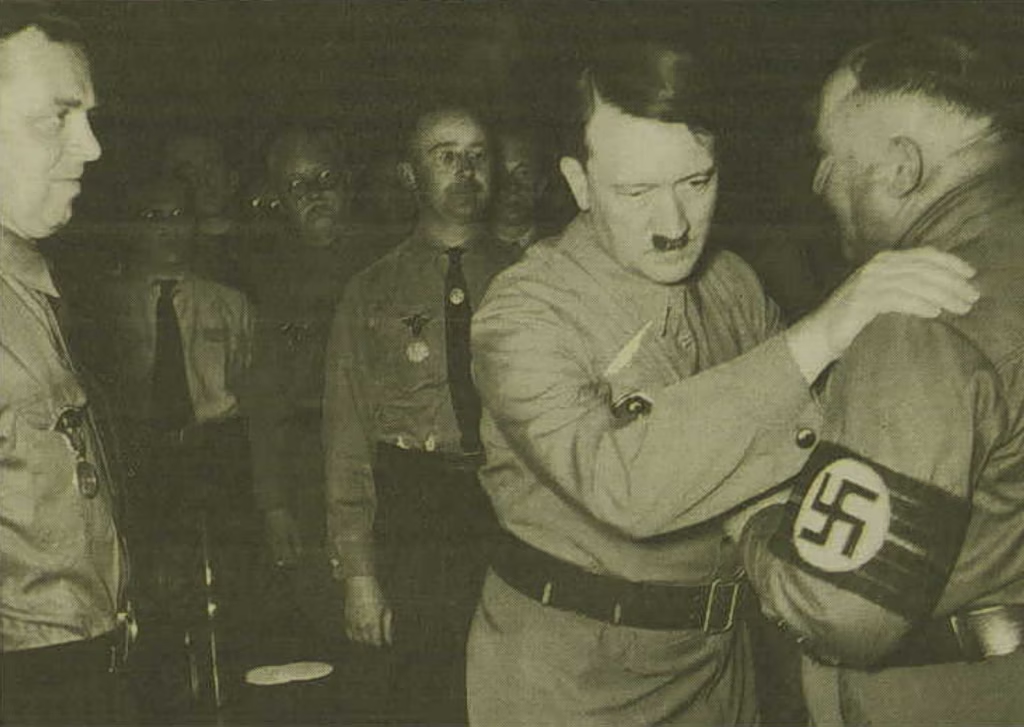
 Hitler’s death has been a topic of widespread cospiracy theories over the years.
The official story goes as follows: On April 30, 1945, Adolf Hitler and his wife of one day, Eva Braun, committed suicide inside the underground shelter of the Reich Chancellery — the infamous “bunker.” The Red Army had already encircled Berlin, and the Third Reich was crumbling.
Months of relentless military defeats for Nazi Germany had preceded this moment, along with the Allied advance from the west, the Soviet push from the east, and the final Battle of Berlin that sealed the fate of the war in Europe.
Yet Hitler’s death immediately gave rise to speculation, contradictory testimony, and theories that kept historians, intelligence agencies, and courts occupied for decades.
In the November 19, 1972 edition of To Vima, the subject was presented as a historical enigma that the two Germanys were attempting to resolve once and for all. Pierre E. Mervil wrote:
“The Germans, East and West, have decided to settle the riddle once and for all: What was the true end of Adolf Hitler? Twenty-one versions of the Führer’s ‘final hours’ were put forward and defended with serious arguments. After the rapprochement of the two German states, the time for truth has come.”
The Will and the Wedding Before the End
In his final hours before taking his life, Hitler dictated both his political and personal last will and testament. As reported in To Vima:
“While the Russians are closing in (no more than 1,500 meters from the bunker), Hitler locks himself in a room with Gertrud Junge to dictate his political and personal will. The secretary types the text in four copies during the night, and Hitler signs it at 4 in the morning of the 29th.”
Immediately afterward came his marriage to Eva Braun: “As soon as the dictation is finished, the Führer moves to the next order of business: he marries Eva Braun. The ceremony takes place without any formality, before a certain Walter Wagner, a registrar from the capital who had been summoned for this purpose by Goebbels.”
The atmosphere in the bunker was chaotic. Some were attempting to flee, others stayed close to Hitler, while Soviet forces drew ever nearer.
On the morning of April 30, Hitler had breakfast and then, together with Eva Braun, said his goodbyes to his close associates. Shortly before 3:30 p.m., the two of them withdrew.
When Hitler Was Found Dead
From that point on, the accounts diverge in their details. A gunshot was heard, and those present entered the room. Hitler had taken his life with a pistol, while Eva Braun had swallowed cyanide. SS adjutant Günsche’s testimony is among the most vivid: he heard the shot, entered after Bormann, and found the Führer seated in a chair, his face covered in blood, while Eva lay on a sofa, her shoes neatly placed beside it, her eyes wide open, and a powerful smell of cyanide filling the room. He then went to the conference hall and announced: “The Führer is dead.”
The bodies were subsequently carried out of the bunker, doused in gasoline, and set on fire.
21 Theories and Speculations
The article listed 21 versions of Hitler’s fate, ranging from suicide to escape to Spain or Japan, including claims by Himmler that Hitler had only days to live, a Hamburg radio report that he died fighting, Stalin’s insistence to Harry Hopkins that Hitler’s death was a fabrication, a claim that a surgeon had made his face unrecognizable, and a press agency report that he had fled to Japan by submarine.
The Soviet Role
The confusion was further compounded by the Soviets, who, despite holding crucial evidence, did not fully cooperate with the West from the outset. The gun used was never found, nor was Martin Bormann’s diary. Access to the bunker was entirely unrestricted, and various visitors were able to remove objects, including Eva Braun’s jewelry.
In July 1946, a reconstruction of events leading to Hitler’s death was staged in the Chancellery garden, with key witnesses brought from Lubyanka Prison and compelled to reenact the death, cremation, and burial. Afterward, the file was officially closed, with the Soviets appearing to have accepted that Hitler had indeed taken his own life.
The 1972 article concluded that, despite all the contradictions, one argument ultimately demolished every theory that Hitler had survived: “If Hitler were not dead, Goebbels would not have taken his own life along with his entire family.”