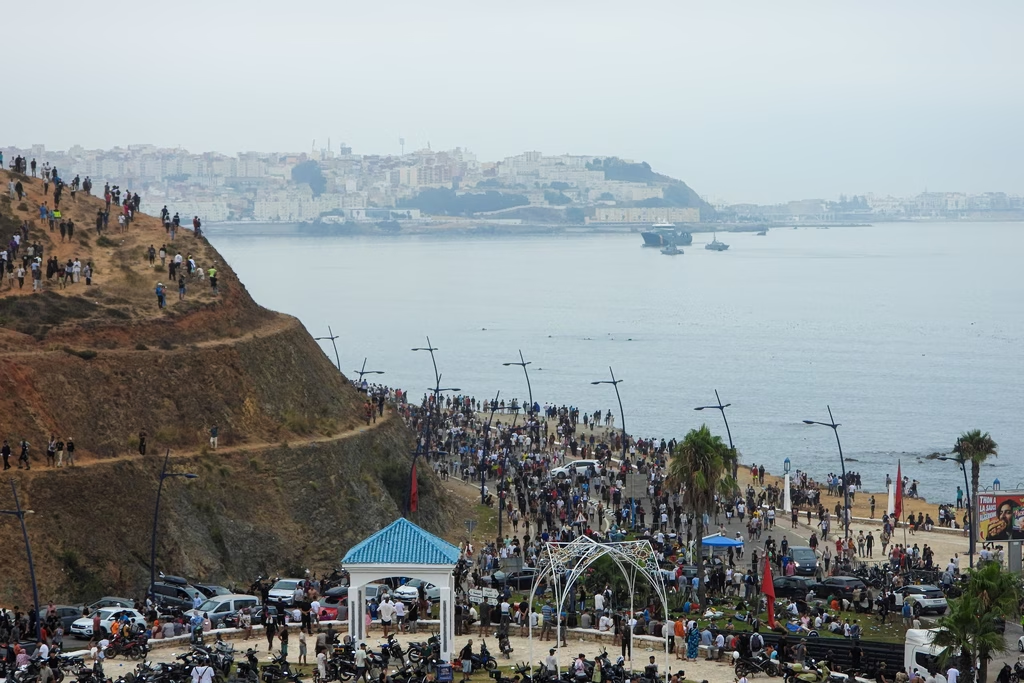
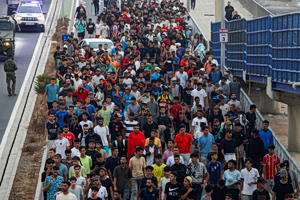
“The border is open and you can cross without papers”: according to migrant accounts, that was the message that spread on Moroccan social media, triggering an unprecedented wave of migration. Accounts that later vanished pointed followers to where to buy wetsuits, flippers, swimming goggles, inflatable boats, and even waterproof bags for carrying documents and phones, alongside screenshots from Google Maps guiding would-be migrants toward Tarajal beach.
Who is behind these accounts? Unknown. Who triggered the migration crisis in Ceuta, and why? Also unknown. Spain’s Supreme Court recently ruled to block immediate deportations of irregular migrants arriving by sea, and that decision “spread like wildfire through the networks of human trafficking mafias and set off an avalanche of arrivals in Ceuta,” Spanish Prime Minister Pedro Sánchez said Friday from the autonomous city, attributing the surge, in line with Morocco’s own official explanation, to criminal trafficking networks. But why did Rabat’s security forces let this mass of desperate people through? Why didn’t they stop them, as they had in previous months and years?
“Did Rabat set out to punish Madrid?” asks Le Monde. The French paper notes that the mass arrival of Moroccan citizens in the Spanish enclave came amid a warming of relations between Madrid and Algeria. For the first time since 2020, Spain’s prime minister traveled to Algiers, where he met President Abdelmadjid Tebboune on July 20.
Morocco and Algeria are at daggers drawn, having severed diplomatic ties five years ago, while the thorny issue of Western Sahara still awaits a political resolution. Still, the same paper notes the migration crisis hasn’t set off a diplomatic clash between the two capitals. Among the possible explanations, Italy’s La Repubblica offers one that sounds almost like geopolitical science fiction, though in the Trump era, it notes, anything goes (see Greenland): the theory holds that Morocco, one of Trump’s most loyal allies, might want to use the opportunity to reclaim the two Spanish enclaves on its territory, Ceuta, Spanish since 1580, and Melilla, Spanish since 1497.
Indeed, on July 30, in the middle of the crisis, Le360, a Moroccan online outlet close to the royal palace, published an analysis describing Ceuta and Melilla as “occupied cities,” calling their status under Spain an “anomaly,” and describing their recovery by the kingdom of Mohammed VI as “inevitable.”
MAGA figures had already voiced views on the fate of these two territories in recent months, and Donald Trump, for his part, has made no secret of his dislike for Spain’s socialist prime minister, whom he accuses of failing to meet NATO defense spending commitments and of refusing to grant military bases for operations against Iran. Last March, Michael Rubin of the American Enterprise Institute urged the Trump administration, writing in the Middle East Forum, to recognize Ceuta and Melilla as Moroccan territory, and called on Morocco to organize a “green wave” of thousands of people to enter Ceuta.
A month later, Mario Diaz-Balart, a Republican congressman close to Marco Rubio and chair of a House Homeland Security subcommittee, said the enclaves “are not on Spanish geographic territory” but on Moroccan territory, and that their future should “be determined, negotiated, and discussed among friends and allies.”
Whatever the cause, the Ceuta crisis has reenergized the international alliance of so-called “sovereigntists”: from the US to Europe, an entire front has coordinated to attack Pedro Sánchez’s Spain and anyone defending migrant-friendly policies. But this shift to the (far) right goes well beyond the Atlantic and Europe.
Israel’s ambassador to the UN, Danny Danon, has already accused Spain of “hypocrisy” for criticizing Israeli occupation of Palestinian territory while, he argues, holding onto territory of its own in North Africa. “Let the sensitive Sánchez open Spain to the people of Gaza too,” Israel’s far-right national security minister Itamar Ben-Gvir jabbed on social media. La Repubblica also notes that Russia has gotten involved, activating the propaganda channels it controls across Europe, particularly in Spain and Italy, around the Ceuta crisis. In some Brussels circles, the timing and the speed and coordination of the reaction have already raised suspicions of a possible hybrid attack aimed at Spain and at the cohesion of the European Union.