 Μake us preferred on Google
The two cases are different. At Pizza Fan, authorities are investigating a mechanism that allegedly concealed food orders paid in cash from the tax reporting system. At Choriatiko, the investigation extends to hundreds of companies and individuals, with authorities examining outstanding debts and the continuation of business activities through different corporate structures.
As a senior industry figure told To Vima, all those accused are presumed innocent. For the market, however, the implications extend well beyond taxation. They concern business credibility, employee protection and the costs borne by companies that comply with their obligations.
Awaiting Developments
In the Choriatiko case, approximately 520 companies are under investigation, while dozens of arrests have been made, including that of owner Angelos Giannakopoulos.
The investigation concerns, among other things, alleged fictitious transactions, unpaid taxes and social security contributions, and individuals listed as company managers.
Reports suggest potential losses exceeding €100 million, primarily involving debts to Greece’s social security agency, EFKA. The amount remains under investigation.
The case involves a business history spanning nearly three decades.
The first Choriatiko store opened in 1997 on Michail Voda Street in Athens. By 2010, the chain operated 17 company-owned stores and 12 partner outlets, maintained a production facility and employed more than 150 people.
Today, its official website lists nine locations.
The family also expanded into other bakery and food service businesses, including Attikoi Fournoi and Bread Factory, the latter of which was subsequently sold to a foreign investor.
The “Complimentary Order” Scheme
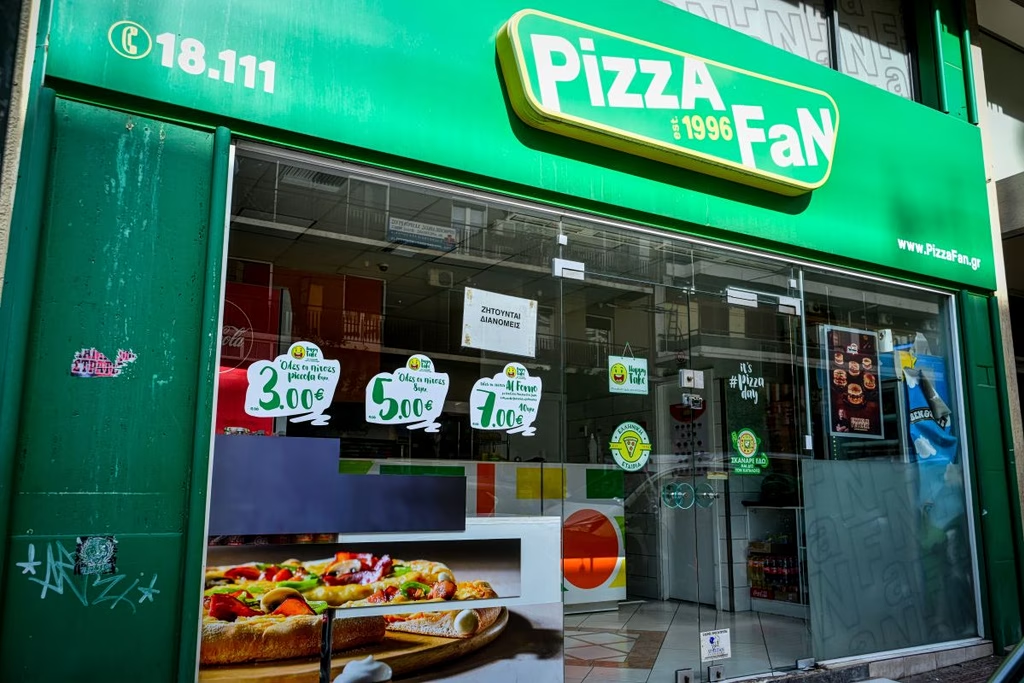
In the Pizza Fan case, following the police operation on October 22 that resulted in dozens of arrests, including that of founder and owner Konstantinos Antaras, efforts are underway to find a way to restart the chain’s operations.
Authorities are investigating the alleged use of a special feature in the ordering system known as the “kerasma,” or complimentary order.
According to the indictment, this feature allegedly allowed selected orders to be completed without issuing the legally required receipt, even though customers had paid in full.
The investigation reportedly covers a period dating back to 2016 and examines an organized operation involving individuals with different roles and the use of specialized software.
Potential losses to the state are estimated at tens of millions of euros, while reports indicate that concealed taxable transactions exceeded €150 million.
The chain’s founder, Konstantinos Antaras, was ordered held in pretrial detention following his testimony.
He denied that a criminal organization had been established, maintaining that the case involved a tax dispute and declaring his willingness to settle any liabilities determined by the authorities.
No Clear Picture
The most immediate concern surrounding Pizza Fan involves its approximately 2,500 employees.
The stores remain closed, although no administrative order suspending operations has been issued. According to information available so far, employment contracts have not been terminated.
Nevertheless, employees remain uncertain about when the chain might reopen and what will happen to their jobs, wages and social security coverage.
Market speculation has centered on the possible entry of an investor, with Vlassis Georgatos, owner of the Gregory’s food service chain, mentioned among potential interested parties.
So far, however, no agreement has been confirmed.
According to people familiar with Georgatos’ position, he is awaiting the findings of the investigation before making any final decisions.
Sources also indicate that another businessman was approached but declined to proceed.
Concerns about potential hidden liabilities that might emerge during a thorough review, as well as the lengthy process involved, reportedly influenced his decision.
Pizza Fan’s extensive network and strong presence in the delivery market are commercial advantages, but these alone are insufficient to overcome the outstanding issues.
Searching for a Solution
Any prospective buyer would need to examine the company’s tax liabilities, approximately 100 franchise agreements and the actual cost of restarting operations.
Industry sources estimate that comprehensive financial and legal due diligence could take more than nine months.
During that period, the chain’s absence from the market risks weakening its brand and driving customers toward competitors.
The purchase price, therefore, is not the only consideration. A new investor would need a precise understanding of the liabilities and business risks being assumed.
The government is reportedly seeking a solution through the relevant ministries, while employees are pressing for swift answers.
Various proposals for support have been discussed, including substantial incentives such as covering employers’ social security contributions. However, it remains unclear what measures, if any, will ultimately be adopted and under what conditions.
For the Greek market, the consequences of Pizza Fan’s closure cannot be measured simply by the number of outlets affected.
The scale of the network has revived memories of the Marinopoulos supermarket chain collapse.
The once-dominant retail group went bankrupt under the weight of mismanagement, nearly triggering a crisis across Greece’s entire retail sector. A wider collapse was narrowly avoided when a solution was found to transfer the entire supermarket network, along with its employees, to Sklavenitis.
Industry representatives emphasize that the comparison concerns the risk of wider consequences for employees, suppliers and the market, rather than similarities in the underlying causes of the two cases.
An Industry Under Pressure
The cases have emerged at a particularly difficult time for Greece’s food service industry.
Industry turnover declined by 3.4% in 2025, falling to €10.73 billion from €11.12 billion in 2024.
The sector comprises an estimated 79,458 businesses employing 288,452 people.
Pressure on consumer spending and declining revenues make the survival of businesses and the preservation of jobs even more critical. This, however, does not offset or justify alleged violations attributed to individual business owners.
For businesses that comply with their obligations, the practices under investigation also raise concerns about fair competition.
A company that fails to record all its transactions may appear to operate at a lower cost than a competitor that properly pays its taxes and social security contributions.