
 Μake us preferred on Google
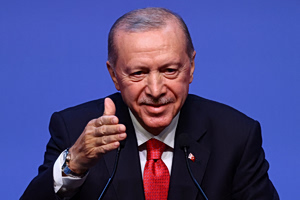
 Turkish President Recep Tayyip Erdogan issued a new warning to Greece over the Aegean islands, reviving Ankara’s longstanding objections to their militarization and saying Turkey would take “whatever is necessary” to defend what it considers its rights.
Speaking to Turkish journalists aboard his plane while returning from Bishkek, Kyrgyzstan, where he attended the Shanghai Cooperation Organization summit, Erdogan said Turkey wanted to maintain good-neighborly relations with Greece but would not tolerate what he described as violations of Turkish rights.
“What should we do? What is our responsibility? We will do whatever is necessary,” Erdogan said.
He also claimed that Turkey had consistently been the “constructive side” in relations with Greece but had not received a similar response from Athens.
Erdogan warns against viewing restraint as weakness
The Turkish president made one of his sharpest remarks when discussing Turkey’s military strength and the geographic proximity between the two countries.
“If we sent a message from our mainland, from Kas, to Greece, they would hear it, wouldn’t they?” Erdogan said, referring to the Turkish coastal town opposite the Greek island of Kastellorizo.
He immediately reiterated that Ankara wanted to proceed with Greece on the basis of good-neighborly relations.
Erdogan said Turkey “does not covet anyone’s territory” but would not allow anyone to violate its own rights. He also accused Greece of ignoring and violating international agreements, arguing that this would not benefit either side.
“Anyone who interprets Turkey’s calm and rational stance as weakness, I say openly, is making a serious mistake,” Erdogan said.
Addressing Athens, he called on Greece to “move away from this wrong path” and abandon what he described as the “military buildup of the islands that have a non-military status.”
Erdogan ended his comments on Greece with an appeal to history, saying it was “a very good guide for those who learn from it.” He also said Turkey would continue working for “peace, security and stability” in the region.
Turkey seeks return to F-35 program
Erdogan also discussed Turkey’s efforts to return to the U.S. F-35 fighter jet program, an issue linked to Ankara’s purchase of Russian S-400 air defense systems.
Asked whether the possible transfer of the S-400 systems to a third country had been discussed during his meeting with Russian President Vladimir Putin, Erdogan said the two leaders had discussed “all issues” on the bilateral agenda.
He emphasized that Turkey had been a partner in the F-35 program and had made a significant contribution to it, adding that talks on its return were continuing.
“We believe that this issue will be behind us once the procedures in America are completed,” Erdogan said.
At the same time, he made clear that Ankara did not want its defense policy to depend solely on the outcome of negotiations with Washington.
“We are not abandoning KAAN. We are not abandoning the development of our own air defense systems. On the contrary, we are increasing Turkey’s options,” he said, presenting the approach as part of a broader plan for a “strong Turkey.”
Erdogan says Turkey and Russia want peace in Ukraine
A significant part of Erdogan’s remarks focused on his meeting with Putin on the sidelines of the Shanghai Cooperation Organization summit.
Erdogan described the meeting as “very productive” and said it took place in a “particularly cordial atmosphere.”
According to Erdogan, the two leaders discussed developments in the Russia-Ukraine war. He said both Turkey and Putin wanted the war to end peacefully as soon as possible.
“We expressed to Mr. Putin that we are ready to do whatever we can for peace,” Erdogan said, reiterating Ankara’s efforts to maintain a role as a mediator in regional conflicts.
He also highlighted the breadth of Turkish-Russian relations, including energy, trade, tourism and investment, noting that Turkey hosts millions of Russian tourists.
Erdogan says Turkey can deepen ties with East and West
Erdogan’s participation in the Shanghai Cooperation Organization summit, he said, reflected Turkey’s effort to expand its economic, political and strategic options.
The Turkish president argued that Ankara could maintain balanced relations with both the West and the East, rejecting the idea that closer ties with the Shanghai Cooperation Organization meant moving away from Western countries.
“Turkey’s prospect of joining the organization does not mean moving away from any bloc or turning our backs on the West,” Erdogan said.
“Our goal is to increase our own influence with a 360-degree perspective,” he added.
Erdogan calls for end to “terrorism” in Turkey
On domestic issues, Erdogan discussed the “Turkey without terrorism” process, saying that no specific timetable could be predicted because the priority was achieving the goal rather than meeting a particular deadline.
He said relevant state institutions were already working on a roadmap and that the process would move forward step by step.
Erdogan also welcomed a decision concerning the dissolution and integration of the YPG-PYD in Syria, saying Turkey wanted to see a “united and intact” Syria.
“The chapter of terrorism must now be closed; the era of weapons and violence must end,” he said.
Erdogan says U.S. now understands Turkey’s position on Syria
The Turkish president also argued that U.S. policy toward Syria was now converging with Ankara’s main positions, particularly regarding Syria’s territorial integrity.
“We said that Syria cannot be a place where terrorist organizations move freely, that instability there could spread throughout the region, and ultimately it was proven that we were right,” Erdogan said.
He called on neighboring and friendly countries to contribute to Syria’s reconstruction and warned against giving space to those seeking to undermine the country’s internal peace.
His remarks also carried a message toward Israel, with which tensions have risen following an Israeli attack on a military base amid claims that Turkey was deploying military forces there.
Turkey proposes permanent Black Sea security mechanism
Erdogan also addressed the security of commercial shipping in the Black Sea, arguing that a permanent mechanism was needed to protect commercial maritime transport from the consequences of the Russia-Ukraine war.
“The conflict between the sides must not escalate to a point that puts the safety of civilians and commercial activity at risk,” he said.
He also highlighted the risk of a renewed food crisis, particularly in Africa, and called for initiatives to be taken before the situation deteriorates.