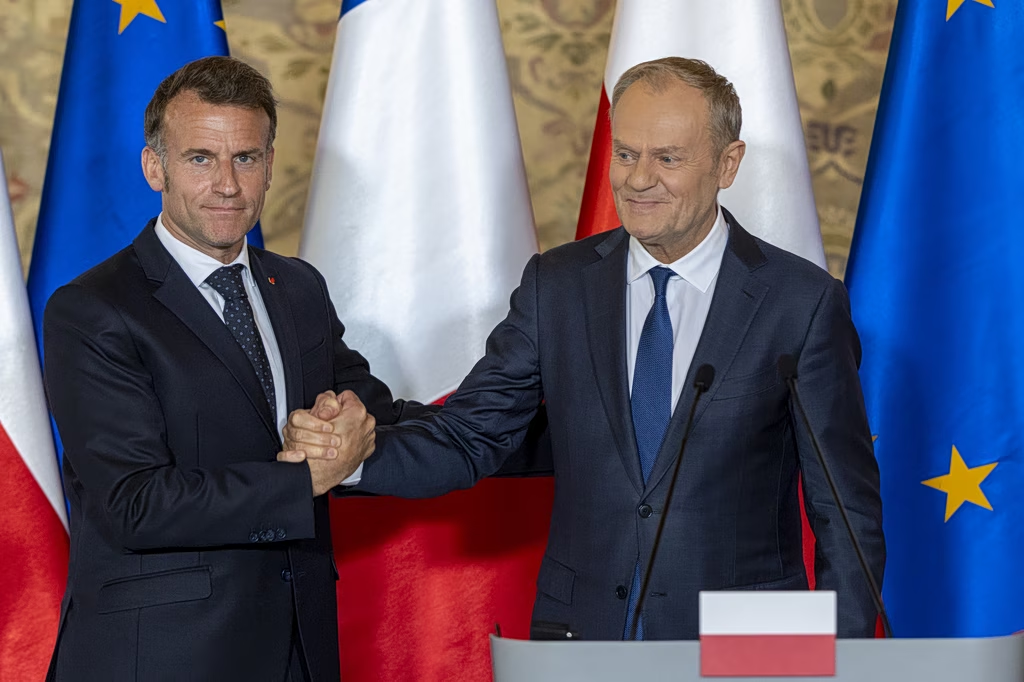
France’s nuclear deterrence initiative is expanding across Europe, with Finland recently becoming the 10th European partner and Latvia this week expressing interest in joining the framework.
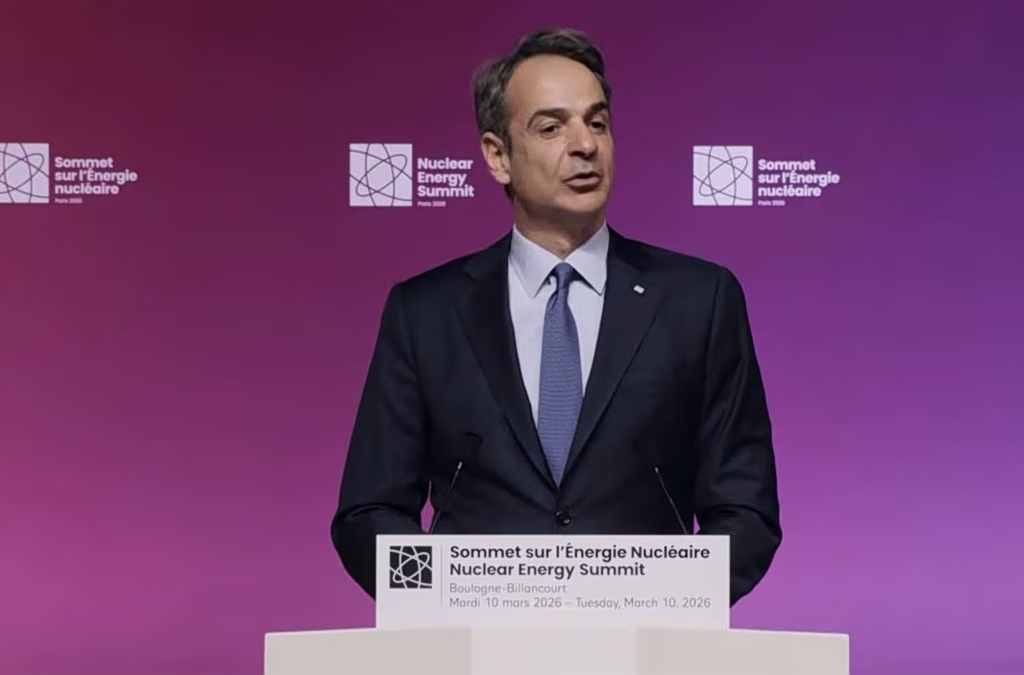
Greece responded to Paris’ invitation in March, becoming the only country from NATO’s southern flank to participate. For Athens, the key questions are what participation in the French nuclear umbrella means in practice and what commitments it entails toward France.
The initiative comes amid concerns over Russia’s nuclear threat and uncertainty over whether US security commitments will continue to have the same impact. European governments have increasingly looked toward France’s nuclear arsenal, while Paris seeks to link the security of European partners more closely to its own without giving up its freedom of action.
French President Emmanuel Macron presented the doctrine of “forward deterrence” on March 2 at the Île Longue submarine base in northwestern France.
The initial participants were the United Kingdom, Germany, Poland, the Netherlands, Belgium, Greece, Sweden and Denmark. Norway joined in May, followed by Finland on September 14, bringing the initiative to a large part of Europe.
The limits of the French umbrella
Macron established clear limits from the outset.
“There will be no sharing of the final decision” on the use of nuclear weapons, he said, making clear that decisions on their use, as well as the planning and execution of nuclear missions, remain exclusively French.
The same applies to France’s “vital interests.” Paris considers these interests to have a European dimension but has deliberately avoided defining their boundaries.
The uncertainty over when France would respond is itself part of the deterrence strategy. Moscow must now take into account the possibility of French involvement in a European crisis, in addition to any American and British response.
The initiative therefore strengthens NATO’s deterrence, according to the analysis.
Britain participates as a nuclear power. The Northwood Declaration, signed in July 2025, provides for coordination between the two independent French and British arsenals and the creation of a joint steering group, giving the two partners the ability to mount a joint nuclear response to an extreme threat.
France plans to increase its nuclear arsenal
Behind the French proposal is an arsenal of about 290 nuclear warheads as of 2025. France’s nuclear forces include Rafale aircraft, each carrying one ASMPA-R cruise missile, which has a range of 2,000 kilometers and a 300-kiloton warhead.
The ASMPA-R is scheduled to be replaced by the ASN4G in 2035.
At Île Longue, Macron announced an increase in the number of nuclear warheads and said France would stop publishing the size of its arsenal in the future. He also reiterated that French nuclear weapons are exclusively strategic and ruled out their tactical use.
However, the weapons carried by Rafale aircraft are, in practice, tactical nuclear weapons, creating an apparent discrepancy between the French characterization and the capabilities of the weapons involved.
Participating allies will be able to contribute conventional forces and support French missions, in coordination with Paris, in the event of a crisis.
Under certain conditions, French strategic aircraft could also be temporarily deployed on the territory of participating countries. No permanent deployment of nuclear weapons has been announced.
For France, access to allied bases provides strategic depth. Dispersing aircraft makes a surprise attack more difficult and complicates an adversary’s planning.
For the host country, meanwhile, the presence of French forces links its security more closely to France’s. An attack could hit French forces, potentially making French involvement more likely.
Northern Europe deepens its involvement
Germany is also becoming actively involved. A joint declaration by Macron and Chancellor Friedrich Merz provides for a nuclear coordination group, dialogue on nuclear doctrine and consultations on combining conventional, missile-defense and French nuclear capabilities.
Germany remains part of NATO’s nuclear planning while also gaining an organized channel with the European Union’s only nuclear power.
For Poland, the priority is deterring a Russian attack against its territory. The first meeting of the French-Polish nuclear coordination group, held July 10, resulted in a joint road map for consultations and military cooperation.
In northern Europe, Sweden and Denmark are emphasizing regional security.
Stockholm has activated a bilateral nuclear coordination group. Sweden’s contribution involves air forces, surveillance capabilities and air-defense systems, giving it a role without possessing its own nuclear arsenal.
Norway is seeking to avoid dependence on a single source of security. NATO remains central to its defense and the United States its most important ally, but its agreement with France is strengthening its European security ties.
In Helsinki, the agreement with France opens the way for strategic consultations and crisis management before any potential use of nuclear weapons. A French-Finnish coordination group is expected to become operational in the coming months.
Both Norway and Finland maintain policies against stationing nuclear weapons on their territory during peacetime.
In The Hague and Brussels, participation in the French initiative adds to existing commitments. The Netherlands and Belgium already host US nuclear weapons and participate in NATO nuclear planning, while the French initiative also creates new channels for military communication with Paris.
What the initiative means for Greece
Greece’s participation gives the initiative a foothold in southeastern Europe and provides Athens with an additional layer of strategic cooperation with France. It also increases the significance of the existing Greek-French mutual defense assistance agreement.
However, France’s public commitments do not amount to an automatic French nuclear guarantee in the event of a Greek-Turkish crisis. The French umbrella is clearly aimed primarily at Russia.
Greece will need to define its participation through bilateral agreements, exercises and support missions.
Early warning, missile defense, surveillance and long-range conventional strikes are among the areas in which Greece could both contribute and benefit.
In bilateral talks, Athens will need to secure a clear understanding of the role of the Greek armed forces, access to information and the support Paris would provide in a potential crisis involving Russia.
These factors will determine how much additional security Greece gains and what obligations accompany its participation.
Concerns over unequal influence
Oliver Meier, a nuclear disarmament expert, wrote in the Bulletin of the Atomic Scientists that separate bilateral consultations place Paris at the center of the initiative, with each partner negotiating individually.
He warned that this could create imbalances in the degree of access and influence available to different partners, as well as differences in transparency and arms-control arrangements.
In any case, participation in the French initiative does not give partner countries a corresponding say in French nuclear decisions.
The decision over whether France’s vital interests are at stake remains with the Élysée Palace. Participating countries, meanwhile, are expected to incur costs, provide forces and potentially expose infrastructure to greater risk, without an equal quid pro quo.