 Μake us preferred on Google
To take things from the top, this was a technically and financially complex undertaking. But it did not seem to lend itself to political entanglement.
There is no doubt that the Greece-Cyprus electrical interconnection is a major project of European significance.
Which is why it is EU-funded, why European states and corporations are involved, and why top-tier European officials emphasize its importance at every opportunity.
In other words, there was absolutely no reason for it to be obstructed or called into question by anyone.
But this, of course, is the Balkans.
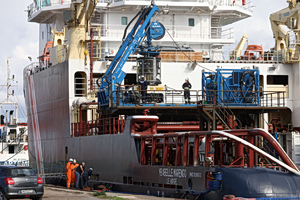
The French research vessel has finally set to work, and we all hope it completes its mission without a single bloody nose.
Turkey’s interference, however, is yet another display of the arrogance with which a country that is not part of Europe continually claims a prominent role and say in a region that does not belong to it and in a project that is none of its concern.
Ankara may have recently discovered that its homeland is “blue,” “green,” or “pink with white polka dots.” It may have invented continental shelves and threats, and signed agreements with any states it fancies. But these are all fabrications of its own, meant purely for domestic consumption.
We wish them all the best in this fantasy world of theirs. But the rest of us have work to do.
Those are the facts of the matter. But two lingering questions remain.
First, how is it that two neighbors cannot agree on what is legal and self-evident in regard to an issue whose political stakes are low, with virtually nonexistent scope for repercussions?
Second, how did an issue with such narrow parameters whip our own domestic opposition into such a frenzy?
Granted, we are in the run-up to a general election. But issues of this nature never seemed amenable to manufactured uproar before.
Even if we make allowances for a certain degree of ignorance and flippancy, the inability of political factions to look, learn, and understand before passing judgment beggars belief.
Yet these questions share a common core: the machinations of factions in both Greece and Turkey that consistently attempt to hijack bilateral relations for their own benefit.
They care nothing for the greater good, nothing for their respective countries, and nothing for the issue at hand—which they likely don’t even understand. All they care about is their own role.
In Greece, of course, they have a target: the government. Fair enough. But in a few months’ time, they will have the opportunity to vote and pass judgment on the current administration at the ballot box.
Why should it bother them if, in the meantime, progress is made on a project which the whole of Europe considers important?