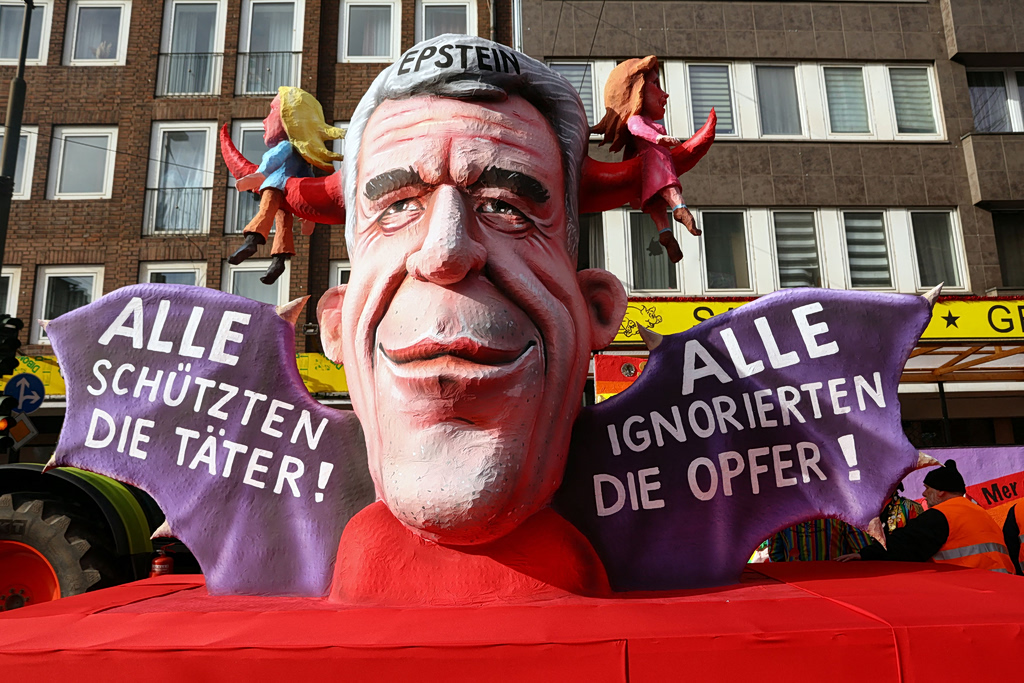

Voracious global interest in the recently released Epstein files has, expectedly, also piqued curiosity in Greece and attention to the more than 1,500 times the country is mentioned in the approximately 3.5 million files and documents released by the Trump administration’s justice department.
While no criminal intent has so far emerged in Jeffrey Epstein’s references to Greece and individuals associated with the east Mediterranean country, journalists, national authorities and private “sleuths” around the world are dissecting every bit of information related to the late financier, convicted sex trafficker and ephebophile.
If keywords such as “Greek” and “Eurogroup” are included, the references increase even further, according to an article in Thursday’s edition of the Athens daily “Ta Nea”.
Most of the references are not relate to personal or criminal reports about individuals contain economic and financial content.
At the same time, there are email correspondences concerning trips to Greece — by Epstein himself, by models for photo shoots or meetings, and by disgraced UK politician and diplomat Peter Mandelson.
Economic crisis, Eurozone and investments
Many documents and conversations relate to the Greek financial crisis and bank bailouts, debt swaps, and government bonds between the turbulent period of 2010–2015. The documents show emails and discussions about how bailouts and how markets functioned in relation to Greece amid the European financial landscape.
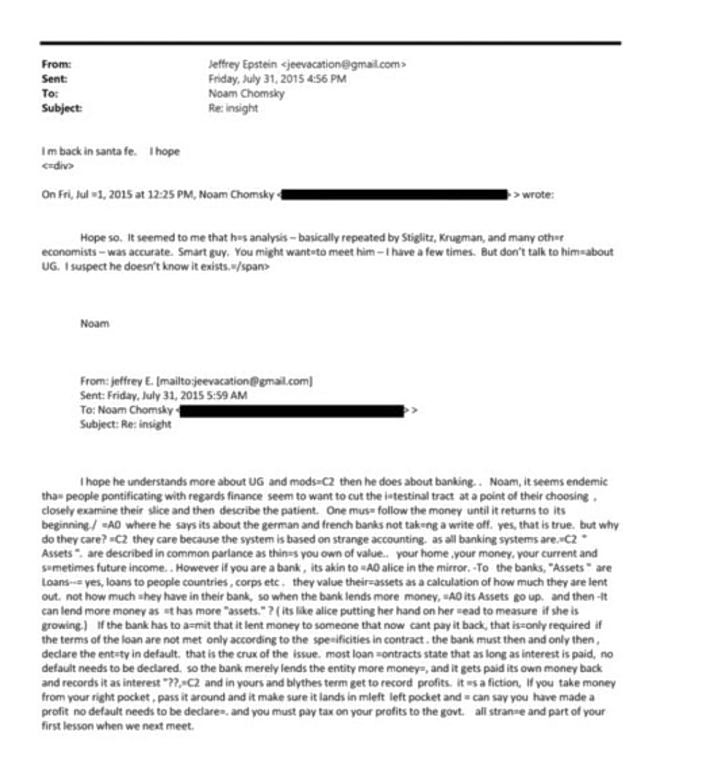
In some emails mentioning Greece, Epstein exchanges views with academics and analysts, including a dialogue with renowned US intellectual and linguist Noam Chomsky, which includes discussion of the Greek bailout crisis and banking loan practices. The correspondence appears to have taken place in July 2015, at the height of the “Grexit” crisis.
On June 25 and May 29, 2015, documents include discussion over investment strategies.
Epstein also corresponded with the late Greek real estate expert George G. Mantzavinatos regarding the timing of investments and investment opportunities in Greece and in central and eastern Europe. Mantzavinatos reportedly assessed (rightly, as it turned out) that Greece – led by SYRIZA-dominated government coalition – would likely reach an agreement with the EU and the IMF by the end of June 2015, ensuring temporary financial stability until September, when an additional 35–40 billion euros would be required.
The latter argued that this timing represented an opportunity for Epstein to consider entering the Greek market, particularly in the banking sector and in banks with significant exposure. He also pointed to other geopolitical risks, such as the situation in Ukraine, outlining broader European investment parameters.
Other references include discussions about experiences following the 2015 referendum and conversations with investors and banking executives.
One such example is an email exchange between Epstein and Ariane de Rothschild, the head of Edmond de Rothschild Group.
Rothschild comments on political developments within the Greek government, especially the replacement of Yanis Varoufakis by Euclid Tsakalotos as economy and finance minister. Epstein responds with assessments of how the change would affect Greece’s negotiations with its Eurozone partners.
Trips… and the Greek islands: From Patmos to Skorpios
Epstein’s interest was not limited to Greece’s finances, as it appears he also viewed certain Greek isles as a means of expanding his social circle and even explored investment interest in Skorpios, the little islet off Lefkada owned by Aristotle Onassis.
His preference for Patmos in the northern Dodecanese was also mentioned. A key role in arranging his trips to Patmos – the isle with St. John the Divine wrote the Book of Revelations – was played by his close associate, Peggy Siegal, who traveled to the island multiple times. Siegal reportedly held meetings there, including with members of a foundation for abused children.
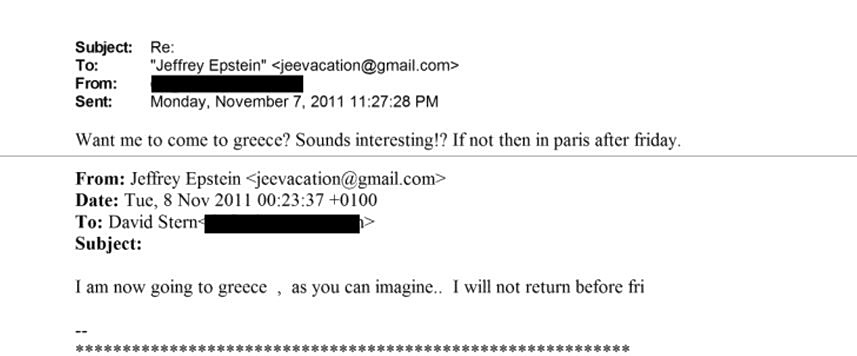
Other emails indicate that Epstein planned to visit Greece in 2011, although the trip never materialized. It remains unclear whether he ultimately traveled to the country at a later date.
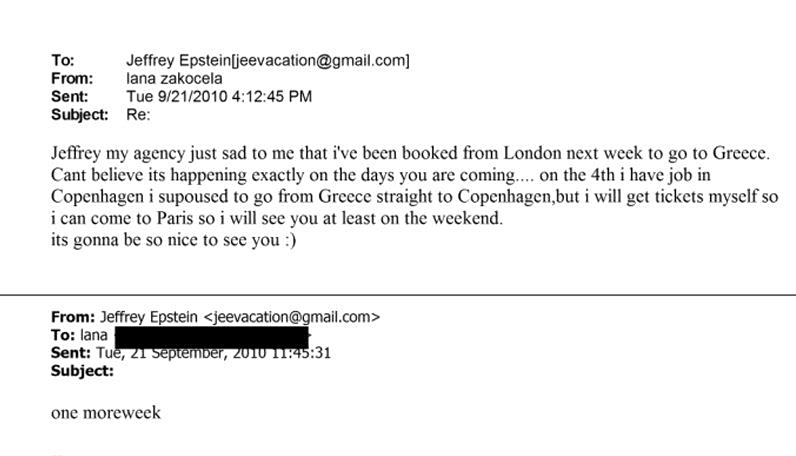
There are also multiple references to models in contact with Epstein and their trips to Greece, such as Lana Zakocela, who was to travel to the country for a Vogue Greece photo shoot.
Zakocela was the model Epstein who reportedly accompanied Epstein to private dinner hosted by the now disgraced ex-Prince Andrew at Buckingham Palace in 2010, when the late Queen Elizabeth II was away in Scotland.
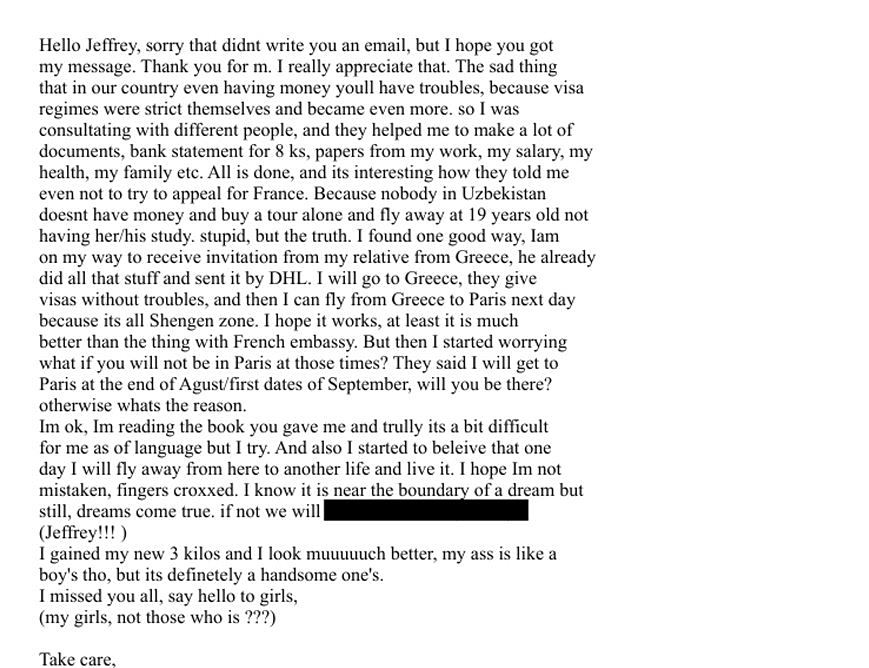
Another document of interest concerns a message from the same 19-year-old model from Uzbekistan. She appeared to be seeking a way to travel to Paris, having found a route via Greece.
After describing how she managed to gather the necessary travel documents through acquaintances, she explained that few people there have the money to fly abroad, especially at 19, but that she had found a solution via Greece:
It is unknown whether she ultimately made the trip.
Epstein and the attempted purchase of Onassis’ isle
Epstein explored the purchase of Skorpios from August 2011 to late 2011, communicating with Boris Nikolic and Richard Giraud. These discussions likely related to potential visits to Greece.
Nikolic informed Epstein in correspondence that the island was private and described its characteristic, such as how many buildings were on it and its size — while Giraud attempted to arrange a private visit. Ultimately, discussions about purchasing Skorpios went nowhere, despite efforts to schedule visits.