U.S. Secretary of State Marco Rubio’s speech in Athens drew international attention well beyond the usual coverage of a diplomatic visit. From The Wall Street Journal, which described it as the “speech of the year,” to German newspapers examining his potential presidential ambitions in 2028, commentators interpreted his appearance as a broader statement about Western identity, American power and the future of the conservative movement.
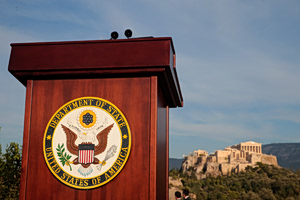
Speaking at the Pnyx, the historic site of ancient Athenian public assemblies, with the Acropolis in the background, Rubio presented the West as a historical continuum stretching from ancient Greece to the United States. His defense of President Donald Trump’s “America First” agenda, framed around an unapologetic pursuit of national power, gave the speech a distinctly ideological and political dimension.

From ancient Athens to “America First”
Rubio invoked individualism, ambition, exploration, invention, honor, duty and heroism as forces that had shaped Western civilization. But he warned that the West stood at a critical crossroads, arguing that a loss of confidence and a departure from its historical values could lead to “atrophy, subjugation and decline.”
His political conclusion was explicit: “Under President Trump, the United States has made its choice. We choose the unapologetic pursuit of national power.”
Reuters linked the remarks directly to the “America First” agenda, noting Rubio’s emphasis on values such as heroism, honor and duty and his argument that prioritizing national interests is not inherently selfish.
The choice of venue reinforced the historical narrative. Rather than presenting the Trump administration’s foreign policy solely in contemporary strategic terms, Rubio sought to place it within a much longer account of Western civilization and its perceived challenges.
Wall Street Journal calls it the “speech of the year”
The most enthusiastic assessment came from The Wall Street Journal, which portrayed Rubio’s address as a forceful response to what it sees as a crisis of confidence in the Western world.
The newspaper argued that Rubio had “got to the heart of the matter” by connecting contemporary challenges with the legacy of Athens and Jerusalem. In its reading, the secretary of state sought to explain why the West must recover the determination to defend its principles and preserve its power.
The setting was central to that interpretation. Rubio was not simply outlining the Trump administration’s foreign policy; he was placing it within a broader historical account of the West and its future.
CNN and Washington Post look beyond the MAGA era
American media also focused on what the speech might reveal about Rubio’s own political future.
CNN argued that the carefully staged appearance was difficult to view as a routine diplomatic obligation. The setting, themes and presentation of Trump’s foreign policy fueled speculation that Rubio was developing a narrative for the period after the MAGA movement’s current phase.
The Washington Post similarly interpreted the speech as a sign of broader political ambitions and an effort by Rubio to position himself within the ideological traditions of the MAGA movement and modern American conservatism.
The discussion goes beyond the possibility of a presidential campaign in 2028. It also raises the question of whether Rubio is presenting a potential next iteration of Trump’s politics—one that retains “America First” while placing greater emphasis on conventional alliances and Western unity.
The Guardian sees a selective reading of history
The British newspaper The Guardian took a more skeptical view, interpreting Rubio’s speech as an attempt to find a historical foundation for Trump’s political agenda.
It highlighted the narrative linking ancient Greece to the American founders and modern America, through which Rubio connected the administration’s emphasis on national power with its rejection of globalization.
The newspaper also suggested that the carefully staged appearance in Athens could carry electoral value if Rubio decides to seek the presidency in 2028.
New York Times highlights Rubio’s message to Europe
The New York Times focused more closely on Rubio’s appeal to European audiences. He urged Europeans to “wake up from their slumber” and recover an earlier spirit of exploration and ambition to ensure that the West remains at the forefront of the world.
The speech appeared to address two audiences. For Europe, it reinforced Washington’s demands for greater contributions to defense and the economy. For Americans, it presented “America First” as a project of national renewal.
International coverage also drew comparisons with Vice President JD Vance’s earlier criticism of Europe at the Munich Security Conference.
Turkish media focus on F-35s, energy and the Aegean
Turkish media gave considerable attention to the strategic implications of Rubio’s visit, viewing closer Greek-American cooperation through the lens of the balance of power in the Aegean and Eastern Mediterranean.
Reports highlighted Greece’s defense programs, including F-35 fighter jets, Rafale aircraft, Belharra-class frigates and the “Achilles’ Shield” defense initiative. They also examined the scale of Greek military spending and Athens’ expanding ties with the United States, France and Israel.
The coverage reflected Ankara’s concern with the broader strategic implications of Greece’s defense modernization and its partnerships with Western allies.
Yeni Şafak puts the Greece-Cyprus-Israel cable under scrutiny
The pro-government newspaper Yeni Şafak placed particular emphasis on the planned electricity interconnection linking Greece, Cyprus and Israel.
The newspaper argued that the cable’s route passes through an area Turkey considers to fall within the maritime zone established by the Turkey-Libya memorandum. On that basis, it maintained that the project requires Turkish consent or, at minimum, coordination with Ankara.
Yeni Şafak portrayed the project’s revival as a political dilemma for Athens, which it said must choose between proceeding despite Turkish objections, accommodating Ankara’s position or finding an intermediate solution.
In this account, the cable is more than an energy project: it is part of the wider dispute over maritime zones and the balance of power in the Eastern Mediterranean.
Aydınlık links military bases, weapons and energy
The nationalist newspaper Aydınlık presented the visit as part of a broader geopolitical strategy linking the American military presence in Greece, energy projects and the Vertical Corridor, which is intended to carry U.S. liquefied natural gas to the Balkans and Central Europe.
The newspaper argued that strengthening the network could reduce Turkey’s energy role in the region. It also attached significance to the presence of economic officials in Rubio’s delegation, presenting the visit as evidence that Washington and Athens are increasingly connecting security, energy, investment and strategic infrastructure.
Turkish analysts quoted in the media described Greek policy as an effort to develop a multilayered military capability. Professor Sezgin Erkan, according to Turkish coverage, referred to the construction of “multilayered defensive and offensive power,” emphasizing the F-35’s stealth characteristics.
CNN Türk focused on the financial scale of Greece’s defense programs and the possibility of exercising an option to purchase another 20 F-35s.
The overall message in Turkish coverage was that Rubio’s visit could not be viewed solely as a bilateral diplomatic engagement. It was connected to a wider network of military cooperation, American infrastructure, energy routes and electricity interconnections.
At the same time, Rubio’s statement that a conflict between Greece and Turkey would be “unthinkable” for the United States offered a different signal: Washington was strengthening its relationship with Athens while seeking to keep communication with Ankara open.
German media see a potential successor to Trump
German newspapers paid particular attention to the possibility that Rubio’s speech was aimed not only at his current role as secretary of state but also at a future presidential campaign.
The Frankfurter Allgemeine Zeitung (FAZ) argued that Rubio was looking to the past for answers to present-day problems. It interpreted his references to ancient Athens as an attempt to make the case that the West must rediscover its historical roots to secure its future.
The newspaper also noted similarities between Rubio’s remarks and positions Vance had expressed in Munich, although Rubio adopted a less confrontational tone. Both men, it observed, are regarded in German media as potential contenders for the Republican presidential nomination in 2028. Rubio’s more moderate public presentation could help distinguish him from other members of the Trump administration.
The Tagesspiegel was more direct, asking whether the speech was an appearance by “Donald Trump’s successor.” It described the event as carefully staged and questioned whether Rubio was speaking primarily to Europeans or to American voters.
The newspaper also highlighted the central choice Rubio presented: the West faces a crossroads between “national power and decline.” His references to higher European defense spending, new partnerships and stronger industrial production were part of that argument.
The outlet t-online focused on the political staging, noting the symbolic significance of the Pnyx as a birthplace of democracy. It offered a critical assessment of Rubio’s message to allies, arguing that the approach described was less a partnership between equals than a relationship in which allies are expected to adapt more closely to American demands.
Die Welt emphasized Rubio’s warning that the West was at a “civilizational turning point,” connecting immigration, defense and energy with his call to restore Western power. The magazine Cicero, meanwhile, published the full speech in German translation, presenting it as an appeal for Europeans to take pride in the West’s shared roots at a moment Rubio considers critical for Western civilization.
A softer tone, familiar Trump-era positions
A recurring theme in German coverage was Rubio’s presentation as a more conventional and less confrontational figure in the Trump administration’s foreign policy, without a significant departure from its underlying ideological positions.
The FAZ, in particular, noted that Rubio’s tone was more conciliatory than Vance’s, even as his substantive positions remained close to those of the administration.
That distinction could matter in 2028. If Rubio seeks the Republican nomination, he may need to maintain his appeal among Trump’s political base while presenting himself as a candidate capable of reaching a broader electorate.
His speech in Athens offered both elements: Trump’s political substance, delivered in Rubio’s style.
Greece presented as a model ally
Beyond the ideological debate, international media also covered the practical outcomes and strategic context of Rubio’s visit.
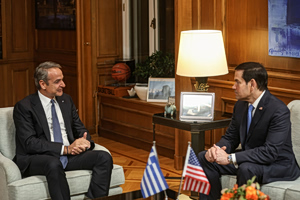
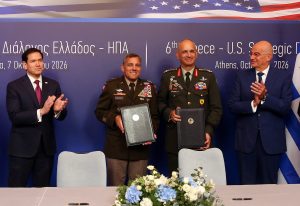
Greek-American cooperation spans defense, energy, security, trade and migration. Rubio presented Greece as an important ally in the Eastern Mediterranean and highlighted its increased defense spending.
The Associated Press emphasized the strategic role of Greek military facilities and the country’s importance to the security of commercial shipping in the Red Sea.
U.S. arms sales, energy cooperation, liquefied natural gas and Greece’s broader strategic position in the Eastern Mediterranean also formed part of the coverage.
The German left-wing newspaper Junge Welt linked the strategic dialogue to F-35s, Greek LNG terminals and hydrocarbon exploration south of Crete, underscoring that the visit extended well beyond the speech at the Pnyx.
A speech with international implications
The international response to Rubio’s Athens appearance reflected three intersecting elements: the symbolic setting, the ideological message and the political ambitions attributed to the speaker.
On one level, Rubio spoke as secretary of state, defending the Trump administration’s strategy, urging European allies to contribute more and presenting Greece as a significant partner.
On another, he spoke as a politician setting out a vision for America and the West. That combination helps explain why media coverage ranged from praise for a powerful defense of Western identity to criticism of a selective use of history and speculation about the 2028 presidential race.