
 Μake us preferred on Google
 The foreign ministers of Australia, India, Japan and the United States have agreed to jointly develop a new port in Fiji and launch initiatives focused on critical minerals and energy security, marking a significant step in efforts to strengthen cooperation within the Quad partnership.
Meeting in New Delhi on Tuesday, the four countries announced a series of measures aimed at delivering practical outcomes across the Indo-Pacific, including what officials described as the group’s first joint infrastructure project.
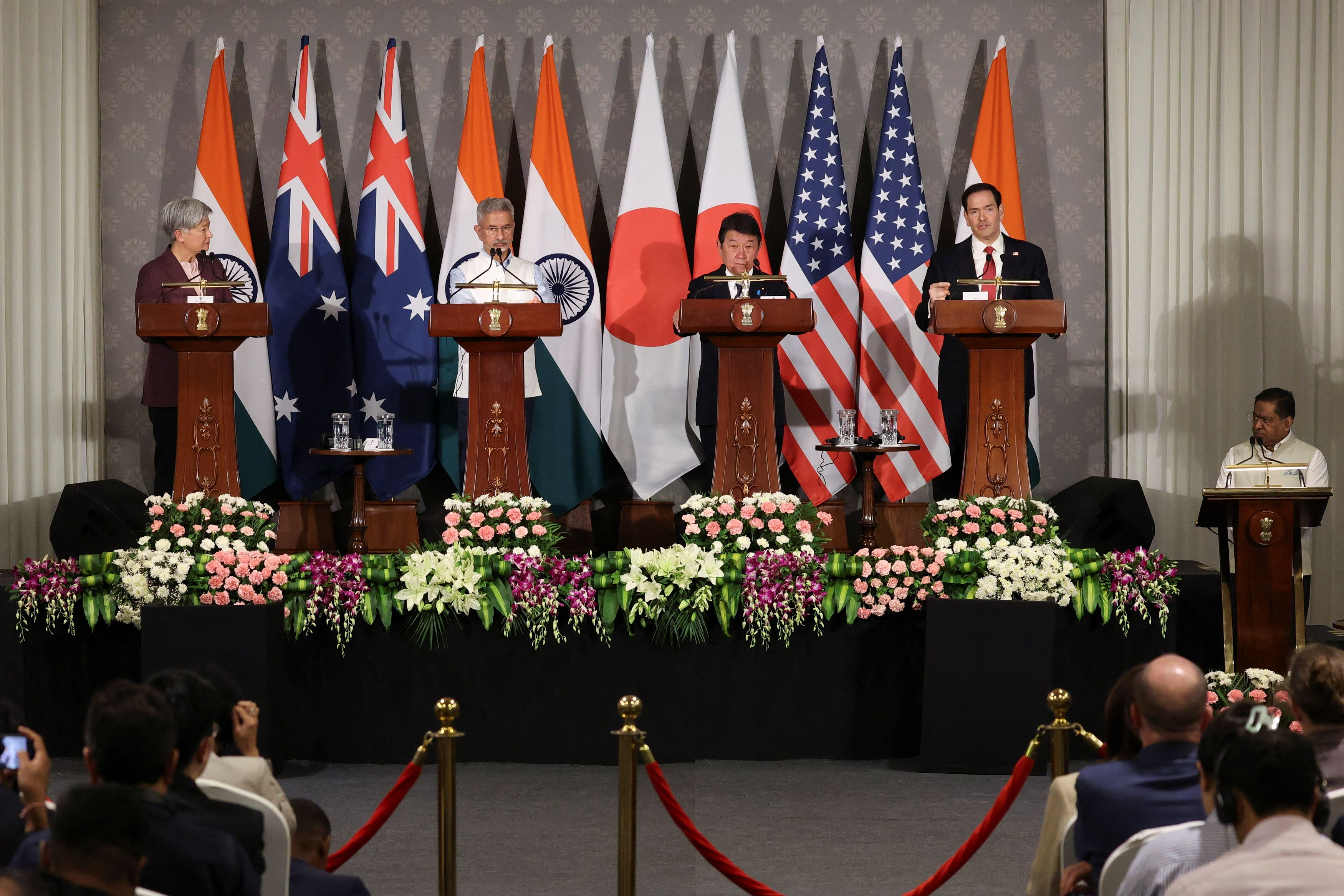
The gathering brought together Australian Foreign Minister Penny Wong, India’s External Affairs Minister S. Jaishankar, Japanese Foreign Minister Toshimitsu Motegi and U.S. Secretary of State Marco Rubio. It was the third ministerial-level Quad meeting since September 2024.
First Joint Infrastructure Project
At the center of the announcements was an agreement to work with Fiji on expanding port infrastructure, addressing concerns over limited port capacity across Pacific Island nations.
Rubio described the project as a tangible example of the Quad’s ability to deliver high-quality and resilient infrastructure through collective action.
“We are announcing plans to work with Fiji,” Rubio said, adding that the initiative would demonstrate the group’s capacity to provide practical solutions to regional challenges.
The Fiji port project represents the first infrastructure venture jointly undertaken by the four Quad members.
Focus on Energy Security and Critical Minerals
The ministers also agreed to establish an Indo-Pacific Energy Security Initiative and introduce a new framework for cooperation on critical minerals.
According to Rubio, the framework will help coordinate investment and economic policy tools to strengthen supply chains for critical minerals, including mining, processing and recycling activities.
The initiative could carry particular significance for Japan following China’s suspension of shipments of certain minerals used in aerospace, defense and semiconductor industries after a diplomatic dispute.
The Quad members said the framework is intended to improve supply chain resilience and reduce vulnerabilities in strategically important sectors.
Renewed Momentum for the Quad
The announcements come as the Quad seeks to regain momentum after a period in which questions emerged about the group’s direction. The alliance did not hold a leaders’ summit last year amid tensions between U.S. President Donald Trump and Indian Prime Minister Narendra Modi over tariffs and other issues.
Rubio stressed that the partnership remains a cornerstone of U.S. strategy in the region.
“We are beginning to show real achievements and real accomplishments,” he said, describing the Quad as a key element of Washington’s broader global approach.
Over recent years, the group has promoted initiatives aimed at maintaining what it calls a “free and open maritime order” in the Indo-Pacific, including efforts to improve maritime awareness and information-sharing capabilities.
Questions Remain Over Leaders’ Summit
While foreign ministers did not provide details about a possible leaders’ summit later this year, Rubio said over the weekend that diplomatic efforts would continue toward arranging a meeting.
Analysts have debated whether the absence of a summit has diminished the Quad’s profile. However, some observers argue that consistent progress at ministerial and working levels can sustain the grouping’s relevance.
“The absence of a leaders’ summit has raised some doubts, but that does not necessarily indicate declining importance,” said Premesha Saha, a senior policy fellow at the Asia Society Australia.
She noted that continued delivery of practical initiatives could reinforce the Quad’s standing even without frequent leader-level meetings.
Regional Context
The meeting took place as the United States and Iran continue discussions aimed at ending their three-month conflict and reopening the Strait of Hormuz, a key global energy shipping route.
The Quad countries have long shared concerns over China’s growing influence in the Indo-Pacific. Rubio has repeatedly emphasized the importance of preserving a “free and open Indo-Pacific,” while Beijing has criticized the grouping as a Cold War-style alliance designed to contain China’s development.
India also continues to manage territorial disputes with China, although Prime Minister Modi has recently signaled a willingness to improve relations with Beijing amid broader diplomatic challenges with Washington.