
The archival correspondence surrounding Jeffrey Epstein reveals an unusually deliberate engagement with classical antiquity. Far from being incidental decoration, Greek and Roman forms appear throughout his acquisitions, architectural planning, and interior design decisions.
Within the recently released Epstein files, a striking theme emerges on the architectural ambitions Jeffrey Epstein held for Little Saint James Island. The island was central to Epstein’s social and financial world. High-profile figures from politics, academia, business, royalty, and entertainment were reported to have visited his properties over the years.
Court documents and criminal proceedings established that Little Saint James was also a key location in Epstein’s sex trafficking operation, where underage girls were abused under the guise of social gatherings and private stays.
A search of the Epstein library within the U.S. Department of Justice archive for the term “Greek” returned 1,079 results, not including the more than 1,500 additional files containing the term “Greece.” Within these parameters, a substantial number of documents pertained to Greek architecture, philosophers, artworks, and mythology.
While connecting the villa to all referenced elements remains a puzzle amid over a thousand files, Epstein’s interest in Greek motifs and classical design is clear; Epstein had an appreciation for Greek architecture and mythology.
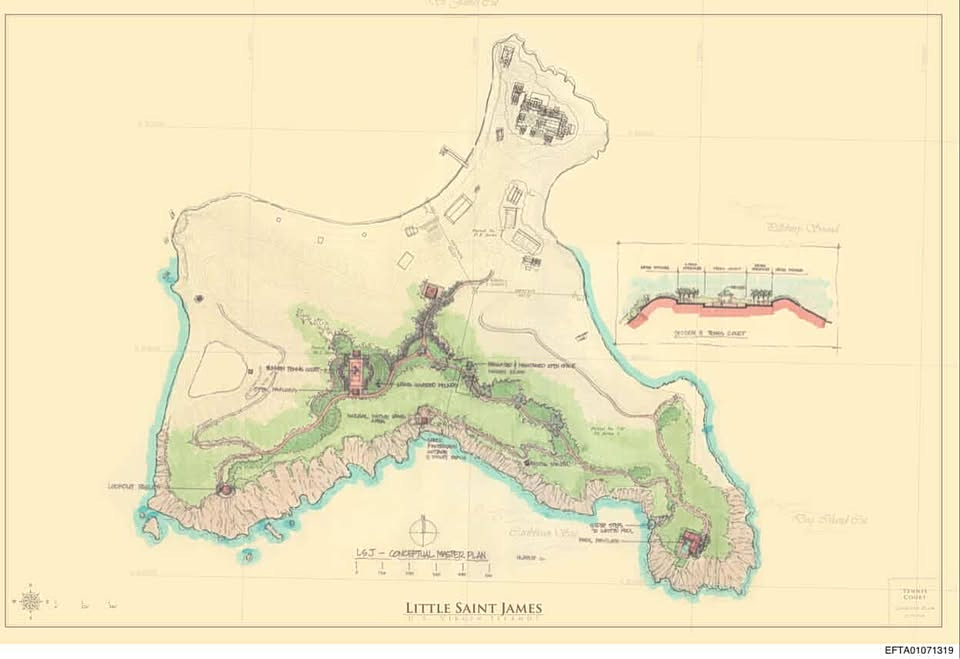
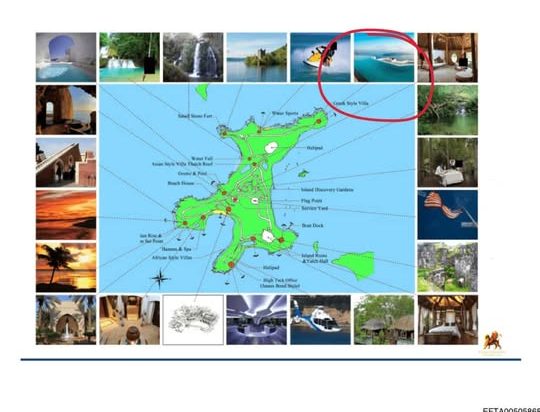
Detailed plans, emails, and presentations reveal a carefully curated landscape featuring beach houses, pool houses, sports areas, spas, and villas—most notably a Greek-style villa (EFTA00505867).
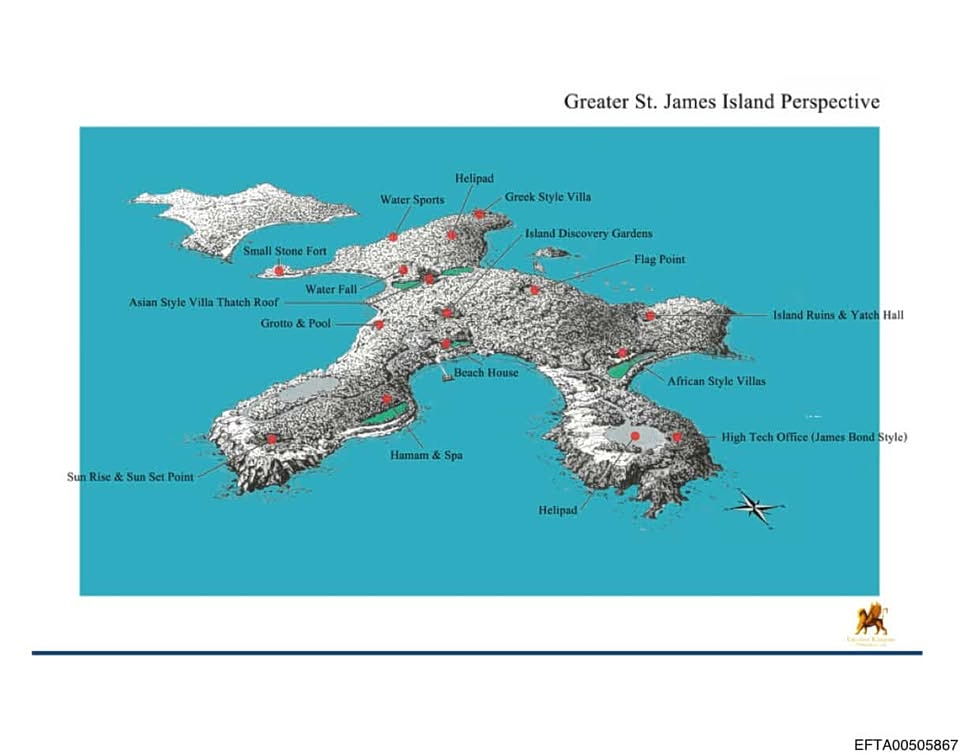
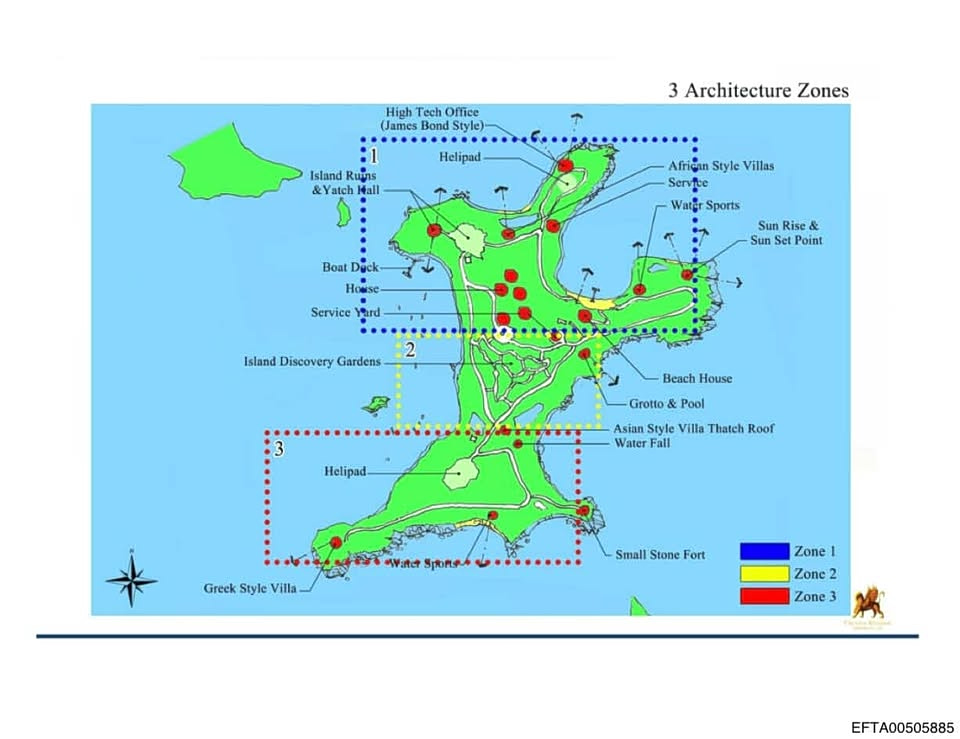
The ‘Greek Villa’ is exactly what most would imagine, aesthetics of Greek islands, reminiscence of Santorini with its infinity pools, sea-facing views and iconic sunsets (EFTA00505868). PowerPoint presentations outlining the concept for Greater St. James in early 2017 delineated three architectural zones, with the Greek-style villa prominently placed in Zone 3 (EFTA00505885).
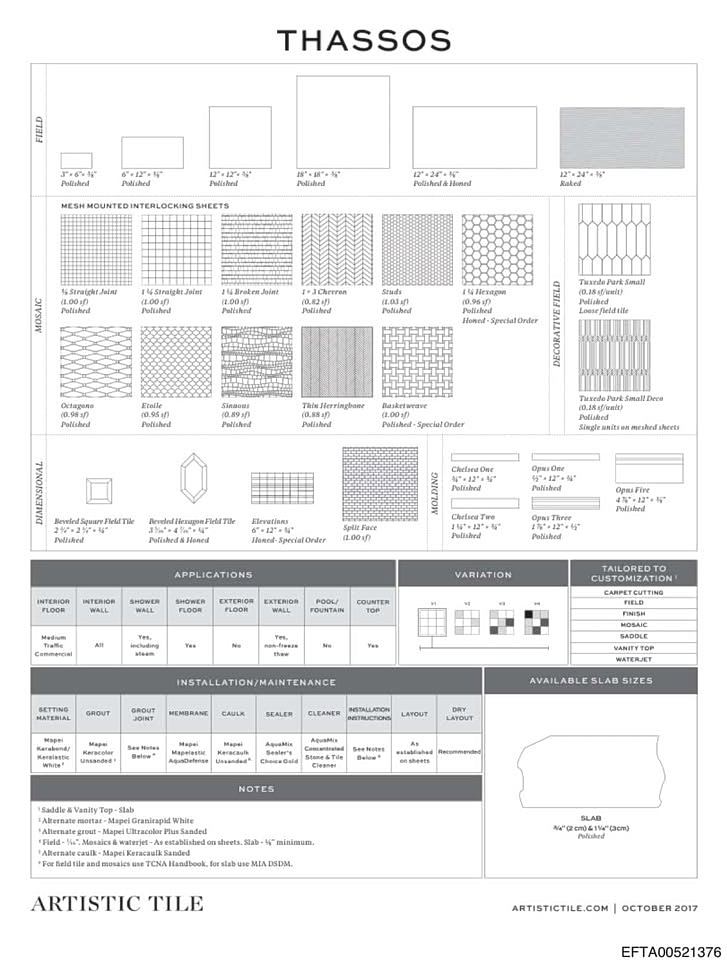
Epstein’s fascination with classical Greek materials is well documented. In the files, a pamphlet of Thassos marbles including specifications and detailed measurements was found, possibly resonating to Epstein’s admiration for the era of classical Greek architecture, and the era of antiquity. (EFTA00521375).
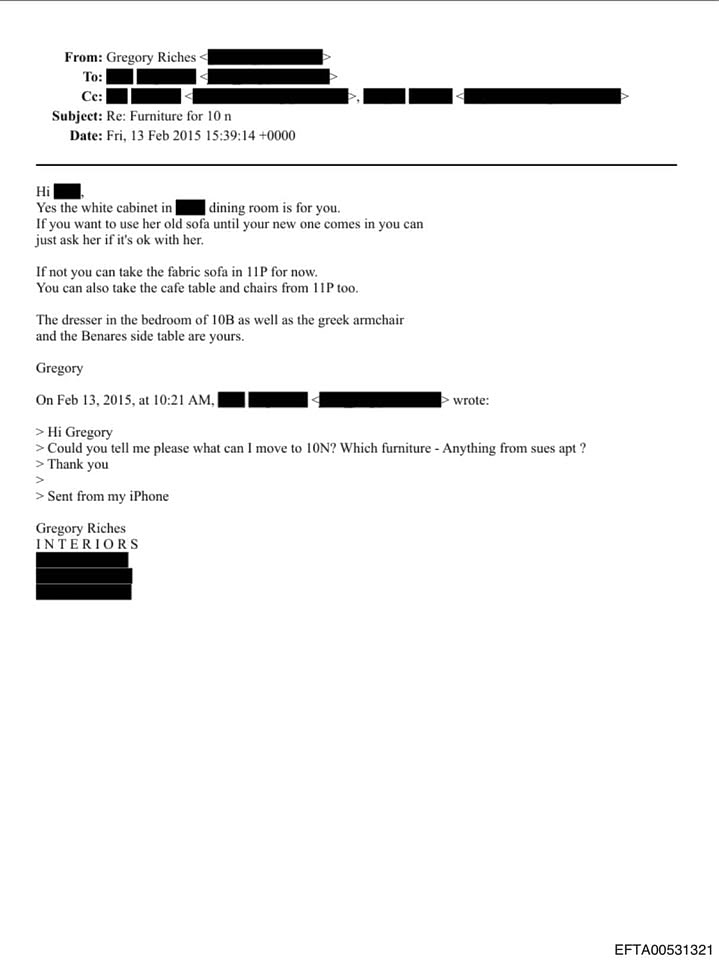
Yet, his appreciation is also shown in “smaller” items such as Greek armchairs specifically ordered for a bedroom of his, ’10B’, as seen in email correspondence with Gregory Riches (EFTA00531321).
Little St. James Island (LSJ)
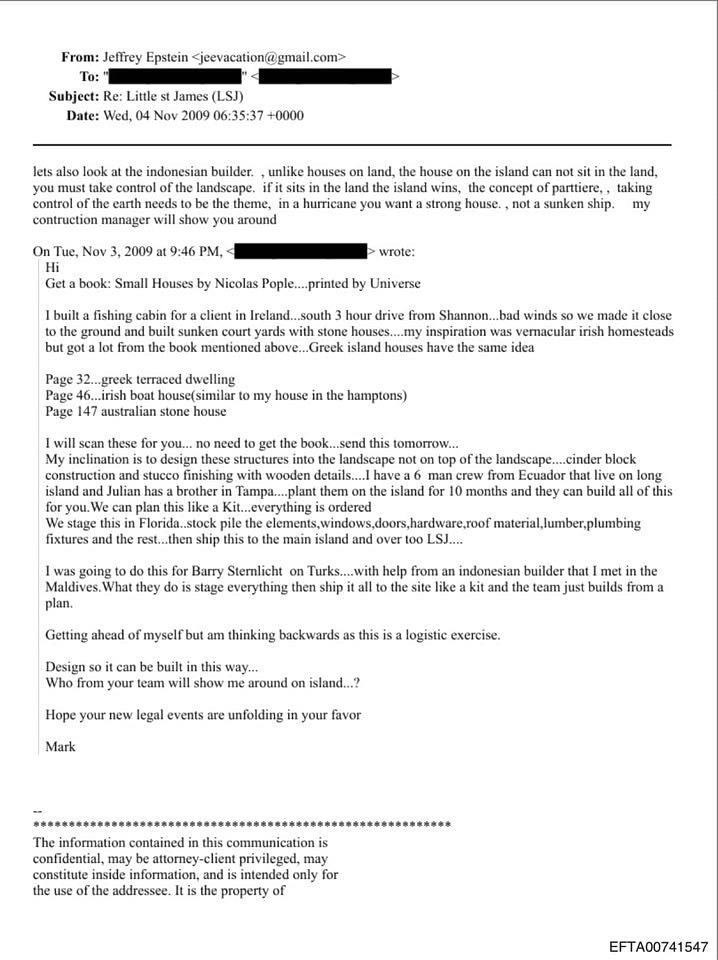
A chain of email correspondence from November 4, 2009, reveals Epstein grappling with both the practical and aesthetic challenges of building on Little Saint James. Epstein noted that structures could not merely “sit in the land” instead, one must “take control of the landscape.” He references the concept of parttiere — formal manipulation of terrain — and rejects integration into the natural environment. “If it sits in the land, the island wins.” (EFTA00741547).
Advice cited in the email drew inspiration from Greek terraced dwellings, Irish homesteads, and other vernacular structures, demonstrating a preference for buildings integrated with the landscape rather than imposed on it (EFTA02434722).
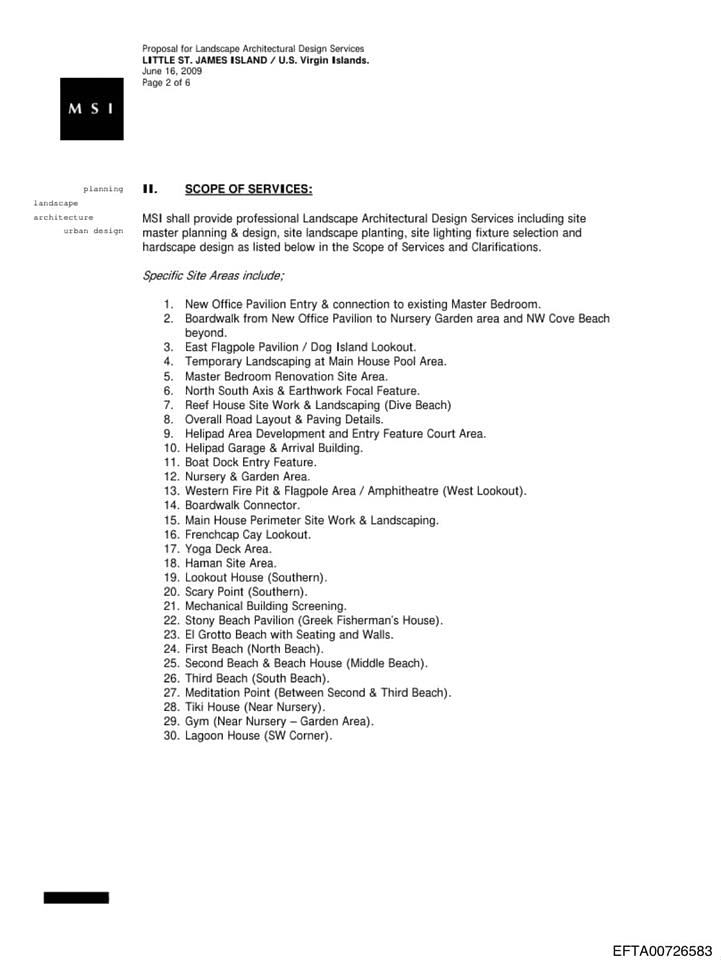
A broader landscape proposal for the architectural design includes axial planning, focal earthworks, pavilions, and a “Greek Fisherman’s House” at Stony Beach (EFTA00726582).
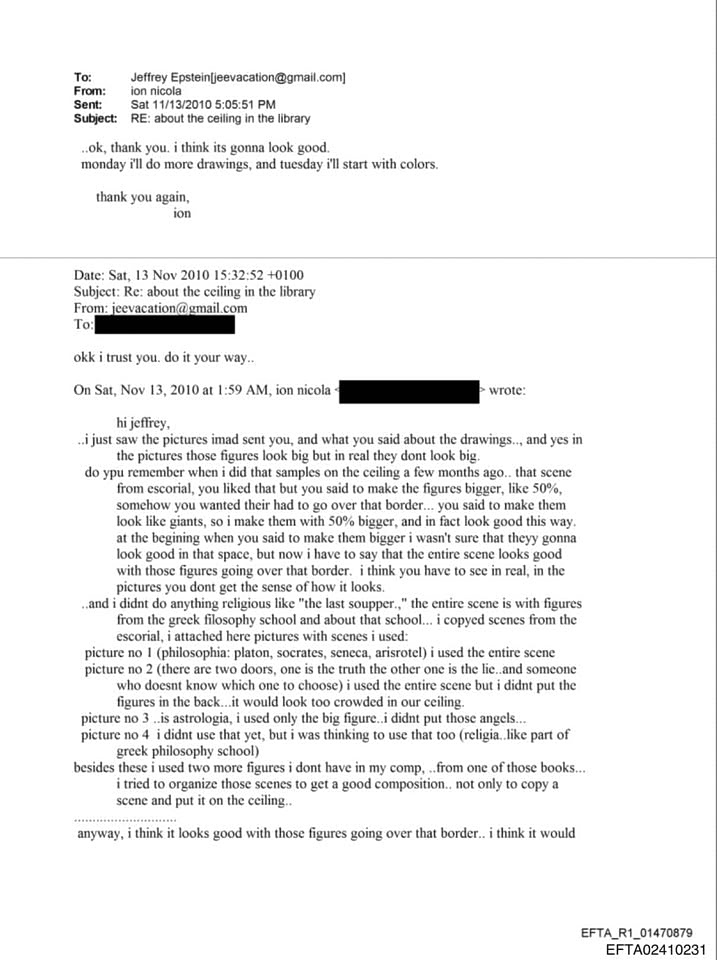
Epstein’s fascination with Greek philosophy extended beyond architecture into art. In a November 2010 email, Ion Nicola described the ceiling artwork in Epstein’s residence, which featured enlarged figures of Greek philosophers such as Plato, Socrates, Seneca, and Aristotle. Following Epstein’s instruction, the figures were increased by 50% to create a monumental effect that transcended the composition’s borders. Nicola emphasized that the full impact could only be appreciated in person, not through photographs (EFTA00753165, EFTA02410231).
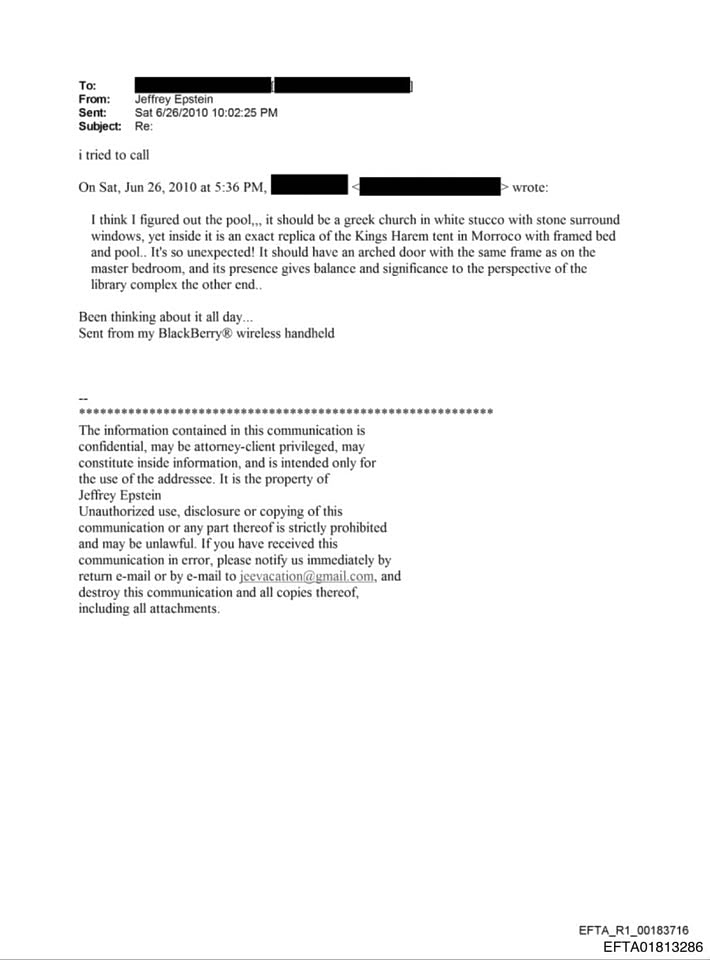
Epstein’s conceptual blending of styles extended to other structures on Little Saint James. One email envisions a pool house resembling a Greek church with white stucco and stone-surrounded windows, but with interiors modeled on a Moroccan royal tent, emphasizing perspective and visual balance across the library complex (EFTA01813286).
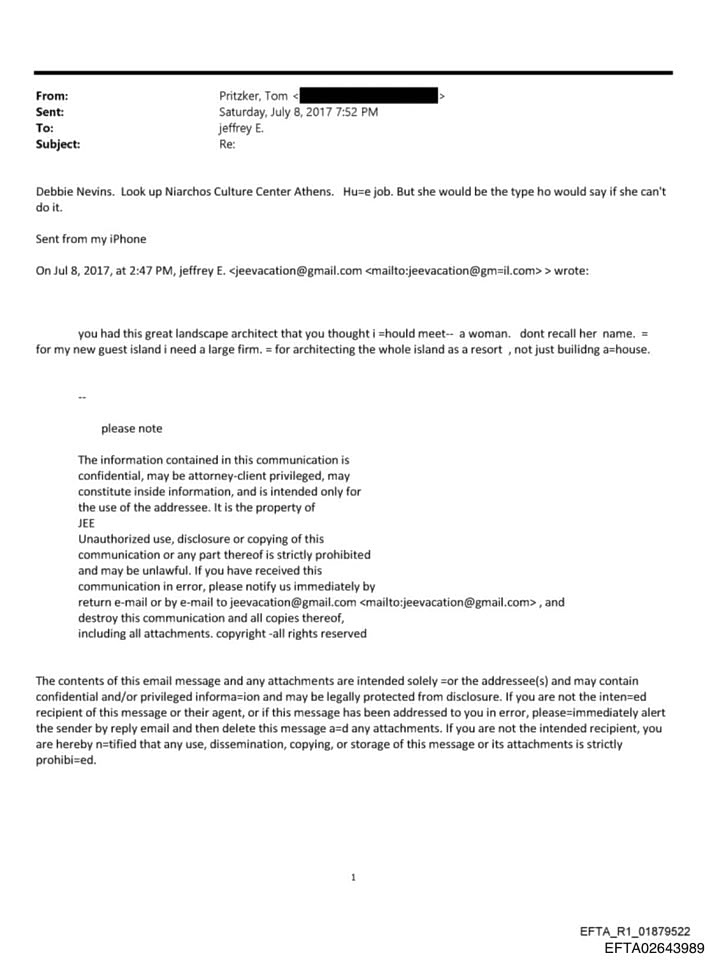
Emails in the Epstein files reveal that Epstein was actively planning large-scale architectural projects for his private islands, showing a keen interest in classical and contemporary Greek design. In correspondence with Tom Pritzker, Epstein inquired about a landscape architect, said to have been associated with the Niarchos Culture Center in Athens, Greece. He expressed the need for a large firm capable of designing the entire island as a resort, not merely individual houses. (EFTA02643989).
Little St. James and Beyond
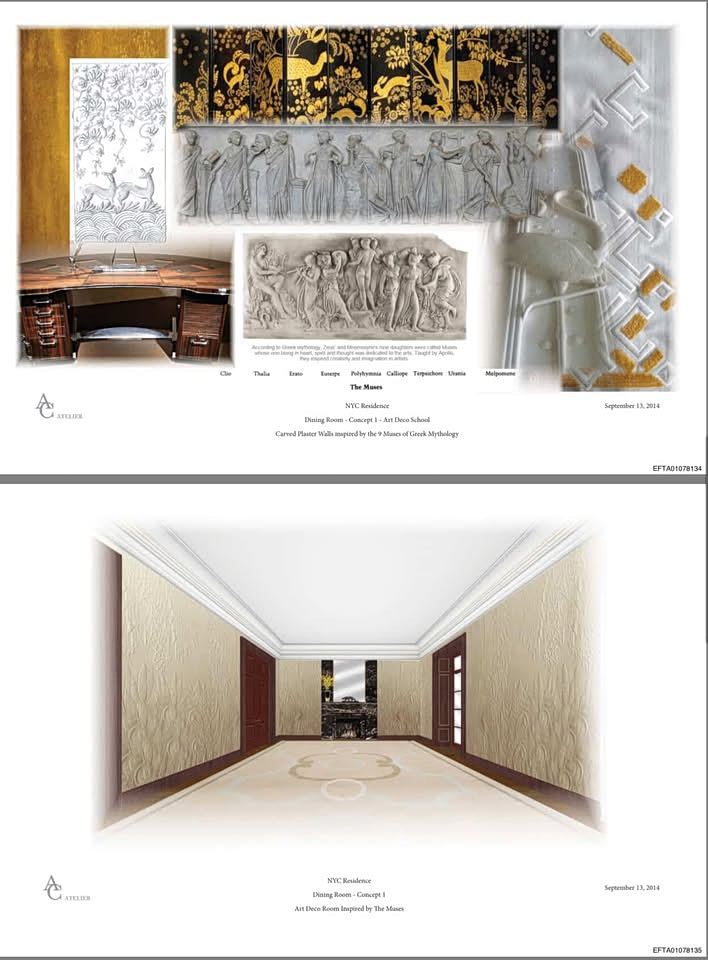
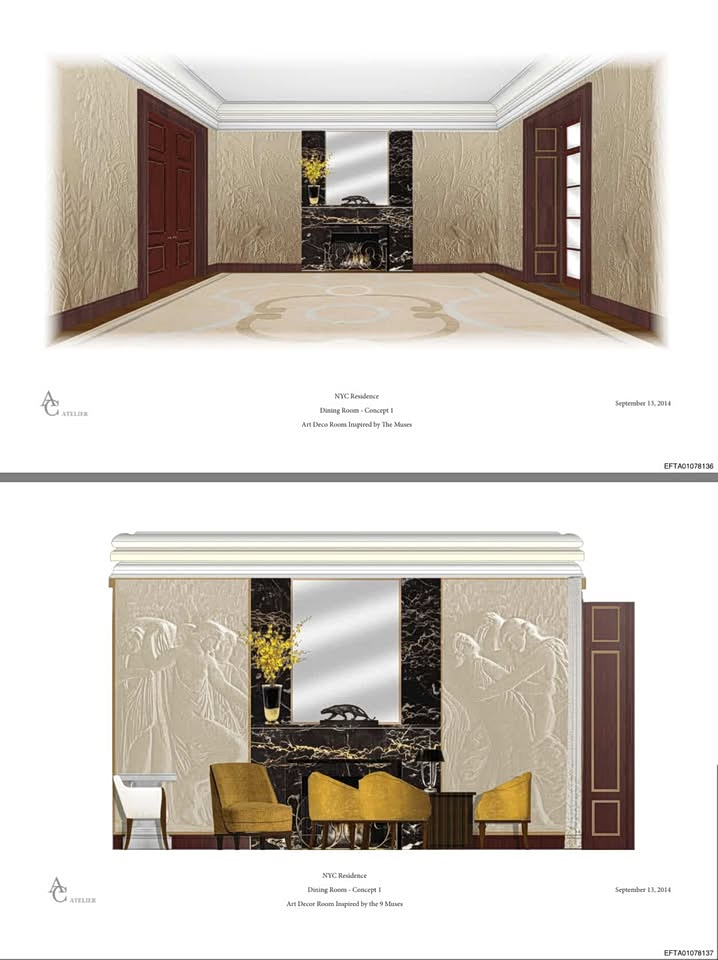
The Greek influence extended to Epstein’s New York City residence as well. The dining room, referred to as Concept 1, blended Art Deco aesthetics with classical Greek motifs, specifically the nine Muses of Greek mythology. The design featured intricately carved plaster walls and decorative elements. (EFTA01078123).
Artwork Acquisitions
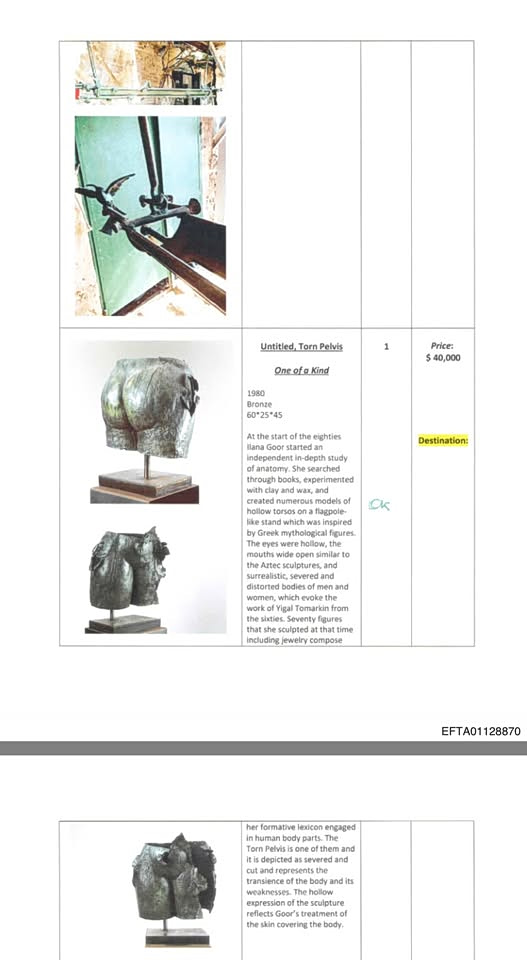
Epstein’s interest in Greek mythology also intersected with the acquisition of artworks. Among the artworks in Epstein’s collection was a bronze sculpture depicting only the lower half of a female body, titled ‘Torn Pelvis’ by Rana Goor, which drew inspiration from Greek mythological figures. The piece featured hollow torsos mounted on flagpole-like stands, with distorted and severed bodies reflecting both anatomical study and surrealism (EFTA01128867).
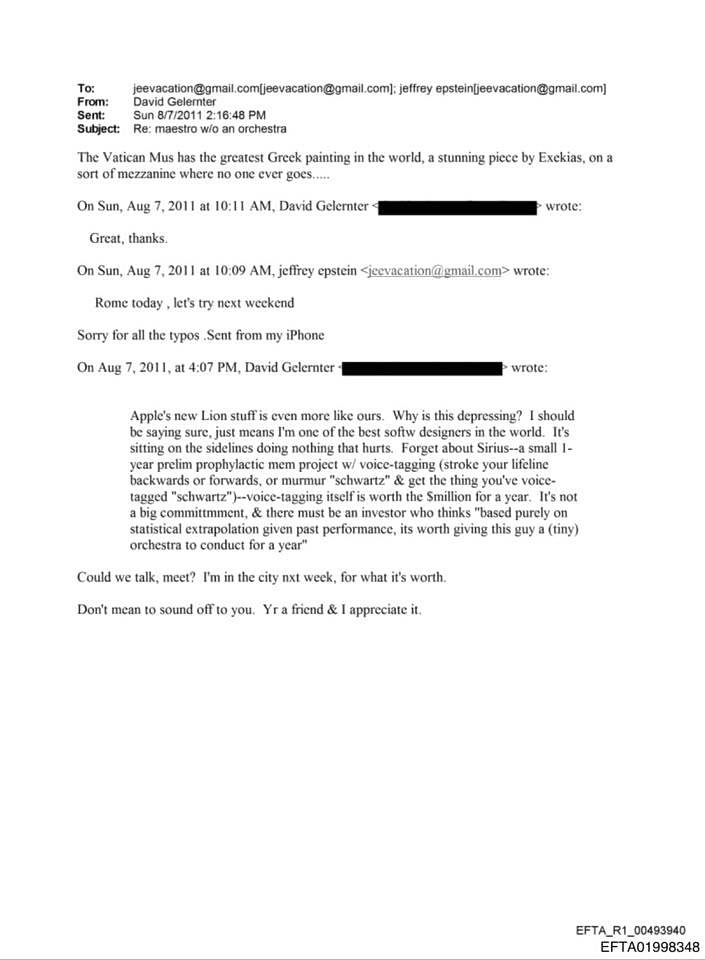
His fascination with Greek art continued during travels. In 2011, Epstein corresponded with David Gelernter regarding a “stunning piece by Exekias” housed in the Vatican Museums, displayed on a mezzanine “where no one ever goes.” Epstein expressed clear interest in viewing the work personally (EFTA01998348).
The island’s villas, pools and landscaped pathways were designed to project the image of a secluded retreat for invited guests. The interest was not limited to architecture as Greece seemingly appears frequently in correspondence.