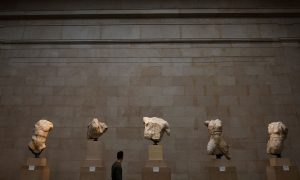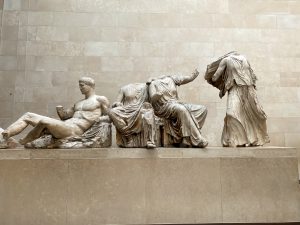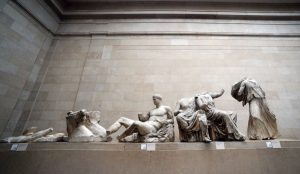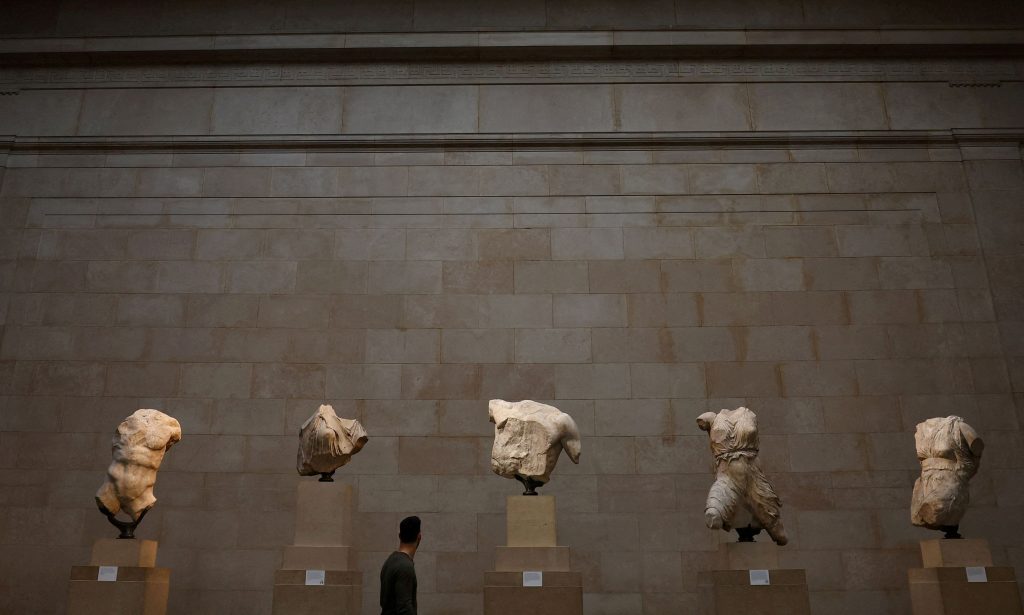
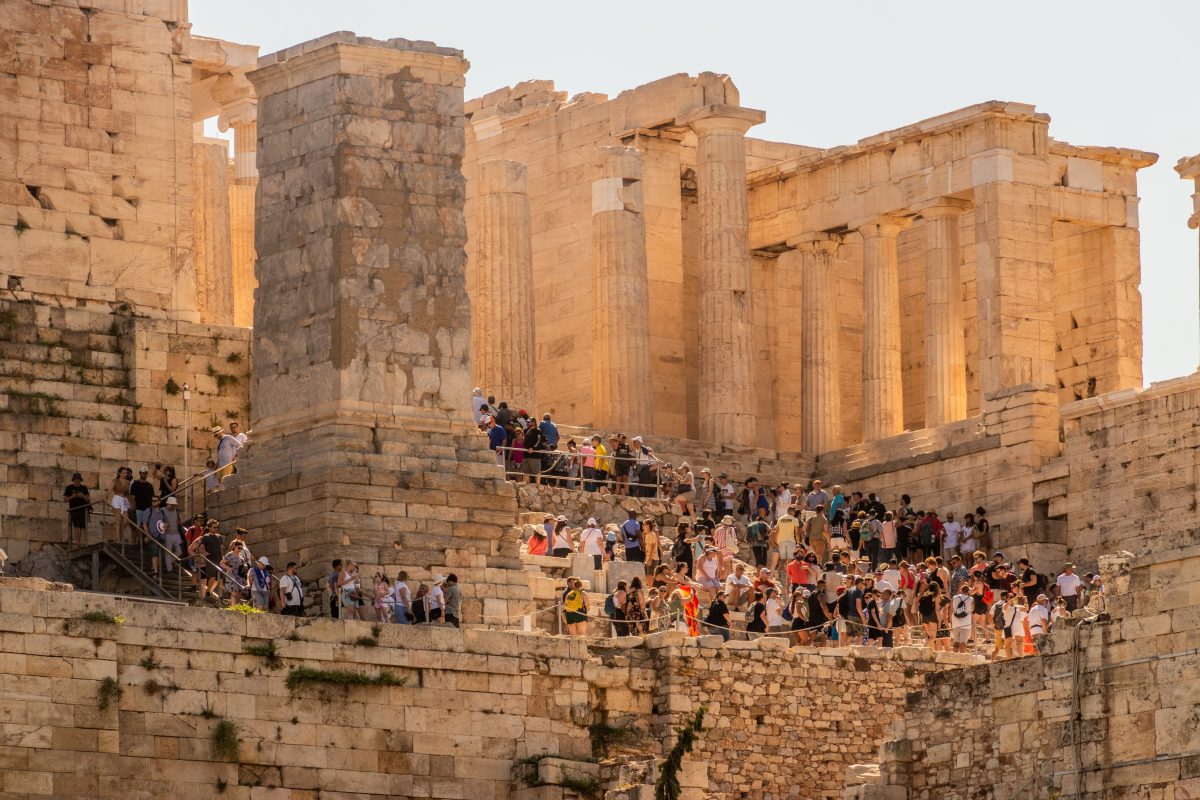
The debate over the Parthenon Marbles continues to provoke passionate arguments. Recent statements from George Osborne, Chairman of the British Museum’s Trustees, have renewed speculation about the possibility of a return to Athens.
“I’ve always said that this has been the museum’s most intractable problem for 200 years,” Osborne told the Sunday Times earlier this month. “So you have to be a bit humble when you turn up and say you are going to solve it. But I’m still pretty optimistic. If we all come at this problem with open minds, there’s a landing zone that satisfies the absolutely understandable requirements of the Greek state and our own requirements and laws. And if we pull it off we’ll have some great objects coming here.”
The comments sparked renewed debate about the potential for the Marbles to be reunited with Greece.
Speaking to TO VIMA, Janet Suzman, DBE, Chair of the British Committee for the Reunification of the Parthenon Marbles (BCRPM), stressed caution:
“Basically there are very few developments to be excited about. Yet. Agreement on both sides is lacking thus far. It is important that the most powerful voice in the British Museum, that of George Osborne, Chairman of the Trustees, is able to acknowledge publicly that the Parthenon Marbles are ‘the museum’s most intractable problem for 200 years. But I’m still pretty optimistic.’ His optimism is sorely needed because so far
precisely nothing has yet happened to make us at the BCRPM feel very hopeful. We cling on to the notion that one day the once-famous British sense of fair play will re-activate itself.”
For over four decades, the BCRPM has campaigned for the return of the Marbles, supporting Greece’s efforts with UNESCO’s ICPRCP, holding demonstrations at the British Museum, and engaging with Greek ambassadors to press for action. “There are other committees, both in the UK and worldwide, agitating for reunification, but no amount of fuss has so far made much difference,” Suzman added.
Osborne’s optimism, she suggests, may be premature. “That is all very well, but there needs to be an amendment in the Museum Act of 1963 and its de-accession law for a legally sound return of the Marbles to Greece, and that is yet to happen. The will to do so is not yet strong enough, but we hope it will increase. Certainly public opinion is steadily growing in favor of return.”
Meanwhile, the British Museum has signaled its willingness to explore exchanges or loans of the Marbles. “The BM needs to decide that a fair exchange, which will result in objects of prime importance coming to London, is worth the loss of its star exhibits,” Suzman said, highlighting resistance among some donors and trustees.
Authors and cultural figures have also entered the debate. Victoria Hislop described what she calls the British Museum’s “arrogance” and its “moral obligation” to Greece. In an interview with TO VIMA, she said:
“Well, if he’s optimistic, he hasn’t really shared the detail of his optimism at all… I’d quite like for us all still to be alive when an agreement is made.”
Hislop also emphasized the historical context of the Marbles’ removal: “The moral obligation just to me seems the very basic acceptance of the truth of how those sculptures came from the Parthenon Temple itself…through bribery, not through official permission…The British Museum consistently say we acquired them legally, but they were stolen goods.”
“I really do find it extraordinary that after all these years the facts are still not acknowledged. The Marbles are part of a greater whole. They are incomplete in London, they are incomplete in Athens, and the Acropolis Museum is by far the most appropriate place for them. Those figures should not be languishing in a grey gallery in London any more.”
Hislop added: “How long is this going to take? I’d quite like for us all still to be alive, when an agreement is made. All the polls with the British public show that more and more of us are saying, yes, they should go back. This isn’t going to be some political catastrophe that if the sculptures are returned to Athens. It’s like, I think it would be a victory. It would make Britain look good and generous and as though we’re doing the right thing. But, for some reason, and I can’t put my feet into their mind, into their way of thinking, I cannot even imagine why they are so set in their attitude to this. I just find it extraordinary.”
Former Conservative MP Tim Loughton offered a contrasting perspective: “The position of the Trustees of the British Museum, including its Chairman, is the same as it has been for years. The Elgin Marbles remain the property of the British Museum according to UK statute and their ownership is not going to change. However, for years the British Museum has been proactive in seeking to come to an arrangement with the Greek authorities whereby they can be lent in part on a temporary or rolling basis and travel to Greece, so that they can be enjoyed by an even wider audience and mutually
beneficial research can take place. In addition offers have been made to produce full copies of the Marbles which could be fashioned using 3D technology out of Pentelic Marble and painted in their original colors. These offers have always been rebuffed because the Greek Government will not acknowledge their ownership and as such their safe return could never be guaranteed. …The decontextualization that would ensue if they were taken from the BM would be highly damaging and set a dangerous precedent for the future of world museums and their collections.”
Classical archaeologist Mario Trabucco della Torretta, who organized the recent campaign against the return of the Parthenon Marbles a few months ago, also spoke to TO VIMA.

He defended the British Museum’s position on legal and historical grounds: “The long-standing British Museum position is rooted in truth and law…The truth is that there never was a ‘theft’ of the Elgin Marbles…The vast majority goes with the mainstream narrative because they don’t know any better, and that’s what I am trying to change, by popularizing what is already well established in academia…If the Marbles are removed from London despite their lawful acquisition, then no object is ever going to be safe. The entire global museum system becomes an open bazaar where everyone is welcome to claim anything, and legitimate acquisition will never be an impediment anymore.”
Trabucco also dismissed arguments based on national prestige or exceptional moral status, asserting the Parthenon is not unique in having fragments dispersed internationally.
As the debate continues, both the British Museum and the Acropolis Museum are exploring possibilities for collaboration, while public opinion in Britain shows a growing interest in the question of return. George Osborne has indicated optimism, but years of negotiations have yet to yield a concrete path forward.
For now, the Parthenon Marbles remain divided, with no agreement in sight, their future resting on legal frameworks, institutional will, and the complex interplay of history, scholarship, and public sentiment.
Mario Trabucco della Torretta added: “Mr. Osborne can be optimistic as much as he likes, but the truth is that after three years of secret negotiations he has precious little to show for it. Mr. Mitsotakis said publicly this month: we are far away from seeing an agreement. Mrs. Mendoni reiterated the same concept this week. Why is that? Because, like many others before him, Mr. Osborne went to war armed only of a water gun and had to realize pretty quickly that there is a reason this debate has been going on for two centuries. He thought he’d be Alexander cutting the Gordian knot in one sweep, gathering applause all around. The truth is that he’s been going at this all wrong. What is needed is for the British Museum and the Acropolis Museum to come together and dedicate some time to crafting a shared narrative of the facts of the removal, one they can both agree upon. Only with that in hand, they can start building upon it and make progress. So far we have one museum that says “legal” and the other that says “stolen”. It is clear that one of them is wrong, and that two world-class museums cannot come together to decide which is which is a disgrace.”