For more than half a century, Sir Ranulph Fiennes has made a career of going where others could not. He crossed Antarctica, reached both poles by surface travel and led some of the most formidable expeditions of the modern age.
Now the man described by Guinness World Records as “the world’s greatest living explorer” is proving unreachable to some of his closest friends and relatives.
Sir Ranulph, 82, has barely been seen publicly for almost two years. Friends and members of his wider family say they have been unable to visit or speak to him, while some say they do not know where he is living.
His stepson, Alex Millington-Cotes, has told TΟ ΒΗΜΑ that he wants the power of attorney held by his mother, Louise Millington-Cotes, Sir Ranulph’s second wife, removed and transferred to people whom he believes would act in the explorer’s best interests.
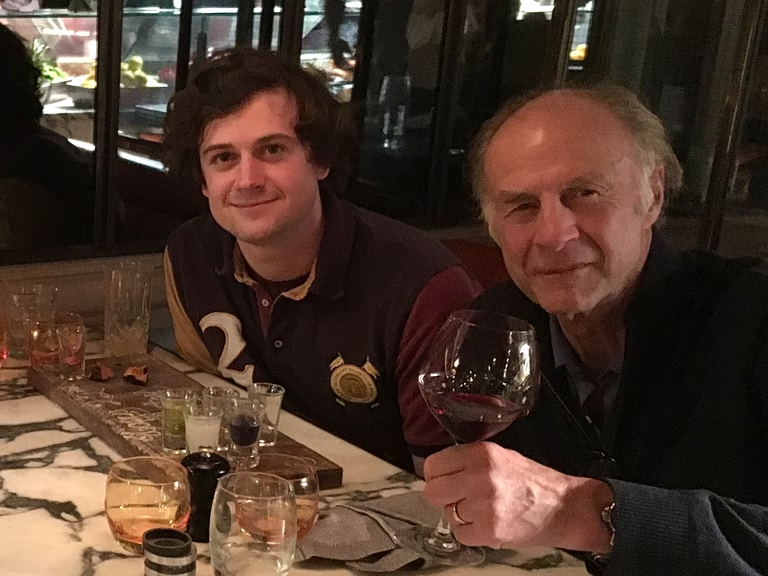
“I have no idea where he is right now unfortunately,” he said. “It’s extremely difficult without knowing where he is. How do you contact someone? It’s almost impossible.”
The claims are strongly at odds with the assessment of Cheshire Police. Detective Chief Superintendent Claire Jesson told TO ΒΗΜΑ that police and partner agencies were aware of the concerns but were satisfied that Fiennes was “living in an appropriate setting with suitable care and professional oversight”.
“No immediate safeguarding concerns have been identified at this time,” she said.
Louise Millington-Cotes was contacted by ΤΟ ΒΗΜΑ for comment.
The dispute has placed the intensely private circumstances of one of Britain’s most celebrated adventurers under unprecedented scrutiny.
‘He hugged me and told me how proud of me he was’
Millington-Cotes said his concerns began after one of his last meetings with his stepfather, at the family farm about two years ago.
The encounter was affectionate. But something about it troubled him.
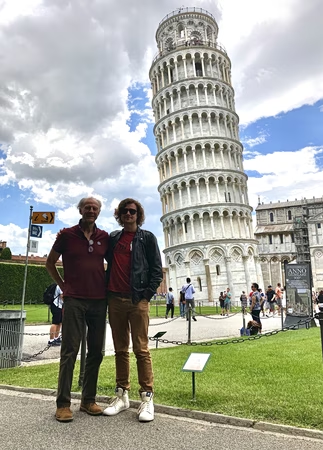
“He walked me back down the drive in quite quick fashion and we spoke a little bit and he hugged me and told me how proud of me he was,” he recalled.
As Sir Ranulph returned to the house, however, Millington-Cotes noticed how rapidly he had tired.
“I realized that he was quite quickly getting tired just from that short walk and that was quite a surprise to me.”
Fiennes had spoken publicly about being diagnosed with Parkinson’s disease, the progressive neurological disorder that can affect movement and muscle control.
What now alarms Millington-Cotes, however, is not simply his stepfather’s physical decline but his apparent separation from people who have known him for decades.
“I don’t believe that that’s in his wishes, to completely isolate himself from everyone,” he said. “I just don’t think that’s true.”
He has tried to telephone him.
“I tried to call him but I had no answer through that phone number sadly,” he said. “I don’t know whether he has access to his phone now. I have no idea.”
‘How do you contact someone? It’s almost impossible’
Millington-Cotes said the apparent inability of friends and family to reach Fiennes was at the heart of his safeguarding concerns.
“Paramountly, he has isolation and he’s not able to speak to or see his very close friends and family over his life,” he said.
He has begun crowdfunding legal action concerning the power of attorney held by his mother.
“As hard as it is to say, I’m hoping that the legal action would achieve removing the power from my mother,” he said, and transferring responsibility to people “who are fully interested in Ran’s needs, his wishes”.
He said the objective was to ensure that Fiennes’ wishes were respected and that “he’s having the very best medical treatment”.
Asked what he would tell his stepfather if he could speak to him today, Millington-Cotes said: “I would say that I love you and that everyone loves you and wants to see you.”
And what would he say to his mother?
“I would just say stop.”
‘He never complains – he’s so gentle, so kind and so humble’
For Martin Hartley, the expedition photographer who first worked with Fiennes in 2005, the present silence is difficult to reconcile with the man he knew.
Hartley photographed him training in the European Alps for Everest and later for an attempt on the north face of the Eiger.
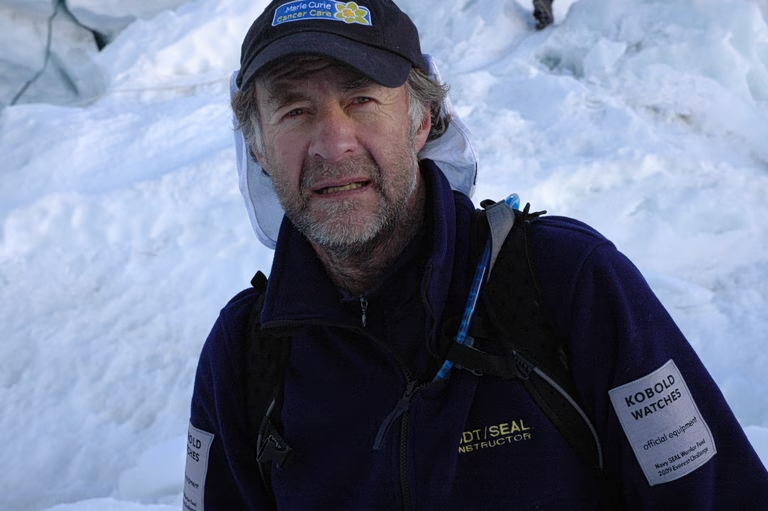
By then Fiennes had lost the fingertips of his left hand to frostbite after a sledging accident in the Arctic.
“Everything he was doing, he was doing with one and a half hands, just as quickly and as ably as I or anyone was doing with ten fingers,” Hartley told TO ΒΗΜΑ.
“Without exception, I’ve never heard him moan, whine, complain about anything, no matter how cold he’s been.
“He just gets on with it. He never complains and he’s so gentle and so kind and so humble.”
Hartley recalls one encounter in particular. Fiennes opened his car door, handed him a pen and asked the photographer to sign one of his books.
“To have one of my heroes ask me for my signature in my book for him – that just tells you all you need to know about how humble the man is.”
Hartley says concern about Fiennes now extends far beyond Britain.
“I’ve been getting phone calls from friends of mine as far apart as New Zealand and northern Canada asking: how is he, where is he?”
‘I don’t want Louise to find out I’ve left the house’
Hartley said the last time he saw Fiennes was in 2022, when the explorer agreed to record a video interview.
According to Hartley, Fiennes arranged an unusually discreet meeting in a car park and said he needed to return home by a particular time.
“He said, without me asking why, ‘I don’t want to be seen. I don’t want to be noticed. And I don’t want Louise to find out I’ve left the house and I need to be back by four o’clock so she doesn’t know I’ve been away.’”
Hartley said: “At that moment, I thought that’s not normal behavior.”
He has subsequently tried emails, voice messages and text messages, but says he has received no response.
“I’ve spoken to some of Ran’s friends and they’ve had the same experience,” he said.
Hartley alleges that communications from friends have been blocked or intercepted.
TO ΒΗΜΑ has not independently established that allegation.
His principal concern, he says, is the absence of independent contact with Fiennes.
“I’m concerned that there’s no independent oversight,” he said.
‘All your friends are missing you’
Hartley also questions whether the police conclusion that Fiennes is in an appropriate setting resolves the concerns raised by those close to him.
“It’s not completely about the space that’s being presented to the police,” he said. “It’s about how he’s cared for in that space.”
He added: “If anyone blocks a free flow of information to a person, including visits, that is not an act of love or care.”
Asked what he would say to his friend if he were sitting opposite him now, Hartley’s answer was simple.
“I’d say all your friends are missing you.”
He would also invite Fiennes back to the Royal Geographical Society, to be among the exploration community he helped to inspire.
“We want to celebrate you, Ran, again,” Hartley said. “They all want to be around you, Ran, because you’ve inspired us all. And it’s now time for you to inspire the next generation of people.”
‘This is the only time in two years that we heard directly from Ran’
Michael Kobold has known Fiennes for 26 years and describes him affectionately as “Uncle Ran”.
Their friendship began when Kobold collected Fiennes from an airport before a graduation ceremony at Frankfurt International School.
Kobold, who had recently started a watch company, decided during the journey to ask one of the world’s most famous explorers to become his brand ambassador.
“Ran, holding on to the handlebar in my Audi, looking straight ahead, said, ‘Anything you want, just please slow down,’” he recalled speaking to TO ΒΗΜΑ.
Today Kobold is among the most outspoken figures campaigning over Fiennes’s welfare.
He makes a series of serious allegations concerning Louise Millington-Cotes and her relationship with her husband, some dating back many years.
Those allegations have not been independently established by TO ΒΗΜΑ.
Kobold points to a meeting in July 2025 between Fiennes and Arabella Pepper, the younger sister of his late first wife, Ginny, as critical evidence that the explorer wanted contact with his old friends.
Pepper has said that she had been unable to see her brother-in-law for more than a year and eventually gained access to him at a care home.
“The first thing I said to him, apart from the usual greetings, was that everybody was worried about him, was looking for him, was longing to see him,” she said.
“The relief on his face was very obvious.”
According to Pepper, Fiennes told her: “Send a message to everybody, send them my love, tell them I love them and tell them I’m longing to see them.”
Kobold, who says he helped arrange the meeting, believes its significance lies in the fact that Fiennes was not expecting Pepper.
“This is the only time in two years that we heard directly from Ran,” he told TO ΒΗΜΑ.
‘He misses his friends’
According to Kobold’s account of what Pepper reported after the meeting, Fiennes said he missed his friends and wanted to speak to them.
Kobold argues that this contradicts any suggestion that the explorer has chosen to withdraw from those close to him.
“He was happy to see her,” he said. “And then he followed it up by saying, ‘I want to see my friends.’”
Kobold said the last time he himself was in contact with Fiennes was in about 2023.
He remembers discussing a complicated subject with him and says Fiennes was able to understand what was being explained.
His overriding concern now, he said, was that his friend was being deprived of ordinary contact and personal freedom.
“Forget the biggest explorer and all of that,” Kobold said. “He is a really kind, gentle, sweet man.
“He is just one of the nicest people ever to roam this planet.”
‘No immediate safeguarding concerns’
The accounts of the three men stand in marked contrast to the assessment of Cheshire Police.
Jesson said: “Police and partner agencies are aware of the concerns raised and are satisfied that Sir Ranulph Fiennes is living in an appropriate setting with suitable care and professional oversight.
“No immediate safeguarding concerns have been identified at this time.”
She added that “any new information received will be assessed and considered through the appropriate multi-agency arrangements.”
“As this is a matter involving an individual’s care and welfare, it would not be appropriate to comment further on personal circumstances,” she said.
Alex Millington-Cotes said he had subsequently been contacted by a detective who asked about his experiences and what evidence he might be able to provide.
The contact, he said, gave him “a little bit” more confidence in the police response.
“It shows that they do still have potentially concerns and some interest and they haven’t completely closed it,” he said.
But he believes the authorities should look more deeply at the circumstances surrounding his stepfather.
“It would have been good if they’d said that enquiries are ongoing,” he added.
‘Restrictions must be lawful, necessary and in their best interests’
Questions have also been raised over Fiennes’s time in residential care in Wales and the restrictions that may have been placed upon him.
TO ΒΗΜΑ contacted Care Inspectorate Wales, which said it could not comment on an individual’s personal circumstances.
The watchdog said it monitors Deprivation of Liberty Safeguards, or DoLS, intended to protect people living in care homes.
Any restrictions on a person’s freedom must be “lawful, necessary and in their best interests”, it said.
Where a care provider believes someone “is or may be deprived of their liberty”, the provider must apply to the relevant local authority for authorization and notify the inspectorate.
“It would not be appropriate for us to comment on an individual’s personal circumstances or care arrangements,” a spokesman said.
From the poles to a deeply private family dispute
Fiennes’s life has been defined by endurance.
After spending his childhood between Britain and South Africa, he joined the British Army and served with the SAS before turning to exploration.
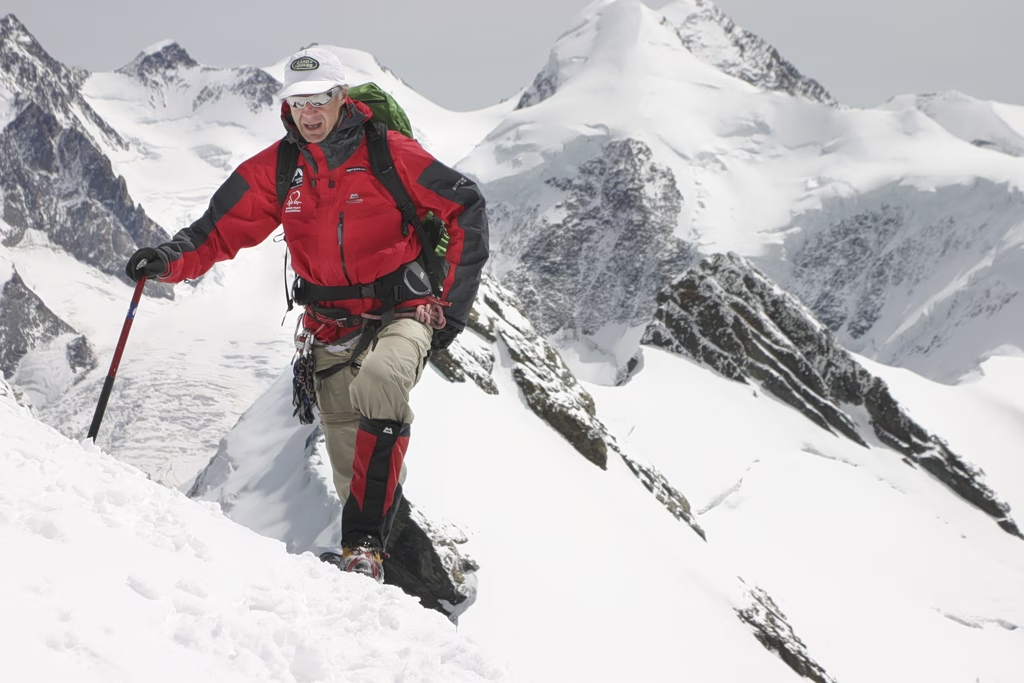
During the Transglobe Expedition of 1979-82, he led the first expedition to circumnavigate the world along its polar axis, becoming the first person to reach both poles by surface means.
In 1993 he and Mike Stroud completed the first unsupported crossing of Antarctica. In 2003, only months after suffering a heart attack, Fiennes completed seven marathons on seven continents in seven days.
His achievements earned him the description that has followed him for decades: “the world’s greatest living explorer”.
But those records are not what his friends talk about first.
Hartley remembers a man who never complained and who asked his own photographer for an autograph. Kobold remembers a gentle friend gripping the handle of a speeding car and agreeing to become an ambassador for a fledgling business. His stepson remembers the hug on the driveway.
Now all three want the same thing: contact.
For Millington-Cotes, the dispute has reached the point where legal action may be necessary.
“It’s a very serious situation and it shouldn’t be taken lightly,” he said. “It’s a very real situation.”
And for Hartley, after decades spent photographing a man who made his name disappearing into the most hostile places on Earth and returning from them, the message is more personal.
“All your friends are missing you,” he said. “We want to celebrate you, Ran, again.”
The man who spent his life reaching the unreachable has, to some of those who know him best, now become unreachable himself.