 Μake us preferred on Google
 David Hockney, who rocketed into the art-world pantheon with exuberant landscapes, evocative portraits and vivid paintings of swimming pools, died at 88.
His depictions of familiar images, often made in a palette of bright acrylics, earned him the mantle of one of the fathers of British pop art. But Hockney didn’t ally himself with the movement—or any other—insisting that his vast oeuvre hinged simply on “looking, always looking.”
“The world is very, very beautiful, if you look at it, but most people don’t look very much, do they?” Hockney said in a 2019 interview for the Louisiana Museum of Modern Art in Humlebæk, Denmark. “They scan the ground in front of them so they can walk, but they don’t really look at things, incredibly well, with an intensity…I do.”
REFILE – CORRECTING NAME OF PAINTING
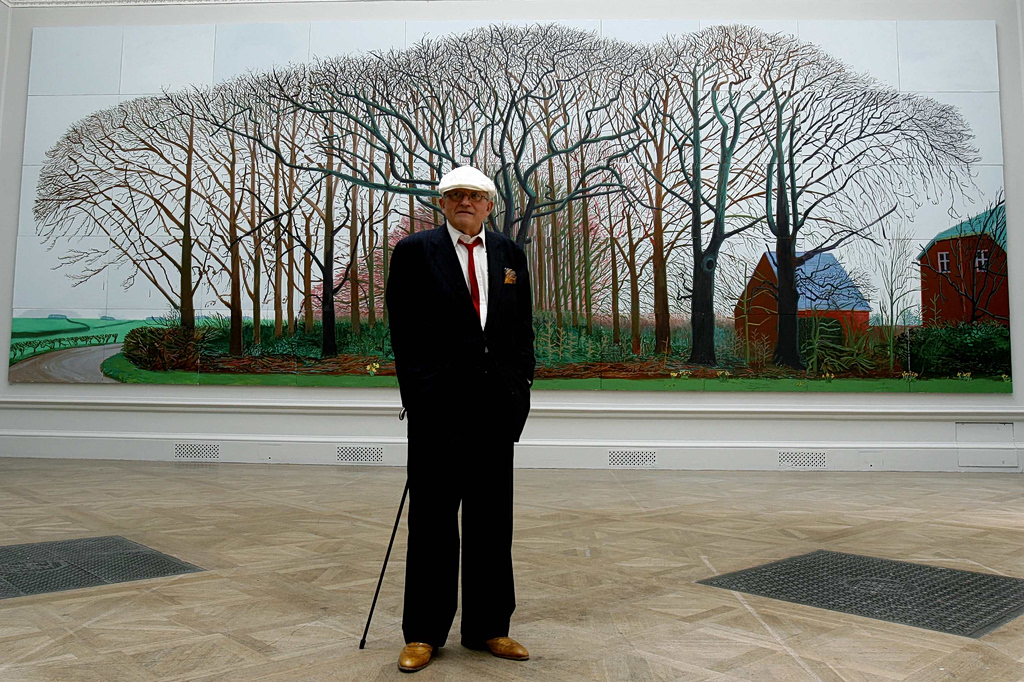
British artist David Hockney stands in front of his latest painting at the Royal Academy of Art in London May 25, 2007. Painted in Yorkshire and entitled “Bigger Trees Near Warter”, the forty-foot (12-metre) wide and fifteen-foot (4.6-metre) high piece is the largest Hockney ever made and is comprised of a grid of fifty small canvasses. REUTERS/Kieran Doherty (BRITAIN)
Hockney died peacefully at home on Thursday, his publicist Erica Bolton said.
From modest roots in West Yorkshire, England, Hockney swiftly established himself as an art-world dynamo, first conquering London, then setting out to become the “Piranesi of Los Angeles,” a reference to the 18th-century artist whose etchings documented the Italy of his time, and later devoting himself to English and French landscapes. His restless intellect and self-confidence propelled him toward color-soaked figurative work and not the abstract expressionism or pop art of many of his peers.
Hockney honed his unique aesthetic with travel and a ravenous appetite for experimentation and technology. For more than 60 years, he hopscotched among media, painting in oils, acrylics and watercolors, drawing, making prints and creating works on fax and copying machines as well as iPads and iPhones .
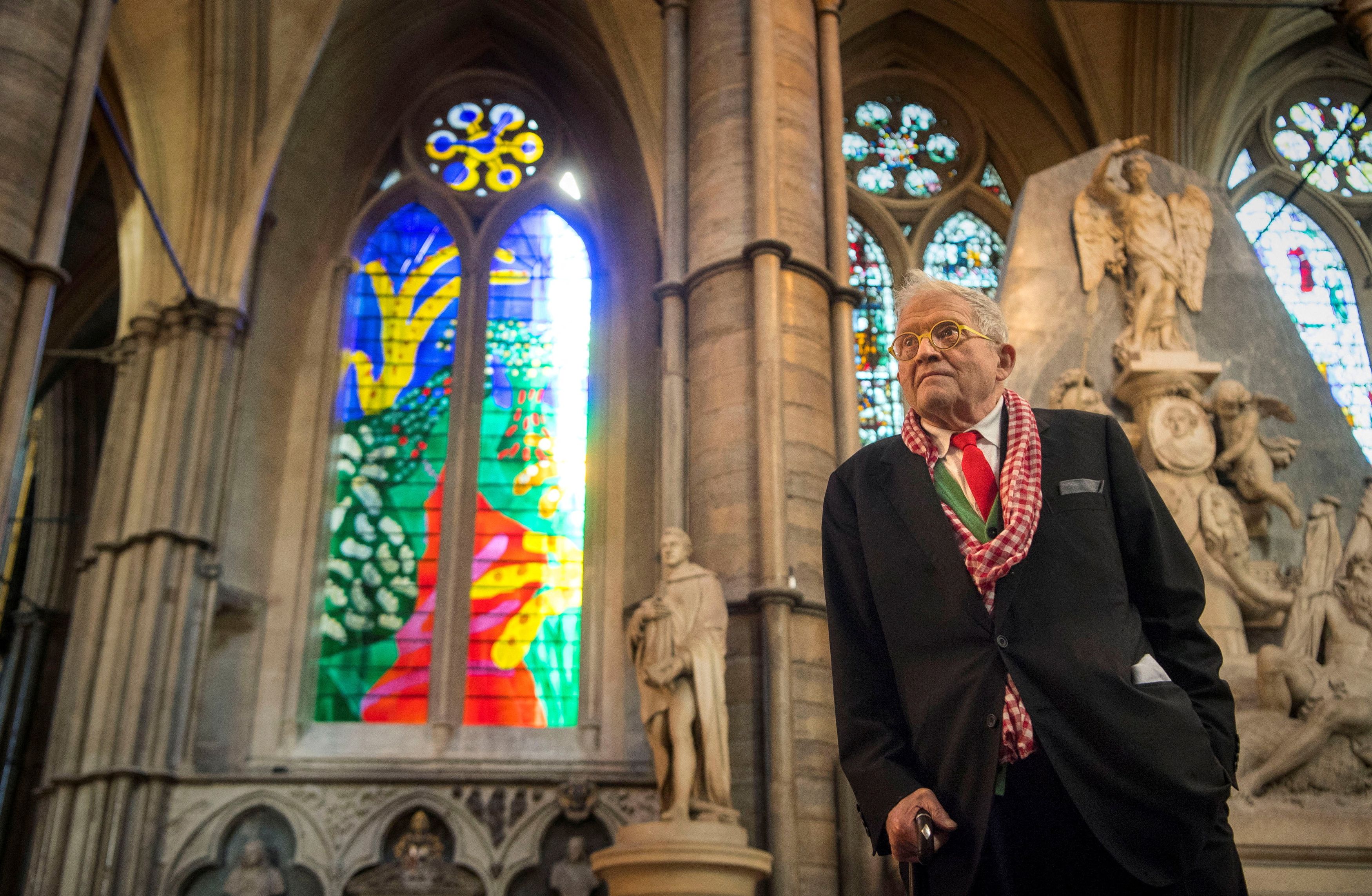
He designed sets for plays and backdrops for operas and—using an iPad—created a hawthorn-blossom pattern for a stained-glass window in Westminster Abbey to honor the reign of Queen Elizabeth II.
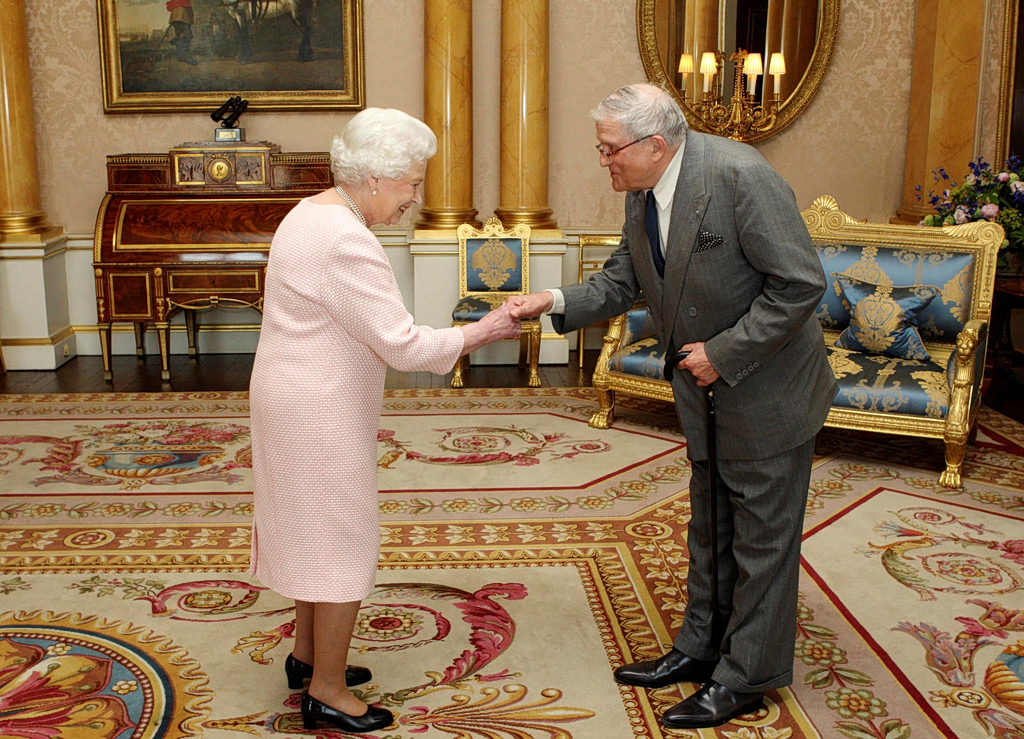
FILE PHOTO: Britain’s Queen Elizabeth presents artist David Hockney with the Order of Merit at Buckingham Palace, in central London May 22, 2012. Hockney’s appointment follows the death in 2011 of Lucian Freud, the only painter in the order ? which has no more than 24 members at one time. REUTERS/Steve Parsons/Pool (BRITAIN – Tags: ENTERTAINMENT SOCIETY ROYALS)/File Photo
Puckish and determined, Hockney didn’t shrink from mutinies small or large. A tobacco enthusiast since age 16, he ignited a furor during the Covid-19 pandemic by musing publicly whether smokers might be immune to the virus. Although a passionate reader, he was a terrible speller, immortalizing “tea” as “tae” in a 1961 painting. He flouted art-school rules and declined to hide his homosexuality in an era when many did. When hearing loss in middle age drove him to rely on hearing aids, he credited the affliction with sharpening his awareness of the world around him—and enhancing his art.
Blockbuster exhibitions of Hockney’s crowd-pleasers drew record numbers of visitors to museums. In 2018, his painting “Portrait of an Artist, (Pool with Two Figures)” sold for $90.3 million —at the time, the highest amount for a living artist at auction. Hockney wrested the title from Jeff Koons, who reclaimed it the following year, when his “Rabbit” sculpture sold for $91 million.
He also was known for his portraits, often of couples, such as his friends, the writer Christopher Isherwood and the artist Don Bachardy.
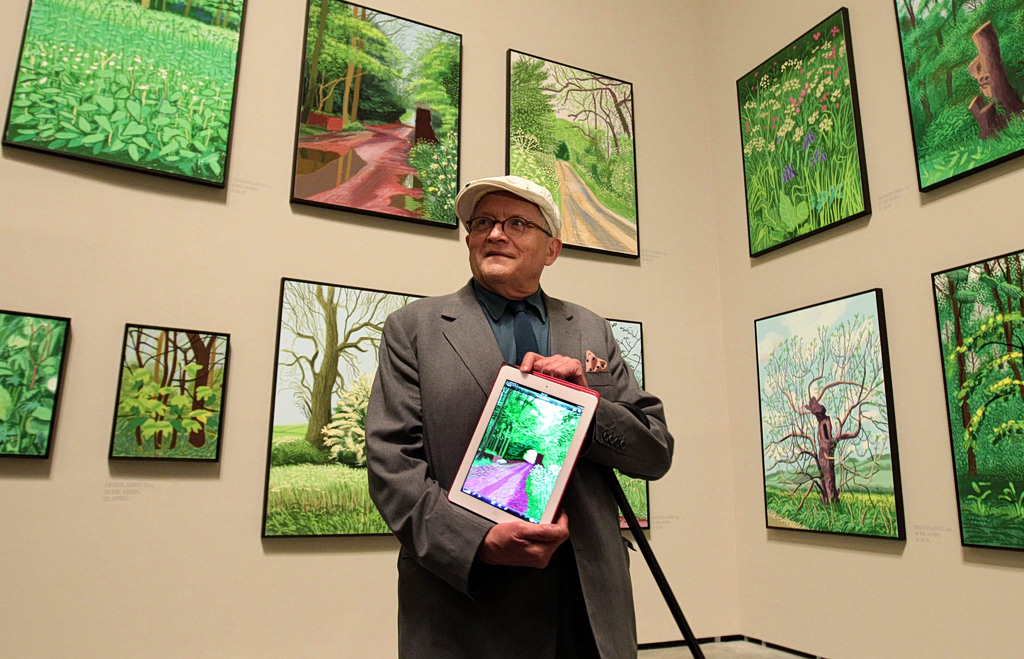
epa03218900 British artist David Hockney poses during the presentation of his exhibition ‘David Hockney: A Wider Perspective’ at the Guggenheim Museum in Bilbao, Spain, 14 May 2012. The Guggenheim will host the first exhibition dedicated to Hockney in Spain from 15 May to 09 Septiember. EPA/ALFREDO ALDAI
Other subjects included Hockney’s dachshunds, Stanley and Boodgie; friends, such as textile designer Celia Birtwell and curator Henry Geldzahler; and family, including his mother and father. The artist also chronicled his own face and physique from youth through old age , with unflinching depictions of time’s toll.
Ever since he began snapping Polaroids in the 1960s, Hockney maintained an intense relationship with photography, taking thousands of pictures and using some in collages and other works. He also worked with 35mm cameras and digital devices, but maintained that photography couldn’t capture nature the way painting could.
Hockney was born in 1937 in Bradford, England. As a boy, he was drawn to painting and the mechanics of moving the brush from pot to canvas. In interviews, he recalled being transfixed as a child by watching his father use fresh paint to make battered bicycles look new. He gravitated to art classes in school and said that, by age 11, he had decided to become an artist.
In 1959, he moved to London to study at the Royal College of Art. Amid a cosmopolitan circle of teachers and students, he experimented with abstract expressionism, then in vogue, but didn’t take to it.
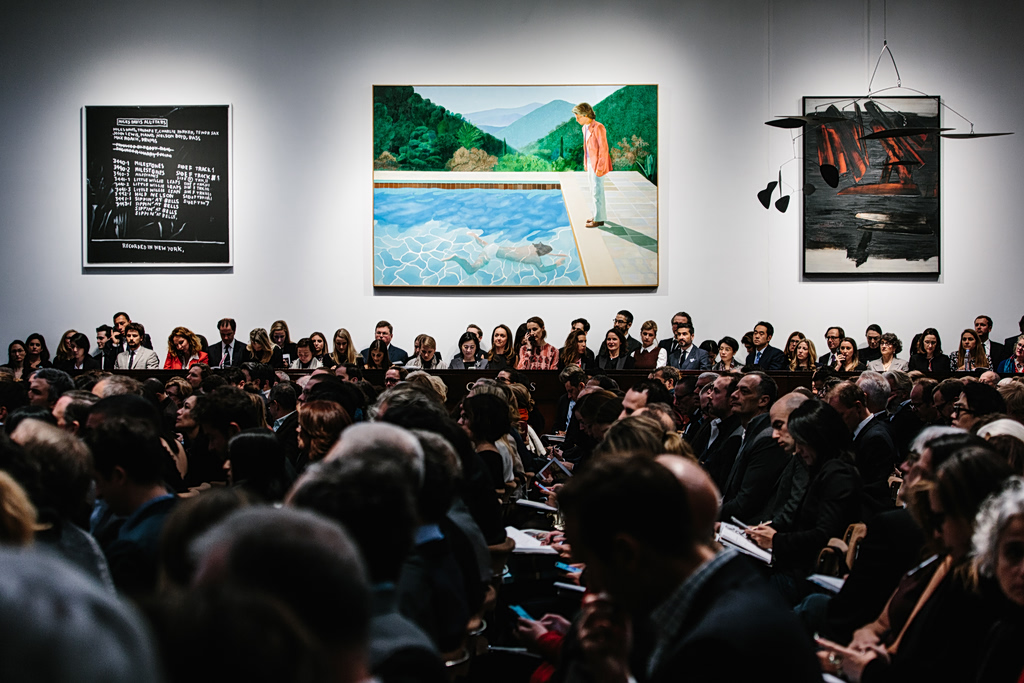
epaselect epa07169125 The painting ‘Portrait of an Artist (Pool with Two Figures)’ by artist David Hockney (C) is displayed during the sales event of the Post War and Contemporary Art Evening Sale at Christie’s auction house in New York, New York, USA, 15 November 2018. ‘Portrait of an Artist (Pool with Two Figures)’ sold on 15 November for 90.3 million US dollar at auction, the highest recorded auction record for a living artist. EPA/ALBA VIGARAY
At the Royal College of Art, Hockney stood out as a superlative draftsman, who absorbed the classical training on his own terms. When the college awarded him its gold medal, Hockney accepted the honor wearing a gold lamé jacket.
As a student, he took up etching, in part because the Royal College of Art covered the costs of his materials. In group shows, Hockney’s paintings won prizes as well as the attention of curators and collectors. After graduating, he took a studio in London’s Notting Hill, then a gritty contrast with the trendy neighborhood it has become. In a productive frenzy, he completed paintings for his first solo exhibition—a sellout—in December 1963 in London.
The following year proved a watershed. Drawn by the weather and the promise of new friends and experiences, Hockney visited California. He arrived without a driver’s license, according to Christopher Simon Sykes’s biography of the artist, and barely passed the test after a skimpy tutorial on a friend’s pickup truck. He enjoyed driving and over the years, graduated to luxurious vehicles from the $1,000 Ford Falcon in which he first took to the freeways.
Hockney painted the palm trees, modern houses and swimming pools of Los Angeles and Santa Monica, falling in love with a region where he would live off and on for more than five decades.
FILE PHOTO: British artist David Hockney poses inside Westminster Abbey, where he has designed a new stained glass window, in London, Britain, September 26, 2018. Victoria Jones/Pool via REUTERS/File Photo
His many designs for theater and opera began with sets for a 1966 revival of “Ubu Roi” by Alfred Jarry at the Royal Court Theatre in London.
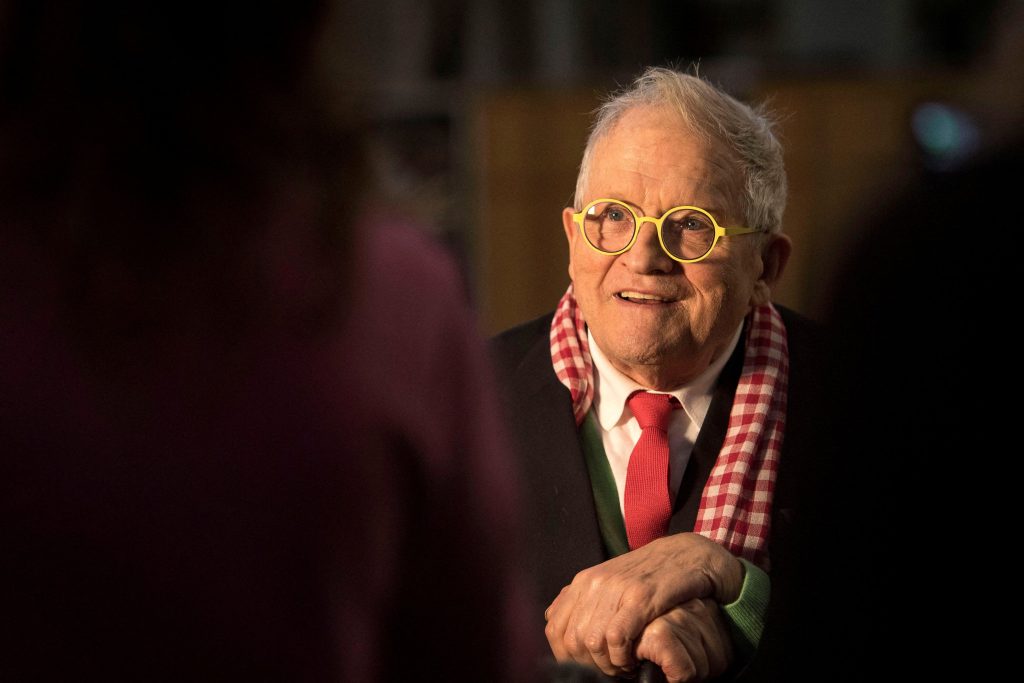
A trans-Atlantic celebrity since the ’60s, Hockney cut a dandyish figure with rakish touches such as floppy bow ties, scarves, caps and pocket squares. Owlish round spectacles, often with heavy black frames, were another signature. In 1961, an advertisement for Lady Clairol hair dye inspired him to turn his natural dark hair white blond.
Hockney was prone to marathon sessions in the studio, particularly when his romantic life turned operatic. His parting from his companion, Peter Schlesinger, in the early ’70s triggered a productive bender that yielded paintings including “Portrait of an Artist, (Pool with Two Figures) ”.
As exhibitions, books and retrospectives built his renown, Hockney increasingly relied on travel—to Paris and elsewhere—so he could work undisturbed before friends and others crowded his schedule.
Later in life, his focus shifted from California back to Europe, amid a new interest in painting outdoors. Nature, and trees in particular, became his fixation. Hockney returned to England in 1997 for his first extended stay in decades. He spent hours driving through, admiring—and painting—the Yorkshire countryside. He returned in 2004, devoting a summer to making watercolors of the landscape. He went on to paint subsequent seasons there in oil.
In recent years, Hockney headed from Southern California to northern France, settling into a house and studio on several acres in Normandy. He bought the property impulsively in 2018, he said, although France’s more relaxed approach to tobacco had something to do with his decision.
“I’ve smoked for more than 60 years,” he told WSJ. Magazine in 2019. “But I think I’m quite healthy. I’m 82. How much longer do I have? I’m going to die of either a smoking-related illness or a nonsmoking-related illness.”
At Hockney’s 70th-birthday party at Tate Britain in London, Sykes’s biography recounts, the museum’s smoke detectors were turned off for 10 minutes after dinner so the guest of honor could have a cigarette.
During the pandemic, he whiled away lockdown by rising early and chronicling nature’s progress in more than 100 pictures on an iPad. Time didn’t diminish his creativity, Hockney explained to The Wall Street Journal in 2014, because “the joy and urge to draw is an ancient, 40,000-year-old impulse.”
Write to Brenda Cronin at brenda.cronin@wsj.com