 Μake us preferred on Google
 BRUSSELS—European leaders rallying support for Kyiv say they are working to defend a democratic country, safeguard international law and counter Russian aggression.
But there is another motivation rooted in self-interest: Europe believes a deal that favors Moscow risks a wider war that could engulf the whole continent.
Russia is in a position to emerge from peace negotiations with vastly expanded military production capacity, confident it can redraw borders by force and viewing NATO as weak.
Cash-drained European capitals fear they would have no other choice but to massively increase military spending and defensive preparations, in the hope of preserving their deterrence.
President Trump and his team want a quick settlement to the conflict, which is set to enter its fifth year. For Europe, as much as for Ukraine, a bad peace deal that leaves Kyiv weak and vulnerable is worse than no deal at all for now.
“The future of Ukraine is closely linked with our own,” said German Defense Minister Boris Pistorius on Tuesday. “If we cannot achieve lasting and just peace for Ukraine, we will not have any guarantee for our own security either,” he told a virtual gathering of mainly European countries contributing to Ukraine’s war effort.
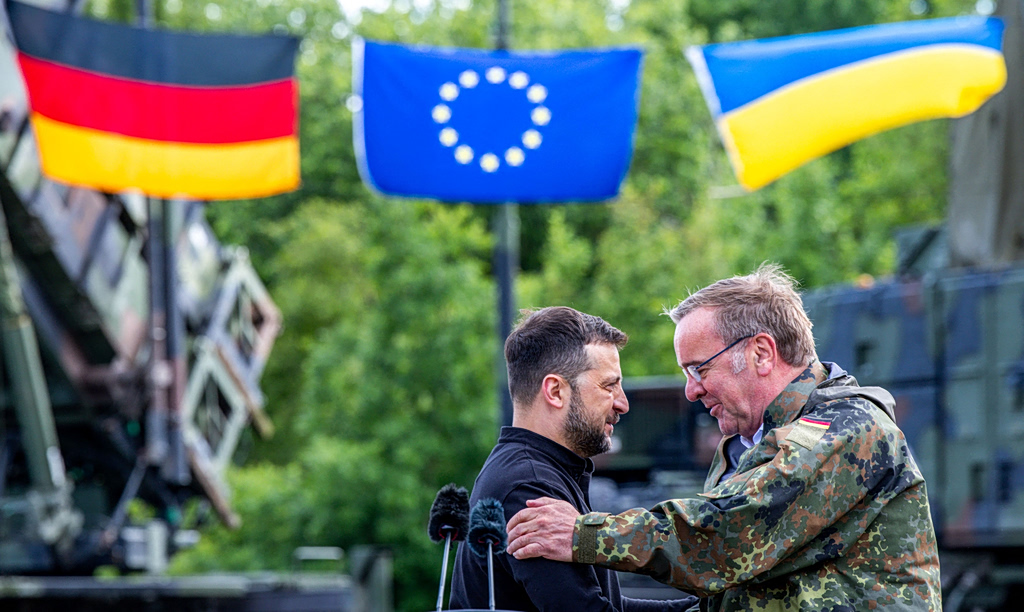
Boris Pistorius, Federal Minister of Defense and Ukrainian President Volodymyr Zelenskiy great each other during their visit to a military training area to find out about the training of Ukrainian soldiers on the “Patriot” anti-aircraft missile system, at an undisclosed location, in Germany, June 11, 2024. Jens Buttner/Pool via REUTERS
The diverging trans-Atlantic positions represent a more fundamental rupture. The Trump administration wants the U.S. and Europe to achieve a rapprochement with Moscow for what the administration terms “strategic stability with Russia.” The White House says that would reduce the risk of a wider war. Administration officials also see potential business opportunities with Russia.
Europe and Ukraine take an opposing view. They see Russia as a long-term threat and believe that any trust must be earned and verified—and until then, Moscow must be deterred.
Russia has accused Europeans—and the U.S. under the Biden administration—of waging a proxy war against it by backing Ukraine. Russian President Vladimir Putin warned recently that if Europe sought war, Russia was ready for it. Kremlin spokesman Dmitry Peskov has said Kyiv’s allies’ strategy is to “fight to the last Ukrainian” rather than quickly reach a settlement. The Kremlin, however, hasn’t accepted the U.S. peace proposal and there is little sign it has any intention of winding down the war.
The competing Western perspectives have been evident in and around U.S.-led peace talks over recent months. Differences have repeatedly strained already volatile relations between Europe and Washington.
A U.S. national security document published this month accused Europeans of harboring “unrealistic expectations” over the war. Days before its release, European leaders had warned Ukrainian President Volodymyr Zelensky to be wary of agreeing to significant concessions in talks with the U.S. before locking in details of what Washington would offer if Russia breached a peace deal and attacked Ukraine again.
“We want peace. But not a peace that is in reality a capitulation,” French President Emmanuel Macron said last month. He described that as a deal that “gives Russia all the freedom to continue to go further” and endanger Europe.
A recent survey of 500 European security specialists ranked “a cease-fire favorable to Russia in its war against Ukraine” as one of the two top risks to the European Union next year. The other risk is hybrid or gray-zone war, which many officials have previously said Russia is already waging against Europe.
“EU security is threatened directly by a peace deal that would lock in territorial gains for Moscow, reward aggression, and undermine Ukraine’s long-term viability as a sovereign, democratic state,” said a summary of the survey, compiled by the European University Institute, an EU research institution. “A ‘Russian peace’ would also signal that the EU cannot shape its own security environment or deter future threats from Russia,” according to the report.
North Atlantic Treaty Organization Secretary-General Mark Rutte last week sketched out the scenario in Berlin. “Just imagine if Putin got his way,” said Rutte, a former Dutch prime minister. “Ukraine under the boot of Russian occupation, his forces pressing against a longer border with NATO, and the significantly increased risk of an armed attack against us.”
Rutte said NATO would need to substantially increase its presence near its borders with Russia and face a financially painful acceleration of military spending, beyond already planned increases.
“So, let’s not forget,” he said. “Ukraine’s security is our security.”
Now, contours of a peace deal that might assuage Ukrainian and European fears are emerging after two days of talks in Berlin that included eight hours of negotiations between Zelensky and Trump’s top Russia envoys.
The U.S. gave a firmer commitment to backstopping European security guarantees to Ukraine, and Trump has pledged to seek U.S. Senate support for Washington’s role. Yet the biggest obstacle to locking Ukraine into the U.S. peace proposal—control of territory—remains unresolved.
Europeans for months have worked to nudge Washington away from peace proposals they see as too favorable to Russia. European leaders recently joined Ukraine in rejecting the White House’s call for Kyiv to withdraw troops from a well-fortified area it still holds in the Donbas region, fearing that ceding it would ease a future Russian invasion.
This week, EU governments will face their biggest test yet of whether they will bear the costs of keeping Ukraine in the fight.
The bloc has indefinitely frozen Russian assets held within its borders to prevent the money returning to Russia unless Moscow agrees to pay reparations to Ukraine. The Trump administration has said it wants to use those funds in part for Russian-U.S. economic projects.
On Thursday, EU leaders will gather in Brussels to decide whether to use the Russian assets to fund a $105 billion loan to Ukraine aimed at covering two-thirds of Kyiv’s budget and military needs for the next two years. Without the loan, Ukraine is projected to run out of cash by the spring, leaving it with very little leverage in any peace talks.
Trump has ended almost all U.S. financial support to Ukraine, so the European decision is critical. Alternative funding options look bleak.
“If the guns fall silent, these funds will be crucial for restarting the war-torn economy and addressing the country’s postconflict challenges,” said Jana Kobzova , senior policy fellow at the European Council on Foreign Relations, a think tank. “If Putin rejects a deal and grinds on with his invasion, the cash will help underpin Ukraine’s self-defense.”
Whatever the outcome of peace talks, she said, deploying the frozen assets is “an investment into Ukraine’s and Europe’s own security.”
Write to Laurence Norman at laurence.norman@wsj.com and Daniel Michaels at Dan.Michaels@wsj.com