 Μake us preferred on Google
 France is on the precipice of a dangerous financial spiral.
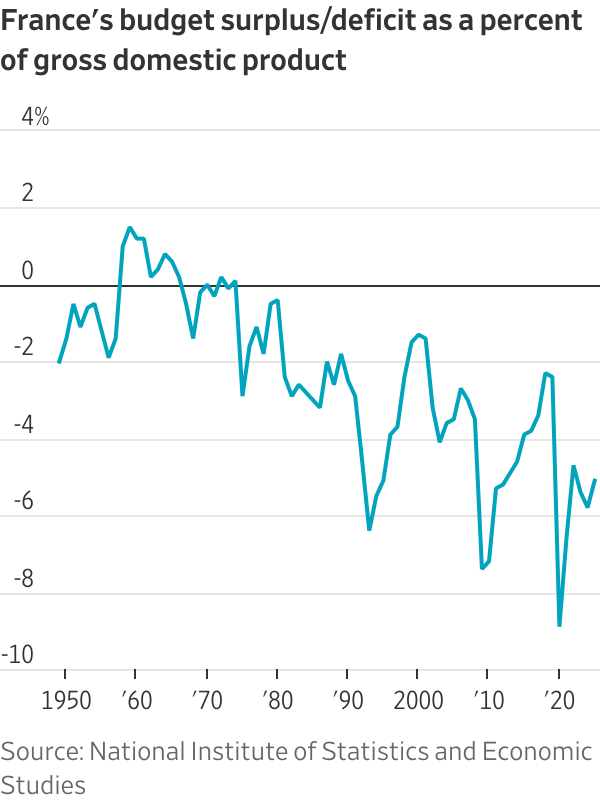
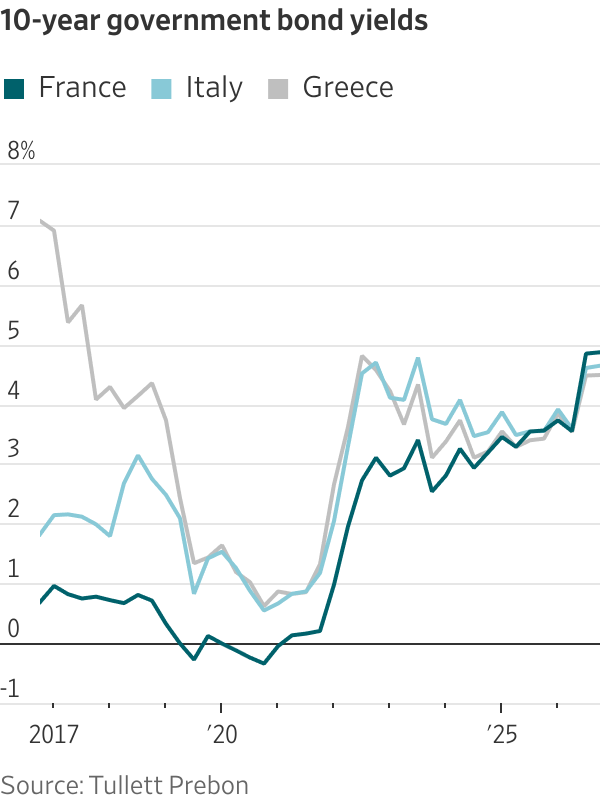
The global surge in interest rates has exposed the country, once considered an oasis of relative stability in Europe’s financial markets, as one of the continent’s weakest links. France now pays more to borrow than former crisis hot spots like Greece and Italy. Its government is running a budget deficit surpassed only by the United States among its peers.
Last week, a slow-burning selloff in France’s government bond market took an alarming turn as it spread across the continent, reviving memories of the eurozone debt crisis last decade. France’s 10-year borrowing cost has risen toward 5%, the highest level since 2002.
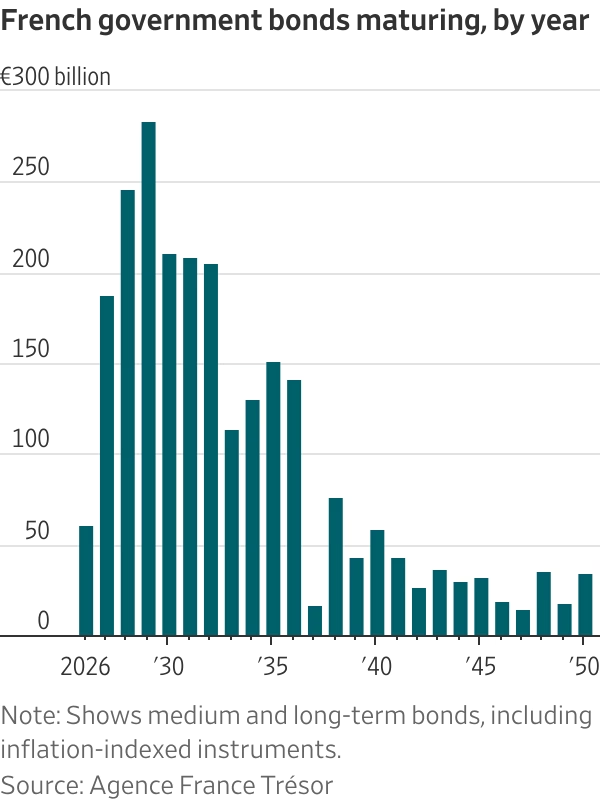
Investors are bracing for things to get worse. The rise in rates is saddling the government with higher costs just as it needs to refinance a mountain of debt borrowed during the era of ultralow interest rates. France has more than $1 trillion in debt coming due by 2030, and next year is set to sell a record of about $380 billion in debt into a market where once-reliable sources of demand have evaporated.
France’s central bank is no longer buying government bonds and is instead letting its portfolio shrink as bonds mature. Once-steady investors like Japanese asset managers have also stepped back. Hedge funds that have stepped into the void have been burned by the recent volatility.
“France has been this free rider in Europe for years, if not decades. It has gotten away with fiscal murder,” said Kevin Thozet, a portfolio adviser at the French asset manager Carmignac. “It worked as long as people were not noticing. Now people have started to notice.”
The cost of servicing France’s debt is expected to climb 59% by 2030, according to a recent study commissioned by the French finance ministry. Debt payments are now one of the French government’s largest line items and could dwarf military spending by the end of the decade. France’s debt, now worth nearly 120% of gross domestic product, risks putting the economy in what its central-bank chief recently called a “gradual stranglehold.”
The selloff is fueled by concerns that France has become so ungovernable that its political system can no longer take corrective action. In recent years, lawmakers in the fractious National Assembly have ousted one prime minister after another who attempted to restore fiscal order with spending cuts. With presidential elections approaching in the spring, leading candidates to replace President Emmanuel Macron , who is term limited, are showering voters with promises to expand government spending.
Marine Le Pen , the far-right candidate who is leading in the polls, has vowed to push France’s age of retirement as low as 60 years old, a measure she says would cost the state an extra 9 billion euros (about $10.1 billion) a year.
Her closest rival in the polls, far-left leader Jean-Luc Mélenchon, wants the European Central Bank to freeze or wipe away the French bond holdings of the Bank of France, a sum worth 488 billion euros.
“Throw it in the fire,” Mélenchon quipped.
The rhetoric, some economists say, is symptomatic of a country that has lost touch with fiscal reality. France’s debt woes are rooted in decades of overspending to fund a sprawling welfare system that conditioned the public to expect coddling from the state, particularly in times of crisis. The country hasn’t balanced its budget since 1974.
“In France we have this reflex of always asking the state for a bit of magic money—to pay, pay, pay,” said Sylvain Maillard, a lawmaker in Macron’s centrist party.
Macron, a former investment banker and technocrat, billed himself as a leader prepared to shock the country back to its senses. He loosened labor-market rules, cut corporate taxes and abolished the country’s wealth tax, measures his camp says helped drive growth and bring the deficit below the EU’s mandatory threshold of 3% of GDP in the early years of his presidency.
Over the years, however, Macron turned to public spending to solve one crisis after another. The shift began with Macron’s unleashing at least 10 billion euros to mollify the violent yellow-vest protest movement, and escalated sharply as France coped with the Covid-19 pandemic and the energy crisis sparked by the Ukraine war.
Macron responded with massive spending programs to shield companies and households from the fallout. Macron coined a slogan for the approach: Quoi qu’il en coûte , or “whatever it costs.”
Some measures added financial burdens that would weigh on state coffers well beyond the pandemic, such as an additional 10 billion euro annual cut in corporate taxes and higher wages for workers across France’s public healthcare system.
Even temporary measures created lasting strain. France launched one of Europe’s biggest paid-leave programs, funding the payrolls of scores of companies, from bistros to large corporations. The subsidies were initially conceived as life support that would end once the pandemic lockdowns were over, but many companies continued to draw on the program for years.
Macron also poured tens of billions of euros into a program that capped energy prices after Russia invaded Ukraine—subsidies that persisted even as Europe’s supplies of natural gas stabilized.
“There was an infusion of public money, and no one in the government had the courage to pull the plug,” said Senator Jean-François Husson, a conservative who oversaw a Senate investigation into the spending.
The unprecedented mix of stimulus, inflation and swings in postpandemic demand threw off economic forecasting models that the finance ministry used for annual budgeting. The scale of distortion started coming into focus in 2023 as Macron was weaning the country off the programs.
On Dec. 7, 2023, Finance Minister Bruno Le Maire received a confidential memo from treasury officials warning of a shortfall in tax receipts, according to a copy reviewed by The Wall Street Journal. A windfall tax the government had recently imposed on energy producers—to help recoup some of its spending on the price cap—was only delivering a fraction of the 3 billion euros in tax revenue that had been forecast. Value-added taxes were also missing their targets, the memo said, while the cost of government spending had been underestimated by 3 billion euros.
The treasury officials estimated the errors might widen the 2023 budget deficit to 5.2% from the initial forecast of 4.9%, potentially opening a 9.2 billion-euro hole in public accounts. The memo advised Le Maire not to disclose the findings to the public, because the estimates were still clouded with uncertainty. Corporate tax receipts were still unclear from companies that had yet to report their 2023 results.
The timing of the memo was delicate. The National Assembly had just given final approval to the 2023 accounts, casting votes based on figures that now appeared erroneous. The mistakes risked bleeding into budgets for years to come. Prime Minister Élisabeth Borne, meanwhile, was on a tight deadline to push the 2024 budget through the assembly by the end of the year.
Le Maire wrote to Borne on Dec. 13, recommending the government inform the public and make 300 million euros in immediate cuts to the 2024 budget before pushing it through parliament, according to a copy of the letter reviewed by the Journal. He also advised Borne to follow that up with 10 billion euros more in cuts at the start of the year.
Borne was broadsided—and didn’t inform the public. She was in the middle of passing a highly contentious immigration bill that was testing her support in the National Assembly. To get the 2024 budget through parliament, she planned to invoke a special clause of the constitution allowing her government to circumvent a vote on the matter.
“We could no longer change anything in the budget,” Borne said in an interview. “We were in the home stretch.”
Borne resigned in early January shortly after the budget passed. Macron appointed 34-year-old Gabriel Attal as prime minister, making him the youngest person to ever hold the post in France’s modern republic. Under Attal, Le Maire moved to cut billions in spending through executive orders, a regulatory power that doesn’t require parliamentary approval.
The state’s finances, however, were deteriorating fast. Corporate tax receipts were coming in far below forecasts. Many companies that once relied on paid-leave subsidies and pandemic-era tax benefits were struggling or going out of business. In February, another treasury memo, which was reviewed by the Journal, informed Le Maire that the 2023 deficit could reach 5.6% while the 2024 budget gap might widen to 5.7%, compared with the 4.4% forecast contained in the recently passed budget bill.
Le Maire suddenly had a 40 billion-euro hole to plug, a sum that he argued exceeded the government’s power to make cuts without the National Assembly’s approval. He began pushing Macron and Attal for new legislation that would correct the 2024 budget with up to 20 billion euros in cuts—in addition to those he had already made. Macron had relied on a fragile alliance with establishment conservatives in the National Assembly to pass previous legislation, and Le Maire contended that conservative lawmakers would ultimately fall in line with his plans.
Attal opposed Le Maire’s approach, preferring to continue using the government’s regulatory power to make cuts, according to Rayan Nezzar, Attal’s economic adviser at the time. Engaging parliament risked a drawn-out debate with opposition lawmakers who would push for tax increases that could hurt growth, he said, adding that the country at large was in a different mindset.
“‘Whatever it costs’ was still on everyone’s mind, and everyone was still living in a world where money was cheap. Debt was not an issue,” he said.
Macron had other considerations. European Parliament elections were around the corner in early June. Macron had made Attal the fresh face of the campaign. If the government went before Parliament seeking approval for a massive correction in the 2024 budget, Macron’s conservative allies might revolt. Attal risked being ousted from office in a no-confidence vote as voters headed to the polls.
In early April, Macron invited a small group of lawmakers to dinner in the gilded Élysée Palace. Over plates of seafood, the president delivered his verdict, according to Maillard who was in attendance.
“I hear people talking about a corrective budget. I don’t see the point of it,” Macron said, adding: “Our problem isn’t excessive spending. The problem is lower tax revenue.”
Instead Attal prepared to exercise his regulatory powers again, lining up about 10 billion euros in additional cuts that he had yet to implement as voters went to the polls in June.
Marine Le Pen’s far-right party ended up trouncing Macron’s forces in the European elections. The same day the results came in, Macron summoned his ministers and told them he planned to dissolve the National Assembly and call snap elections. Attal was stone-faced, his arms folded across his chest as Macron spoke.
For Le Maire, any chance of fixing France’s finances was now gone. He told the room they were risking a “ crise de regime .”
A strong showing in the snap elections would have strengthened Macron’s hand in the National Assembly, clearing the way for him to make significant cuts. Instead Macron’s party bled seats, depriving him of a majority. Attal resigned, freezing billions in spending on his way out for his successor to handle.
“People didn’t realize at the time that 2024 was perhaps the last, or one of the last times that we were still able to reduce our deficit in a proper way,” said Nezzar, Attal’s economic adviser.
The National Assembly was now divided between three blocs—Le Pen’s, Macron allies and a rowdy leftist coalition including Mélenchon—that promised gridlock.
The decision to dissolve parliament shocked many investors and laid bare the mounting dysfunction in France.
“It felt like things perhaps are worse below the surface than they appear…we’ve got to the point where nothing can happen here,” said Ales Koutny, head of international rates at American asset manager Vanguard, who sold French bonds in the following months. “It was somewhat of a turning point for us.”
The annual process of passing a budget turned to chaos, toppling successive prime ministers who had proposed big spending cuts and rattling markets. France’s budget deficit has been stuck above 5% for the past three years, and could reach 6.8% of GDP by 2030, according to the recent report commissioned by the finance ministry.
What appeared to be a slow-moving fiscal erosion turned urgent in recent months. The rise in interest rates sparked in part by the war in Iran has hit France especially hard, with investors taking aim at countries with high debt loads.
Thozet, of Carmignac, points to a simple equation that underscores France’s increasingly impossible debt math. In a reversal from the low-rates era, the interest rate on France’s total stock of debt is expected to surpass its level of economic growth in the coming years, guaranteeing the debt load will continue rising without drastic spending cuts.
“You start to have a snowball effect,” he said.
France’s debt level could reach 200% by 2050 if it doesn’t cut spending, the OECD recently estimated.
While the turmoil last week drew references to the early days of the eurozone debt crisis, a French bond meltdown isn’t yet inevitable, investors say. The region is better equipped to handle market fallout these days, backstopped by the European Central Bank. The latest selloff was amplified by the sudden unwind of risky hedge-fund trades that had grown popular in recent months.
Muddling along would come at an economic cost, with the rising cost of repaying debt eroding the government’s room for more productive investments.
The wild card that could push France to the edge is the upcoming presidential election. Investors fear neither Mélenchon or Le Pen are taking France’s financial problems seriously.
“Everybody is talking about further ways to spend money,” said Koutny of Vanguard. “The fiscal situation in France is already not amazing. If you then incorporate policies these parties are talking about, it looks even worse. “
Investors often describe bond markets as enforcers of financial discipline, citing countries like Greece that transformed their finances after painful debt crises. Charles Rodwell, a centrist lawmaker who sits on the finance committee of the National Assembly, said he hopes market pressure will help focus minds across the political spectrum, adding: “We need shock therapy.”
Write to Stacy Meichtry at Stacy.Meichtry@wsj.com and Chelsey Dulaney at chelsey.dulaney@wsj.com