 Μake us preferred on Google
 The future of the Monastery of St. Catherine in Sinai, the world’s oldest continuously operating monastery, could be decided within the next 20 days, as the venerable Greek Orthodox religious institution and the Egyptian state seek to reach a settlement over its property and legal status.
The monastery, located in a remote mountainous area in the south of Egypt’s Sinai Peninsula, has been at the center of a legal dispute since a first lawsuit over its property was filed in 2015.
The dispute intensified in May 2022, when a court in South Sinai issued a ruling that recognized Egyptian state ownership of land managed by the monastery and ordered the demolition of auxiliary buildings erected by the monks that were not classified as monuments. More shockingly, it also ordered the monks’ eviction, including from parts of the monastery compound itself, and imposed a substantial payment to the Egyptian state for what it considered unlawful possession and use of state property.
The monastery appealed, and the Ismailia Court of Appeal issued a more favorable ruling, recognizing the validity of the monastery’s contracts for agricultural land and affirming the monks’ right to continue using its places of worship.
The case has since reached Egypt’s Court of Cassation, the country’s highest court for such appeals. The court has already taken a decision but has postponed its publication four times, ostensibly to allow the monastery’s brotherhood and the Egyptian state time to negotiate.
According to information reaching the Sinai monastic community from Egyptian sources, there will be no fifth postponement. Unless a settlement is reached, the ruling is expected to be published on October 24, leaving the two sides just 20 days to reach an agreement.
A monastery operating for nearly 15 centuries
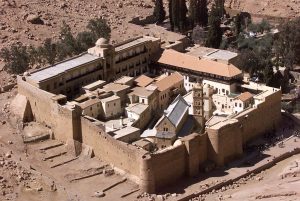
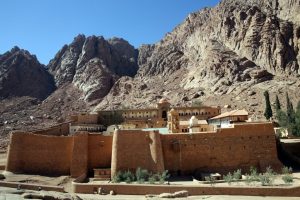
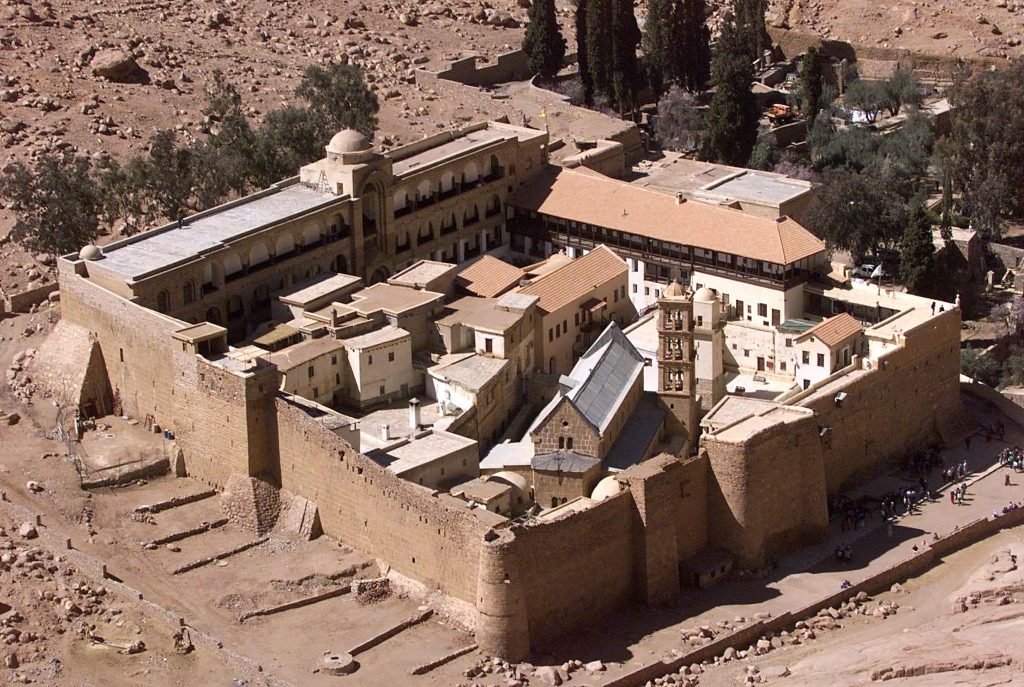
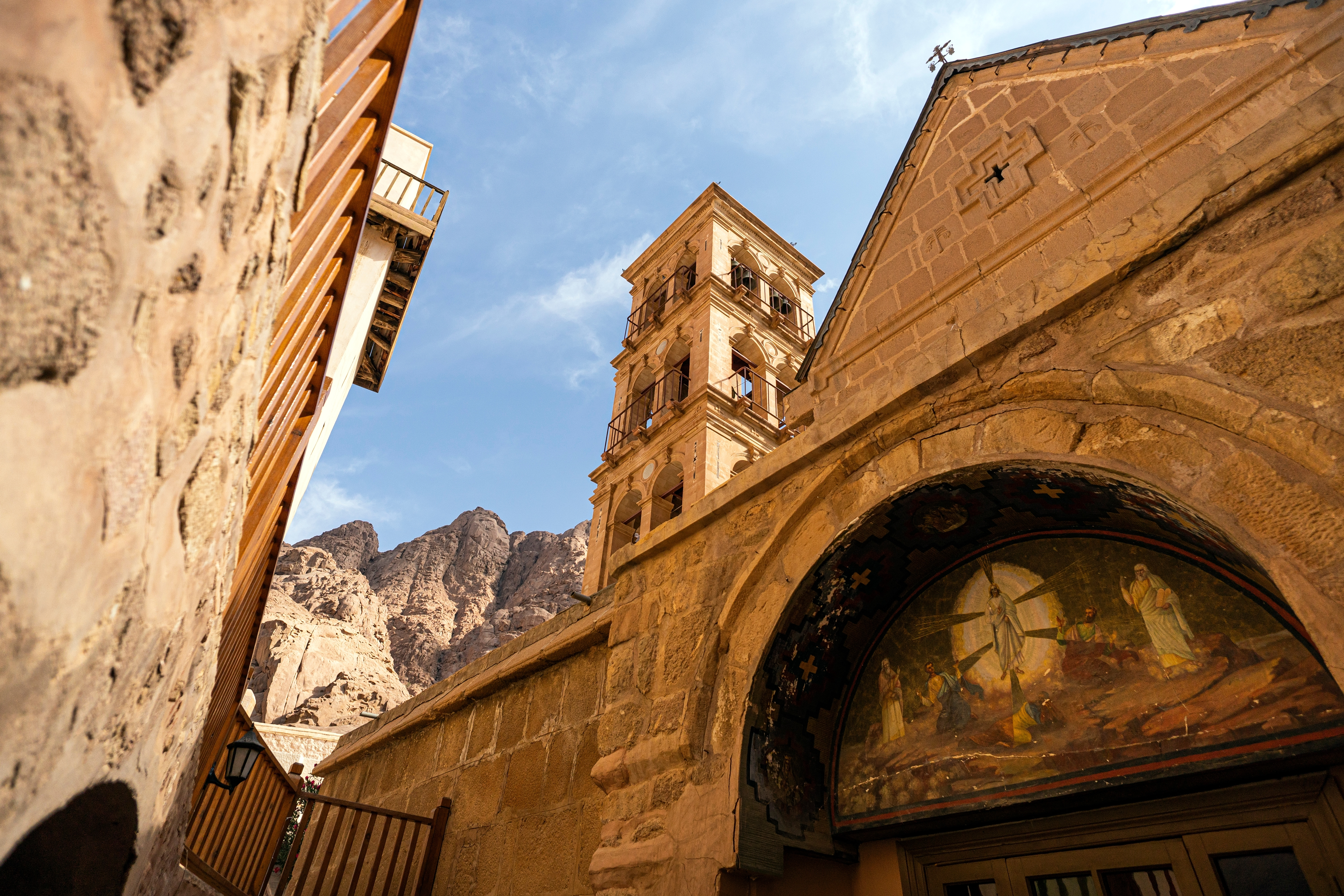
The Monastery of St. Catherine stands behind imposing walls built during the reign of Eastern Roman Emperor Justinian, between two towering mountains.
Visitors must leave their vehicles at a security checkpoint about 800 meters from the monastery and pass through a small entrance. The site is subject to strict security controls because the Sinai is considered particularly sensitive, in terms of public order, by the Egyptian authorities.
The monastery’s compound reflects nearly 15 centuries of continuous operation, with buildings from different historical periods forming an intricate layout.
Its history has been turbulent, but the property dispute has created a particularly complex challenge since 2015 and especially since the 2022 South Sinai court ruling.
The monastery’s principal legal argument was initially that the lawsuit had been filed by a private individual who did not own the disputed land. Egyptian authorities subsequently entered the case as the claimed owners of the property.
The South Sinai court applied Egypt’s general legislation dating to 1963, as well as specific legislation governing Sinai, introduced in 1983, after the territory returned to Egyptian sovereignty.
Under those laws, monuments belong to the state, while non-Egyptian citizens and foreign legal entities cannot own agricultural land. In Sinai specifically, so-called “desert lands” and “naturally protected areas” belong exclusively to the state, which may grant their use or exploitation under state supervision for defined periods.
The court therefore recognized Egyptian state ownership of the land and ruled against the monastery’s claim that centuries of possession had resulted in ownership in the present day.
Appeal offers monastery greater protection
The Ismailia Court of Appeal took a more favorable approach to the recourse filed by the monastery’s brotherhood of Orthodox monks.
It recognized the validity of the monastery’s contracts concerning agricultural land. For the monastery’s places of worship – the monastery’s main cathedral (Catholicon), churches, chapels and shrines – it found that although they are classified as monuments, they have remained in continuous use by the monks and therefore the monks have the right to continue using them.
The lengthy ruling referred to decisions issued during Justinian’s reign as well as Egypt’s modern constitution. It did not refer to the Covenant of the Prophet Muhammad, an ancient and invaluable document traditionally regarded as guaranteeing protection for the monastery’s monks and property. The monastery itself had not invoked the document, and the court did not consider itself bound by it.
The two court decisions confirmed what the monks had already encountered in 1984, when they attempted to register all the land they possessed: Egyptian law did not allow them to hold full ownership of either the monuments or the monastery’s other estates.
Because the authorities had not enforced the relevant legislation for years, however, a “gray area” emerged. This later became part of the monastery’s argument that its long-term possession had resulted in ownership through adverse possession.
The Egyptian court rejected that argument, refusing to recognize adverse possession over state-owned land.
Court ruling triggers wider controversy
The Ismailia appeals court ruling prompted strong reactions beyond the Christian world because St. Catherine’s Monastery is a UNESCO World Heritage Site.
The dispute also attracted broader attention because of the Covenant of the Prophet Muhammad, which bears what is traditionally described as the latter’s handprint as a seal, and has historically been regarded as a symbol of peaceful coexistence between Muslims and Christians.
The symbolism is also reflected inside the monastery, where a dome topped by a cross stands alongside a minaret topped by a crescent.
The case then graduated to the Court of Cassation, which has repeatedly delayed publication of its decision to give the monastery and the Egyptian state — including the ministries of Justice and Foreign Affairs — time to reach a settlement.
Under Egyptian law, if the parties reach a settlement before the ruling is published, the settlement is accepted and the court does not publish its decision.
Negotiations reached 99%
The negotiations gained momentum after the election of Symeon as the new Archbishop of Sinai, Pharan and Raitho and abbot (hegumen) of the St. Catherine Monastery. His Eminence Symeon took office after a major internal crisis among the monastery’s brotherhood.
His predecessor, 90-year-old Elder Archbishop Damianos, resigned on September 12, 2025, after 52 years on the ecclesiastical throne of the Archdiocese. Symeon was elected as his successor and was formally enthroned at the monastery on October 31.
After assuming the ecclesiastical post, Symeon appointed a scholarly team to document the monastery’s properties and their uses, distinguishing between religious and agricultural properties and identifying those located close to the monastery.
The team also documented historical information and provided supporting material from international academic literature.
The technical approach was viewed positively by the Egyptian state and provided what was described as a sincere basis for negotiations.
The talks eventually produced an oral agreement on a broader deal recognizing and protecting the monastery’s Greek Orthodox identity, regulating its operation, recognizing the monks’ religious freedom and addressing its Fundamental Regulations.
The agreement would be the first and only such agreement between Egypt and the monastery and would represent a strategic achievement for the brotherhood and its position within Egypt’s legal system.
On property matters, the monastic community agreed to accept that the properties were subject to Egyptian law while asking that ownership issues be addressed through separate negotiations. Those talks intensified in June.
Among the proposals reportedly under discussion was allowing the monastery to retain possession and use of properties with exclusively religious functions indefinitely and without rent, while agricultural properties would be used under a symbolic lease rate.
The broader agreement reportedly reached 99% completion, but it was not finalized despite three lengthy meetings between the two delegations.
The exchange of proposals stopped shortly before the Dormition of the Virgin Mary feast day, which is celebrated at St. Catherine’s on August 28, when the monastery receives a large number of pilgrims and the monks had to focus on accommodating them.
Pressure against a settlement
As the agreement appeared close to completion, various groups opposed to a settlement reportedly began mobilizing.
The original deadline for publication of the Court of Cassation ruling had been August 26 before the court granted a fourth postponement.
Groups opposing any agreement exist in both Egypt and Greece, according to the report, contributing to mistrust on both sides.
On August 15, Michael Rigas, the Greek/American US Deputy Secretary of State for Management and Resource, visited the monastery as a pilgrim. Rigas is described as an Old Calendarist Orthodox worshipper with ties to the ultra-conservative brotherhood of monks occupying the Esphigmenou Monastery on Mount Athos, which the Ecumenical Patriarchate deems as a non-canonical brotherhood. The latter has repeatedly spoken about alleged violations of the rights of the Sinai monastic community.
Rigas’ visit reportedly prompted the Egyptian Foreign Ministry to send a delegation to accompany him. Rigas did not make public statements during the visit.
A few days later, Archbishop Symeon became seriously ill and traveled to Athens for medical treatment.
While he was recovering, a letter from the 20 monasteries of the monastic community of Mount Athos – a semi-autonomous polity located on a northern Greece promontory – to Symeon was published on September 11, expressing opposition to any change in the Sinai monastery’s property status.
The epistle, or letter, warned that anything respected for more than 16 centuries should remain respected today and argued that changing the existing arrangements could create a dangerous precedent for other Orthodox monasteries and religious monuments.
This intervention reportedly took the monastic brotherhood St. Catherine by surprise, because it had been produced without the knowledge of the Archbishop and because it supposedly treated the Sinai monastery as though it were a monastery of Mount Athos, although its spiritual and ecclesiastical affiliation is under the Patriarchate of Jerusalem.
The move was also considered offensive by both Patriarch Theophilos of Jerusalem and Ecumenical Patriarch Bartholomew, according to the report.
Bartholomew, under whose jurisdiction Mount Athos falls as the Primate of the Ecumenical Patriarchate of Constantinople, immediately summoned the signatories of the letter to a meeting at the Phanar, as the seat of the Ecumenical Patriarchate in Istanbul is called. The latter responded that representatives of the Holy Community of Mount Athos should first convene, while later it emerged that they were willing to attend a summons at the Ecumenical Patriarchate on a day Bartholomew was scheduled to travel to England. No such meeting materialized, in the end.
The contents of the letter were also supported by the head of a Greek political party, Kyriakos Velopoulos, Athens-based attorney Maria Gratsia, who represented members of the Sinai brotherhood who opposed the creation of a public-law legal entity in Greece to manage the monastery’s property in the country, as well as by another smaller political party represented in Greece’s parliament, Niki.
Meanwhile, Egyptian media have published various scenarios about the Court of Cassation ruling, with some reports suggesting it could be closer to the Ismailia appeal ruling while others forecast an outcome closer to the original South Sinai court decision.
A last-minute settlement remains possible.
Athens quietly backs the monastery
The Greek government is described as softly but strongly supporting the efforts of the Sinai monastic community.
According to information cited in the report, Prime Minister Kyriakos Mitsotakis sought discreetly to gain more time for the monastery during his Sept. 8 meeting with Egyptian President Abdel Fattah el-Sisi in El Alamein, on the sidelines of the trilateral meeting between Greece, Egypt and Cyprus.
The difficulties of the negotiations were also highlighted during a recent visit to the monastery by Nikolas Farantouris, a European MEP from Greece’s PASOK party.
Farantouris visited to learn more about the dispute and explore how the European Parliament might contribute to a fair and sustainable solution.
During a meeting with Yasmine Moussa, a legal adviser in the office of Egypt’s foreign minister who is responsible for the “Sinai file,” Farantouris argued for preserving the monastery’s property status.
Moussa heard his arguments but presented Egypt’s reasoning for not transferring ownership of the properties to the monastery. The discussion also touched on the fact that Egypt receives roughly four billion euros in financial assistance from the European Union.
The exchange underscored the difficulty of the negotiations and the sensitivity of a dispute involving Egypt’s insistence on asserting sovereignty over its territory.
A divided monastic community awaits the outcome
The stakes are particularly high for the monks themselves.
From the windows and crenels in the monastery’s fortified walls, the threat is no longer imagined as invading armies but as large-scale tourism infrastructure developing around the site and seeking to capitalize on its proximity to the monastery.
The monks continue to live according to the monastery’s traditional rhythm, but they are concerned about developments that could disrupt it.
There is one positive development: Archbishop Symeon is recovering and is expected to resume the negotiations.
“The monastery has survived many empires,” one monk told To Vima. “The Prophet Muhammad and Napoleon passed through here, as did Christian emperors and Muslim caliphs. After every trial, it becomes stronger. We are not afraid of anything for the monastery.”
Seventeen monks remain at the monastery. Four are currently in Athens accompanying Symeon, while another five are associated with Damianos. The community remains divided and is still attempting to heal from the internal conflict of August 2025.
Another monk described life at Sinai as existing between earthly and spiritual needs.
“At Sinai, the rocks are bare. There is nowhere to hide from yourself. And from God, who once walked these mountains. Here, you can do nothing but be truthful,” he said.
The monastery also remains connected to the once-thriving ethnic Greek community in Egypt. The ethnic Greek population, which once numbered as many as 80,000, has fallen to around 2,000.
A central figure in the community is Antonis Kazamias, president of the Hellenic Center in Cairo, who has long supported the monastery and maintains close relations with the Egyptian government and society.
The community’s property also includes the Abet Foundation, the Greek school in Cairo, which has substantial assets and whose president is traditionally the archbishop of Sinai.
Before his resignation, Damianos amended the foundation’s statutes so that his successor as archbishop would have no authority to make decisions for three years. The foundation is now managed by people close to Damianos. Parts of the ethnic Greek community had fallen out with him in recent years and blame him and his close associates for some of the monastery’s current difficulties.
For the monastery and its monks, the coming weeks will therefore be decisive. With the Court of Cassation’s ruling due on October 24 unless another settlement is reached, the window for an agreement is rapidly closing.