Turns out, Ukraine has got cards.
Just last fall, Russia was inexorably advancing on the battlefield, money was running out and President Trump was pressing a peace deal on terms that favored Moscow.
Then, Trump’s war against Iran reshuffled the world. Drone warfare—the kind in which Ukraine has garnered four years of unmatched experience—went global with Iranian attacks throughout the Middle East. Instead of being seen as a problem to be solved, Ukraine became a sought-after solution—for Gulf monarchies, for European neighbors and increasingly for the U.S. military.
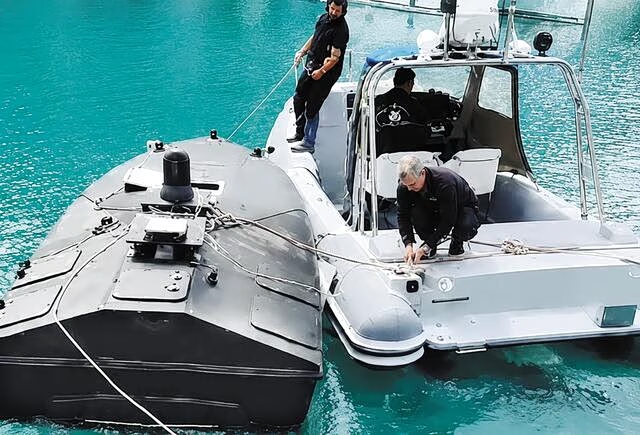
President Volodymyr Zelensky has repeatedly toured the Gulf in recent months, sending some 200 troops to showcase Ukrainian drone-interception technologies and to ink deals that could lead to investment and co-production. This followed the establishment of Ukrainian drone-manufacturing plants across Europe earlier this year, and the growing adoption of Ukrainian military innovation by Western militaries, particularly in Europe.
“Our technological game-changers have transformed the war. There is now a shift from seeing Ukraine as just a recipient of aid, as a consumer of security, to viewing it as a subject, a contributor to security,” Ukraine’s deputy foreign minister Mariana Betsa said in an interview. “Ukraine has shown leadership not just in the war against Russia, but also in the global conflict that now involves the Middle East.”
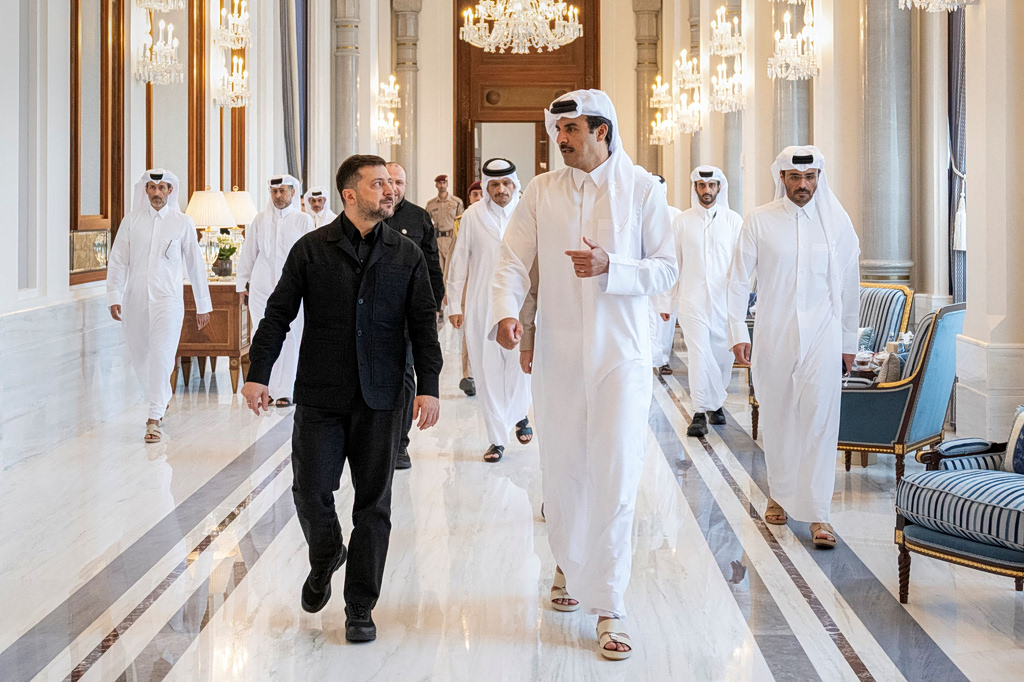
The Emir of Qatar, Sheikh Tamim bin Hamad Al Thani, meets President of Ukraine, Volodymyr Zelenskiy, in Doha, Qatar, March 28, 2026. Amiri Diwan/Handout via REUTERS .
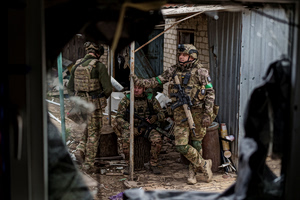
It’s thanks to an edge in using drones, thousands of which are manufactured daily, that Ukrainian forces have been able to offset Russia’s manpower advantage. The front-line has mostly stabilized, as Russian advances were stalled and Ukraine managed to regain some strategic ground. Ukrainian-made drones and missiles are also increasingly bringing the war home to Russia, including the recent attacks on the heavily protected capital, Moscow.
Meanwhile, trans-Atlantic tensions fueled by the war on Iran have made Ukraine even more relevant for its closest allies in Europe. Angered by European nations’ refusal to join the campaign, Trump has ordered the withdrawal of thousands of American troops from Europe and said that he is considering leaving the North Atlantic Treaty Organization altogether. As risks of a broader war in Europe loom, European defense and security officials increasingly view Ukrainian capabilities as fundamental for the continent’s own future security. The European Union, which provides most of the foreign funding for Ukraine, in April completed a $105 billion lifeline for Kyiv, ensuring its defense needs through next year.
“If our main worry right now is security, then who knows best how to fight and defend in a modern war? It’s Ukraine,” Kaja Kallas , the EU’s high representative for foreign affairs and security, said in an interview. “They have the most experienced military, they have the most experienced defense industry when it comes to drones, the state-of-the-art technology. We have a lot to learn from them and they have a lot to teach us.”
The Middle East war, of course, has also brought bad news for Ukraine. Iranian missile barrages on the Gulf and Israel have consumed a significant part of U.S.-made missile interceptors, such as Patriots, putting in doubt future supplies of these scarce weapons for Ukraine. The global rise in the price of oil and the suspension of some U.S. sanctions on Russian oil have, for now, also partially relieved pressure on the Russian economy, providing the Kremlin with tens of billions of dollars of additional revenue.
Ukraine’s intensified strikes on Russia’s oil ports and pipelines, however, have made it harder for Moscow to cash in on that windfall. As new Ukrainian drones and missiles hit Russian energy sites almost daily this spring, the hope in Kyiv is that the pain suffered by Russia will compound so significantly that President Vladimir Putin will be compelled to a deal sparing each other’s vital infrastructure, including the power grid, before next winter sets in.
“The only way to end this war is by moving it to the enemy’s territory. And we are doing precisely this, successfully, with our Ukrainian weapons,” Oleksandr Kamyshin, Zelensky’s top advisor overseeing the Ukrainian defense industry, said in an interview.
Inside Ukraine, Russian forces have been losing more than 30,000 soldiers a month, more than Russia’s ability to recruit replacements according to Western intelligence estimates, with virtually no territorial gains to show. The current way of waging war is becoming increasingly unsustainable for the Russian state, especially as the country’s economic troubles make it more difficult to find money to sign up new recruits.
Now that Putin’s inconclusive campaign against Ukraine has lasted longer than the Soviet Union’s victorious war against Nazi Germany, even ultranationalist supporters of the war are expressing disappointment.
“Russia no longer has an advantage over us in anything except the quantity of manpower,” said Dmytro Putiata, a Ukrainian drone warfare expert who served until recently as an officer in the Ukrainian Unmanned Systems Forces. “I am much more optimistic than a few months ago because, now, I am finally seeing Ukrainian technologies at work.”
THE NEW confidence in Kyiv, and among supporters of Ukraine, contrasts with last year’s dark predictions of Ukraine’s imminent demise.
Trump famously told Zelensky “you don’t have the cards” before unceremoniously expelling him from the White House in February last year. Then, after a summit with Putin in Anchorage, Alaska, last August, he pressed for a deal under which Ukraine would surrender to Russia the fortified belt of cities in the north of the Donetsk region. Trump argued that Russia would soon capture the strategic area anyway, and that it was better for Ukraine to cede it in an agreement that opens the floodgates to lucrative business between the U.S. and Russia.
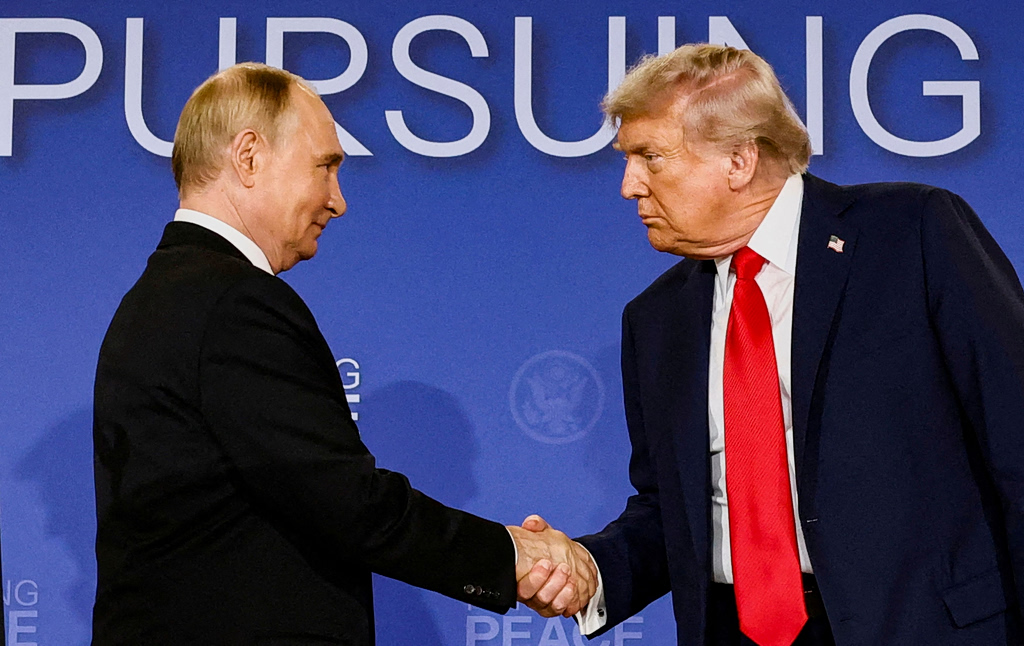
FILE PHOTO: U.S. President Donald Trump and Russian President Vladimir Putin shake hands during a press conference following their meeting to negotiate an end to the war in Ukraine, at Joint Base Elmendorf-Richardson, in Anchorage, Alaska, U.S., August 15, 2025. REUTERS/Kevin Lamarque
A corruption scandal involving some of Zelensky’s closest allies, including his chief of staff, seemed to make Kyiv especially vulnerable to pressure at the time. Yet, Zelensky refused to hand over valuable territory that Russia has been unable to conquer in more than four years of war.
Today, more than eight months after Anchorage, Russia still hasn’t gotten much closer to capturing it. In a March interview, after the U.S. military asked for assistance against Iranian drones, a beaming Zelensky quipped that he had the cards all along—but, as a good player, had chosen not to show them.
“Trump’s Russia policy has been premised on the idea of an inevitable Russian victory,” said Thomas Gomart, director of the French Institute of International Relations. “In reality, the element of strategic surprise—for Washington, and to a lesser degree, for Europe—turned out to be the level of Ukrainian military resistance, combined with how Ukraine has managed to organize itself in industrial terms to sustain this over the long run.”
This doesn’t mean that Trump has lost interest in a rapprochement with Putin. But the prospect of such a diplomatic breakthrough has been undermined by his failure to compel Iran’s leadership into an agreement acceptable to the U.S., despite weeks of airstrikes.
Putin likely believed that he could make a deal with the U.S. and Washington would then force it on Europe and Ukraine, said Jennifer Cavanagh, director of military analysis at Defense Priorities, a think tank urging restraint in U.S. foreign policy.
After watching America’s inconclusive performance in the Middle East, she added, Putin likely sees “Trump as unreliable and sort of noncredible, and the U.S. generally weaker than it might have seemed, and unable to deliver. He is thinking: Is it worth making a deal with a U.S. that is in decline?”
American military bases in the Middle East and the vital infrastructure of America’s Gulf partners and allies were heavily damaged by Iranian drones and missiles in the 40 days of full-out conflict in March and April.
Ukraine has spent four years defending against the same Iranian-designed Shahed drones that have become the mainstay of Russia’s arsenal, and has more experience operating Patriots in warfare conditions than any other military. “We can now shoot down 97% of Shaheds. Personally, I was surprised that someone launched an attack on Iran without first seeking a solution against the Shaheds, for themselves or for their regional allies,” Kamyshin said. “Obviously, we were happy to help out.”
Faced with the Russian onslaught, Ukraine’s defense companies have also mastered the art of manufacturing cheap products in vast quantities, as constant feedback from front-line units improves performance and counters Russian innovation.
All these capabilities are integrated in a single Ukrainian-designed Delta battlespace management and awareness system that connects feeds from drones, sensors, satellites and other information sources, enabling real-time command and control across the entire military. In a recent testimony, U.S. Army Secretary Daniel Driscoll said the system is “absolutely incredible,” outmatching comparable U.S. platforms.
With U.S. defense companies facing multiyear production backlogs for critical items like missile interceptors, and traditionally reluctant to share technology or co-produce locally, Ukraine—alongside other defense manufacturers such as South Korea and Turkey—has emerged as a valuable alternative, a senior Gulf official said.
Even before the war on Iran, Ukrainian defense companies were already working with Saudi partners, a cooperation that is expected to expand dramatically as the Iranian regime remains undeterred, continuing occasional strikes on Gulf states.
“Ukrainian defense technology is relevant because it reflects a highly active innovation environment where systems are developed, adapted and improved quickly,” said Idris al Zakari, chief executive of Riyadh-based defense company Science Technology, which also makes Ukrainian-designed drones. “The Ukrainians have displayed a willingness to explore ways to cooperate, and it’s been reciprocated.”
Trump has repeatedly dismissed Ukraine’s drone capabilities, repeating his no-cards assertion. U.S. military officials, however, say they are closely working with Kyiv to prepare for the new drone-dominated ways of waging war.
“We’ve adopted a large number of tactics, techniques and procedures that the Ukrainians have passed to us that helped us to defend Americans. All our partners are working with the Ukrainians in some way, shape or form,” the commander of the U.S. Central Command which is responsible for the Middle East, Adm. Brad Cooper, said in a recent congressional hearing. “Are they more effective as a result? Yes.”
Write to Yaroslav Trofimov at yaroslav.trofimov@wsj.com