The body of Iran’s slain supreme leader Ayatollah Ali Khamenei was laid in state at Tehran’s Grand Mosalla mosque Friday, preparing the stage for a dayslong funeral ceremony that is expected to become a massive show of defiance against the West.
The turnout is expected to be one of the largest gatherings in history. Iranian authorities predict that over the six days of ceremonies beginning Saturday, up to 20 million people will turn out to honor Khamenei, who was killed alongside several family members in the first wave of Israeli and U.S. airstrikes on Tehran more than four months ago.
Ahead of the ceremonies, foreign dignitaries convened to pay their respects, including Dmitry Medvedev, deputy chairman of Russia’s Security Council, and He Wei, vice chairman of China’s top lawmaking body.
Pakistan, Iraq, India, Turkey and other countries also sent representatives.
State media showed five simple caskets wrapped in Iranian flags inside the mosque, including a small one containing the body of Khamenei’s 1-year-old granddaughter who Iran said was killed in the airstrike alongside him.
The Islamic Republic will seek to use the mass gatherings to galvanize supporters amid a fragile ceasefire with the U.S. following months of devastating war.
Hossein Ansari, a translator who planned to join the final burial ceremony on July 9 in the holy city of Mashhad, said the large crowds would “show to those inside and outside the country that, unlike what is being portrayed in the West, the majority of the people respected him in the country even if they were not that religious.”
Days before the funeral, shops in Tehran closed down and shopping center parking lots filled up, as crowds descended on the capital. The state funeral of Khamenei’s predecessor, Ayatollah Ruhollah Khomeini , in 1989, drew an estimated 10 million mourners and prompted chaotic scenes, in which officials nearly lost control of his coffin.
The funeral in Tehran will last for three days, with the airspace over the capital partially closed, before the body is moved to the holy city of Qom on Tuesday. On Wednesday, Khamenei’s casket will be transported to Najaf and Karbala in Iraq, where Iran supports numerous armed groups, and where many among the Shia majority population regard Khamenei as a religious authority. The late ayatollah will be buried on Thursday in his birth city of Mashhad in eastern Iran.
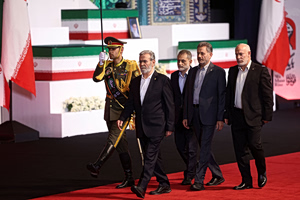
Ziyad al-Nakhalah, Secretary-General of Palestinian Islamic Jihad attends a farewell ceremony for Iran’s late Supreme Leader Ayatollah Ali Khamenei, who was killed on February 28 during Israeli and U.S. airstrikes on Iran, for international delegates at the Imam Khomeini Grand Mosalla in Tehran, Iran July 3, 2026. Majid Asgaripour/WANA (West Asia News Agency) via REUTERS
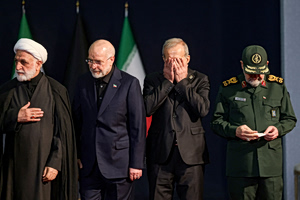
Chief Justice of Iran Gholamhossein Mohseni Ejei, Iran’s parliament speaker Mohammad Baqer Qalibaf, Iranian President Masoud Pezeshkian and adviser to Iran’s supreme leader Mohsen Rezaei attend the farewell ceremony, July 3, 2026. REUTERS
Iranian authorities haven’t announced whether Mojtaba Khamenei , the supreme leader’s son and successor, would appear during the ceremonies. He was injured in the airstrike that killed his father, wife and other relatives, and hasn’t been seen in public since , delivering only sporadic messages in writing.
Putting up a show of resistance against foreign enemies, often to the death, has been a pillar of the Islamic Republic’s credo and propaganda for nearly 50 years. The Islamic Republic was founded after an anti-Western uprising in 1979, and consolidated its rule through a subsequent eight-year war with Iraq.
Mohammad Bagher Ghalibaf , a longtime power broker and current chief negotiator, this week called the funeral “a renewal of a nation’s covenant with the glorious path of the martyrs,” and a reminder of “the values of the Islamic Revolution.”
A woman in Tehran said Khamenei would be remembered for his ascetic lifestyle and efforts to strengthen Iran’s sovereignty and indigenous military capabilities.
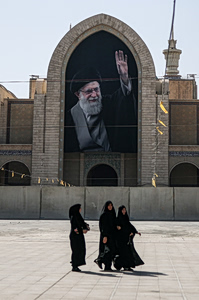
Women walk past a large image of Iran’s late Supreme Leader Ayatollah Ali Khamenei outside the Imam Khomeini Grand Mosalla, July 3, 2026. REUTERS/Mohammed Salem
“His political legacy is Iran-centrism and resistance against the world’s major powers, in the sense that we should decide our own future ourselves,” she said.
Khamenei leaves behind an Iran that for decades has been bitterly divided. A whole generation grew up under repression, economic collapse and came of age hating him, said Narges Bajoghli, associate professor at Johns Hopkins School of Advanced International Studies.
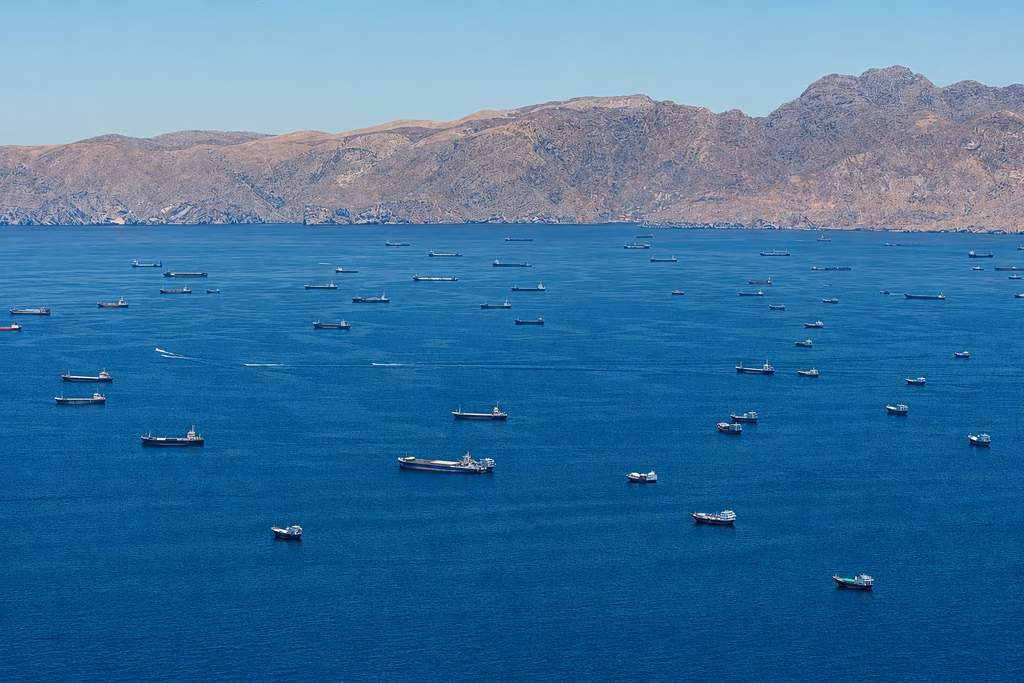
But the recent war has changed many’s perception, she said. For many Iranians, the regime’s ability to survive and inflict pain on its enemies, including with attacks on U.S. bases and by blocking the Strait of Hormuz, vindicated Khamenei’s hard-line strategy.
“That doesn’t erase the domestic record,” Bajoghli said. “But it’s shifting what he represents in death: from a repressive figure many wanted gone, to the architect of a strategy that, in the end, kept the country intact against its gravest modern threat.”
A 23-year-old university student in Tehran said history would judge Khamenei more kindly than does the present.
“In history, it will not be the suffering of the people that is recorded, but rather Iran’s boldness and ambition during his rule in expanding its sphere of influence. And Iranians usually admire such rulers in history,” he said.
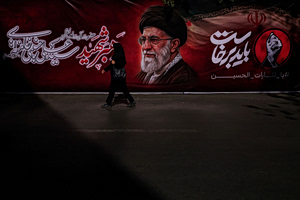
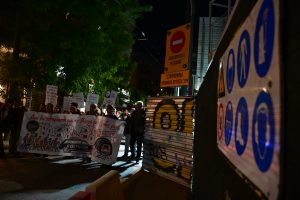
A woman walks past a banner depicting Iran’s late Supreme Leader Ayatollah Ali Khamenei, July 3, 2026. REUTERS/Alkis Konstantinidis
Although Khamenei’s rule became increasingly unpopular in recent years, millions of predominantly conservative Iranians still support the clerical leadership and the military that projects Iranian power in the Middle East.
Conservatives who dominate the clergy and the military establishment have in recent days given anti-Israel and anti-American speeches to justify a confrontational approach against the U.S. Some commanders singled out Iran’s stockpile of missiles and its proficiency in using drones as one of Khamenei’s main achievements.
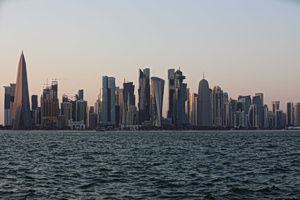
At the same time, President Masoud Pezeshkian was under pressure from more conciliatory forces to get frozen funds released in ongoing negotiations with the U.S., ahead of the funeral, in order to show benefits of the talks, according to mediators in the negotiations. In indirect talks in Doha this week, the president’s team failed to unlock any new funds or get sanctions relief, as Iran refused to cede control of the Strait of Hormuz.
The Islamic Revolutionary Guard Corps controls the strait and is often at odds with Iran’s civilian leaders. Some experts say Khamenei’s hard-line policies were the reason the 86-year-old cleric was killed in the end.
“He was killed because of his own limitations, pursuing policies in the region that were destabilizing” and prompted Israel to strike, said Sanam Vakil, Middle East director at Chatham House, a London-based think tank.
“The regime has to show respect for his policies as they bury him. The question is whether they bury his ideas too and allow the regime to break with the old ways of the past,” she said.