Iran and the U.S. agreed to the creation of a mechanism to ensure the termination of military operations in Lebanon, mediators said.
The announcement by Pakistan and Qatar, the two mediators in Iran peace talks, came early Monday local time after President Trump on Sunday had threatened Iran on social media over its support of Lebanese faction Hezbollah. The warning caused a flare up in tensions between the two sides as Vice President JD Vance was in Switzerland for talks with Iran.
The discussions were diverted to focus on fighting between the militant group and Israel that imperiled a peace deal Trump signed last week. The administration had originally wanted the discussion to focus on Iran’s nuclear program.
The president’s threats prompted the Iranian delegation to leave the negotiation venue, Iranian state media reported. But officials from Pakistan and Qatar later resumed their mediation, officials said.
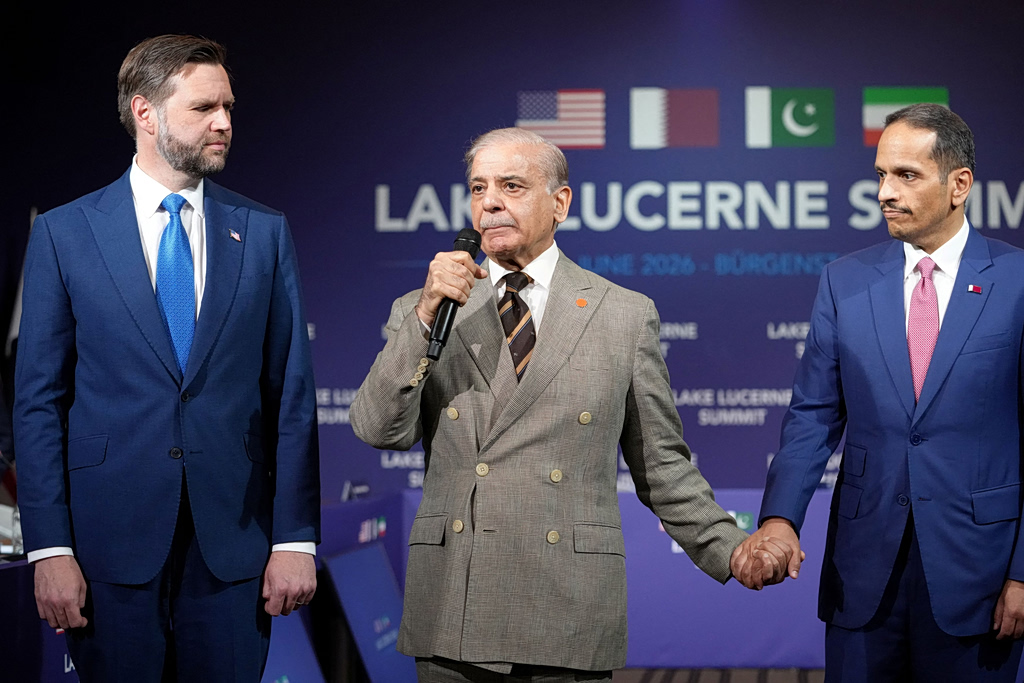
Pakistan’s Prime Minister Shehbaz Sharif speaks next to U.S. Vice President JD Vance and Qatar’s Prime Minister and Minister for Foreign Affairs Sheikh Mohammed bin Abdulrahman bin Jassim Al-Thani during a quadrilateral meeting between the U.S., Iran, Pakistan, and Qatar at the Lake Lucerne Summit, aimed at advancing a deal to end the Middle East conflict, at Buergenstock Resort Lake Lucerne, near Stansstad, Switzerland, June 21, 2026. REUTERS/Nathan Howard/Pool
In a statement early Monday, Qatar and Pakistan said a line of communication between Iran and the U.S. had been formed to avoid incidents and enable safe passage for commercial vessels through the Strait of Hormuz.
Technical talks will continue for the remainder of the week at the Bürgenstock resort on all issues, the mediators said.
Iranian negotiator Hossein Ghorbanzadeh said separately that progress was being made on sanction waivers on Iran’s oil sales and, through Qatari mediation, the release of frozen assets.
Still, wider negotiations with the U.S. won’t advance unless the war in Lebanon ends, Ghorbanzadeh told the military-affiliated Tasnim news agency.
Last week, Trump and Vance aired the administration’s frustration with Israel after what they called a heavy-handed retaliatory strike nearly derailed their deal with Iran. Israel has argued that it will keep fighting as long as Hezbollah does.
Trump’s new comments Sunday focused on Iran instead.
“Iran must immediately stop their highly paid PROXIES in Lebanon from causing trouble,” Trump said on social media Sunday. “If they don’t, we’ll hit Iran very hard again, just like we did last week, only harder!!!”
Iranian state media said Trump’s comments violated the preliminary peace deal signed Wednesday, which bars the two sides from attacking or threatening each other.
The deal opens the Strait of Hormuz , sets up talks on Iran’s nuclear program and calls for an end to the fighting in Lebanon—a key Iranian demand—in its opening paragraph. But fighting over the past two days led Iran to announce Saturday that it had closed the waterway and to say it would focus the talks on resolving the situation in Lebanon.
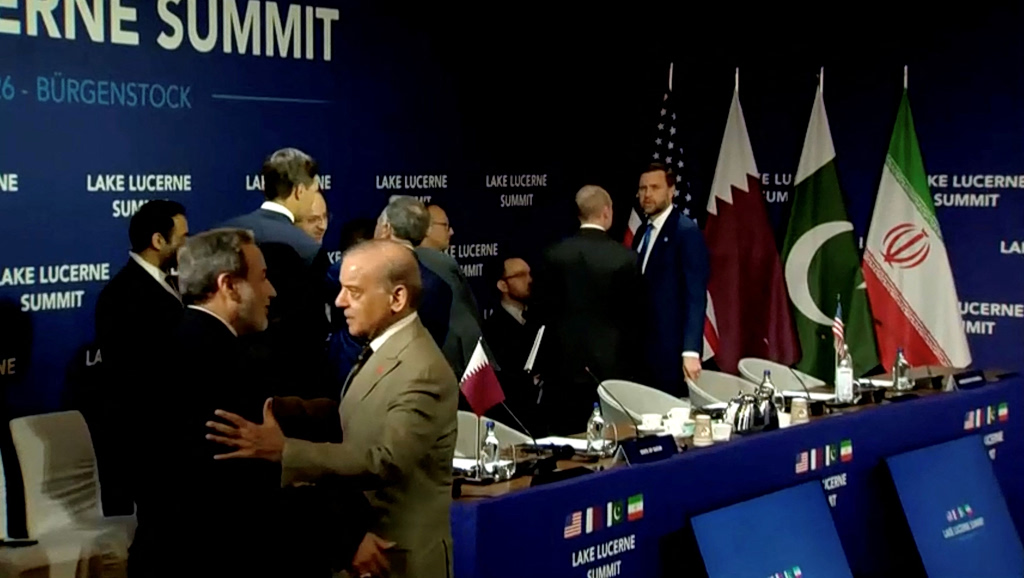
Pakistan’s Prime Minister Shehbaz Sharif welcomes Iran’s Foreign Minister Abbas Araqchi, as U.S. Vice President JD Vance and U.S. President Donald Trump’s son-in-law Jared Kushner stand in the background, before the start of a quadrilateral meeting between the U.S., Iran, Pakistan, and Qatar at the Lake Lucerne Summit, aimed at advancing a deal to end the Middle East conflict, at Buergenstock Resort Lake Lucerne, near Stansstad, Switzerland, June 21, 2026, in this screenshot obtained from a video. US NETWORK POOL via REUTERS UNITED STATES OUT. NO COMMERCIAL OR EDITORIAL SALES IN UNITED STATES
Fox News reported that Trump, in an interview, said that he had spoken with Iranian officials Saturday night and warned them not to close the strait.
“You close it, and you won’t have a country,” Fox said, quoting Trump. “You won’t even make it back to your f—ing country.”
The Iranian delegation suspended the talks because of Trump’s threats, according to Nour News, which is affiliated with Iran’s Supreme National Security Council.
Parliament Speaker Mohammad Bagher Ghalibaf , Tehran’s chief negotiator, said Iran was prepared to respond militarily. “They better be careful with their statements, our armed forces are ready to respond in a different way,” he said on his X account. “Whatever they say, we are the ones who will act.”
In a sign of the high stakes in Switzerland, Vance is leading the talks for the U.S. The two sides began direct talks at the Alpine resort of Bürgenstock after meeting separately with mediators from Qatar and Pakistan, according to Iran’s state media.
Vance struck an upbeat tone after his initial round of talks with Iran on Sunday.
“We’ve already made great progress over just the last few hours, and I expect that we will make additional progress in the hours to come,” Vance said in an impromptu press conference at the site of the negotiations, adding that conditions were improving in Lebanon.
If Iran stops what the vice president called destabilizing activities, the U.S. is ready to “turn over a new leaf to transform our relationship with the people of Iran,” Vance said.
Iran’s Ghalibaf was absent from the press conference.
“The Israeli regime continues to violate its commitments,” Iranian Foreign Ministry spokesman Esmail Baghaei said earlier Sunday, arguing that the U.S. had been unable or unwilling to rein in its ally. “This issue is the main subject of today’s talks.”
The venue was guarded by a heavy security detail. Visitors were greeted by security forces in flak jackets, some in military camouflage and others toting submachine guns, scattered amid a landscape of green pastures, wooden chalets and snowy peaks. The entrance of the luxurious hotel hosting the negotiations was protected by concrete blocks and metal barricades.
Both sides are under pressure to end the fighting between U.S. ally Israel and Iran-backed Lebanese faction Hezbollah, neither of which are party to the talks.
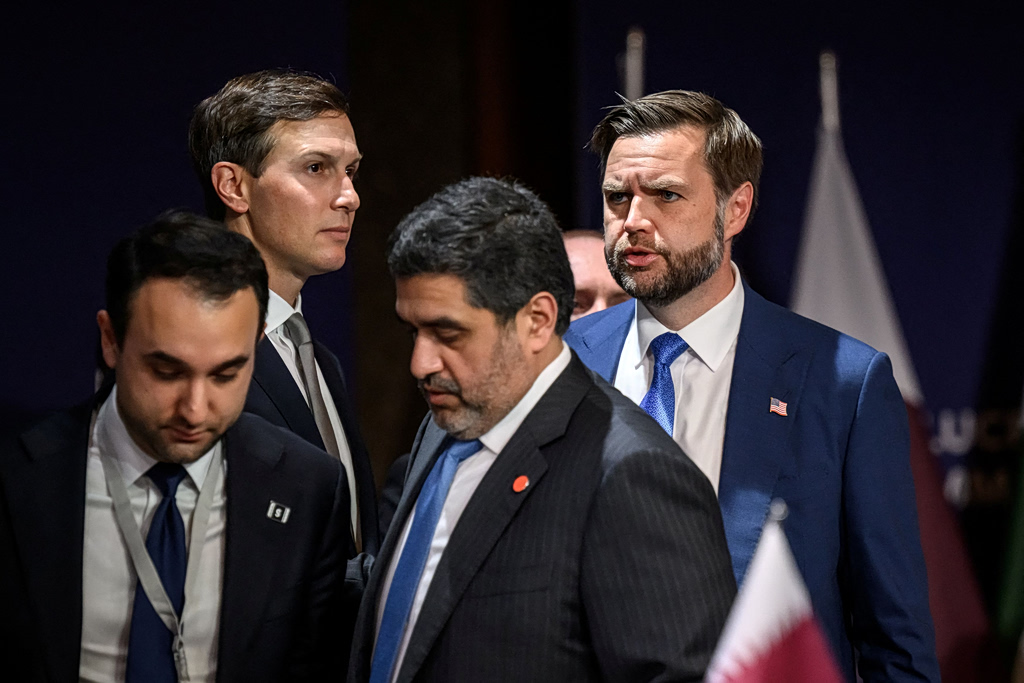
U.S. Vice President JD Vance speaks next to U.S. President Donald Trump’s son-in-law Jared Kushner prior to a quadrilateral meeting between the United States, Iran, Pakistan and Qatar at the Burgenstock luxury hotel complex overlooking Lake Lucerne, Switzerland, on June 21, 2026. Fabrice Coffrini/Pool via REUTERS
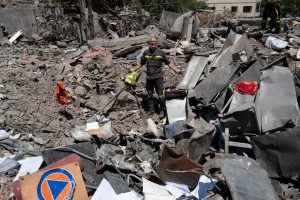
Last week saw one of the most serious escalations in Lebanon since a ceasefire was reached in April. The fighting had never stopped for long despite the truce, as Israel continued to hold territory in southern Lebanon and the two sides repeatedly clashed. The front was relatively quiet early Sunday.
In response to the latest escalation, Iranian security officials on Saturday said they had closed the Strait of Hormuz . The waterway was still shut Sunday, according to Iran’s military-affiliated Fars news agency. The U.S. military said that the strait remained open and that it would monitor the situation to make sure it didn’t change. Ship tracker Lloyd’s List said some transits continued, albeit at a limited rate.
Iran moved late in the week to set up new procedures for navigating Hormuz, where wartime blockades unsettled a fifth of the world’s oil supply.
Iran’s Tasnim News Agency, which is affiliated with the country’s military, warned that Hormuz won’t reopen unless the Lebanon ceasefire holds and Iran is allowed to export its oil.
The issues of Hormuz and Lebanon were supposed to be resolved in the memorandum of understanding signed Wednesday. The U.S. agreed to drop its blockade of Iranian ports, and Tehran pledged to reopen the Strait of Hormuz, in a deal that aimed to be a prelude to 60 days of talks to resolve the longstanding, complex dispute over Iran’s nuclear program.
Iran postponed plans to send its diplomatic team to the talks Friday, after Israel carried out a round of heavy strikes in retaliation for a Hezbollah drone attack that killed four Israeli soldiers. But Tehran agreed to attend the negotiations late Saturday after announcing they would focus on ending the fighting in Lebanon.
As he headed to the talks Saturday, Vance confirmed that a key focus would be to make progress on the Lebanon ceasefire.
A U.S. official said Sunday that both sides had also discussed all elements of the nuclear deal. The U.S. and Iran had been set to discuss what to do with Iran’s stockpile of enriched uranium, which Washington suspects could be used to develop a nuclear weapon.
The Trump administration wants Tehran to destroy or turn over its stockpile and suspend future enrichment. Iran has expressed openness to “downblending” the uranium to lower levels of enrichment inside the country and stop enrichment activities for about a decade. The U.S. wants it to stop for 20 years.
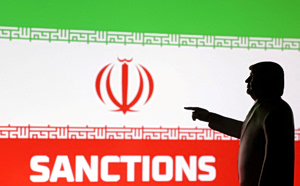
In exchange for concessions, the U.S. is offering extensive sanctions relief. It opened the door to Iranian oil sales and is working on ways to release billions of dollars in frozen Iranian cash as upfront incentives to open the strait and keep Iran at the table.
Write to Benoit Faucon at benoit.faucon@wsj.com