 Μake us preferred on Google
 The deal to end the conflict between the U.S. and Iran doesn’t address key reasons President Trump gave for going to war: the Islamic Republic’s missiles, drones and support for militias. That triple threat remains one of the biggest concerns for Tehran’s Gulf neighbors.
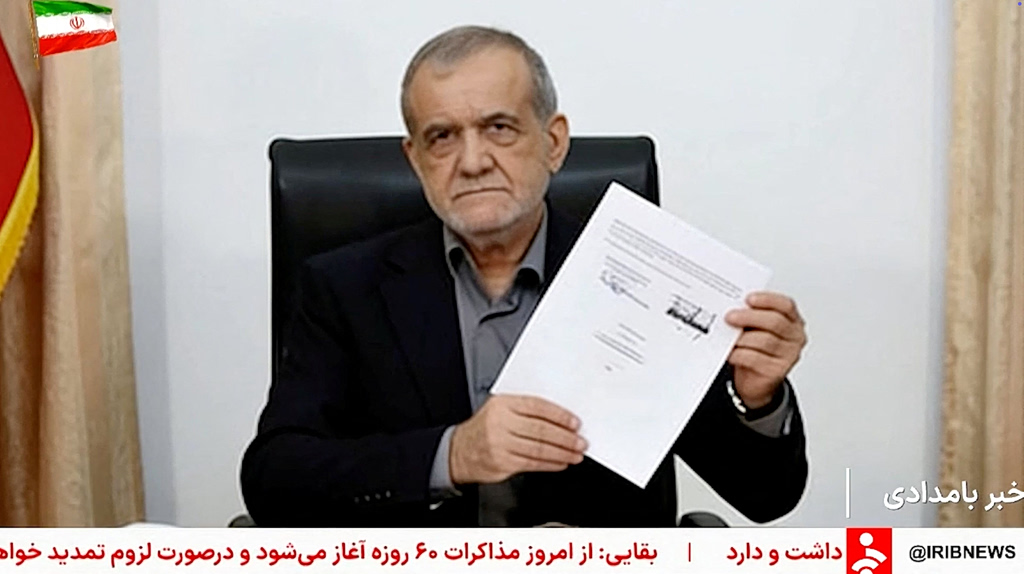
The agreement, a memorandum of understanding that Trump signed Wednesday, places no limits on Tehran’s stockpile of the weapons that it used to menace international shipping, nor on the powerful regional network of armed militias that helped it attack Arab Gulf nations.
“The MOU doesn’t address any of Iran’s core power-projection capabilities,” said Hasan Alhasan, a former foreign-policy analyst on the staff of the crown prince of Bahrain and now a senior fellow at the International Institute for Strategic Studies.
The document does insist on the permanent termination of military operations in Lebanon—where Israel is fighting the Iran-backed militant group Hezbollah. The first clause mentions Lebanon three times and commits the U.S. to ensuring its territorial integrity and sovereignty.
The war with Iran, which began in February, was sparked by U.S. and Israeli opposition not only to Tehran’s nuclear program but also to its arsenal of missiles and patronage of armed militia groups.
On Thursday, Iran’s Supreme Leader Mojtaba Khamenei said he only agreed to the country’s president signing the deal after receiving assurances from him and others that the interests of its militias, known by the regime as the Axis of Resistance, would be protected. “They have also explicitly stated that if the American side seeks excessive demands, they will not submit to them,” Khamenei said in a statement on X.
Throughout the conflict, Iran improved its regional position by tightening the alliances that it relies on for its defense, while weakening the bond between Israel and the U.S. over Israel’s most important security issue.
Tehran has shown it can withstand an onslaught by the world’s most advanced militaries, activate its proxies and translate that defiance into diplomatic and economic leverage.
Iran still has thousands of ballistic missiles in its arsenal that it could use by retrieving launchers from underground storage areas, The Wall Street Journal reported in April , citing American officials familiar with U.S. intelligence assessments.
Iran now has well under half of the one-way attack drones it had at the start of the war—because it has expended many of them during the conflict and Tehran’s weapons-production sites have been attacked by the U.S. and Israel, U.S. officials say. But Tehran could acquire similar systems from Russia to use against its neighbors, U.S. officials said.
Trump on Wednesday defended the agreement, saying he wanted to avoid an economic catastrophe that could have resulted if the war the U.S. initiated had continued.
The president—who signed the deal in Versailles, France—said he was influenced by the stock market’s rise as he worked toward a resolution of the conflict. He said he didn’t want to be compared with Herbert Hoover, who was president during the 1929 market crash that led to the Great Depression.
Trump told reporters that he supports Iran keeping some of its ballistic missiles. “I’m saying that if other countries have them, it’s a little bit unfair for them not to have some,” he said.
The outcome of the war and the deal to stop it means Iran enters crucial talks over its nuclear program emboldened, analysts said. Sanctions relief promised in the deal, in exchange for a pledge that Iran has long made not to develop a nuclear weapon, would also bring billions of dollars in oil revenue back to the theocratic state.
By successfully negotiating to include Lebanon in the ceasefire deal with the U.S., Iran has put further distance between the Trump administration and Israel, which advocated forcefully against including Lebanon in the agreement so that Israel could continue its campaign against Hezbollah.
It is a remarkable rebound.
Before the conflict, the connection between Iran and Hezbollah had frayed. Iran launched a missile barrage at Israel in 2024, when Israel killed Hezbollah leader Hassan Nasrallah and killed or maimed its operatives with explosive pagers, but stood aside for most of the two-month war that left the Lebanese militant group badly wounded. Hezbollah then sat out Iran’s 12-day war with the U.S. and Israel in June last year. Iranian militias in Yemen and Iraq also stayed quiet.
The war in Lebanon weakened Hezbollah within the Lebanese political system, ushering in the election of a pro-Western government that is working to further diminish and disarm the militant group. Iran also suffered a stinging military defeat in Syria, where its ally, the Assad regime, collapsed after rebels seized power in late 2024.
But this spring, after the opening strike of the U.S.-Israeli war with Iran killed Supreme Leader Ayatollah Ali Khamenei , Hezbollah sprang into action, firing rockets into northern Israel and reasserting its support for its patron in Tehran. Houthi militants in Yemen also offered support, and militias in Iraq stepped up to inflict pain on Iran’s Arab Gulf neighbors.
“Iran has definitely taken a hit, but I do think the war was a strategic blunder because it has made Iran stronger in many ways,” said Dina Esfandiary, an Iran expert at Bloomberg Economics. “It allowed Iran to recuperate some of the losses in terms of regional influence over the course of the last two years, when Israel attacked its partners and proxies in the region.”
For years, Iran’s Islamic Revolutionary Guard Corps, through its foreign military wing, the Quds Force, has trained and funded militias in Lebanon, Gaza and Iraq to protect the Islamic Republic from dangerous open conflict with its enemies Israel and the U.S.
The Revolutionary Guard, established in 1979 to ensure the survival of the new Islamic government, had been preparing for decades for the possibility of direct conflict with the U.S. or Israel. When it happened, the leadership mobilized a vast paramilitary force of more than 190,000 active-duty soldiers, a force specifically designed to survive and respond to an outside attack.
The Quds Force includes some 5,000 members, according to an annual assessment from the International Institute for Strategic Studies. Israel’s strategy of decapitation, which has worked to some extent against Hamas in Gaza and Hezbollah in Lebanon , wasn’t as effective in Iran, a country of around 90 million people with a strategy of layered defense.
The Revolutionary Guard used missiles, mines and cheap one-way attack drones to kneecap Iran’s Gulf Arab neighbors and menace shipping through the Strait of Hormuz to disrupt the global economy.
“Iran now is led by an IRGC that appears willing to use all of these tools against all of its neighbors whereas in the past it used these weapons as a whole only against Israel,” said Norman Roule, a former senior U.S. intelligence official, using an acronym for the armed force.
Iranian-allied militias in Iraq fired drones into Saudi Arabia and Kuwait. Hezbollah sent rockets into Israel. Yemen’s Houthi militants played a smaller role but were an ace in the hole, posing an implied threat to another strategic waterway, the Bab al-Mandab Strait that connects the Red Sea with the Indian Ocean.
The war has driven an evolution in Iran’s defense doctrine where it fights alongside its militia allies in battles with the U.S., Israel and Arab allies of Washington.
“The missiles are kind of acting also to support those allies and partners,” said Hamidreza Azizi, a visiting fellow at the German Institute for International and Security Affairs.