 Μake us preferred on Google
 On Jan. 7, Parviz Afshari received the last messages his son, Sam, would ever send him: “I’m planning to join the protest tomorrow / But don’t tell Mom.”
Relatives found the boy’s body four days later, among rows of corpses laid out on a morgue floor in the Iranian city of Karaj, his father said in a phone interview from his home in Germany.
Sam, who had just turned 17, is one of an expanding list of teenagers and other young people emerging as victims of the brutal crackdown on protests in Iran, a country where almost half of the population is under 30. Among the dead were athletes, artists and students whose photographs and brief biographies have since flooded social media, creating a digital memorial of young lives snuffed out under an internet blockade.
Ranks of youth often form the front lines of mass protests—from China’s 1989 pro-democracy demonstrations to the Arab Spring uprisings of the early 2010s, to Myanmar’s youth rebellion against a military coup in 2021. The Gen Z protest movement that has rolled around the globe in recent years has felled governments in places as far apart as Bangladesh and Bulgaria.
The demonstrations in Iran took on a different tenor, initially spearheaded by conservative bazaar workers disgruntled at the collapse in Iran’s currency. The regime acknowledged their concerns and promised to make economic concessions. But when young people joined in, the protests morphed into an antiregime uprising that presented the greatest challenge to the country’s Shiite cleric rulers in their almost five decades in power. The crackdown was swift and decisive.
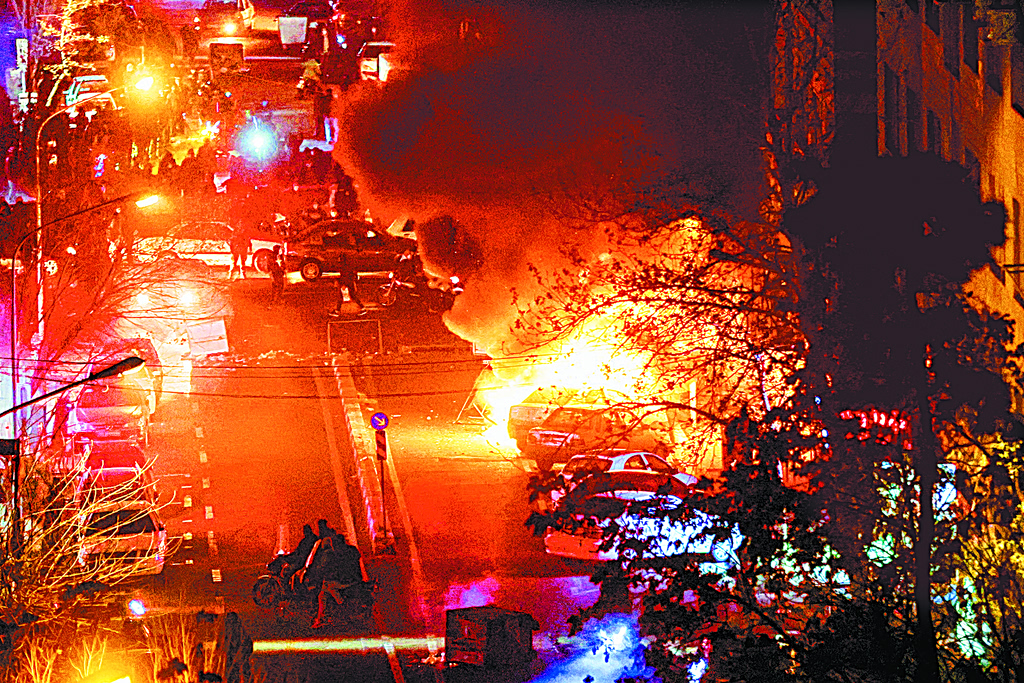
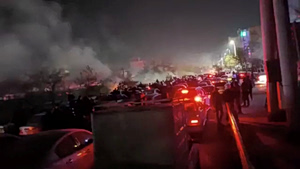
Cars burn in a street during a protest over the collapse of the currency’s value, in Tehran, Iran, January 8, 2026. Stringer/WANA (West Asia News Agency) via REUTERS ATTENTION EDITORS – THIS PICTURE WAS PROVIDED BY A THIRD PARTY
The scale of the violence in Iran is still coming into view. The regime shut down the internet on Jan. 8, the night Sam disappeared, and moved to crush the protests that had swelled in cities nationwide. Most of the country was under a near-total communications blackout for weeks, making information slow to transmit and difficult to verify. Connectivity remains heavily restricted.
Still, stories have trickled out, mostly via Starlink satellite connections and testimonies of people who either left the country or got online using foreign SIM cards near its borders. Human-rights researchers who are painstakingly piecing together evidence say the death toll may surpass 10,000, which would make it the deadliest episode of political suppression in modern history.
Iranian authorities said more than 3,100 people were killed and alleged, without providing evidence, that most of the deaths were linked to terrorism.
The U.S.-based nonprofit Human Rights Activists in Iran puts the confirmed death toll at more than 6,000. Of the dead that it has identified so far, at least 137 people were under the age of 18 when they were killed. Tallies by other human-rights groups suggest about half of those killed were likely members of Iran’s Gen Z, those born roughly between 1997 and 2012.
They were the first generation of Iranians to grow up with widespread access to the internet, exposing them to the outside world like never before. They witnessed a brief window of optimism with the easing of sanctions in 2016, which raised hopes of an economic rebirth—until Iran’s nuclear deal collapsed two years later and plunged the nation further into isolation.
Some 42% of Iranians are under 30 years old, according to the United Nations population agency. Their prospects have shrunk as the economic situation has worsened—youth unemployment is above 20%—and many feel the ultraconservative Islamic regime is out of touch.
Young Iranians last took to the streets en masse in 2022, outraged over the death of a young woman in custody of the country’s “morality police,” who accused her of wearing her headscarf improperly.
The U.N. says at least 551 people were killed when authorities crushed those protests, known as the “Woman, Life, Freedom” movement.
“These young Iranians take to the streets fully aware that they may be met with bullets and batons, and do so because they believe their future is worth fighting for,” said Holly Dagres, a senior fellow at the Washington Institute who grew up in Iran. “Iranian Gen Z wants to be part of the world and, in very basic terms, be able to express themselves freely, have economic opportunities, and live with dignity,” she said.
Like many of his generation, Sam belonged to a scattered family. Parviz, his father, moved to Germany in search of opportunity when the boy was about 10. The distance was painful, Parviz said, but they spoke regularly on WhatsApp video calls, sometimes three times a week. Sam was his only child.
Back home in Karaj, Sam studied English and German languages and was planning to join his father in Bavaria later this year to complete his education in information technology. He loved computers, his father said, but his greatest passion was swimming.
When he didn’t come home, his family hoped that he had only been detained. Local authorities said they had no record of his arrest and that the family should check the hospitals. One by one, they scoured the city’s medical centers until they came across a medic who said they had seen the boy.
The medic told them Sam was in critical condition being treated for a single gunshot wound in the back of his head, until authorities came and took him and other patients away. The medic advised them to check the morgues, Parviz said.
They found him inside a body bag on Jan. 11 with a second bullet wound that tore through half of his face and made him almost unrecognizable, Parviz said.
“My son could have built the future of the country, this regime is just killing kids who are asking for freedom,” said Parviz, sobbing. “It isn’t fair.”
Relatives of three other teenagers killed in the crackdown shared similar stories with The Wall Street Journal. One, a 16-year-old from the city of Kermanshah, told his parents he was going to the library but never returned.
Another, 17-year-old soccer player Rebin Moradi, called his family as he was leaving a game and told them he was joining a demonstration on his way home. They found him four days later in Tehran’s Kahrizak morgue.
And another, Amirali Heidari, was days away from his 18th birthday when he joined a protest in Kermanshah with a group of close friends, according to a relative who lives abroad. A witness who later fled the country told the relative he saw security forces shoot Heidari in the chest and then beat him to death with the butt of a rifle as he lay bleeding on the ground, the family member said.
As young as he was, Heidari felt a duty to fight for his generation’s future, the relative said. The relative fled Iran years ago after being badly injured at an antiregime protest. He said his own history with the regime had an impact on the young boy, who took up the fight in his absence.
“The younger people always take more risks, in protests and in life,” said Ghazal Abdollahi, an Iranian artist who went into exile after participating in the 2022 protests. For her, too, the struggle was personal—her mother is a well-known activist who spent many years imprisoned.