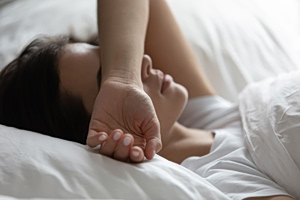
Chrissy Lawler saw her social life dry up awhile back. There were fewer invitations. Snarky comments about her behavior. A good friend told her that she no longer wanted to hang out.
When Lawler asked what was wrong, she was surprised by the answer. You’re not that fun anymore—you leave early to go to bed, she says her friends told her.
“I was devastated,” says Lawler, who is 38 and lives in Las Vegas. “People turned away from me because I prioritized my sleep.”
It’s hard enough to snooze at night . Now there’s a new source of worry: Sleep shame—the subtle, and not so subtle, ways that people judge and undermine how and when we rest.
No one is immune. Are you, like Lawler, an early bird up with the dawn? You’re considered boring. A night owl who sleeps in? What a sloth. Enjoy an afternoon nap? How irresponsible. And how much shut-eye did you get last night anyway? Doesn’t matter, it’s never enough.
Much of the shaming is cultural, psychologists say. We live in a society that values hard work, where we’ve been told since we were small children that “the early bird gets the worm.”
Our nearest and dearest—who can be disappointed and judgy when we don’t do things their way—can be part of the problem, too. And making matters even worse: We’re often the ones shaming ourselves. (I felt guilty recently after my Oura ring informed me I had almost six hours of sleep debt.)
“We get shamed if we express our need for sleep and we get shamed if we don’t sleep enough,” says Wendy Troxel , a psychologist and senior behavioral scientist at Rand and author of a book on couples and sleep. “But this is not how sleep works—it is not a test to pass.”
While reporting this story, I heard about a woman who said she was ghosted by someone she was dating after she explained that she goes to bed early, adult siblings who got into a spat after one suggested the other would “get more done” if she got up earlier, and a man who said his personal trainer berated him for not getting enough sleep.
When Ann Turner’s husband asked—one too many times—if she was “going to bed already?” after she said good night at 9 p.m., she stopped giving her usual excuses, such as that she woke up early. “Stop sleep-shaming me!,” the 58-year-old therapist, who lives in Bethesda, Md., blurted out. “I’m tired, and there’s nothing wrong with going to bed when I’m tired.” (He says he now understands.)
The biggest problem with sleep shame, experts say, is that it makes our problems spiral. Think of it as a finger trap, the little prank toy that tightens around your fingers the harder you pull, says Alex Dimitriu , a psychiatrist who specializes in sleep issues in Menlo Park, Calif. “The more you force yourself, the worse it is,” he says. “The trick is to relax and not try so hard.”
Sleep shame is driven by the idea that there’s a one-size-fits-all approach, experts say. Yet we all have different sleep needs, both in terms of amount and timing. Some people are natural early birds, others night owls. These chronotypes, as they’re called, are biologically set and typically hard to change, Rand’s Troxel says. A theory I have long loved, as a night owl, holds that evolution set us up this way to ensure there was always someone in the tribe awake to tend the fire and watch for danger. Forcing yourself to sleep outside your optimal time can lead to poorer sleep, Troxel says.
Many people, like me, also end up shamed by their sleep trackers. This is where our growing obsession with achieving optimal sleep—an issue that researchers call orthosomnia—becomes harmful. “Sleep naturally varies day to day, but people lose sight of the big picture,” says Zlatan Krizan , a professor of psychology who runs a laboratory that studies sleep and personality at Iowa State University.
So what’s a sleep-ashamed person to do? Here is some advice from the experts.
Own your needs
How much sleep you need—and the timing—is innate. You’ll feel less ashamed if you remember this.
Reframe your sleep as a performance-enhancing strategy, says Troxel. We expect pilots, surgeons and athletes to get their rest. Why not you?
“The stakes are high no matter who you are,” she says. “Your health, your well-being, your relationships, your ability to perform at your best are all shaped by the quality of your sleep.”
Zoom out on your data
Don’t judge your sleep health based on just one night.
Sleep metrics are hard to understand unless you are a sleep scientist, says Iowa’s Krizan. He suggests you choose a long-term goal when using your sleep tracker. Maybe you want to identify what messes with your slumber, such as working out late, or monitor your patterns over time.
“Sleep is naturally variable and flexible,” he says. “It can take weeks, or months, to understand what is really going on.”
Respect your partner’s chronotype
Your partner’s early bedtime when you want to stay up isn’t lazy, selfish or a reflection of their love. It’s a biological need.
Research shows that couples with different sleep habits may have more conflict. To avoid this, discuss your individual needs. Then come up with a compromise.
Troxel recommends that couples spend quality time together in bed before the early bird goes to sleep, cuddling, bonding, being intimate. Then the night owl can get out of bed and continue on with his or her evening.
“Preserving the ritual of being together before bedtime is more important than sleeping together ,” she says.
Push back
Labeling sleep shame can help you address it. This is true even when you are the one beating yourself up.
It helps to have a short, go-to mantra. Joshua Tal, a psychologist in New York who specializes in sleep issues, suggests: “Every person has different sleep needs and these are mine.”
But if that makes you feel defensive, try ignoring the comments. “The ultimate response to sleep bullies is to nod and smile,” Tal says.
When Lawler’s friends ditched her for going to bed early, she was doubly frustrated: Not only is she a mother of four who needs to wake up early, she also is a therapist who specializes in helping parents teach their kids to sleep.
So she reminded herself that her desire to go to bed early doesn’t make her boring or anti-fun; it means that she’s putting her health, her family and her productivity first.
“If I realize that my good sleep matters, then I am immune to other people’s judgment,” she says. “It’s my life, and nobody is going to care about my well-being more than I will.”
Write to Elizabeth Bernstein at Elizabeth.Bernstein@wsj.com