ZVERNEC, Albania—Residents of this tiny coastal village were shocked two years ago when Jared Kushner posted renderings of a planned Mediterranean resort on a slim peninsula sandwiched by the azure sea and a lagoon where flamingoes flock.
The images were of a spit of land where their parents and grandparents once raised potatoes. The villagers contended the property was stolen from them in the 2000s by Artur Shehu —a suspected gangster who fled to Miami after a gunfight at his bar.
So they wrote a letter to Kushner saying they were locked in nearly two decades of court disputes with Shehu, urging the developers not to proceed. The site, they wrote, is “owned by the village and its residents.”
Instead, a Kushner-backed development group pressed ahead and paid Shehu over $120 million for the land earlier this year. Two months later, Albanian prosecutors sought Shehu’s arrest for allegedly playing a lead role in a sweeping international drug-smuggling operation that brought cocaine from South America to Europe in shipments of charcoal and fruit paste.
Shehu laundered money through property—including the peninsula in Zvernec—that was stolen using techniques such as forged Ottoman-era land records, prosecutors said.
The controversy is the latest black eye for Kushner’s foreign real-estate ambitions—one piece of the post-2020 business career he launched after the first Trump administration. While most of his investing has been out of his $6 billion private-equity fund backed by Gulf wealth funds , Kushner also turned back to his real-estate roots. He talked of getting in front of the investment curve by developing in the Balkans, where tourism and property prices are rising, targeting Serbia and Albania.
He struck a no-bid deal with Serbia’s government to develop state-owned land in central Belgrade—drawing local criticism that Serbia’s government was trying to cozy up to Trump, a charge the government denied. The Serbia plans fell apart after weeks of protests and the indictment of a cabinet minister who pushed through project approvals. Kushner pulled out in December .
The Albania project in Zvernec has drawn a larger popular backlash. A video showing the Kushner-backed group’s private guards punching a local villager and dragging him across a beach sparked large daily protests in Tirana. They have continued for over two months, with protesters expanding their criticisms to endemic corruption and rampant development in a movement they call the Flamingo Revolution.
Unlike in Serbia, money has already changed hands here. The Kushner-backed development group paid well over $240 million for land to private landowners including Shehu, according to a person familiar with the sales.
Shehu’s lawyer, Kujtim Cakrani , says Shehu is neither a drug dealer nor a land thief, and he never dealt directly with Kushner—only acting through an intermediary.
“He has absolutely no connection to the charges,” Cakrani said. “He is simply a landowner, coming from a large landowning family,” and his interactions with others in the indictment were solely for legitimate business deals.
A spokesman for the development group—a venture of Kushner and other partners—said the Albanian legal system is “the appropriate venue for resolving questions about land ownership and the integrity of prior transactions.”
The group is aware of the allegations “regarding the land seller” and isn’t itself the subject of any investigation, he said, adding, “We continue to believe the underlying land acquisitions were conducted lawfully.”
Prosecutors say they have frozen Shehu’s money from the sale.
“Theoretically, the courts have the authority to temporarily block the disputed development,” Sotir Dhamo, an urban planning professor at Polis University in Tirana, said of contested properties facing development. “In practice, the courts are not fully independent from politics and hidden economic interests.”
Flamingo Drive
Shehu, 60, today lives in Miami, where property records show he owns a column-lined 4,000 square foot home on Miami Beach’s Flamingo Drive with his wife, a former Albanian television celebrity.
His route to South Florida runs through a particularly turbulent few decades of upheaval in his native Albania.
Isolated and poor during the Cold War, when its government broke with both the Soviet Union and China, Albania fared little better during the postcommunist 1990s. The country was racked with political instability, organized crime, depopulation and a massive pyramid scheme that nearly plunged the country into civil war.
Amid the disorder, Shehu emerged as an entrepreneur whose holdings included a hotel in the rough-and-tumble city of Vlore.
He caught the eye of Albanian antidrug police and Italian authorities, who suspected him of being in business with the Italian mafia—trafficking marijuana and smuggling aspiring émigrés to Italy with speedboats, said Dritan Zagani, one of the former Albanian state police officers who investigated him.
One day in 1999, Zagani said, police rushed to a bar after reports of fired shots. Shehu, they learned, got in a gunfight with a rival gang.
“After that, Artur disappeared,” Zagani said.
Cakrani, Shehu’s lawyer, said Shehu was attacked by pro-communist gangs for his anticommunist views. The law-enforcement scrutiny was politically motivated, he said. Neither the Italian nor the Albanian investigations led to charges.
Shehu resurfaced in Miami. He moved to the U.S. in 2001 and won asylum after citing attacks from the communist gangs, who killed his uncle and brother, Cakrani said.
He ultimately secured U.S. citizenship, Cakrani said, but kept a foot in Albania, growing a real-estate portfolio.
Shehu fell into the sights of law enforcement again in 2012 when Italian prosecutors sought his arrest in a broader case against an Italian crime family. Shehu co-owned a gelateria in Albania with an Italian mafia crime boss who wired Shehu over €1 million (roughly $1.3 million at the time), according to an Italian court ruling. Shehu also rented him space in a building for a casino, prosecutors said.
The Italian judge rejected the attempted arrest, saying that there wasn’t sufficient evidence to show Shehu was connected to anything illegal. Cakrani said Shehu’s involvement was solely as a landlord.
Still, he kept popping up in drug investigations. European law enforcement on surveillance operations spotted him in Monaco with suspected narcotics traffickers, Albanian prosecutors said. They got photos of him in 2019 in Mallorca at a meeting alongside a suspected top mob boss who has since been arrested. Shehu wasn’t charged in these investigations. His attorney said Shehu hasn’t had any legal trouble with any European country beyond Albania, and he was only involved in legal business deals.
His fortunes changed in June.
European drug investigators in Spain, Belgium and multiple other countries handed over voluminous files to an Albanian special prosecutors’ office known as SPAK, a unit set up in 2019 partly to address European Union concerns about Albanian corruption.
It is a widespread problem: In the past four years, prosecutors from SPAK have filed corruption charges against two former prime ministers, two former deputy prime ministers and numerous former cabinet ministers, all of whom have denied the charges. Armed with the European investigators’ files, SPAK in June secured a judge’s order to arrest Shehu and 19 other members of what they said was a large European drug ring.
Shehu had a “leadership position within the organization,” prosecutors said, charging him with money laundering and participating in a structured criminal group—similar to racketeering in the U.S.
The alleged drug network reached up and down the cocaine supply chain: Members of the Albanian network supervised production in Ecuador, put cocaine shipments onto boats hidden among fruits, soy, sugar and other products, guided them through Dutch ports, processed the drug at small factories and distributed it throughout Europe, prosecutors said.
Gains from cocaine filtered their way to Albania via cryptocurrency and cash smuggled on buses—with the group ultimately laundering money through Albanian real estate, prosecutors said. Some ended up financing a boxy red skyscraper in downtown Tirana, Albania’s capital, and coastal villas, prosecutors said. Shehu and his proxies were crucial to this effort, prosecutors said .
Cakrani said Shehu only conducted legitimate real-estate transactions and wasn’t involved in money laundering or any of the other alleged crimes.
Among the prosecutors’ charges: Shehu and his network acquired land used for laundering money by claiming historic ownership, frequently relying on forged documents. One of the larger pieces prosecutors cited: the land in Zvernec, the spot Kushner wants to develop.
‘A psychological problem’
The tiny village of Zvernec sits on the coast outside Vlore, known for its more than 700-year-old Byzantine-era monastery on the edge of the Narta Lagoon. Homes are clustered on a hill that sports vistas of the sea and trees dripping with figs and pomegranates.
Zoi Pula, 71, grew up in the village before moving to Greece where work was more plentiful. He returns in the summers to his family home on the hill. His great-grandfather moved to the village and used a patch of land in the nearby peninsula for grazing, he said.
When property was collectivized, his family used the land to farm potatoes, onions and other crops. After the communist government fell in 1991, his family was handed ownership of its chunk of peninsula farmland, which had since gone fallow.
In the mid-2000s, he said, he learned what one villager after another had discovered: Local property officials had given Shehu control of their peninsula land.
“We went crazy. We got angry. It was a psychological problem,” he said.
Real-estate ownership in Albania has been fraught for decades. After the fall of communism, the new government crafted a series of laws to return expropriated land, opening the door to a flood of overlapping claims. Those fell to the country’s creaky court system, where authorities have found numerous cases of corruption.
As they pursued their case, the villagers and others claiming ownership found Shehu had used similar tactics to amass much of the land in Zvernec: Through a lawyer, he used historic documents to show that his ancestor Seit Shehu previously owned the property.
One chunk of land was secured by one of Shehu’s lawyers in 2007 by presenting property officials a mistranslated Ottoman-era land record. While translating from Ottoman Turkish, an archivist substituted out the original owner and inserted Seit Shehu’s name instead, a court found. The lawyer and the archivist were later convicted on falsified documents-related charges, though the lawyer’s case is being retried.
“The falsity of this document has been proven,” Albania’s High Court ruled.
Shehu and numerous land claimants have traded victories in various trials and appeals, none of which forced Shehu to relinquish the land. Retrials and appeals are snaking through the system.
Cakrani said Shehu’s claims are based on substantial documentation showing his family was a large landowner—in Zvernec and elsewhere. Evidence filed in court cases includes numerous documents from the fascist Italian occupation and others from the early 1900s.
“There are legitimate documents that prove this is his land,” he said.
Razor wire
Kushner and his wife Ivanka Trump first got interested in Albania while on a yacht trip through the Mediterranean after Trump’s first term, dropping anchor en route between Montenegro and Greece. They explored the publicly owned island of Sazan, a former military site where locals trek by boat for day-trips.
“We swam to the island. We went on a hike,” she said on a podcast in May. “We were just captivated.”
Kushner later reached an accord with Prime Minister Edi Rama to develop Sazan, and began working on plans with Asher Abehsera, a U.S.-based developer who was Kushner’s partner redeveloping Brooklyn offices in the 2010s.
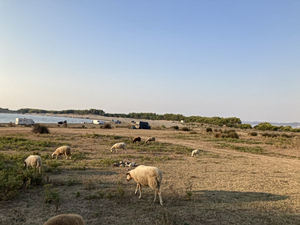
Soon after, Abehsera said in a June interview, the pair turned their gaze to the strip of undeveloped land 5 miles away, on the shore in Zvernec. There, locals take 4x4s to rest on pristine beaches where sea turtles nest and sheep graze.
Abehsera said he struck a deal with local partners, an Albanian conglomerate called Kastrati, whose name adorns gas stations around the country. The group approached landowners in Zvernec, initially offering to partner with them, Abehsera told The Wall Street Journal in 2024.
That spring, Kushner posted renderings of plans on Instagram, with villas carved into the cliff-side at Sazan and hotels lining Zvernec’s beaches.
Months later, in September 2024, a group of villagers sent their letter to Kushner’s firm urging the developer to refrain “from taking actions that undermine the real property rights of the village” while the disputes continue, according to a copy reviewed by the Journal.
At the time, Zvernec land disputes over the site were well-known locally, covered repeatedly in the press.
“We have no interest in developing anything that’s not rightfully or legally ours to develop,” Abehsera told the Journal in 2024 when asked about the disputes.
Sent a list of four landowners—including Shehu—Abehsera said “none of these are our partners,” in a 2024 message to the Journal.
Kushner and Abehsera refined plans, forming a venture named Sazan Real Estate Development.
Also on board was a large Qatari investment group run by the Al-Khayyat family. Kushner met the Al-Khayatts at the 2022 World Cup, and eventually turned to them as partners, as the family has experience developing island resorts in the Maldives and the Gulf
The development group, using an entity called Albania Land Development, paid €110 million, equivalent to $125 million, to Shehu for his land in April, prosecutors in the money-laundering case against Shehu said. Albanian corporate records show the entity is owned by Sazan Real Estate Development.
In late April, the Kushner-backed group put construction fencing at the environmentally protected peninsula’s edges, lining it with spools of razor wire.
When locals showed up to protest, hired security guards blocked the site. One punched a local villager in the throat, then dragged him across a beach, as police nearby watched.
The development group publicly disavowed the actions, attributing them to an unnamed security contractor.
But a video of the incident went viral. Outrage spread and protesters began filling downtown Tirana carrying signs with images of Kushner, flamingoes, and Trump. Days later, t he indictment of Shehu was reported in Albanian media, bringing more people to the streets.
Soon after, Abehsera, Sazan Real Estate’s chairman, distanced his group from the controversy. He told the Journal in June he didn’t know if his firm had paid Shehu for land.
He also denied prior knowledge of the fights over the land. “We did not see or hear of any dispute at all,” he said.
The group is currently working on an environmental review document—a prerequisite to government approvals before construction. Despite a backlash that has included tens of thousands of protesters, European Union officials and celebrities such as Dua Lipa, the development has strong backing from Albanian Prime Minister Edi Rama. He celebrates the $5 billion project as an important foreign investment that will boost the economy.
The Zvernec villagers fear getting bulldozed once again. “The only thing that I want now is that they give me back my land,” said Kostaq Konomi, village leader of Zvernec.
Write to Eliot Brown at Eliot.Brown@wsj.com