 Μake us preferred on Google
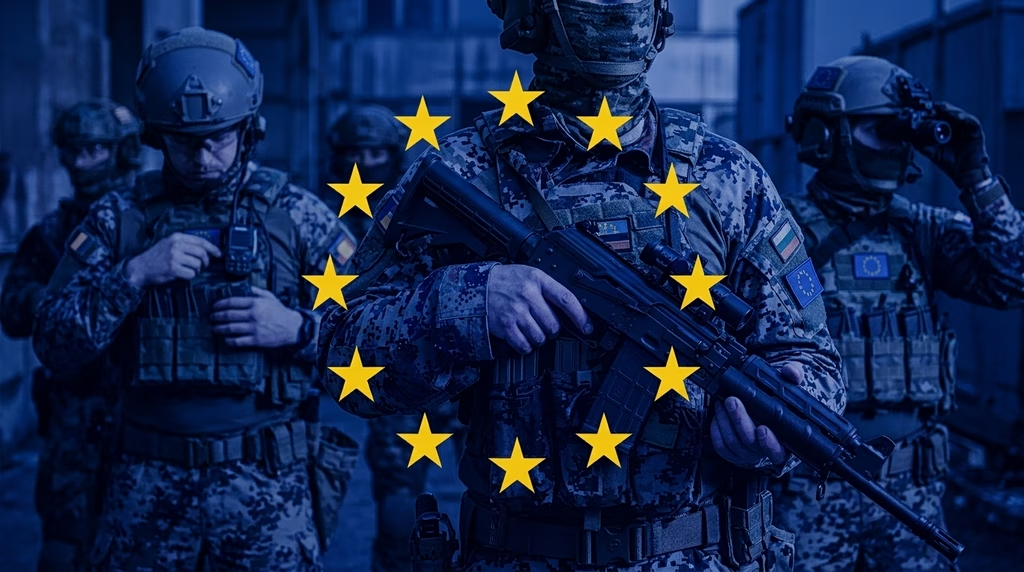
European public opinion is moving toward the idea of a stronger and more autonomous European defense, but without wanting to move away from NATO. Doubts about the reliability of the United States, the Russian threat and the war in Ukraine are speeding up this shift. What remains uncertain is whether governments can turn it into military power, institutional credibility and real readiness. Public opinion seems to have moved further ahead than state capabilities.
This is the main finding of the new edition of the annual GLOBSEC Trends 2026: The Reality Check survey, released on November 13 by GLOBSEC’s Centre for Democracy & Resilience. This year’s 11th edition is the broadest so far, as it covers 14 countries for the first time, combining Central and Eastern Europe with France, Germany, Britain and the United States.
The survey, carried out in May 2026 together with HarrisX, records not only changing views on security and international alliances, but also a deeper crisis of trust in democratic institutions. Citizens are calling for a stronger Europe while doubting how effective their own governments are.
A Strong Majority Backs A European Army
Of respondents in the EU countries surveyed, 71% support creating a European army. Support is especially high in Romania, at 82%, Lithuania, at 78%, and France, at 75%.
The idea also has notable appeal in countries that have traditionally been cautious about deeper European defense integration. In Poland and Bulgaria, about seven in 10 support a European army, while in Germany the figure is 69%.
This support, however, does not mean Europeans want to replace NATO with a purely European defense structure. On the contrary, 78% of citizens in European NATO member countries say they would vote for their country to stay in NATO. At the same time, 78% of respondents in EU countries want Europe to develop independent defense capabilities.
This is a clear public mandate for a stronger European pillar within the alliance. European autonomy is seen more as a complement to the transatlantic alliance than as an alternative to it.
Washington Is Losing Europeans’ Trust, But Not Its Strategic Importance
The image of the United States is changing noticeably. Of Europeans, 35% now see the United States as a threat to their country’s security, while only 54% still regard it as a reliable partner.
Germany is the most striking case. It is the only country in the survey where a majority sees the United States as a threat to national security. About half of respondents in France and Britain share this view, while in Central and Eastern Europe the figure is around 31%.
The discontent mainly concerns the unilateral use of American power. Of Europeans, 73% view U.S. military interventions abroad negatively, and 78% oppose U.S. efforts to acquire Greenland.
However, this criticism does not translate into a desire for the Americans to withdraw from European security. Of respondents, 77% consider the U.S. role in Europe’s security important, and 65% view the presence of American troops on the continent positively.
The contradiction is clear: Europeans increasingly question Washington’s political reliability, but still consider the American military presence necessary.
Germany: The Big Exception
German public opinion differs most from the rest of the European average, not only on the United States but also on the war in Ukraine.
About 40% of German respondents agree with the claim that the treatment of Russian-speaking populations in Ukraine justified the Russian invasion. In addition, 39% believe the West caused the conflict.
These views are linked to a more cautious attitude toward supporting Kyiv. Only slightly more than half of Germans believe Ukraine’s fight matters for their own country’s security, while almost six in 10 would accept Ukrainian territorial concessions in exchange for peace.
Germany thus appears to be in an unusual position. It supports strengthening Europe’s military power, but at the same time shows high levels of distrust toward the United States and greater tolerance for arguments the Kremlin uses to justify the war.
Ukraine Remains A Matter Of European Security
Despite disagreements over the terms of a peace deal, support for Ukraine still has a strong public base. Of Europeans, 62% believe Europe should keep supporting Kyiv regardless of the U.S. position. In the United States, the corresponding figure is 76%.
Even more telling, 82% of respondents across the 14 countries believe that any peace agreement must include credible long-term security guarantees for Ukraine.
Opinions are divided, however, on territorial concessions. In countries bordering Russia or Belarus, 42% would accept Ukraine giving up territory as the price of lasting peace. In the other countries, the figure rises to 59%.
The difference reflects how differently the threat is perceived. For countries on the eastern flank, Russian aggression is a direct and existential danger. Farther from Russian territory, the wish to end the war seems to weigh more heavily on attitudes toward territorial concessions.
Overall, 68% consider Russia a threat to their country’s security. Moscow remains the main external danger to European security, but its influence is not limited to the military sphere.
Russian Propaganda Finds An Audience In Europe
One of the most worrying findings concerns the spread of Kremlin narratives. Four years after the full-scale invasion of Ukraine, 37% of respondents still agree that the alleged oppression of Russian-speaking populations justified the Russian invasion. In addition, 35% believe Europe and the United States caused the war.
Disinformation also appears to have real consequences for attitudes toward military aid to Ukraine. In countries where pro-Russian narratives have greater appeal, support for military assistance to Kyiv is weaker.
The survey thus highlights a problem that cannot be tackled with defense spending or military capabilities alone. Resilience against Russian influence also depends on information, the credibility of institutions and citizens’ ability to recognize organized manipulation of information.
Citizens Are Willing To Fight But Do Not Trust Their Countries’ Readiness
Willingness to take personal responsibility for national defense is higher than one might expect. Of respondents in the 14 countries, 62% say they would defend their country if it were attacked.
In countries without compulsory military service, 64% support bringing it back. Support is highest in the Czech Republic, France, Germany and Slovakia. Overall, in nine of the 10 countries where the question was asked, majorities favor reintroducing or expanding compulsory military service.
In addition, 61% support higher defense spending. This willingness, however, has clear limits. In the European NATO member countries surveyed, support for more defense spending drops from 61% to 44% when the increase is linked to cuts in health care or social security.
The gap between personal willingness and confidence in state capabilities is even wider. Only 34% believe their country is prepared for a major security crisis or a war.
Likewise, only 49% of Europeans believe European countries could ensure their security without strong American support.
The problem, therefore, is not only funding for weapons. It is real operational readiness, civil protection, infrastructure, military production and the ability of states to mobilize their citizens in an emergency.
Citizens Are Losing Faith In Democracy
The survey records a second, equally serious weakness in Europe’s political system. Although 84% believe that democracy based on the rule of law is good for their country, only 8% believe democracy works fully in their country.
Another 52% believe it works but faces problems. And 41% believe it has serious failings or that their country is not even a democracy.
Citizens see the biggest threats as coming from within their political systems. Corruption, economic inequality and excessive concentration of power in the executive branch top their concerns.
This finding is especially significant because it shifts the focus of the debate on democratic resilience. Foreign interference and disinformation are real threats, but they become more effective when citizens have already lost trust in institutions.
GLOBSEC notes that the answer cannot be limited to defending democracy through messaging. What is needed are tangible results in fighting corruption, an independent judiciary, effective public services and real institutional checks.
Artificial Intelligence: A Positive Image, But Fears For Jobs And Global Stability
For the first time, this year’s survey also systematically examines citizens’ views on artificial intelligence, placing it within the debate on security and democratic resilience.
Of respondents, 71% say they are familiar with AI and 61% view it positively. However, only 16% say they are excited about its prospects.
The reservations mainly concern the job market and geopolitical consequences. Of respondents, 77% believe AI will eliminate more jobs than it creates. In addition, 61% believe it will lead to less global stability.
Concern is stronger in Western countries, while societies in Central and Eastern Europe appear more optimistic, with Ukraine a notable example.
GLOBSEC stresses that AI policy cannot be limited to innovation and productivity. It must also address the effects on information, elections, public services and social cohesion.
Europe’s Challenge Is To Turn Political Will Into Real Capabilities
The overall picture from the survey is of a European society that recognizes the security environment is changing, but is not yet convinced that political leaders can respond.
Support for a European army, keeping NATO, continuing aid to Ukraine and increasing defense efforts together form a new public foundation for European security policy.
There are, however, two serious limits. The first is dependence on the United States, despite the erosion of trust in Washington. The second is the internal weakness of European states, reflected in citizens’ limited confidence in their readiness and in how democracy works.
GLOBSEC’s stated priorities include linking defense investment to domestic industry and jobs, energy security at affordable prices, stronger civil protection, the sustainability of independent journalism and tackling disinformation.
It also places particular emphasis on raising awareness of threats from China, Iran and North Korea, since these are perceived as dangers much less in Central and Eastern Europe than in Western Europe and the United States.
The main conclusion is that European strategic autonomy now has significant public support. What remains uncertain is whether governments can turn it into military power, institutional credibility and real readiness. Public opinion seems to have moved further ahead than state capabilities.