 Μake us preferred on Google
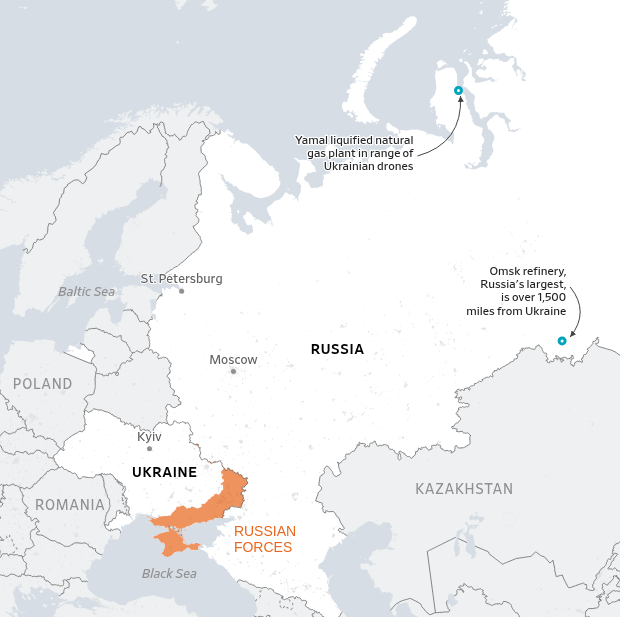
 Several Ukrainian drones circled over Russia’s largest refinery on Monday and then, one after another, slammed into its crude distillation unit, engulfing the facility in fireballs and clouds of smoke. There was no air defense to speak of because Russian authorities had assumed that the refinery, in the Siberian city of Omsk, was too far from Ukraine to be imperiled.
The hit, which triggered Wednesday’s ban on diesel exports and intensified Russia’s monthlong fuel crisis , marked a major expansion in the range of Ukraine’s deep strikes. Until now, they have been confined to European Russia, within some 1,000 miles of Kyiv-controlled territory. But Omsk lies nearly 1,500 miles away in a straight line, and the drones flying there had to take a longer, more circuitous route to avoid air defenses.
Ukrainian drones used in this operation have a maximum range of 2,100 miles, according to the manufacturer, Fire Point. This means that a vast additional swath of Russia, including the core of its oil-and-gas industry in western Siberia, and hundreds of key military installations, will also need to be protected from Ukrainian air raids—when Russia’s air defenses are already stretched thin by Kyiv’s relentless drone and missile campaign.
“We’re leveling the playing field. In 2026, we can finally do, intensively, what Russia has been doing to us since 2022,” said Mykola Bielieskov, a research fellow at the National Institute for Strategic Studies, a state think tank in Ukraine, and a senior analyst at the Come Back Alive foundation that supports and equips the Ukrainian military. “Russia is much bigger than us, and this means that the attacker has an advantage because they never know what will be struck next, and will find it very difficult to defend. Undoubtedly, geography here works in our favor.”
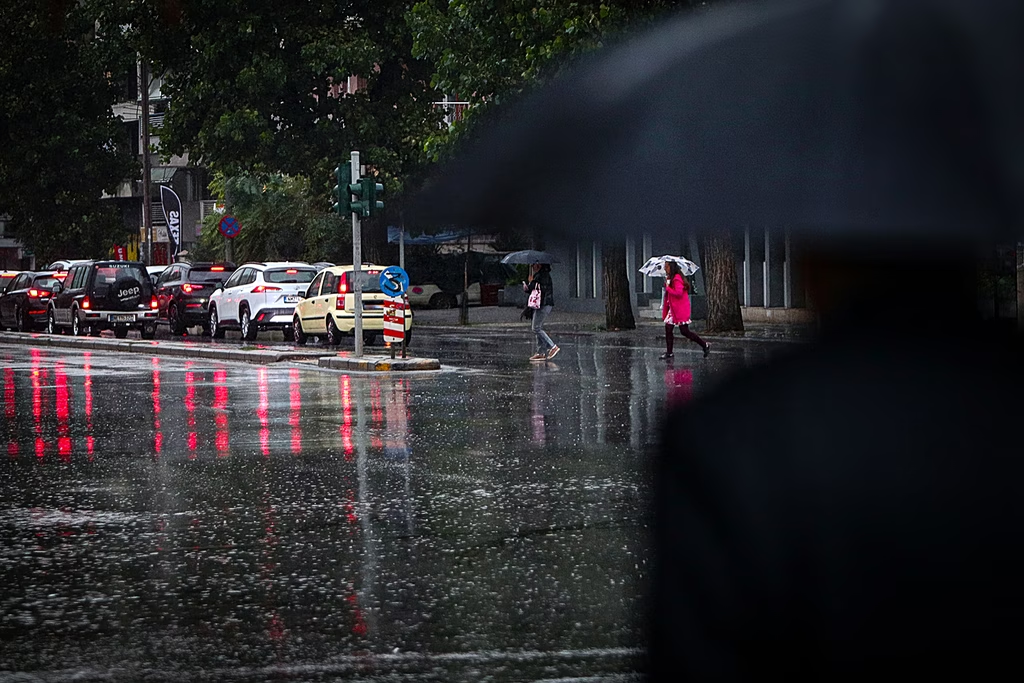
All the major refineries in the European part of Russia have been hit this year, with varying degrees of damage. Production of gasoline is estimated to have fallen by at least one quarter, causing long lines, shortages and rationing throughout the country. Neighboring Kazakhstan on Thursday deployed 59 checkpoints on its border with Russia, to prevent Russian motorists from smuggling out fuel.
Russia’s diesel production used to exceed consumption by one-third, allowing the country to become one of the world’s leading exporters. But diesel shortages are starting to emerge too, which is why Moscow on Wednesday announced the export ban, rattling global markets.
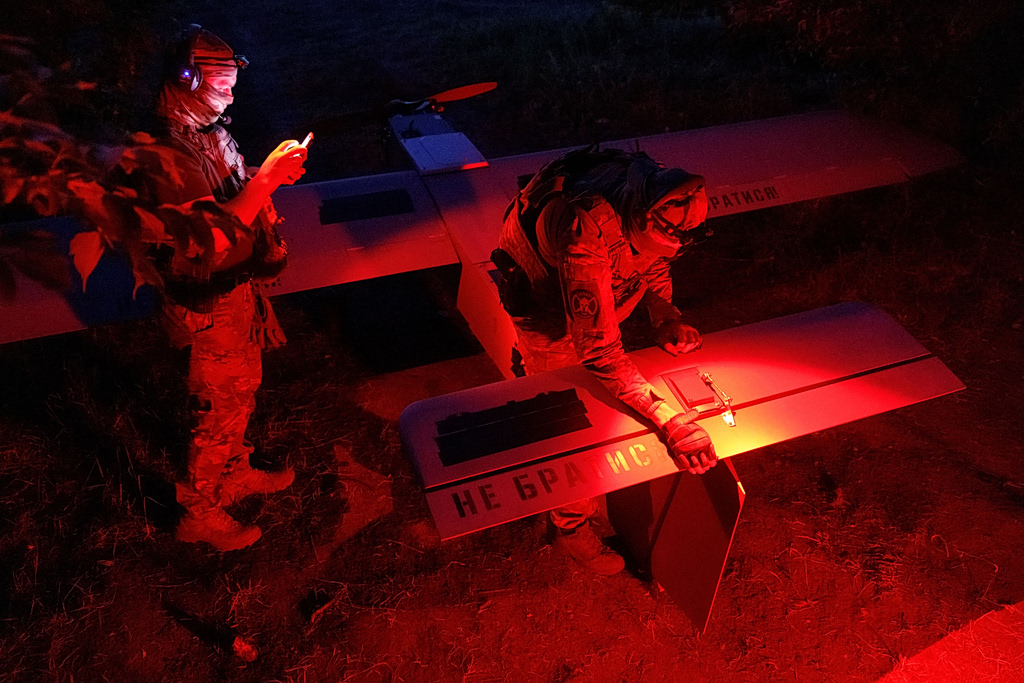
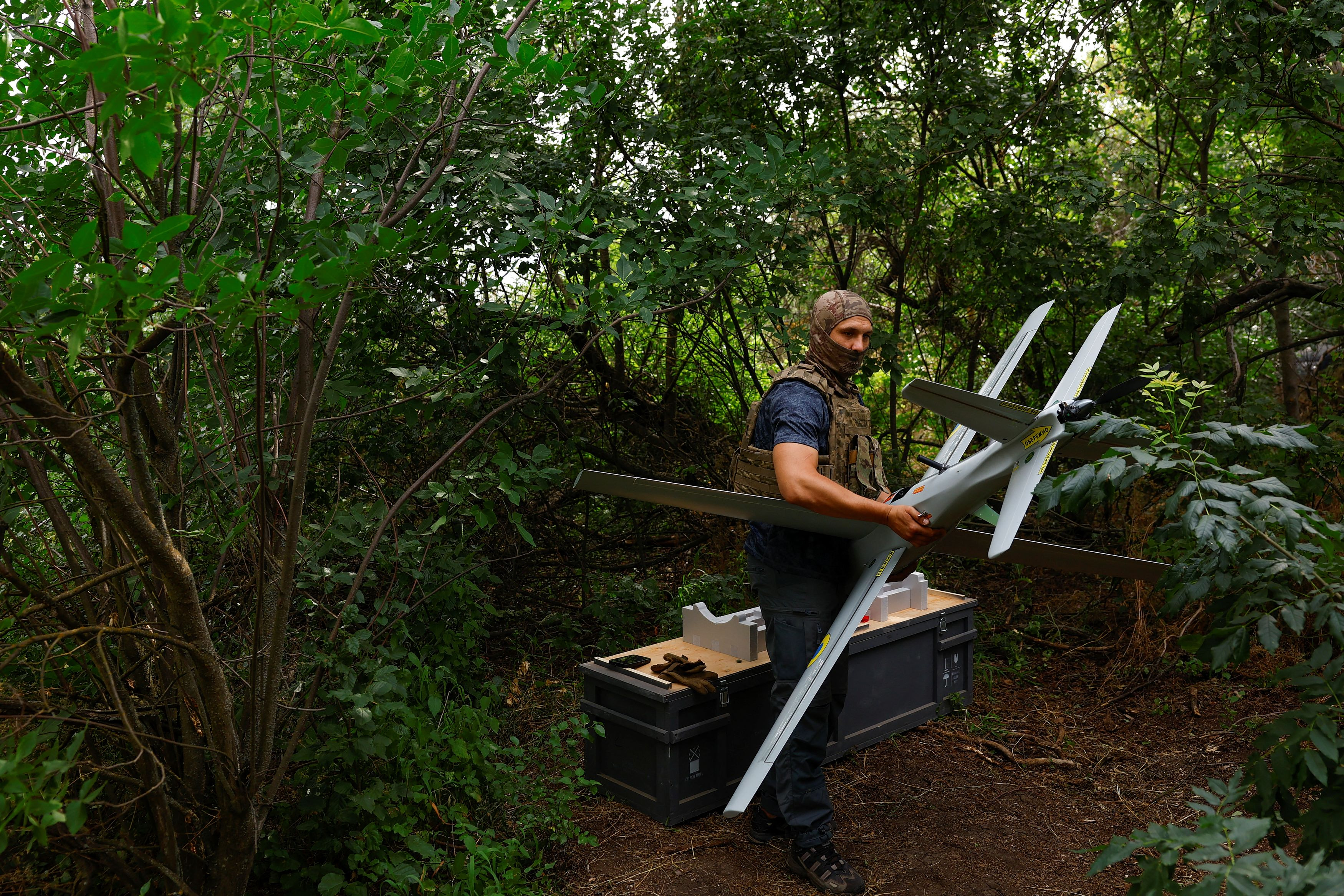
Service members of the Sparta company of the 422nd Unmanned Systems Regiment ‘Luftwaffe’ of the Ukrainian Armed Forces, prepare a Zozulia mid-strike drone for a flight while they work at a position near a front line, amid Russia’s attack on Ukraine, in an undisclosed location in Southern Ukraine, on an undisclosed date, 2026. REUTERS/Valentyn Ogirenko
“In a sense, hitting Omsk may well be the straw that broke the camel’s back,” said James Henderson, distinguished research fellow at the Oxford Institute for Energy Studies. “It’s certainly significant, and the further the Ukrainians hit, the more serious it gets for the Russian energy system.”
President Vladimir Putin , at an emergency meeting with his ministers and several governors Wednesday, minimized Ukrainian strikes as mostly a psychological operation. “It’s evident that the enemy is trying to damage the economy, but its main goal is to create an atmosphere of tension in the society. We all understand that it is an unachievable task,” he said. “The resilience of the Russian energy system is very high, one of the highest in the world.”
Indeed, despite Ukrainian attacks, Russia shouldn’t be seeing the current chaos at the gas pump, said Mikhail Khodorkovsky , a Russian opposition politician who ran Yukos, one of Russia’s biggest oil companies at the time, before a clash with Putin ended up in his 2003 imprisonment and, a decade later, exile: “The loss of capacity is significant, but it is not yet critical.”
The Russian oil companies and the state are sitting on significant fuel reserves that could be used to soften the blow, and it doesn’t take much to activate so-called teapot refineries producing lower-grade gasoline that would help alleviate the shortage, he said.
“The damage that has been caused until now is the result of a management crisis, not of a gasoline crisis,” Khodorkovsky said. “It has been demonstrated to the Russian society that Putin’s system of governance doesn’t work, and this is very unpleasant to Putin politically.”
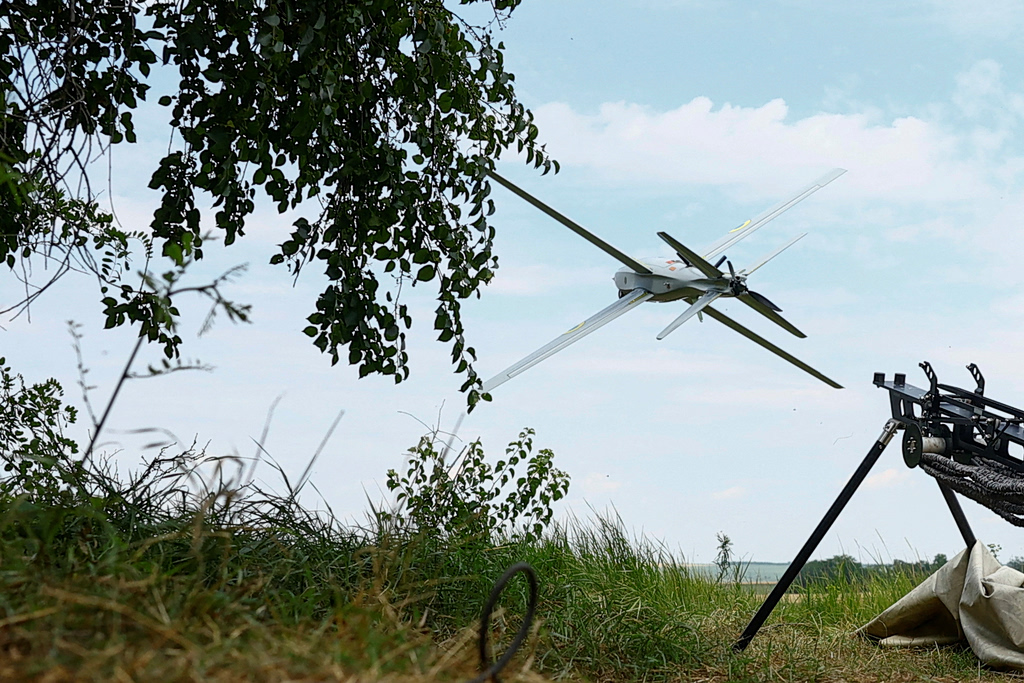
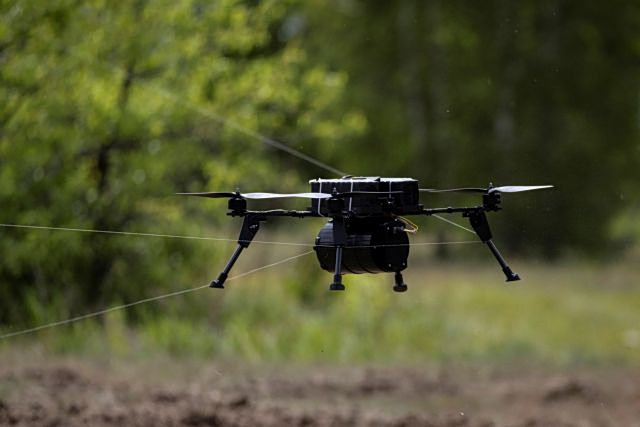
A RAM-2X strike drone launches from a position of service members of the 422nd Unmanned Systems Regiment ‘Luftwaffe’ of the Ukrainian Armed Forces near a front line, amid Russia’s attack on Ukraine, in an undisclosed location in Southern Ukraine, on an undisclosed date, 2026. REUTERS/Valentyn Ogirenko
The parts of refineries that have been hit by Ukrainian drones can usually be fixed within weeks or months, and sometimes days. To truly hammer the Russian energy industry, Ukraine must be able to supplement drones with more-powerful missiles. “If 500-kg warheads start hitting refineries, then the situation will change radically,” Khodorkovsky said.
So far, Ukraine has managed only a few successful strikes by its Flamingo cruise missiles that aimed at more hardened Russian targets, such as facilities that make components for Russia’s own ballistic-missile program. The longer the range of Ukrainian drones, the smaller their warheads must be to allow for additional fuel.
Kyiv’s expanding campaign of “deep strikes” hitting targets across Russia is combined with the parallel “middle-strike” campaign that focuses on occupied southern Ukraine and Crimea, in the 50 to 150-mile range. Guided drones patrol the main highways there, striking fuel tankers and military logistics, as well as fuel storage facilities and the electricity infrastructure. In recent days, Ukraine has managed to hit dozens of small tankers that attempted to ferry fuel to Crimea in the Azov and Black seas, while also plunging much of Crimea—where fuel is by and large unavailable—into a dayslong blackout.
“Russia has now lost both its operational and its strategic depth,” said retired Royal Air Force Air Marshal Edward Stringer, who ran operations in the British Ministry of Defense. “Russia has only got a certain number of air-defense assets, and those cannot be all on the front line. The more territory Russia now has to defend, which is essentially all the way to Vladivostok, the more porous the front line becomes—which means that Ukraine will find it even easier to send ordnance through and into Russia’s rear.”
The new targets within Ukraine’s reach include Russia’s main liquefied natural-gas terminal on the Yamal Peninsula in the Arctic, the country’s principal oil-and-gas production facilities in western Siberia, pipeline nodes and pumping stations, as well as some of the most sensitive parts of Russia’s military industry. Ukraine currently launches several hundred medium- and long-range drones daily.
Amid the new abundance of targets, the gasoline refineries remain Russia’s Achilles’ heel, economists say. Because of the legacy of the Soviet system, which considered private ownership of vehicles a luxury, the production of gasoline—as opposed to diesel—was never as developed. It is only this month, however, that Russia was forced to start importing gasoline, for the first time in decades.
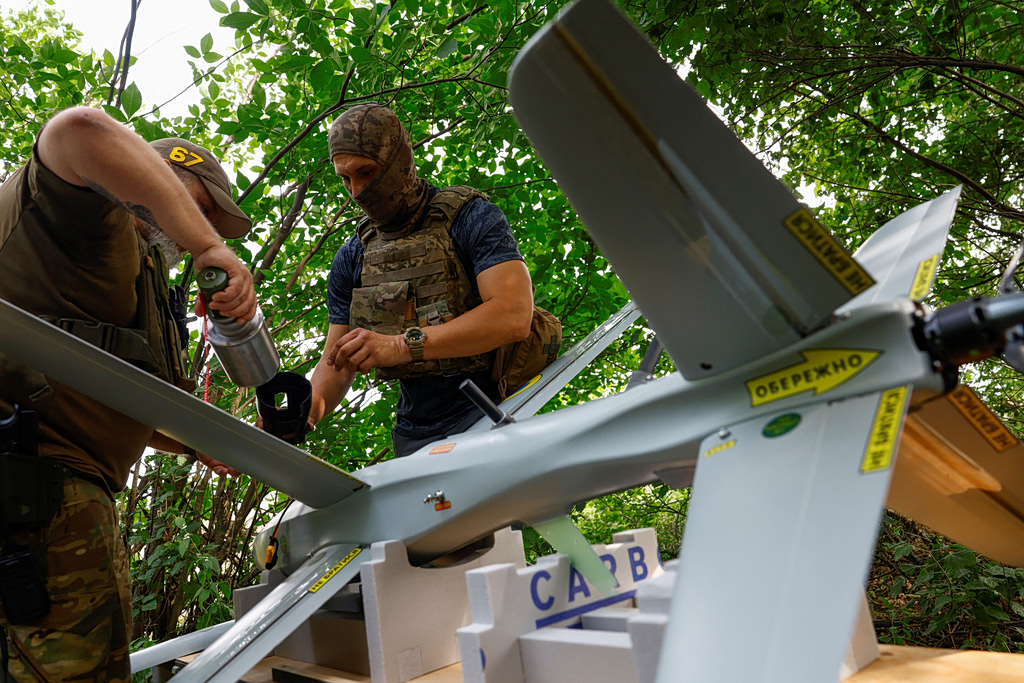
Service members of the 422nd Unmanned Systems Regiment ‘Luftwaffe’ of the Ukrainian Armed Forces, prepare a RAM-2X strike drone for a flight while they work at a position near a front line, amid Russia’s attack on Ukraine, in an undisclosed location in Southern Ukraine, on an undisclosed date, 2026. REUTERS/Valentyn Ogirenko
“It’s something new and something very complicated because gasoline can’t be imported from nearby Europe anymore. It’s a game changer,” said Vladimir Milov, an exiled opposition politician who served as Russia’s deputy minister of energy early in the Putin administration.
With Russia’s economy used to cheap fuel, subsidies—including those needed to keep farmers and airlines in business—could easily run to several billion dollars a month, just as income from exporting petroleum products evaporates, Milov added: “The fuel situation is exerting a strong pressure on the budget, increasing the deficit, and this could force them to return to considering an end to the war.”
The strategic goal of Ukraine’s air campaign is indeed to force Putin—who demands a Ukrainian surrender of the Donetsk region of Ukraine, and possibly other areas, as a precondition—to agree to a ceasefire along the current front lines. President Trump , after meeting Ukrainian leader Volodymyr Zelensky at the NATO summit in Turkey on Wednesday, endorsed Kyiv’s long-range attacks on Russia. “It’s an escalation, but it’s also an escalation that can help lead to an end,” he said.
So far, there are no signs that this approach works. Putin has been encouraged by Ukraine running out of Patriot interceptors, and has responded to Ukrainian strikes on refineries by repeatedly raining ballistic missiles on the Ukrainian capital, causing dozens of civilian casualties.
The Russian leader’s decision to pursue the war effort despite all the new challenges fits with his character, said Khodorkovsky: “Putin’s traditional model of behavior is to make decisions at the last possible moment, when the situation is already crap. And, so far, it is not yet completely crap.”
Yet, if the Ukrainian strikes continue and the Russian fuel crisis intensifies, systemic ripple effects will emerge. “The shortage of fuel will also translate into shortages for the military, into disruptions for shipping consumer goods, including food, and we are seeing that farmers already face problems with fuel, too,” said Norway-based Russian energy expert Mikhail Krutikhin.
At some point—perhaps even this year—such growing pressure could force Putin to end the war, Ukrainian and Western officials hope.
“If you consider the strategic game theory, what Putin is doing is pretending that he is crazy, and that he will not stop. Yet, at some point he will stop, because he is a rational player,” said Tymofiy Mylovanov, president of the Kyiv School of Economics and a former Ukrainian minister of economic development and trade. “But for this to happen, Russia must feel five to 10 times more pain than now.”
Write to Yaroslav Trofimov at yaroslav.trofimov@wsj.com