On a balmy evening, Jibril “One-Armed” Yahya Ali and his new bride set out for a honeymoon drive along the beach outside al-Ghaydah, Yemen .
Jibril, a Somali, and his Yemeni wife had met through a mutual acquaintance, an arms dealer who helped Jibril buy military-grade weapons from Yemen’s Houthi rebels. Jibril would then smuggle the arms to al-Shabaab, an Islamist insurgent group fighting to overthrow the government in Somalia.
The budding alliance benefited both sides. Al-Shabaab, the world’s richest al Qaeda wing, had cash but needed weapons and training. The Houthis had sophisticated arms and tech know-how, but coveted money and a new perch for attacks against the West.
The exchange also made Jibril a target .
On Feb. 12, four months after Jibril married Budoor Murshid , the couple took the Toyota Corolla on their sunset drive. Budoor’s phone rang. They parked, and Budoor stepped outside to take the call.
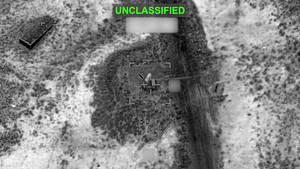
Moments later, a U.S. missile slammed through the car roof. Rather than explode, it sliced up the Corolla like a weaponized can opener.
Jibril died instantly. A friend spirited Budoor away.
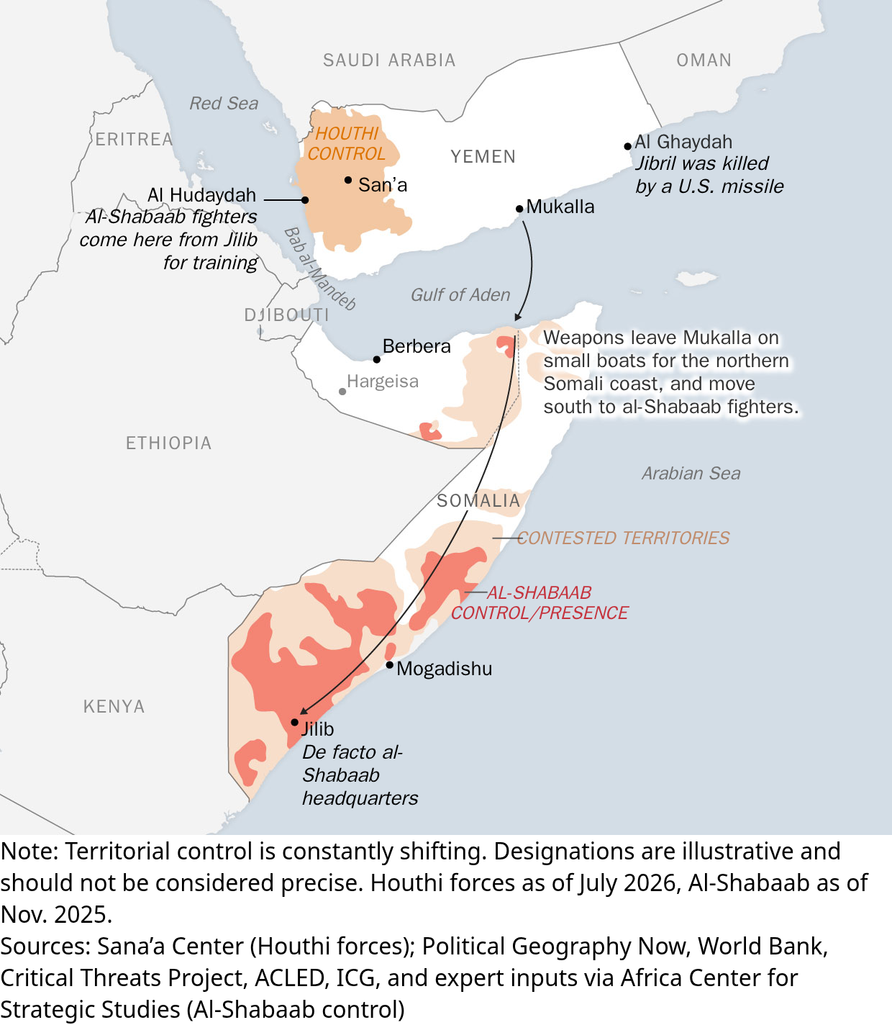
The airstrike was an opening shot in the American effort to disrupt the unlikely alliance between two implacable U.S. foes: al-Shabaab militants who have been fighting in Somalia for two decades, and the Houthi rebels, longtime beneficiaries of weapons and training from Iran’s Islamic Revolutionary Guard Corps.
For the U.S., Jibril’s death came too late to stop the chain of events he helped set in motion.
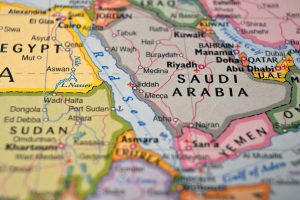
The Houthis and al-Shabaab had been sectarian adversaries until Jibril and others brokered a partnership that now threatens to further destabilize the Middle East and energy markets worldwide. Their home countries, Yemen and Somalia, sit on opposite shores of the Gulf of Aden , through which 12% of the world’s seaborne oil passed before the Iran war.
With the Strait of Hormuz all but closed by Iranian forces, the gulf could serve as an escape route for Middle East oil. Except the Houthis have come to the aid of their allies in Tehran, attacking Saudi-linked oil tankers with missiles and drones in the Red Sea.
Since at least 2023, Jibril had served as a liaison between the two militant groups, united in their hatred of America and Israel, according to U.S., Somali and Yemeni officials.
Jibril was killed two weeks before the U.S. began the war with Iran. He never saw his legacy—how two U.S.-designated terrorist groups, locked in a marriage of convenience, inherited a strategic maritime pinch-point that empowers them to threaten the global oil trade in a time of crisis.
“You have al-Shabaab, al Qaeda’s largest and most lucrative affiliate, gaining access to more sophisticated weapons and training,” U.S. Gen. Dagvin Anderson , commander of American forces in Africa, told The Wall Street Journal.
“On the other side, the Houthis are extending their geographic reach, gaining a foothold that could further destabilize one of the world’s most critical economic chokepoints,” he said. “This isn’t just a regional problem. It has global implications.”
Two American sources familiar with the operation confirmed it was a U.S. airstrike that killed Jibril. U.S. Central Command, in charge of American forces in the Middle East, said it wasn’t a military operation. A Central Intelligence Agency spokesperson declined to say whether the spy service was behind the killing.
Yemen’s ambassador to the U.S. declined an interview request. Houthi officials didn’t respond to written questions about the group’s relationship with al-Shabaab. Budoor couldn’t be reached for comment.
Enemy of my enemy
The Houthis, predominantly Shia Muslims, and al-Shabaab, which adheres to Sunni Islam, are among the hundreds of millions divided by a seventh-century schism over who was the rightful successor to the Prophet Muhammad. The sectarian split still flares into violence in spots from Afghanistan to Iraq to Syria.
Common enemies, however, now unite the Houthis and al-Shabaab. “They hate the West, they hate Israel,” said Abdulaahi Mohamed Ali , a former Somali intelligence chief.
Yemen’s Counter-Terrorism Service described Jibril as “one of the key figures in strengthening ties between the Houthis and al-Shabaab through the exchange of expertise and coordination, particularly in facilitating the transfer of weapons and military equipment,” according to an internal assessment reviewed by the Journal.
Jibril moved clandestinely between Somalia and Yemen, operating as al-Shabaab’s liaison with Houthi command, according to Matt Bryden , a former United Nations official who monitored arms flows to Somalia. Bryden outlined Jibril’s life and death in a closed-door intelligence briefing in June attended by U.S. special-operations personnel and East African government officials.
Jibril, 38 years old when he died, had studied veterinary medicine in Yemen and ran a charity in Mogadishu, Somalia’s capital. He owned a foreign-exchange outlet and an import-export firm. He bore scars from gunshot wounds. His injuries earned him the nickname Gacaamey—roughly translated as one-armed—despite his having both limbs.
The Houthis provided Jibril with a furnished apartment in San’a, the rebel-controlled Yemeni capital, according to the briefing, and he attended official functions. The rebels issued him a phony but convincing Yemeni passport under an assumed name, according to a document viewed by the Journal.
In 2024, al-Shabaab dispatched a more senior envoy, Sheikh Ahmed Elmi Samatar, to work alongside Jibril. Samatar presented the Houthis with a lengthy weapons wish list, viewed by the Journal, which included shoulder-fired antiaircraft missiles, 107 mm Katyusha rockets, Dragunov sniper rifles, explosive attack drones, antitank missiles and U.S. night-vision gear.
A U.S. military intelligence official confirmed that al-Shabaab sought advanced weaponry from the Houthis, in addition to rifles, machine guns and ammunition.
Yemeni government officials arrested Samatar in January 2025 and later released him in a prisoner exchange with the Houthis, according to the briefing. Samatar returned to Somalia, leaving Jibril to press al-Shabaab’s interests in Yemen.
Jibril continued to broker arms shipments, and al-Shabaab dispatched two weapons experts to Yemen to assist him. After Jibril’s killing, al-Shabaab picked a replacement in Yemen to continue the work, Bryden said. Jibril’s wife is on the run, he said.
Front companies in Yemen disguise the shipments as civilian products and move them to Mukalla and other ports, the Yemeni intelligence report said. The weapons cross the Gulf of Aden in speedboats or fishing vessels and are transferred ashore on poorly monitored sections of coastline in northern Somalia, according to the U.S. military-intelligence official. They are transported to al-Shabaab combat units in southern Somalia, where the insurgents’ activities are concentrated.
In April 2025, the U.S. destroyed two unflagged boats entering Somali waters from Yemen, carrying what U.S. Africa Command described as advanced conventional weapons. It isn’t clear what items on the lengthy al-Shabaab wish list have reached the militants in Somalia. But the idea that al-Shabaab might acquire attack drones or other arms capable of striking U.S. and Somali bases from the air makes both militaries nervous.
“I don’t know what their plans are, but there’s definitely something cooking,” said Brig. Gen. Ahmed Abdullahi Sheikh, a former commander of Somali special forces.
Complicating security concerns was Israel’s decision in December to recognize the independence of Somaliland, a region within the northwest of Somalia’s acknowledged borders that declared itself a separate country in 1991.
Somaliland could provide Israel access to Berbera, a Red Sea port city with a runway so long that NASA once rented it as an emergency landing strip for the space shuttle. Berbera could give the Israelis another position where they could monitor and attack their Houthi enemies.
Michael Milshtein, a former senior Israeli intelligence officer, said the Houthis were front of mind when Israel recognized Somaliland as an independent nation. “Military deployment in Somaliland gives you a very strong position to confront the Houthis,” he said.
The Israeli government didn’t respond to requests for comment.
In a televised speech this month, Houthi leader Abdul Malik al-Houthi said the group was closely monitoring Israeli actions in Somaliland, which he alleged were aimed at controlling the Gulf of Aden, the Bab al-Mandeb strait and the Red Sea.
“We will move at any time to target any activity or presence of the Israeli enemy in Somaliland,” al-Houthi said.
Traffic stop
In June, a four-person Houthi delegation set sail from Yemen, crossed the Gulf of Aden and came ashore in southern Somalia. The men trekked through the bush to meet with their counterparts in Jilib, the de facto capital of al-Shabaab-held territory, according to a regional intelligence source.
The Houthis sought to coordinate the disruption of Israeli activities in Berbera, fearing the port would serve as Israel’s permanent platform for surveillance and attacks on Yemen, according to the briefing and the intelligence source. The Houthis promised al-Shabaab leaders more advanced weapons and training, according to a report, viewed by the Journal, from one of the regional intelligence source’s agents.
Al-Shabaab fighters regularly travel to Yemen for Houthi training to build more lethal roadside bombs as well as operate advanced weaponry. At least 100 al-Shabaab fighters have made the trip, the U.S. military-intelligence official said. The U.N. reported last year that al-Shabaab sends classes of about 30 militants to learn marksmanship, antiaircraft operations and techniques for making more lethal booby-trap bombs.
In 2024, the first batch of trainees completed a pre-travel course that included religious education and advice on how to endure limited family communications while overseas, according to information gathered by the regional intelligence source. There was a goodbye ceremony and motivational speeches for the departing militants.
In his June briefing, Bryden said a group of al-Shabaab fighters spent three months this year in Sa’dah, Yemen, studying drone assembly and systems that allow operators to see the view from drone cameras as if they were in a cockpit. Houthi trainers also travel to Somalia to coach al-Shabaab on drone operations, the U.S. military official said.
Al-Shabaab, which pays in cash, can well afford the Houthi goods and services.
The militant group brings in at least $100 million a year extorting money from Somali businesses and passersby at roadside checkpoints and the port of Mogadishu, according to a U.S. intelligence assessment. Al-Shabaab also exploits artisanal gold mines along the northern Cal Madow Mountains, according to Abdullahi, the former Somali commander.
The U.S. military has conducted some 40 airstrikes against al-Shabaab targets in Somalia this year, compared with 41 for all of 2025, according to U.S. Africa Command.
For the Houthis, gaining a southern perch in Somalia overlooking commercial traffic through the Gulf of Aden is as important as cash from al-Shabaab.
“Traditionally, the relations between Houthis and al-Shabaab were purely transactional,” Awes Yusuf Ahmed, Somalia’s national security adviser, said in an interview. “That doesn’t mean there aren’t some new factors added after the Iran-U.S.A. war which can be of strategic importance.”
Among the Houthis’ aspirations, according to the briefing, is securing al-Shabaab’s help deploying radar to monitor ships in the waters they share.
Write to Michael M. Phillips at Michael.Phillips@wsj.com