 Μake us preferred on Google
 They say the apple doesn’t fall far from the tree. In this case, it didn’t just fall—it blossomed into something entirely its own. Born to a jazz singer mother, Mattie Della, and a pianist-composer father, John Lewis Nelson, Prince Rogers Nelson grew into a towering figure whose legacy remains etched in music history.
Prince, who died on April 21, 2016 at the age of 57, was more than a performer. He was a singer, songwriter, multi-instrumentalist, dancer and actor—above all, a pioneer of the “Minneapolis sound,” blending funk, rock, R&B and pop into something entirely new. Widely regarded as one of the greatest musicians of his era, his influence reshaped the trajectory of modern music.
— Chevrolet (@chevrolet) April 22, 2016
NEWSLETTER TABLE TALK
Never miss a story.
Subscribe now.The most important news & topics every week in your inbox.
The Minneapolis Years
Raised in Minneapolis, Minnesota, Prince signed with Warner Bros. Records at just 18 and released his debut album For You two years later. His rise was swift, with Dirty Mind (1980), Controversy (1981) and 1999 (1982) cementing his reputation.
Then came 1984—a defining moment. With Purple Rain, its soundtrack, and the hit single When Doves Cry, Prince achieved something unprecedented: a film, album and single all topping U.S. charts simultaneously. The album, recorded with his band The Revolution, dominated the Billboard 200 for six consecutive months and won the Academy Award for Best Original Score.
When the Prince Gave Up His Name
After The Revolution disbanded, Prince released Sign o’ the Times in 1987—widely considered his masterpiece and one of the greatest albums ever recorded.
In 1993, amid a legal battle with Warner Bros., he famously changed his name to an unpronounceable symbol—the “Love Symbol”—in a bold protest against record label control. By 2000, after signing with Arista Records, he reclaimed the name Prince and continued producing acclaimed work, including Musicology (2004), which earned two Grammy Awards.
Over his lifetime, he released 39 albums and left behind a vast archive of unreleased material.
Awards and Global Impact
Prince sold over 100 million records worldwide, placing him among the best-selling artists of all time. His accolades include the Grammy President’s Merit Award, American Music Awards for Achievement and Merit, the Billboard Icon Award, an Academy Award and a Golden Globe. He was inducted into the Rock and Roll Hall of Fame in 2004, the Rhythm and Blues Music Hall of Fame in 2016, the Songwriters Hall of Fame in 2024 and twice into the Black Music & Entertainment Walk of Fame in 2022.
A Legacy Beyond Numbers
These achievements, impressive as they are, only tell part of the story. Prince was, by nature, a revolutionary—both musically and visually. His creative versatility and relentless productivity—40 studio albums, five live albums and countless compilations—were matched by his fight for artistic independence.
Above all, he transformed modern pop by fusing funk, rock, R&B and new wave into a bold, genre-defying sound.
A Musician’s Musician
Prince understood music from the inside out. He played 27 instruments and controlled every stage of creation—writing, composing, performing and producing. He could move effortlessly from tender ballads to aggressive rock, while his signature falsetto and baritone range made his voice unmistakable.
He also led the charge in reclaiming artistic ownership, becoming one of the first major artists to regain control of his master recordings and distribute music directly to fans through platforms like the NPG Music Club and releases such as Crystal Ball.
According to Billboard, he was “the greatest musician of his generation,” while journalist Simon Reynolds described him as a “pop polymath” blending funk, acid rock, soul and emotional balladry—often within a single song.
Defying Labels
Prince’s work transcended categories. His early music fused disco and synth-funk, while his later output merged rock, soul, R&B and electronic pop. Critics from the Los Angeles Times called him “a pop star who defied easy labels of race, genre and commercial appeal.”
His influence is undeniable. Artists such as Beyoncé, Bruno Mars, Rihanna, The Weeknd and Lady Gaga have all cited him as inspiration. Bono of U2 once called him one of his favorite composers of the 20th century.
Influences and Innovation
Prince drew inspiration from a vast array of artists, including James Brown, Jimi Hendrix, Stevie Wonder and David Bowie. Even Miles Davis praised him, calling him a unique blend of musical legends.
He was also a technological innovator, pioneering the use of drum machines like the Linn LM-1 and integrating synthesizers into funk music, shaping its post-1970s evolution.
Style, Identity and Cultural Impact
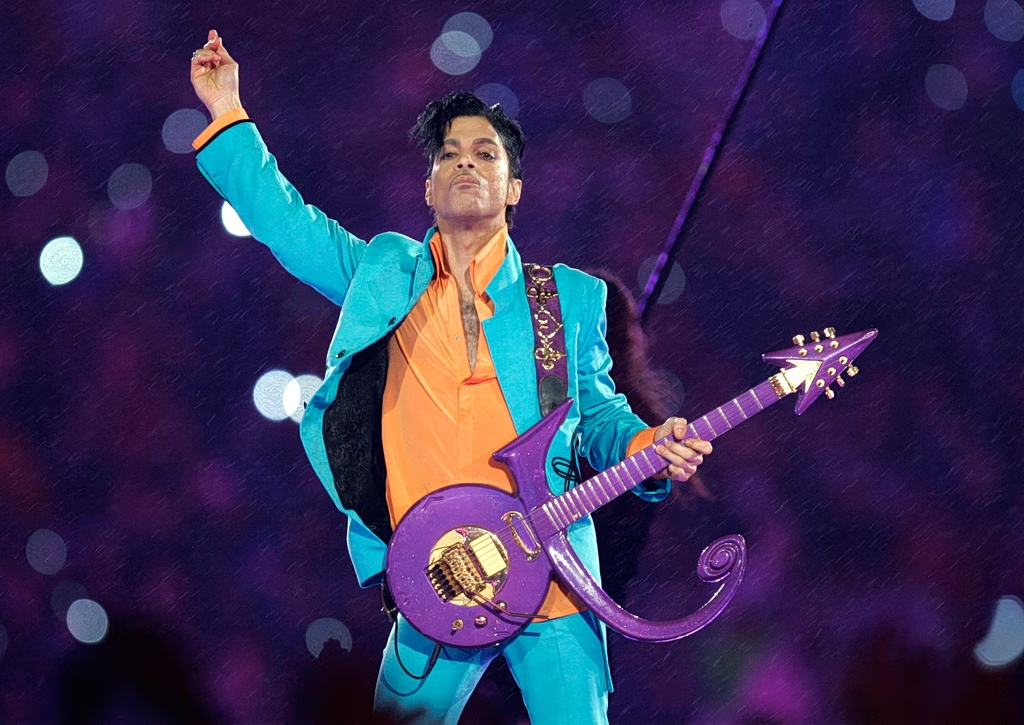
Known for his flamboyant style and electrifying performances, Prince challenged gender norms and racial stereotypes. His androgynous image drew comparisons to icons like Little Richard and David Bowie.
Through songs like Controversy and I Would Die 4 U, he openly questioned identity, sexuality and societal expectations. Though some of his later-life views sparked controversy, he remains a queer icon for many fans due to his lasting cultural influence.
Journalist Suzanne Moore once wrote in The Guardian: “Prince didn’t write about sex. He was sex.” His work explored desire, faith and the darker sides of human relationships, including the AIDS crisis—always pushing boundaries.
An Enduring Cultural Force
A decade after his death, Prince’s presence remains undeniable. His work is not merely musical—it is architectural in its complexity and vision. A master of funk, rock, R&B and pop, he built a legacy that continues to challenge and inspire.
Few artists have managed to blend so many genres so seamlessly over an entire career. Prince did—and then some.
The question now is not whether his influence endures—it clearly does. The question is: who will take that legacy forward, and push it even further.