When a deadly heatwave grips Europe or torrential rain triggers devastating floods, one question inevitably follows: Was climate change responsible?
A decade ago, scientists could only answer that question in broad terms. They knew that a warming planet was making many extreme weather events more likely, but they could rarely determine how much climate change had influenced any one disaster.
That is changing.
A landmark report released by the U.S. National Academies of Sciences, Engineering and Medicine concludes that scientists can now assess, with growing confidence, whether and to what extent human-caused climate change influenced individual extreme weather events.
The report marks a significant milestone for the rapidly evolving field of extreme event attribution, which combines observations, climate models and statistical analysis to compare the world as it exists today with a hypothetical world unaffected by human greenhouse gas emissions.
The result is a much clearer picture of climate change’s fingerprint on specific weather events.
Some Events Can Now Be Attributed With High Confidence
The report concludes that attribution science has advanced dramatically over the past decade, particularly for weather extremes directly linked to a warming atmosphere.
Researchers now have high confidence in attribution studies involving:
- extreme heatwaves;
- cold extremes;
- widespread heavy rainfall.
For these events, scientists can increasingly estimate how much climate change altered the likelihood or intensity of an event.
This represents an important shift from understanding long-term climate trends to evaluating the role climate change played in individual disasters.

A nurse holds a hand fan at the Manhes Private Hospital in Fleury-Merogis near Paris during a heatwave affecting a majority of the country, France, June 25, 2026. REUTERS/Abdul Saboor
Climate Science Is Beginning to Measure More Than the Weather
Perhaps the report’s most significant development is what comes next.
Scientists are increasingly moving beyond asking whether climate change influenced an event to asking how much damage climate change caused.
The report highlights the emergence of Extreme Event Impact Attribution (EEIA)—a new branch of research that seeks to estimate the extent to which climate change contributed to:
- deaths during heatwaves;
- health impacts;
- agricultural losses;
- infrastructure damage;
- wider economic costs.
Rather than simply linking climate change to weather, researchers are beginning to quantify its human and financial consequences.
Although still in its early stages, the National Academies say this emerging science has enormous potential to improve understanding of climate risks and help societies prepare for future extremes.
Why It Matters
The implications extend well beyond climate research.
By better understanding how climate change influences specific events, governments can improve disaster planning, infrastructure design and climate adaptation strategies.
Meanwhile, businesses can refine risk assessments and investment decisions, and insurance companies can better understand changing hazards.
And communities can make more informed decisions about where and how they build.
The report notes that attribution studies are increasingly becoming a practical tool for local decision-making rather than remaining purely academic exercises.
Better Science, Better Data
The report attributes the rapid progress to several scientific advances.
Over the past decade, researchers have gained access to richer observational datasets through expanded radar networks, satellite observations and long-term weather records.
Climate models have also improved considerably.
Using much larger ensembles of simulations, scientists can now better distinguish the signal of human-caused warming from natural climate variability.
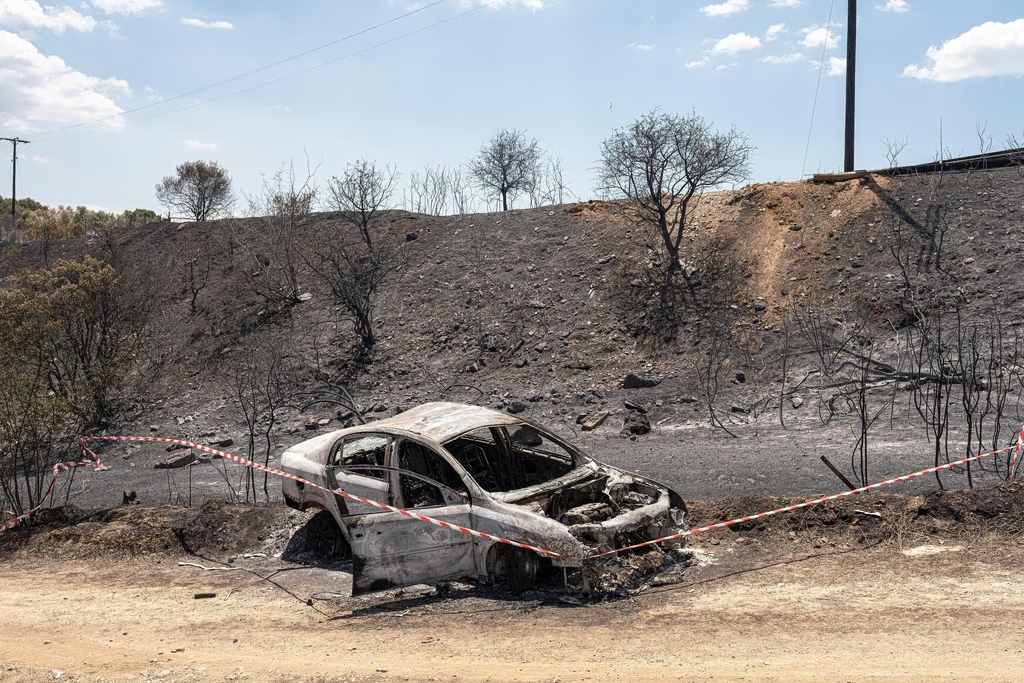
Burnt area in the Filothei area of Oraiokastro,Thessaloniki, Greece on July 6, 2026. / Καμένη έκταση στην περιοχή Φιλοθέη Ωραιοκάστρου, 6 Ιουλίου 2026.
At the same time, improved statistical techniques and a better understanding of the physical processes behind extreme weather have increased confidence in attribution results.
As James Hurrell, who chaired the National Academies committee, noted, advances in methods and modelling now allow “more robust assessments of extreme events” than were possible ten years ago.
Important Gaps Remain
Despite this progress, the report cautions that attribution science is not equally reliable for every type of weather event.
Confidence remains much lower for hazards driven by highly localised atmospheric processes that today’s global climate models struggle to simulate.
These include severe thunderstorms, tornadoes and some convective storms.
Scientists also face significant limitations in many parts of the Global South, where long-term weather observations are sparse and climate models are less well equipped to capture regional conditions.
As a result, confidence in attribution studies varies significantly depending on where an event occurs and what type of weather is being analysed.
The Next Generation of Attribution Science
To strengthen the field further, the National Academies recommend several priorities.
Researchers should develop internationally agreed best practices to improve consistency and public confidence in attribution studies.
The report also calls for investment in higher-resolution climate models capable of better simulating local weather extremes, alongside more studies that compare multiple attribution methods for the same event.
The authors argue that closer collaboration with local governments, emergency managers and affected communities will also make attribution science more useful in practice.
Particular attention is needed to improve observations and modelling in under-resourced regions and to expand research into the cascading impacts of extreme events.
A Science Coming of Age
Ten years ago, attribution science was still emerging.
Today, the National Academies conclude, it has matured into a discipline capable of answering one of the defining questions of the climate era: what role did climate change play in this disaster?
While important uncertainties remain—and scientists stress that not every event can yet be attributed with equal confidence—the field is moving rapidly from explaining climate trends to informing real-world decisions.
For communities facing increasingly frequent extremes, that means climate science is becoming not only better at explaining the past, but also more useful in preparing for the future.