 Μake us preferred on Google
 Greece’s Ministry of Culture has launched a major restoration and enhancement project for the Southeast Temple at the Ancient Agora of Athens, as part of a broader initiative to upgrade the archaeological site and improve accessibility.
The works will cover both the temple itself and the Panathenaic Way, aiming to restore the monument’s historical continuity and make it more legible within its original urban setting.
The project forms part of the Ministry’s wider strategy to enhance the visitor experience at the capital’s landmark archaeological sites while promoting the sustainable management and presentation of Greece’s cultural heritage.
Culture Minister Lina Mendoni described the temple, dating to the first half of the 2nd century AD, as a key monument in the southeastern sector of the Ancient Agora. She said the intervention seeks to restore the temple’s rightful place within the site, improving its visibility and functional integration while ensuring equitable access for all visitors.
The Southeast Temple was uncovered in 1959 during works to create the Agora’s southern entrance and connect the site with the Acropolis via the ancient Panathenaic Way. In the second half of the 2nd century AD, a Nymphaeum was built immediately to its west. Although the monument later suffered extensive damage, its surviving foundations provide sufficient evidence for the accurate restoration of its ground plan.
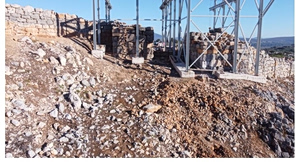
Today, the temple is difficult to interpret, with part of it obscured by the visitor route and its layout fragmented across different levels. Scattered architectural fragments and remains of its cult statue further hinder visitors’ understanding of the monument and its relationship with the Panathenaic Way and neighbouring structures.
Restoration works include reconstructing the temple’s crepidoma, completing the cella walls to a defined height, and re-erecting selected columns. Both original ancient elements and carefully differentiated new materials will be used, in full respect of the monument’s historical documentation and architectural integrity.