 Μake us preferred on Google
 Dungeons & Dragons (D&D) is the most well-known tabletop role-playing game.
Its basic premise is that a group of people meet together, in-person or remotely, to create a shared story by taking on the roles of fictional characters.
A member of the group takes on the role of Dungeon Master (DM), or narrator, who guides the story, while the players control their own characters. Dice rolls introduce an element of chance and randomness to their decisions and to the adventure as a whole.
The DM also controls all the characters the players interact with.
To get a deeper sense of the game and its culture, ΤΟ ΒΗΜΑ International Edition interviewed Dimitris Ballios, the founder of Exodus Games one of Greece’s first venues built specifically as a shared space for D&D and tabletop RPG communities.
We discuss the nature of the game, how it can act as a generational bridge, and offer Greece a multifaceted hobby to create creative spaces of community.
What drew you into this world? Can you tell us a bit about your background?
I’ve always loved fantasy — as a kid I used to set up whole battles with my toys. But I only entered the world of D&D and roleplaying games recently, through a friend. The problem was I had nobody to play with. When I moved to Athens, a friend ran a single session for us and I was hooked. A whole new world unfurled in front of me — but then he didn’t have the time to keep running it.
Then the pandemic hit. I desperately wanted to play, yet had no group, and nobody to run it. So I started running the game myself.
We built three or four different groups and played almost every day. Back then we were all at home on our PCs in the afternoons. It only grew from there.
When the opportunity came to set up a proper game space, I took all components I’d accumulated at home — books, miniatures, dice, etc — and set it all up here. I brought in other DMs too, and now we’ve built a space with three rooms, where what I used to do in my living room with my cats interrupting us, we now do with people uninterrupted. A small community is growing and I love it.
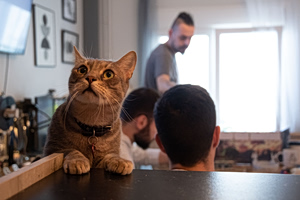
Pontikis the house cat claims the table and demands the spotlight mid-session. Photo by: Kostas Gerontis
And this space you’ve built — that’s Exodus Games? Can you tell us about it?
Exodus Games, yes. I opened it in 2023. The original idea was to take what I’d been building slowly in my living room and give other people the chance to do the same.
It’s a space created specifically to play D&D. The rooms were designed from the start to be soundproof — so the person shouting at the next table doesn’t disturb you, and you can shout at yours. Because things can get intense in a roleplaying game.
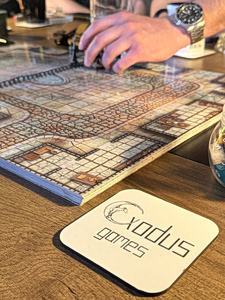
The Dungeon Master Places a Figurine on the Battlemap at Exodus Games, Where Every Move Shapes the Story. Photo by: Angelos Gassenschmidt
We provide everything you need: miniatures, maps, playlists, images, everything. And plenty of space — a big table is essential.
I must say though, that the miniatures, the music, the ambience, the lighting, the maps — all of that just adds to the game. You can have a wonderful time with a great group of people, just playing with napkins and sunflower seeds instead of miniatures. If you’re with people you enjoy, you’ll have a good time in any context. What this space does is give people who don’t already have that group — like I didn’t — the chance to build one.

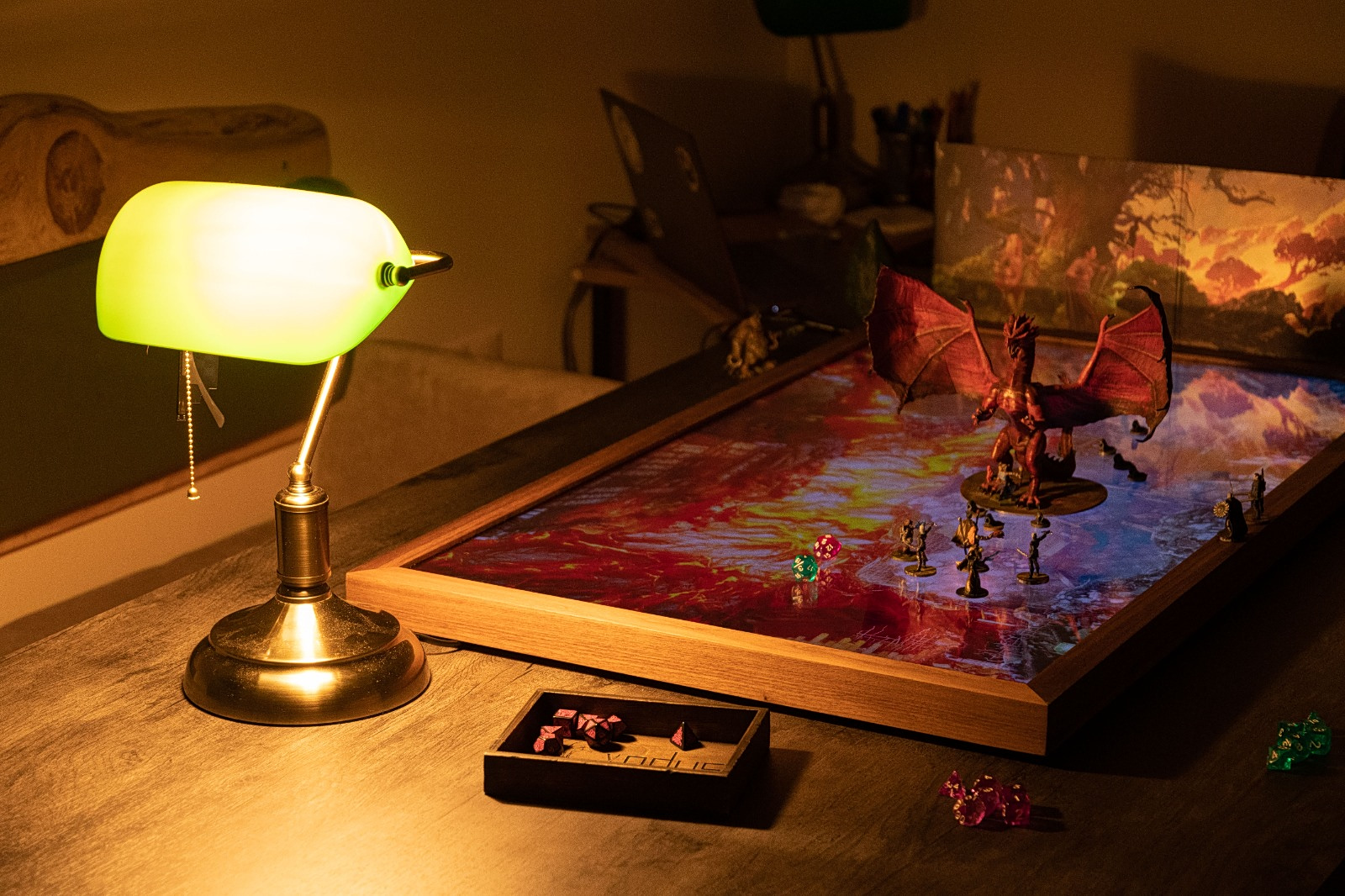
Banker’s lamps cast a warm glow over the table of one of Exodus Games dedicated game rooms, set and ready for adventure. Photo by: Kostas Gerontis
At Exodus Games, we also place a strong emphasis on inclusivity — welcoming people from any background or identity. The old image of the hobby was a bunch of weird guys in a basement with beards. Today, almost every table at Exodus has at least one woman. And that makes me genuinely happy.
Beyond the space itself, you’ve also created your own setting, your own world let’s say, based on real history. Can you tell us about that?
Most D&D settings are medieval fantasy, heavily inspired by Tolkien.
I wanted to tell my stories in a world I knew well and because of my political history background that world happened to be our real one.
From childhood, whenever I read history, I’d visualize it in my mind. And often, those images would take on a life of their own and you’d start imagining the people you were reading about actually speaking.
It’s a short road from that to wondering what it would be like if those people had magic, if there were monsters in their world. That’s how a whole fantasy world begins to take shape. The world stays our own, Earth, but it’s an alternate universe, one might say.
Your world spans stories in Medieval Macedonia, Ottoman-era Preveza, Medieval Lebanon, and fascinatingly, early modern India, China, and Indonesia. Can you tell us more?
My family is from Macedonia, so for that particular story I was inspired by stories from the folklore and real history of the area. I mixed them together, and set it around 1400, after the Ottoman conquest of Macedonia.
It’s a fantasy story about ten villages cut off because zombies have appeared in the region — no one can enter or leave.
And it becomes intensely political very quickly. Even though you have ten villages of five hundred people each, the question of who holds power and who’s exploiting the situation becomes absolutely central.
I also have another story set just before the Third Crusade, where players can meet Richard the Lionheart and Saladin and all the big names of history at the time.
The heroes don’t have to engage with the actual history — it unfolds in the background and shapes what they see in front of them.
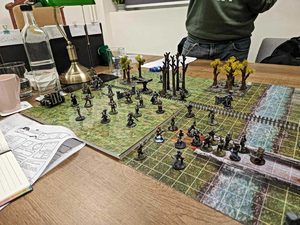
A meticulously arranged battlemap sets the stage for a tense confrontation at a river crossing, with painted miniatures poised for combat on both sides. Photo by: Dimitris Ballios
So the players move freely within that historical framework?
Exactly. I tell them: look, this may not be historically accurate, but nothing stops us from doing it. The people who lived eight hundred years ago aren’t going to rise from their graves to tell us off.
You can lean heavily into what ifs — what would have happened if the message had reached the front earlier, what if the battle had gone the other way.
Do you think those what ifs create a deeper interest in history — not necessarily as an academic discipline, but as a creative form of expression?
Quite possibly. They go a long way toward helping us question the way history is taught to us in school. Living through a story is a much more immediate way to engage with what actually happened.
I often see real excitement in players when we finish a story and I tell them: the choices you made — that’s actually what happened in real history. You made the same decisions as the real people who were in your position. And I watch them light up.
For me, what’s fundamental to how history should be taught is learning from the past, from its mistakes and its achievements — so we don’t repeat them today.
Can we look at the DM’s role? What does it actually take to run a game well?
The most useful advice I’ve ever received, and always pass on, is: don’t go overboard. You can spend hours building a thousand details nobody will ever ask about. What’s the river called, why it got that name, how it flows, what happened there a thousand years ago.
The truth is, a DM spends maybe thirty percent of their time preparing. The other seventy is improvisation — responding to what the players do that you didn’t plan for, what they ask, where they go.
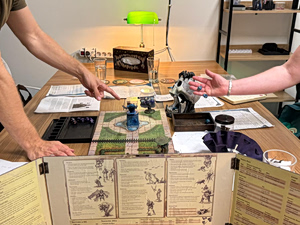
The Dungeon Master marks the target as a player opens their hand to reveal the roll — the outcome hanging in the air between them. Photo by: Alexandra Theodorou
And those unexpected questions are actually what build the world. Just the other day, a player asked: the gold coins our characters are carrying — whose face is on them? Which is a question that unlocks so much. Which kingdom is this? Where are the coins minted? What’s gold worth here?
You as a DM might say “I don’t have the answer right now, but I’ll have it next week”. So gradually, the world builds itself. The more players engage with the world through their characters, the richer it becomes. In turn, they feel it too — that the world is more real, more alive and intriguing.
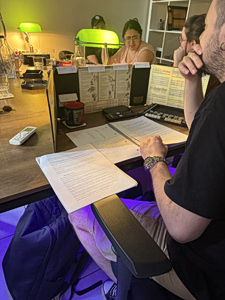
The Dungeon Master Quietly Observes the Players’ Deliberations While Consulting His Notes by Lamplight. Photo by: Angelos Gassenschmidt
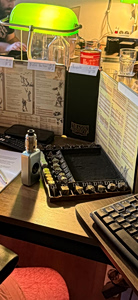
A metal dice set rests in its Dragon Shield tray behind the Dungeon Master screen, ready to decide the fate of the party. Photo by: Angelos Gassenschmidt
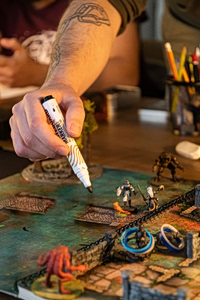
The Dungeon Master marks the next move on a fantasy battlemap, surrounded by miniatures and terrain pieces. Photo by: Kostas Gerontis
How would you describe the players’ role?
Players are essentially improvising. The DM’s privilege is knowing where the story goes next, knowing what the adversaries are doing behind the scenes.
Players don’t know that. They can only guess.
I think what draws so many people to D&D is that it can be creative without requiring any prior knowledge, any preparation, or any particular skill.
You, for example, you’re tall, but could still play a pixie: a tiny fairy who speaks in a high pitch and casts spells. You can do that, and you’ll convince all of us, because we’re all roleplaying. You’re expressing yourself creatively within that fictional realm.
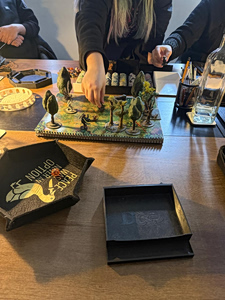
A player repositions their characters miniature among the trees of a lush forest battlemap bringing the encounter to life. Photo by: Angelos Gassenschmidt
Is that creative freedom central to being a player?
The character you play is created by you. They came from your mind.
So as time passes, and you play and inhabit said character, they become a part of you. Every Thursday, you slip into this particular dwarf, are devoted to this particular god, who has become so deeply ingrained in the story that they may have children by now.
So if the Dungeon Master tells you that one of your character’s closest friends dies right in front of you — you’ll very likely cry, because it feels real. It genuinely moves you.
With so much room for creativity and personalization, how do you create an environment where you can bring people from different generations to the same table?
Age and life experience don’t really matter because what the other players are actually encountering for most of the game is your character, not you as a person.
Your character might be a thirty-year-old playing a sixty-year-old, and vice-versa. You embody that character and behave as they would.
I find that older players tap into their youth, while younger players step into more mature roles. Both sides have something to learn from each other, and the game is a way for them to come closer.
Later in life, younger people will need to work alongside people with different perspectives.
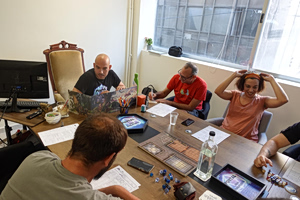
The Dungeon Master poses a pivotal question as players share a laugh around the table, dice and character sheets at the ready. Photo by: Dimitris Ballios
Through D&D, you can cultivate empathy.
This empathy can also drive human connection for those who might struggle with opening up.
Often people come who don’t feel socially comfortable, but they come because they sense the game can give them the chance to open up.
You see it happen slowly over sessions: someone who in the first weeks was not making eye contact, not speaking — a few months later they’ve become the center of the fun.
That’s when you truly understand what it is that the game gave them.
A safe space where they won’t feel judged. Because that’s exactly what the game itself is — a safe space.
Do you think D&D could ever go mainstream in Greek society?
I’d love it to. But it’s not just D&D, the game where we gather and tell stories, but also the many related activities that bring life to the community: 3D printing, miniature painting, map-making, and character drawings, even scented candles that might suit a particular setting.
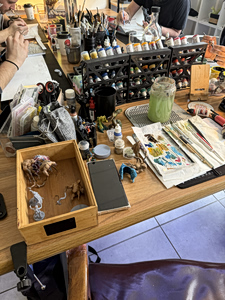
A Miniature Painting Session in Full Swing — Brushes, Paints, and Tiny Monsters Crowd the Workshop Table. Photo by: Angelos Gassenschmidt
There are many layers to building the game, and in Greece we have a very strong community with very talented creators.
If you go on YouTube you’ll find beautiful D&D stories. All Against Darkness is a wonderful series. Most recently, I Syntrofia (The Fellowship) has had enormous success. So, I think we have some genuinely excellent creators.
I’d love this to be the next wave of artists — the way we once had actors or singers or lyricists or poets who defined a generation in Greece. It would be nice if one day we could say that we were there when things changed. When roleplaying games started to be recognized as a genuine artistic expression.
Now for something a little abstract. Do you think D&D as a hobby offers something that’s missing from the collective consciousness of Greece?
I think what D&D can offer is the ability to envision a different, better, more hopeful world. Which is what we do as characters when we play. We actively fight to achieve something better within the world of the game.
But in our real lives, many people have stopped envisioning a better world.
What the game can offer is this: No matter how many challenges a character faces, there’s always the possibility to achieve something better.
That hope builds slowly and grows stronger with time, much like a small stone rolling downhill until it becomes an avalanche. If the die you roll at the table—and the feeling of achievement when your character succeeds—can be that first stone, then I hope it is the one that starts the avalanche.