 Μake us preferred on Google
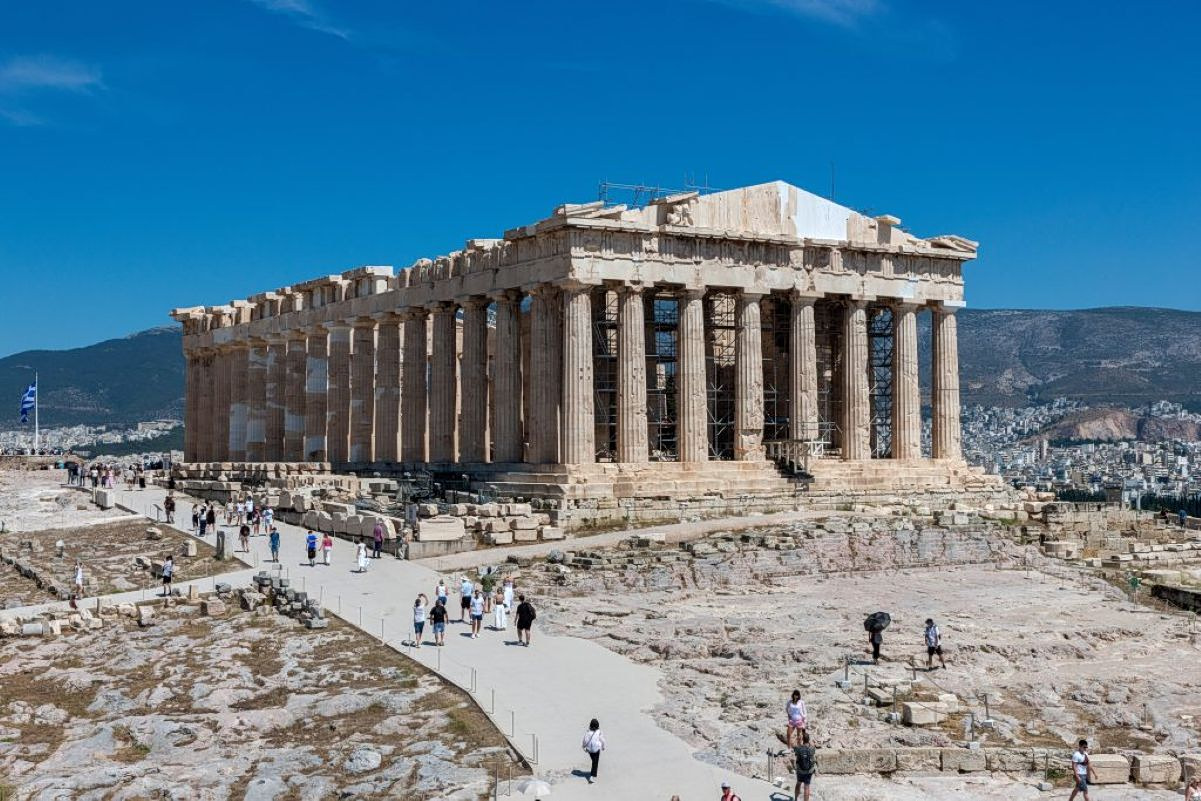
 A significant milestone in the long-term conservation and presentation of the Acropolis monuments has been marked by the completion of the restoration of the western pediment of the Parthenon and the permanent removal of external scaffolding from the monument’s western facade.
For the first time in approximately 220 years, it was noted that the western face of the Parthenon is being presented by the Ministry of Culture in its fullest attainable form. With the placement of two orthostates in previously vacant positions and the completion of the restoration of the counter-support wall, the architectural unity of the pediment has been fully re-established.
Culture Minister Lina Mendoni emphasized that only a few months earlier reference had been made to the first unobstructed view of the Parthenon, following decades in which scaffolding had covered its western side. She now pointed to the completion of what she described as an exceptionally demanding restoration, through which the western pediment has been returned to its most complete form in roughly 220 years.
Mendoni described the result as “striking”, noting that generations of visitors and citizens had become accustomed to an incomplete image of the monument, underlining that the new orthostates do not simply fill missing structural spaces, but also restore the monument’s proportions and highlight its geometric coherence. The intervention, she added, reflects the work of scientists, engineers, conservators, and craftsmen, which is evidence of the continued international standing of the Greek restoration approach.
According to information provided by the competent services, the intervention on the orthostates of the tympanum is considered one of the most complex operations undertaken in recent years by the Acropolis Monuments Restoration Service. Specialized techniques were required at every stage, from the processing of new marble blocks to their precise lifting and installation.
One of the orthostates was reconstructed through the recomposition of surviving ancient fragments combined with new marble, while the second was crafted entirely from new material. A newly designed scaffolding system, meeting stringent safety standards and adapted visually to the monument, was installed to facilitate the final phase of the works.