 Μake us preferred on Google
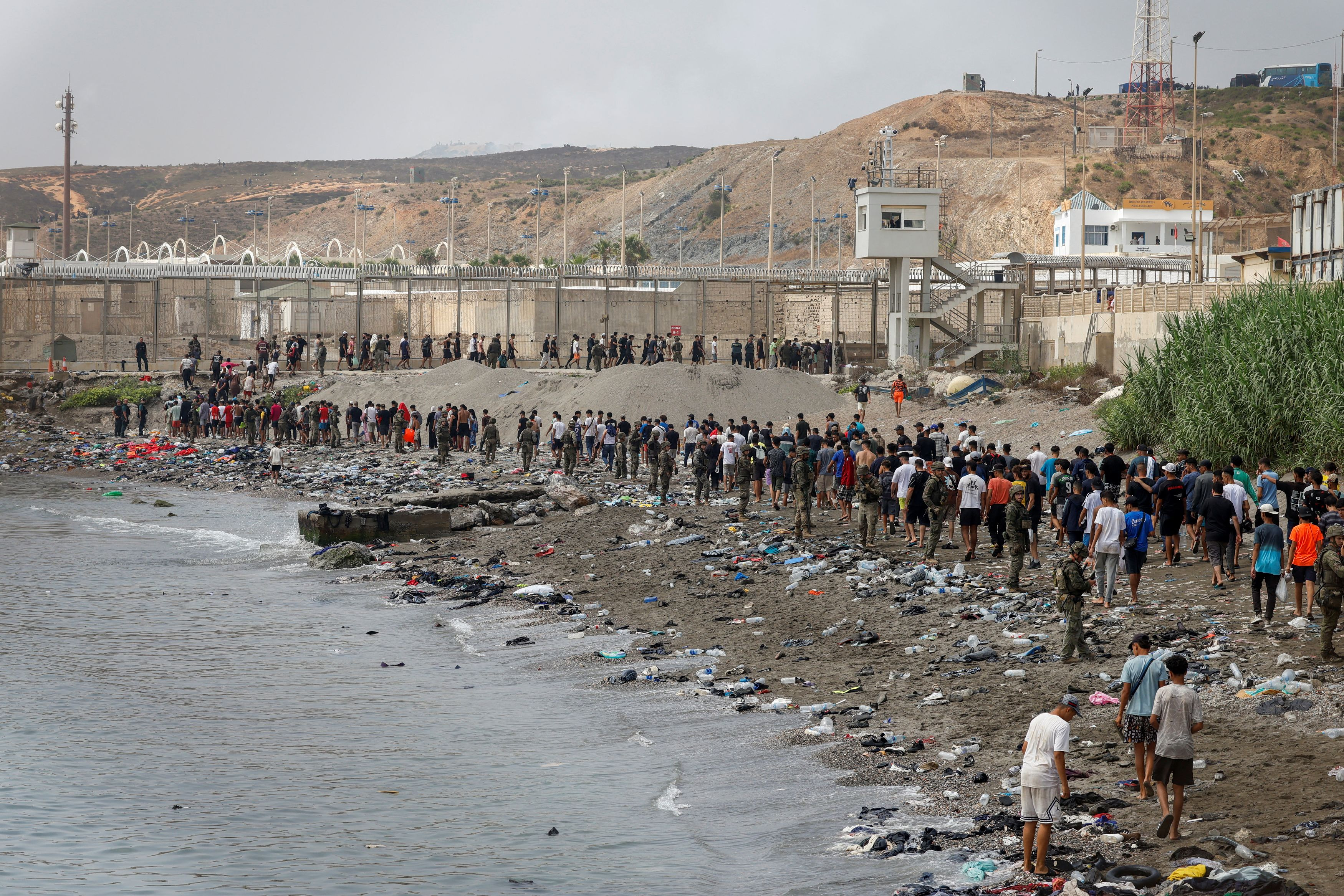
 Television screens and social media were inundated on 30-31 July 2026 by images of thousands of hopeful migrants emerging from the sea and roaming through the streets of the Spanish autonomous city of Ceuta, on the southwestern shore of the Mediterranean. Getting undocumented migrants from Africa eager to enter Europe is nothing new to Ceuta and to Melilla, the other Spanish autonomous city surrounded by Morocco. Ceuta’s almost sixty thousand arrivals in such a short period, though, created an unprecedented crisis this time. No surprise that the city’s police were caught off guard and things got out of control in the initial hours. With systematic pushbacks and help from the Spanish military, the aspiring migrants were repelled and normality eventually returned to Ceuta. This article explores the political factors that directly or indirectly played a role in this Ceuta drama and potential repercussions, leaving aside the loss of scores of human lives to the sea.
What may have caused and/or allowed this migratory tsunami to take place, and why at this particular point in time? Tensions between Morocco and Spain are not new. No need to go as far back as the Middle Ages and the expulsion of the Moros from the Iberian Peninsula that sealed the fate of once glorious centers of Islamic civilization like Cordova, Seville and Granada. The status of Ceuta and Melilla is a recurring cause of friction, as is the future of Western Sahara, a former Spanish colony in prolonged limbo because of Morocco’s sovereignty claims and demands by the indigenous Sahrawi people for self-determination. In this light, the visit on 20 July 2026 by Prime Minister Pedro Sanchez to Algeria, a strong supporter of Western Sahara independence, even if it was primarily meant to strengthen bilateral relations and secure Algerian natural gas supplies for Spain, was certainly a cause of concern for Morocco.
Thus, lots of axes to grind, which could explain why the Moroccan border guards were nowhere to be found when the tens of thousands of would-be migrants amassed on the border with Ceuta and took the plunge into the Mediterranean to bypass the Spaniards’ protective fence. Was there some kind of signal sent to all those, mostly young Moroccan men, who jumped into the water heading to Ceuta, and if so, who sent it? Or perhaps they misinterpreted a recent Spanish court decision that migrants arriving from the sea could not be pushed back immediately, and/or they wrongly thought they could still benefit from the momentous decision of the Sanchez government to regularize hundreds of thousands of undocumented immigrants already in Spain?
What about broader political considerations that might explain the Moroccan authorities’ hands-off attitude towards the aspiring migrants? Was anybody doing the bidding of Israel and the US, both of whom have been holding serious grudges against Spain? The Spanish government has been openly speaking of genocide in Gaza and has been critical of the US-Israel war on Iran, not allowing the use of Spanish airspace and military facilities for operations against Iran. Let’s not also forget that Spain has been the only holdout regarding the NATO allies’ decision to increase defense spending to 5 per cent of GDP. Teaching Spain a lesson, and helping incite xenophobic reactions within its population, looks like a desirable pay-back to anybody wishing to punish the Spanish government and reduce its chances of reelection in 2027 by strengthening the anti-migrant forces of the right.
One could foresee any of the above “open fronts” coming to hit Sanchez at some point, but all of them coming together at the same time can hardly be a coincidence. Don’t forget also the mega wildfires that have been raging throughout Spain for days, already straining the country’s resources and political balances. Under the circumstances, perhaps the most unexpected blow to Spain was that dealt by its very own partners in the European Union. No fewer than 22 EU country leaders signed a joint letter, prepared apparently at no time, expressing concern about Spain’s handling of the Ceuta crisis and its migration policies, and suggesting the temporary reintroduction of internal border controls. No emphasis on solidarity and offer of support to Spain in its dealing with the sudden migrant influx, but rather criticism and the prospect of ostracizing it from the Schengen free-movement arrangements. Ranging from center left to quite far right, the 22 leaders obviously felt this was an opportune moment to strengthen their anti-migration credentials with their respective voters, on top of teaching iconoclastic Spain a lesson. The chance of also endearing themselves to the US and Israel through such a move is probably a bonus shining somewhere on the strategic horizon of at least some of those leaders.
The EU is planning to hold an emergency teleconference of interior ministers to discuss the Ceuta crisis on 4 August 2026, even though the situation has returned to normal in the meantime. A large majority of EU governments seem intent on castigating the Sanchez government for its migration policies, ignoring the context and apparent causes of the latest crisis. Political expediency rather than solidarity and the principled search for mutually beneficial solutions may carry the day this time around, but that can only augur badly for the longer-term.