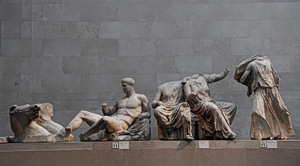
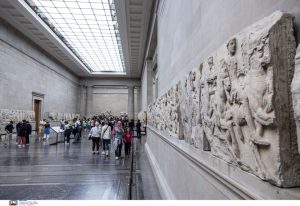
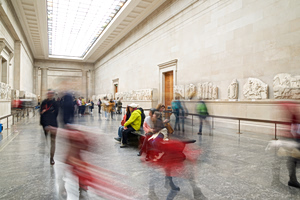
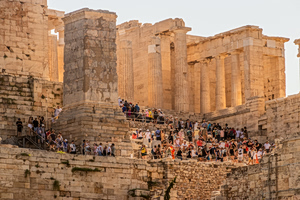
A few days after the death of Melina Mercouri in 1994, the House of Commons paid tribute to the woman who had managed to transform the return of the Parthenon Marbles from a Greek demand into an international cultural issue. Among the British MPs, one figure stood out—a man who would go on to dedicate almost his entire political career to the cause of the Marbles: Labour MP Eddie O’Hara. A few days later, he submitted the first Early Day Motion (which could be rendered as a motion for a resolution) in Parliament calling for the reunification of the Parthenon Marbles. It was the first of nine parliamentary initiatives he would undertake in the following years, establishing himself as the most consistent and persistent parliamentary supporter of the Greek position in Britain.
A graduate of Classical Studies from Oxford, O’Hara had served in Cyprus, spoke Greek, had a deep love for Greek culture, and later became chairman of the British Committee for the Reunification of the Parthenon Marbles (BCRPM). A decade after his death, those continuing his campaign believe that the political circumstances may finally vindicate his efforts.
To Vima reveals the new BCRPM booklet, which is expected to be made public at the beginning of next week and constitutes a detailed, point-by-point response to the official booklet distributed by the British Museum to visitors in the Parthenon Marbles gallery. With comments printed in red ink alongside the Museum’s text, the Committee seeks to challenge what it considers inaccuracies and omissions regarding the removal of the Marbles by Lord Elgin and the arguments put forward in favor of keeping them in London.
“The public has the right to know”
Speaking to To Vima, Dame Janet Suzman, president of the BCRPM, explains that the purpose of the new publication is not to confront the British Museum, but to provide visitors with a more complete picture of the history of the Marbles.
“The public has the right to know things that the British Museum does not say. It claims that the Marbles taken by Lord Elgin were acquired legally. We know that this was not the case. There is no trace of a firman, only a strange Italian translation of a letter, which allowed Elgin to climb scaffolding or a ladder to draw the sculptures, perhaps to collect pieces that were lying on the ground. There is nothing in our booklet that the British Museum does not already know. It simply does not want to publish it.”
The booklet comes at a significant political moment. Following Andy Burnham’s appointment as prime minister, many believe that the atmosphere in Westminster is more favorable. Suzman remains cautious and does not claim that an agreement is imminent. She acknowledges that the new prime minister is facing urgent challenges, which is why it remains uncertain when optimism will translate into action.
To Vima spoke with Eddie O’Hara’s grandson, Stuart O’Hara, a member of the BCRPM, who described Eddie O’Hara’s relationship with the new prime minister. For years, Burnham was one of the few senior Labor figures who supported the reunification of the Marbles. According to Stuart O’Hara, his grandfather always believed that Burnham would one day lead the country.
“This is the first time we have a prime minister who has been on record supporting the return of the Marbles before becoming prime minister… I think it is now only a matter of time,” he adds.
Cautious optimism is reflected in the views of leading experts who spoke to To Vima. Amy Shakespeare, an expert on the repatriation of cultural property, believes that political balances could shift:
“Given that Burnham is the first prime minister who has consistently supported the reunification of the Parthenon Marbles, there is a possibility that he will also support their return from his new position.”
At the same time, she points to another important development:
“I hope that when the review of the Charities Act takes place in February 2027, national museums will acquire the ability to return objects on ethical grounds… This would provide the best opportunity for the return of the Marbles.”
For Tristram Besterman, former director of the Manchester Museum, “the deadlock will only be overcome if the British Parliament becomes involved, as the reunification of the Parthenon Marbles requires legislative action.”
The distinguished legal scholar Geoffrey Robertson KC believes that “the British Museum is hesitant to negotiate without political guidance, which we hope Burnham will provide.”
Judith Herrin, emeritus professor of Late Antique and Byzantine Studies at King’s College London, expresses hope “given Burnham’s previous support for the reunification of the Marbles.”
Historian Michael Wood adopts a more cautious tone:
“Burnham’s premiership is a positive development, although he has much more urgent issues to deal with. The major issue is the trustees of the British Museum: if they support reunification, then it will happen one way or another.”
Professor Anthony Snodgrass, a distinguished archaeologist at the University of Cambridge, tells us that “patience is still needed until Burnham formulates the new government’s policy on this specific issue.”
The complex legal reality
Despite the change in the political climate, the legal reality remains considerably more complex.
According to Alexander Herman, director of the Institute of Art and Law, successive British governments have argued that the future of the Marbles is the exclusive responsibility of the British Museum’s trustees. However, as he points out:
“This position has always been somewhat misleading, as the British Museum Act 1963 imposes general restrictions on the trustees’ ability to manage the collection.”
He adds that Parliament imposed these restrictions and, if there is political will, it can also amend them:
“If the prime minister remains committed to his previous positions, the return of the Marbles could become official British government policy, potentially leading to legislative changes to implement it.”
Even so, he warns, new legislation would most likely provide trustees with the ability—but not the obligation—to act, making negotiations the most likely route toward a future agreement.
The British Museum insists that dialogue with Greece is continuing. In a statement to To Vima, a Museum spokesperson said:
“Discussions for a Parthenon partnership continue in a constructive spirit. We believe that such a long-term partnership would achieve the right balance between sharing our most important objects with audiences around the world and maintaining the integrity of the outstanding collection we hold at the Museum.”
To Vima contacted Downing Street for comment. The Prime Minister’s Office referred us to the Department for Culture, which reiterated the government’s established position that:
“Decisions concerning the care and management of the Museum’s collections, including the lending of objects, are the responsibility of the trustees.”
The response avoided any reference to Burnham’s stated support for the reunification of the Marbles.