José Balza (Orinoco Delta, 1939), winner of the Venezuelan National Prize for Literature, is one of the most distinctive voices in Latin American prose, whilst his academic background in psychology and literary theory nourishes his in-depth exploration of consciousness, memory and perception. With Seven Hundred Palm Trees Planted in the Same Spot, we are taken on a journey to the Venezuela of the 1960s.
The novel was published in 1974, a year after the 1973 oil crisis, when oil prices had risen to record highs. Venezuela, one of the world’s largest oil-producing countries, was then at the height of its economic growth.
At the same time, the exploitation of the country’s mineral wealth had created deep social inequalities. The 1970s were the period during which the gradual nationalisation of extraction was decided upon, with the aim of the social distribution of wealth — something which, however, never actually materialised.
Although Balza’s book is not politicized, it captures the social reality surrounding these historical events. It is written alternately in the first and third person and recounts personal moments from the author’s life. At the same time, it documents the explosive growth of Caracas at the height of the economic boom, as the country’s urbanization intensifies, with the capital at its center. From there, we are transported to San Rafael, the author’s birthplace, in the delta of the distant Orinoco, where life in the jungle flows at a leisurely pace. Writing in an autobiographical, stream-of-consciousness style, Balza takes us back and forth in time, between Caracas and the Orinoco, but also between his desire to make a film about Praxiteles and his inability to gather the necessary material.
A central theme running throughout the book is the search for Praxiteles — and it is precisely this that opens an unexpected door for readers steeped in the Greek world. Praxiteles depicts perfection on a human scale, an ideal of beauty that brings the gods down to the familiar, everyday realm. This quest resembles an escape from the harsh realities of daily life towards an ideal reality.
As the author writes: “Praxiteles would show me exactly how to sculpt the hours and my emotions, insofar as these in turn forge my own perception. But that was only one side of the matter. The other, which is far deeper, still eludes me. Even now I struggle to grasp it. The only thing I understand about it is that it is a force which draws me closer to everything around me — people and things — and impels me to seek out the beauty that lies within them.”
After all, Hellenism is no random choice for a Venezuelan writer. Latin America’s connection with ancient Greece dates back to the years of independence: the Venezuelan revolutionary Francisco de Miranda, who travelled through Greek territories under Ottoman rule, found in classical Greece a reflection of the Latin American struggles for freedom from colonial rule. Borges, Carpentier and the writers of the ‘boom’ in Latin American literature of the 1960s and 1970s continued this tradition, using Greek myths and philosophy as tools to understand, and often to critique, their own colonial history and social reality. Balza follows in this long tradition, drawing on ancient Greek aesthetics not out of nostalgia for a foreign past, but as a way of speaking about Venezuela’s present.
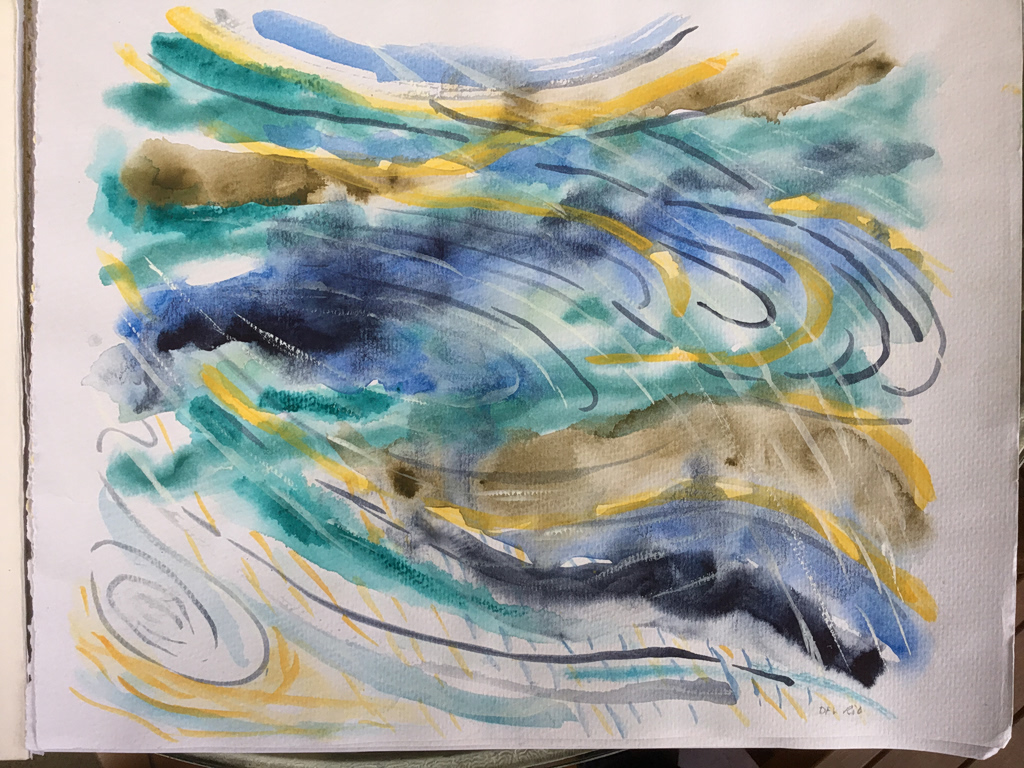
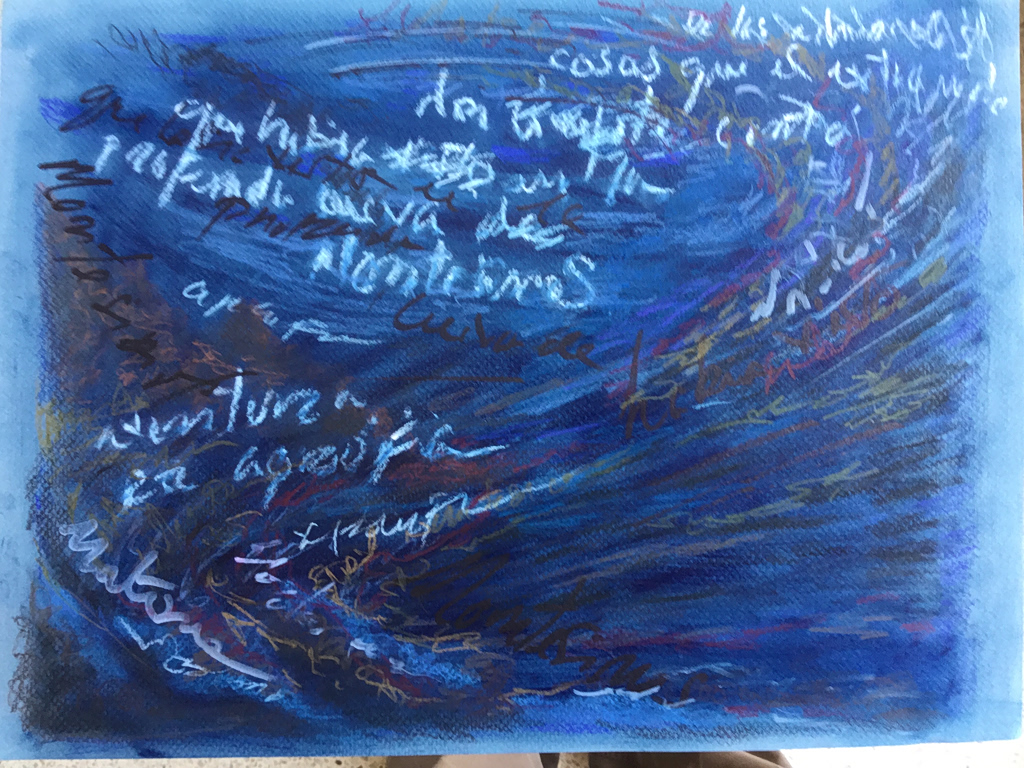
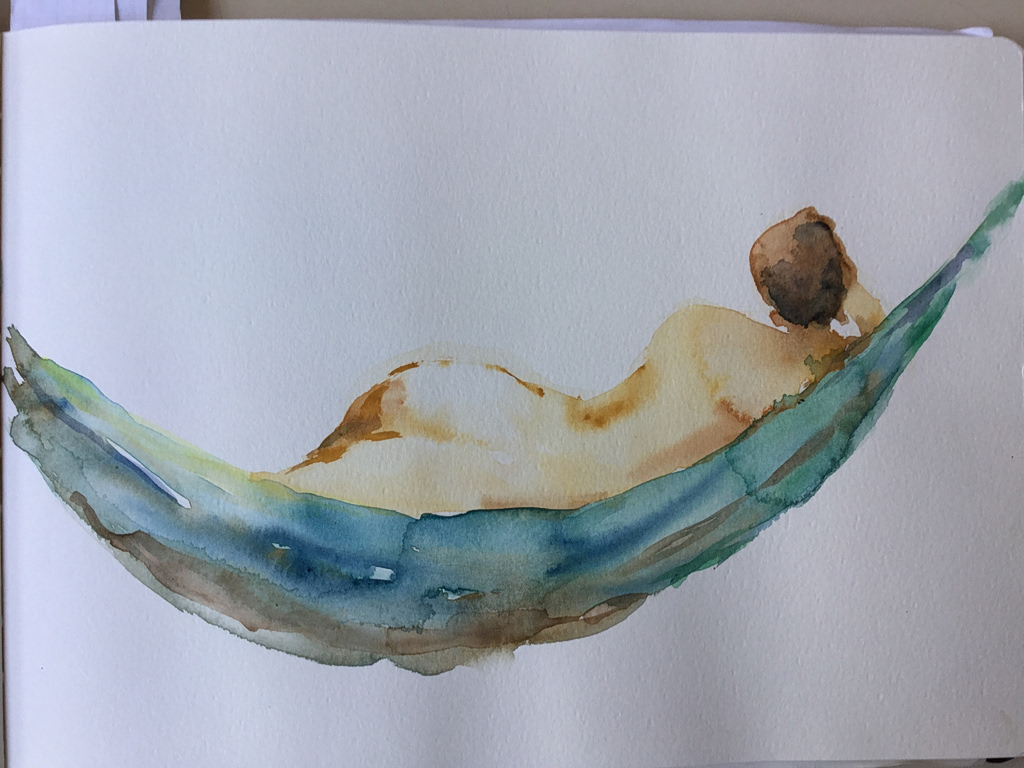
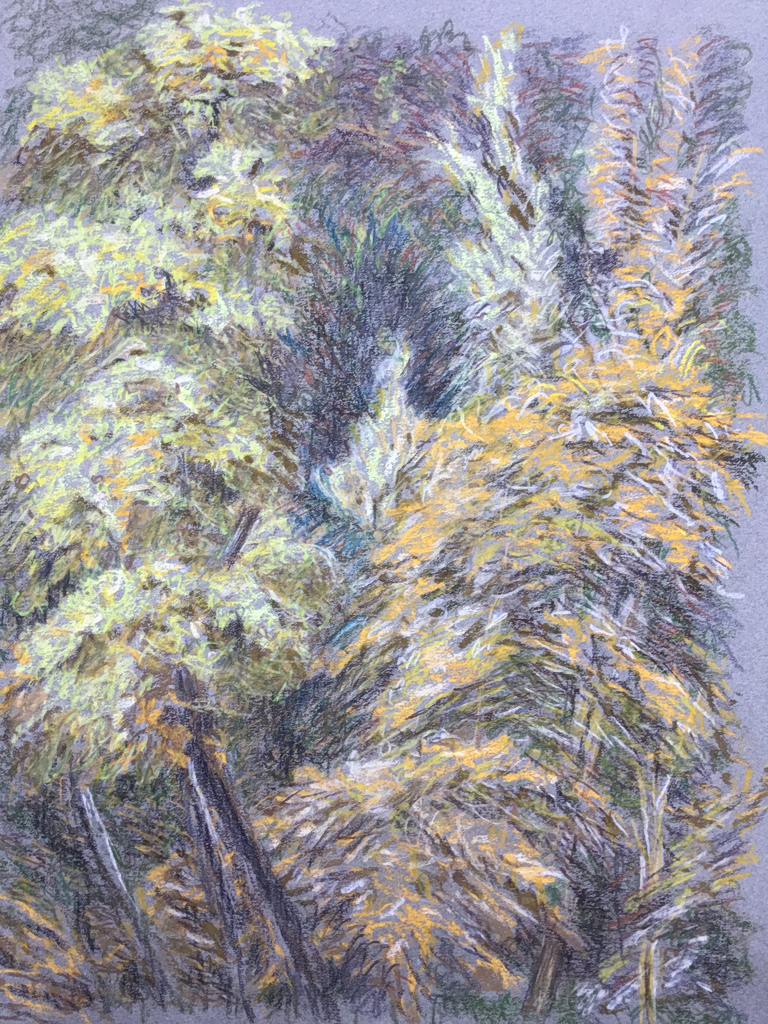
Balza’s artistic vision is not limited to his obsession with Praxiteles: he is an artist in his own right. He produces drawings, some of which he has kindly provided to illustrate this feature.
His simple, unadorned style of description reveals his love for the clean lines of ancient Greek aesthetics. By emphasising light and simple images of nature, he stands in contrast to writers such as Proust, whom he even mentions sarcastically: “that fairy Proust over there (whose book, incidentally, he was soon to finish) would have needed at least eighteen pages, full of visual and gustatory imagery, to describe that very same meal.”
Moreover, we see the narrator himself leaving his homeland in the distant Orinoco and coming to Caracas to study, leading a frenetic life: “what on earth was it that was happening to the other young people, his friends, that made them want to rob, to lose themselves entirely and to kill in cold blood? And why, too, could Raquel and the people of her social circle not bear the gilded confines of their own lives either?”
The book’s many cultural references are illuminated by translator Lefteris Makedonas, who spent three years in contact with the author — seeking clarifications, historical detail and references relating to the country, and explaining, amongst other things, the names of unknown plants.
Fifty years on, the world Balza sketches reads almost like a prophecy: dependence on oil and the unequal distribution of wealth plunged Venezuela into a prolonged crisis, with more than eight million people having left the country since 2014. And only this past January 2026, the country experienced a dramatic turning point when, following an American military operation in Caracas, the then-president Nicolás Maduro was arrested and taken to New York to stand trial for drug trafficking.
Beyond capturing the historical reality of his era, the book is also a beautiful journey into a different way of thinking and another country, with Praxiteles’s ‘keys’ in hand. It leaves the reader free to travel and to reconstruct their own reality. The film about the life of Praxiteles that the author dreams of ultimately seems to be the film of our own lives. In this way, the seven hundred palm trees seem few in number, planted in the same spot, whilst in reality there are many more — as many as there are readings of the story. José Balza spoke to VIMAgazino about the novel, Praxiteles and his lifelong bond with Greece.
Why did you choose Praxiteles — a sculptor, a creator of bodies in stone — rather than a poet or a philosopher, as the Greek figure your narrator pursues? What does sculpture give you that words do not?
It is a narrative — sensual, concrete, visual — not an abstract study. I have lived my whole life carrying something Greek within me (as I believe is true of millions of people around the world, always), and at that time I also had a direct impression of the Greek world, because I had travelled around various parts of Greece in a Volkswagen.
Of course, I had begun writing Palm Trees back in 1966. It was the product of research, of reading (I recall, for instance, Will Durant’s The Life of Greece) and of personal visions. But when I had some 200 pages ready, a friend I greatly admired, the same age as me, read them and said: “This thing has no life in it.” So I began again, in a different key. I wrote that second book from 1968 to 1973. In the end, I condensed all of it, everything I had written, into a long short story, a tribute to Kazantzakis (“I gather my tools” [a phrase echoing the prologue to Report to Greco]), titled “Alexis the Frequent” (“Alexis el frecuente”). The opening scenes of Palm Trees in fact belong to that story.
A theme that interested me then (and still interests me) was the power of the spirit as it flows from the body. A sculptor is his own body and the body of his works; and we, too, can become his works. Praxiteles was calling to me. On the other hand, I have spent my whole life watching cinema, or at least cinema on television. The narrator of Palm Trees is meditating on a film.
For me, it is words that create the volume and density of the world; a writer can be a sculptor in hiding.
In the book, a child finds in the mud of his homeland a small ancient female sculpture that, according to one version, “was the very one Praxiteles beheld in the stadium of Athens” — and which is then carried off by “the Yankees from the nearest oil company”. The scene, which “in a sense marked a personal humiliation for him: the fall of the deity that would have protected his childhood years”, seems to condense extraction, foreign intervention and a culture being lost for the sake of a small profit — “a few bottles of the worst-quality whisky”. Did you conceive it from the outset as a symbol, or was it born first as a memory, its symbolic dimension emerging later?
Your question is itself its own answer, and I agree entirely with what you say. I can only add that both at that time (the 1960s) and today, indigenous art — whether the art of the word, of dance, or of weaving — has not been valued as it deserves in the country, with very few exceptions. The great rock masses and mountains of Venezuela reveal incisions, whole engravings upon the stone, which are in fact our original visual idiom. Millennia-old messages that passed entirely unnoticed. Practical or sacred in purpose. The same is true of cups, funerary urns, amphorae, sculpted figures. Today, since 1980, something has changed, mainly because the value of basketry and other objects of folk art has begun to be appreciated.
It was therefore natural for the protagonist of Palm Trees to believe that he descended from some ancient dynasty, human or divine, or that he was the heir of certain ancient, secret artists. It is even possible that all of us, in every corner of the planet, carry a similar feeling within us, even if we are unaware of it. To the figurine I added certain transcendent powers — Greek ones, of course — so as to underline both its humility and the influence it exerted.
And, as you yourself say, it falls to the reader to determine the precise nature of those powers.
How did Greek culture first enter your life — was there a particular book or journey that made you feel Greece would become one of the “inner places” of your work? And if you had to choose one Greek philosopher who accompanies your thinking or your writing, who would it be, and why?
When I was a child, in the jungles of the Orinoco, almost no one had books. And yet in San Rafael de Manamo, that tiny village where I lived, there were three people who owned books. So it happened that I saw a book on art, written in English. Little text, but a great many black-and-white photographs. There I saw some Caryatids, who reminded me of the women who used to wash in my own river, the Orinoco; depictions of foliage by Albrecht Altdorfer that resembled the foliage around my home; and a Venus by Praxiteles.
When I reached Caracas, at the age of seventeen, I began to read everything obsessively: fiction, essays, poetry. It did not take me long to encounter the Greek tragedians, Kafka, Borges, Cervantes. And, to my great surprise, I met the Caryatids again, the sculptures of Praxiteles (imitations, or perhaps genuine).
In 1963 I saw an unconventional film in which Brigitte Bardot passed by some gods (made of cardboard): Contempt, I think, by Godard. By then I had already studied some philosophy. I had attended a seminar on Plato. Greece — with Seferis, Karyotakis (who so closely resembles our own Ramos Sucre) and Melina Mercouri — was part of my life, my culture, the bars I frequented with friends.
In 1972, with my friend Víctor Fuenmayor, we rented a Volkswagen in Athens and drove all across mainland Greece. The harsh years of the colonels. In the villages at night I would sing songs by Hadjidakis in Greek (even though I did not know the language). I saw theatre at Epidaurus and stayed a few days in Delphi.
Ever since, I have remained steadfastly faithful to the Greek world. When I was writing Palm Trees, it was natural for its protagonist to want to contemplate Praxiteles as the summit of what an artist can be.
Not much was known (or is known) about him; only a few works are attributed to him with certainty: a void large enough to hold me too.
I remain interested in the loftiest intellectual life of that world, but also in its vigorous everyday life today (for example, the music of Stavros Lantsias).
And I am a practical man: within a few days or a few months I can adapt completely to the thought of yet another Greek philosopher — Heraclitus, Anaximander, or Pindar (yes, the poet) — or any other…
As a lifelong admirer of Kazantzakis, may I ask you to clarify something about “Alexis the Frequent” (“Alexis el frecuente”): has it ever been published?
It was first published in the magazine Imagen, in May 1970, in Caracas. Later it appeared in the books Cuentos (Ejercicios Narrativos; Paréntesis, Seville, Spain, 2012) and Antología de J.B. (El Nacional, Caracas, 2013).
While reading the references to Praxiteles in your book, I found myself returning to a passage from Plotinus’s Enneads, which I should be delighted to share with you: “How, then, might you see what kind of beauty a good soul has? Withdraw into yourself and look. And if you do not yet see yourself as beautiful, then — just as the maker of a statue that must become beautiful removes one part, chisels away another, makes one part smooth and another clean, until he brings forth a beautiful face upon the statue — so you too: remove all that is excessive, straighten all that is crooked, and, cleansing all that is dark, work to make it bright; and do not cease fashioning your own statue, until the godlike radiance of virtue shines out upon you, until you see self-mastery standing firm upon its pure pedestal.”
I have passed, Niki, from absolute adoration of Plato to suspicion and dread: I admired him until I was about fifty. But when I studied his Republic, I drew away from him. The same did not happen with Plotinus, his successor, whose search for beauty as something higher I still understand to this day. And yet I do not share Plotinus’s philosophy: I think that beauty at the level of the intellect (music, painting, literature, and so on) coincides with what he proposes — a broad, external stairway of ascent, of purification, of repetitions. In reality, though, for me beauty is immediate, earthly, bodily. It gives us everything in a single instant. Of course, we may change, and come to find less beautiful what once thrilled us. Praxiteles satisfies this condition: he forges what is beautiful for himself — a work of art, a moment. And I continue to identify with his ideal of natural beauty. Yet I also agree with Plotinus: that, to reach the beauty of the intellect, one must strip away everything trite, the commonplaces, all that has been imposed on us by commerce or by society. It is an attainment at the level of individual freedom. We are the meaning we assign to beauty, according to our perception and our daily practice.
Many thanks to the award-winning translator Lefteris Makedonas, who kindly put me in touch with José Balza regarding his artwork and this interview, and who also translated our conversation from Spanish into Greek.