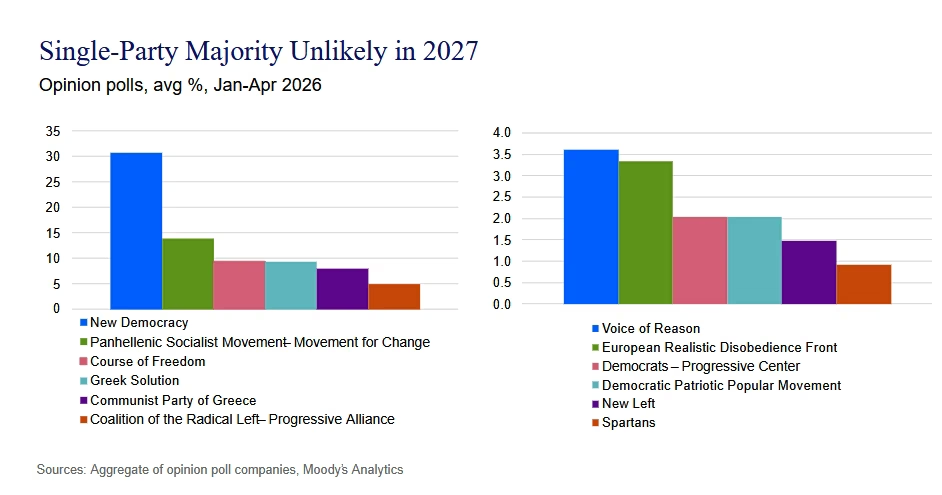
Greece could face renewed political uncertainty ahead of its next national elections, Moody’s warned. The ratings agency in its latest analysis examining possible election scenarios through 2027, stresses that the country remains economically vulnerable despite years of recovery and fiscal improvement. It also underlines that recent opinion polls suggest it is unlikely that a single party would secure an outright parliamentary majority. That, Moody’s said, raises the prospect of extended coalition negotiations or even repeated elections. Both scenarios could unsettle markets and slow economic activity.
The agency nonetheless stressed that Greece has achieved a notable turnaround since the eurozone debt crisis. Unemployment has fallen to its lowest level since 2008, while economic growth has consistently outpaced the eurozone average since 2021. Public debt, meanwhile, has declined to 148% of GDP in 2025 from a peak of 206% in 2020. Yet Moody’s argued that the scars of the country’s decade-long financial crisis remain visible.
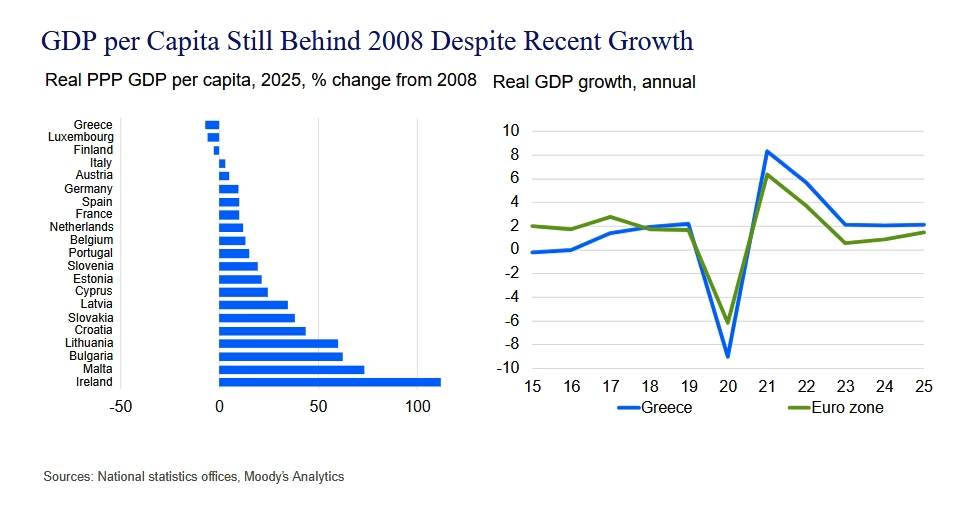
Greece still carries the highest public debt burden in the eurozone, while GDP per capita remains among the lowest in the European Union and is still 7.3% below pre-crisis 2008 levels. In 2025, Greek GDP per capita was only marginally above that of Latvia and Bulgaria, while over the past decade Greece has fallen behind Cyprus, Portugal, Lithuania and Croatia.
Political Risks Back in Focus
The rating agency analysis observed that Greece’s political climate has become increasingly turbulent in recent years. It pointed to the 2023 Tempi railway disaster as well as more recent tensions involving the EPPO investigation into the OPEKEPE agriculral subsidy scandal. Those developments, it said, have repeatedly placed the Greek government under international scrutiny.
According to Moody’s, political uncertainty affects the economy through several channels, including investment decisions, hiring, household savings, credit expansion and capital flows. Those pressures tend to intensify during election periods, as seen during the eurozone debt crisis, when Greek bond yields surged and liquidity conditions tightened sharply.
The Economic Policy Uncertainty Index climbed in March to its highest level since the pandemic, reaching 153 points. Moody’s attributed the rise largely to U.S.-Israeli strikes against Iran and the resulting surge in energy prices as well as the effective closure of the Strait of Hormuz due to the US-Iran conflict. The index remained elevated in April at 111 points, while domestic attention centered on the OPEKEPE agricultural subsidies case.
The agency also warned that uncertainty now appears to be spilling more directly into the real economy. Unemployment, which had been falling steadily for four years, began rising again in early 2026, increasing from 7.9% in December to 9% in March. Inflation, meanwhile, accelerated from 1.6% in October to 4.6% by April, driven by higher energy and import costs.
Four Election Scenarios
Moody’s outlined four possible paths for Greece heading into the elections and the potential implications for the economy.
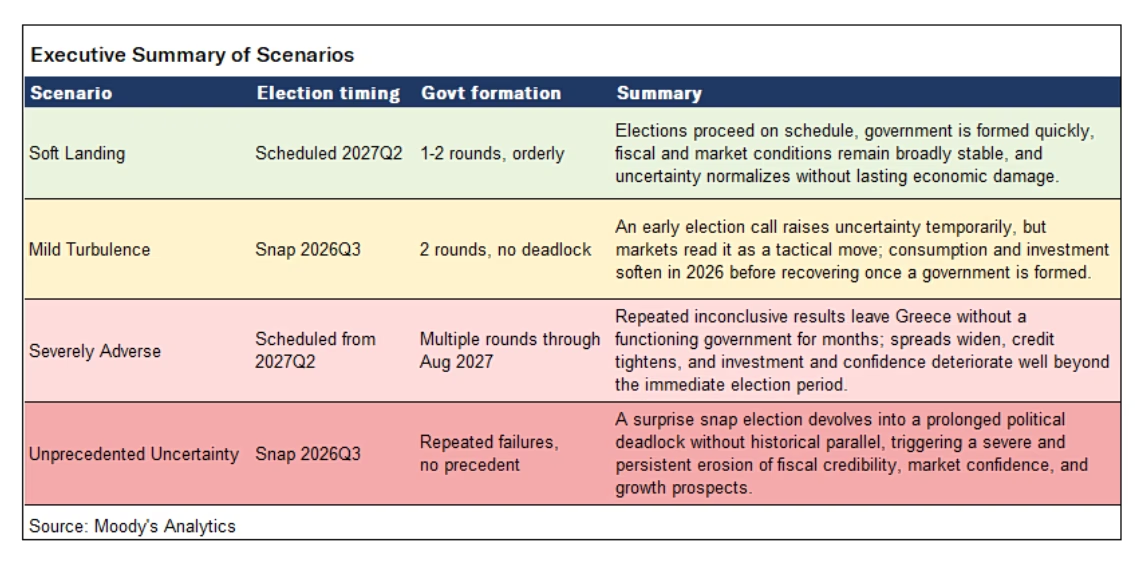
Under its “Soft Landing” scenario, elections would take place as scheduled in the second quarter of 2027, with a government formed after one or two rounds of voting. Fiscal conditions and markets would remain broadly stable, allowing uncertainty to ease without lasting economic damage.
A second scenario, described as “Mild Turbulence,” envisages an early election in the third quarter of 2026. While uncertainty would rise temporarily, Moody’s said markets could interpret the move as tactical rather than destabilizing. Consumption and investment would weaken in the short term before recovering once a government is formed.
The more adverse scenarios focus on the possibility of repeated inconclusive election results.
In the “Severely Adverse” case, elections held in 2027 would lead to months of coalition deadlock extending through August of that year. Moody’s warned such an outcome could widen bond spreads, tighten credit conditions and undermine investor confidence well beyond the election period itself.
Its most extreme scenario — labeled “Unprecedented Uncertainty” — envisages a snap election in 2026 followed by repeated failures to form a government. Moody’s said such a prolonged impasse, without historical precedent in Greece’s recent political history, could trigger a sharp deterioration in fiscal credibility, market confidence and growth prospects.
Narrow Margin for Error
Moody’s said the central risk for Greece is not simply the possibility of early elections, but the prospect of repeated and unsuccessful electoral rounds.
Under its more favorable scenarios, the agency expects the Greek economy to continue growing by between 2.4% and 2.7% in 2027, while public debt would keep declining.
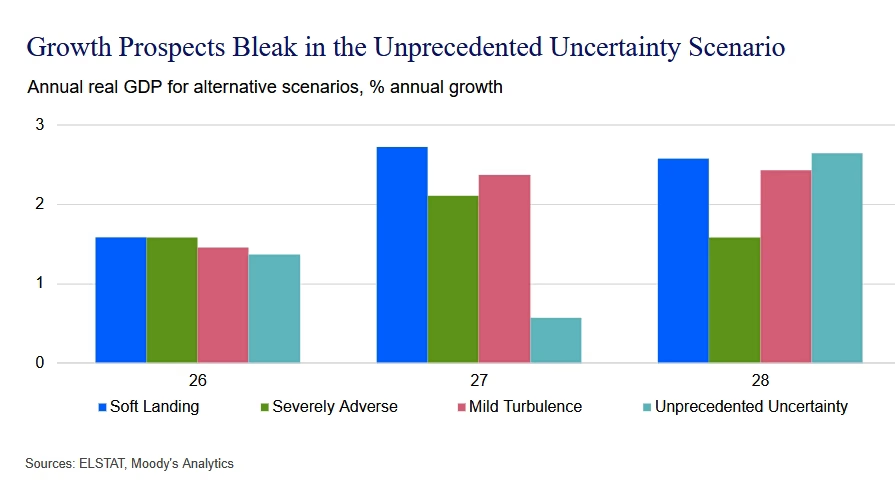
Under a prolonged political crisis, however, investment could fall by as much as 8.2%, unemployment could once again move above 9%, and Greek bond yields could return to levels previously seen during the debt crisis and the turmoil of 2015.
In the most severe scenario, Greece’s real economic growth would slow to just 0.6% in 2027.
Moody’s said its baseline expectation remains one of political stability after no more than two rounds of elections. Still, it warned that for a country carrying the eurozone’s heaviest debt load, the room for policy error remains exceptionally limited.
Source: OT.gr