 Μake us preferred on Google
 Greece’s Public Power Corporation (PPC), the dominant power utility in the country, on Thursday announced robust financial results for 2025, with adjusted EBITDA reaching two billion euros and net profits totaling 450 million euros. In a press release, the ATHEX-listed company said the results reflect continued progress on the utility’s strategic transformation and business plan goals.
Total investments amounted to 2.8 billion euros, with 87% allocated to renewable energy projects, flexible generation, and upgrades to distribution networks—key priorities in the utility’s energy transition strategy.
Electricity production from renewable sources rose 12% year-on-year, totaling 6.9 TWh, or 33% of PPC’s overall output. Wind and solar generation increased 39% and 13%, respectively, following the addition of new capacity. Large hydroelectric production remained stable at 3.4 TWh, with Q4 2025 showing improved performance due to higher rainfall.
Lignite-based generation fell 16% to 2.7 TWh, accounting for 13% of total production. PPC confirmed that 2026 will be the final year of lignite generation, marking a key milestone in its decarbonization strategy. Natural gas generation remained stable at 7.7 TWh, or 37% of total output. As a result, Scope 1 CO₂ emissions decreased by around 5% compared to 2024.
PPC’s ongoing transition to a sustainable energy model is also reflected in enhanced ESG ratings from leading international agencies throughout 2025.
As a result, PPC’s board of directors has proposed a dividend of €0.60 per share for 2025, representing a 50% increase compared to 2024. The proposal will be submitted for approval at the company’s annual general assembly of shareholders.
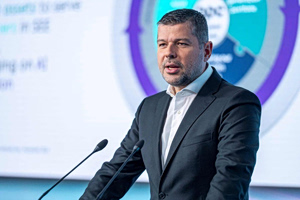
PPC CEO Stassis
Commenting on the results, Georgios Stassis, the chairman and CEO of PPC, said:
“The Group’s results confirm the consistent progress we are making in executing our strategy and strengthening both operational and financial performance.
“We continue to transform the Group, focusing on the development of clean energy sources, enhancing the flexibility of our energy portfolio, and modernizing distribution networks through targeted investments. These initiatives strengthen the Group’s long-term competitiveness and create sustainable value for shareholders, customers, and the markets in which we operate,” he said.