
 Μake us preferred on Google
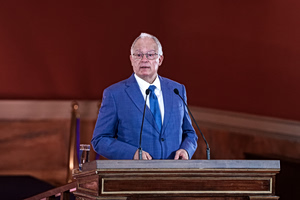
 Bank of Greece Governor Yannis Stournaras spoke at TO BHMA’s conference “Dialogues for Athens” about the role of ancient Athens and the institutions that contributed to its economic prosperity, then about modern Athens’s contribution to the Greek economy, and finally about the challenges Athens faces today and the policies that can strengthen its role in driving growth for the benefit of the whole country.
Athens Today in Numbers
Stournaras described today’s Athens as a modern metropolitan center and presented the numbers that reflect this. “Athens, as the core of the country’s largest metropolitan area, is today the most important economic hub of the Greek economy. The strength of the capital’s economic activity is reflected primarily in the regional footprint of Attica. According to the most recent regional accounts of ELSTAT, Attica produces almost half of the national wealth in terms of gross value added, has the highest GDP per capita at almost €30,000, compared with a national average of €21,000, and accounts for about one third of the country’s gross fixed capital formation. At the same time, employment in Attica represents almost 40% of the country’s total employment,” he noted.
“The Athenian economy is characterized by a high concentration of service sector activities. Trade, transportation, storage, food service, accommodation, real estate management, financial activities, and services to businesses and households make up a large part of its productive base. This concentration creates economies of scale and networking. Businesses, workers, universities, financial institutions, and new investments interact in a shared economic space, facilitating the spread of knowledge and the development of new activities,” he added.
The Contribution of Culture and Tourism
Tourism and culture make a particularly important contribution to Athens’s strong performance, Stournaras said. “Athens has developed into an independent international tourist destination, taking advantage of the major comparative advantage offered by its historical and cultural heritage, its beauty, and its global recognition. In 2025, Attica was the most visited region in Greece. Travel receipts were up 125% compared to 2019, and visits rose 63.8%. As a result, Attica’s share of the country’s total travel receipts increased from 14.7% in 2019 to 25.8% in 2025, while its share of visits grew from 16% to 23%. This momentum is linked to Athens’s growing appeal as a city-break destination, as well as to the significant upgrade of tourism infrastructure. It also has significant multiplier effects on the economy and employment, supporting a broad ecosystem of businesses in the hotel market, food service, retail, transportation, culture, and real estate,” he said.
The Real Estate Market
This led the Bank of Greece governor to a more detailed analysis of the real estate market. “The concentration of population, businesses, investments, and millions of visitors increases demand for housing, transportation, energy, public space, and basic infrastructure. In other words, some of Athens’s biggest challenges today are, to some extent, a consequence of its own economic success. The real estate market is a typical example. Athens is at the center of a new investment cycle, with significant capital inflows, particularly foreign capital, and increased demand for homes and commercial properties, as reflected in the steady rise in prices.
In 2025, apartment prices in Athens rose by an average of 6.5%, while in the second quarter of 2026, the annual increase was 5%. This trend reflects the city’s economic and investment momentum, but at the same time it intensifies the problem of affordable housing, especially for young people and households with lower or even middle incomes. And here the economic dimension is broader. The same momentum that strengthens Athens’s economic importance also creates the typical pressures of a large metropolitan center.”
The Problems and the Necessary Interventions
According to Stournaras, this situation creates problems and makes immediate interventions and infrastructure projects necessary. He also sounded the alarm about the rest of the country’s regions. “Housing costs are rising faster than incomes, and the problem is not only social. It limits labor mobility, makes it harder for businesses to attract and retain workers, and raises the cost of living in a city that aims to attract human capital and high value-added businesses. As you may know, similar and even worse problems are seen today in many cities in the United States and Europe.
“Likewise, traffic congestion is perhaps the clearest example of the economic cost that metropolitan congestion can create. The time lost every day in commuting is not just an inconvenience for citizens. It reduces available productive hours, inflates the cost of transporting workers and goods, burdens businesses, increases energy consumption and air pollution, and ultimately limits productivity and reduces the city’s attractiveness. For this reason, maintaining Athens’s growth momentum requires a new cycle of investment in metropolitan infrastructure aimed at addressing environmental pressures and residents’ urban needs.
“The expansion and upgrade of the metro, more effective use of the suburban railway, and the strengthening of public transportation in general all work in this direction. At the same time, investments are needed in digital and energy infrastructure, water supply and waste management networks, flood protection projects, and the expansion of urban green spaces. Climate change makes some of these investments even more urgent. Measures to increase housing supply must also be a key policy element, and I don’t mean only building new homes but also bringing back into use those that are vacant today.
“These should not be seen simply as interventions to improve daily life. They are productive investments. They lower the city’s operating costs, facilitate labor mobility, strengthen resilience, increase productivity, and improve Athens’s ability to attract businesses, investment, and human capital. Infrastructure, therefore, should not simply follow the city’s growth. It must be planned in time to support and guide it.
“The overall picture is undeniably dynamic, but it should not lead to complacency. Athens has many of the key features of a modern European metropolitan center: human resources, international connectivity, tourism recognition, business activity, universities and research institutions, financial services, and constantly growing investment interest. The next step is the transition from growth based largely on the concentration of activities, tourism, and real estate to an even more productive and innovative metropolitan model, with greater emphasis on technology, the green and digital transition, infrastructure, and high value-added activities.
And this matters not only for Athens itself. When one metropolitan area produces almost half of the country’s gross value added, its productivity, infrastructure, and competitiveness become a national economic issue. The large concentration of economic activity in Attica creates significant agglomeration economies, but it also carries the risk of widening regional inequalities if the benefits of growth remain geographically concentrated.”
The Challenges of Athens
At the end of his speech, Stournaras proposed actions and initiatives so that Athens can continue to grow. “The challenge, therefore, is twofold. Athens must continue to function as an engine of growth, investment, and openness, while at the same time strengthening the mechanisms through which this momentum spreads to the rest of the country. This can be achieved through stronger interregional value chains and greater demand for products and services produced in the regions. It can also be achieved through the spread of technology and knowledge from Athens’s universities, research centers, and businesses, as well as through regional businesses’ access to financing, specialized services, and international markets. A critical condition is better physical and digital connections between Athens and the other regions, so that metropolitan concentration acts as a source of positive spillovers and not as a factor of further economic divergence.
“The challenges of Athens do not concern only the capital. To a large extent, they reflect the broader challenges of the Greek economy. For Greece, the goal today is not only to maintain macroeconomic stability but mainly to ensure sustainable long-term growth and real convergence with the most advanced European economies. To achieve this, above all, productivity must be strengthened. We need more, but mainly higher-quality, investment in innovation, digital and green technologies, infrastructure, energy, and outward-looking, high value-added activities. We need better links between universities, research, and production, upgraded skills, and the ability to attract human capital.
“At the same time, we need more effective institutions, faster justice, simpler procedures, stronger competition, and a stable and predictable business environment. Athens can act as an accelerator of productive transformation, as it brings together human capital, universities, research centers, business and financial services, and a significant part of the country’s innovation ecosystem. The goal, however, is not a strong Athens and weaker regions. It is a more productive and internationally competitive Athens, better connected with a more productive and outward-looking Greece.
And here there is an interesting continuity with ancient Athens. Times and advantages have changed, but some conditions for economic success and power remain the same: effective institutions, trust, investment, knowledge, openness, and adaptability. Ancient Athens flourished because it managed to combine institutions and infrastructure with trade, knowledge, and the attraction of people and ideas from a much wider geographic area. Similarly, modern Athens can use its concentration of human capital, businesses, universities, and investment not only for its own growth but as a lever for the productive upgrade and greater openness of the entire Greek economy. This may be Athens’s most meaningful contribution to the Greece of the future,” he concluded.